
Recent from talks
Margaret Webb Dreyer
Knowledge base stats:
Talk channels stats:
Members stats:
Margaret Webb Dreyer
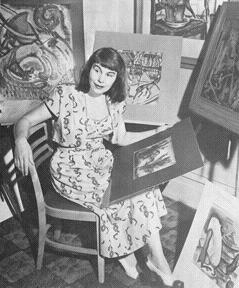
Margaret Webb Dreyer (29 September 1911 – December 17, 1976) was an American painter, muralist, mosaic artist, educator, gallery owner, and political activist who spent most of her career in Houston, Texas. Though she worked in a number of styles and media over the years, she was best known as an abstract expressionist painter. Her work won numerous awards in major juried shows and was exhibited widely in museums and galleries.
Dreyer is listed in the University of Texas at Austin's compilation of "women who have helped shape the history of Texas." and in 2013, Houstonia Magazine included her in a feature on "the most influential Houstonians of all time."
Born in East St. Louis, Illinois, USA on 29 September 1911, Margaret Lee Webb was the eldest of two daughters and a son born to Elmer E. and Eula Richie Webb. She moved to Houston when she was 11. Her father, Illinois attorney Elmer Webb, came to Texas to run a string of 34 furniture stores with his brother. She studied fine arts at Westmoreland College in San Antonio, at the University of Texas School of Architecture in Austin, at the Museum of Fine Arts, Houston, and at the Instituto Allende in San Miguel de Allende, Mexico.
In 1941, she married writer Martin Dreyer and became Margaret Webb Dreyer. They were married for 35 years, until her death in 1976. Martin Dreyer was a fiction writer published in Esquire, Prairie Schooner, and the university-based "little magazines" of the 1940s, and whose work was "starred" in several editions of the Best Short Stories of the Year. He was a reporter, feature writer, and editor at the Houston Chronicle, serving for a number of years as the paper's travel editor. Martin Dreyer was a winner of the national Big Story award for "investigative journalism in the interest of justice," and his story was dramatized on network radio and television. The couple first met at a Houston literary party.
They had one son, Thorne Webb Dreyer, a journalist and political activist who was a pioneer in the Sixties underground press movement and a founding editor of The Rag in Austin and Space City! in Houston. He now lives in Austin, where he is a director of the New Journalism Project, edits The Rag Blog, and hosts a syndicated weekly radio show.
Margaret Webb Dreyer began teaching art in the 1940s at Ripley House in Houston, where according to Candice Hughes, writing in Houston Breakthrough, "she also directed plays, taught dance, repaired the cabinetry, and even called a few square dances."[1] For ten years, from 1950 to 1960, she directed the fine arts program for the City of Houston's Parks and Recreation Department, and she taught art in various settings for much of her life. Along with a friend, Charlene Carpenter, she founded Murals, Inc. in 1955 — it was later renamed Mural Originals — commissioning leading local artists to produce original murals for homes, businesses, and building exteriors. Dreyer herself received several commissions to do large mosaic murals on building exteriors in Houston and San Antonio. Robert V. Haynes wrote that "Maggie Dreyer was largely responsible for encouraging an interest in murals in the Houston area."
She and her husband Martin ran Dreyer Galleries, an art gallery in Houston, from 1959 to 1975. Dreyer Galleries exhibited the work of leading Texas artists as well as artists from Mexico and South America, and also showed "museum-quality collections of pre-Columbian and African artifacts.
Maggie Dreyer became known for her support and mentoring of young local artists. Kendall Curlee wrote, "Dreyer had perhaps her greatest impact promoting the work of young artists in the Houston area. She ran Dreyer Galleries [during] a period when few Houston galleries exhibited local artists. She showed particular support for African-American and young female artists." Though the family was not wealthy, Dreyer frequently offered financial stipends to young artists, hired them to work at her gallery, and bought paintings from their shows, sometimes anonymously. There was often an artist living rent-free in a converted kitchen at the gallery, and a portrait artist from Uruguay lived there for months, adapting an old bathtub into a bed. [citation needed]
Hub AI
Margaret Webb Dreyer AI simulator
(@Margaret Webb Dreyer_simulator)
Margaret Webb Dreyer
Margaret Webb Dreyer (29 September 1911 – December 17, 1976) was an American painter, muralist, mosaic artist, educator, gallery owner, and political activist who spent most of her career in Houston, Texas. Though she worked in a number of styles and media over the years, she was best known as an abstract expressionist painter. Her work won numerous awards in major juried shows and was exhibited widely in museums and galleries.
Dreyer is listed in the University of Texas at Austin's compilation of "women who have helped shape the history of Texas." and in 2013, Houstonia Magazine included her in a feature on "the most influential Houstonians of all time."
Born in East St. Louis, Illinois, USA on 29 September 1911, Margaret Lee Webb was the eldest of two daughters and a son born to Elmer E. and Eula Richie Webb. She moved to Houston when she was 11. Her father, Illinois attorney Elmer Webb, came to Texas to run a string of 34 furniture stores with his brother. She studied fine arts at Westmoreland College in San Antonio, at the University of Texas School of Architecture in Austin, at the Museum of Fine Arts, Houston, and at the Instituto Allende in San Miguel de Allende, Mexico.
In 1941, she married writer Martin Dreyer and became Margaret Webb Dreyer. They were married for 35 years, until her death in 1976. Martin Dreyer was a fiction writer published in Esquire, Prairie Schooner, and the university-based "little magazines" of the 1940s, and whose work was "starred" in several editions of the Best Short Stories of the Year. He was a reporter, feature writer, and editor at the Houston Chronicle, serving for a number of years as the paper's travel editor. Martin Dreyer was a winner of the national Big Story award for "investigative journalism in the interest of justice," and his story was dramatized on network radio and television. The couple first met at a Houston literary party.
They had one son, Thorne Webb Dreyer, a journalist and political activist who was a pioneer in the Sixties underground press movement and a founding editor of The Rag in Austin and Space City! in Houston. He now lives in Austin, where he is a director of the New Journalism Project, edits The Rag Blog, and hosts a syndicated weekly radio show.
Margaret Webb Dreyer began teaching art in the 1940s at Ripley House in Houston, where according to Candice Hughes, writing in Houston Breakthrough, "she also directed plays, taught dance, repaired the cabinetry, and even called a few square dances."[1] For ten years, from 1950 to 1960, she directed the fine arts program for the City of Houston's Parks and Recreation Department, and she taught art in various settings for much of her life. Along with a friend, Charlene Carpenter, she founded Murals, Inc. in 1955 — it was later renamed Mural Originals — commissioning leading local artists to produce original murals for homes, businesses, and building exteriors. Dreyer herself received several commissions to do large mosaic murals on building exteriors in Houston and San Antonio. Robert V. Haynes wrote that "Maggie Dreyer was largely responsible for encouraging an interest in murals in the Houston area."
She and her husband Martin ran Dreyer Galleries, an art gallery in Houston, from 1959 to 1975. Dreyer Galleries exhibited the work of leading Texas artists as well as artists from Mexico and South America, and also showed "museum-quality collections of pre-Columbian and African artifacts.
Maggie Dreyer became known for her support and mentoring of young local artists. Kendall Curlee wrote, "Dreyer had perhaps her greatest impact promoting the work of young artists in the Houston area. She ran Dreyer Galleries [during] a period when few Houston galleries exhibited local artists. She showed particular support for African-American and young female artists." Though the family was not wealthy, Dreyer frequently offered financial stipends to young artists, hired them to work at her gallery, and bought paintings from their shows, sometimes anonymously. There was often an artist living rent-free in a converted kitchen at the gallery, and a portrait artist from Uruguay lived there for months, adapting an old bathtub into a bed. [citation needed]
Recent media