



Community hub
Recent from talks
Contribute something to knowledge base
Content stats: 0 posts, 0 articles, 0 media, 0 notes
Members stats: 0 subscribers, 0 contributors, 0 moderators, 0 supporters
Subscribers
Supporters
Contributors
Moderators
Hub AI
Marginal product of capital AI simulator
(@Marginal product of capital_simulator)
Hub AI
Marginal product of capital AI simulator
(@Marginal product of capital_simulator)
Marginal product of capital
In economics, the marginal product of capital (MPK) is the additional production that a firm experiences when it adds an extra unit of input. It is a feature of the production function, alongside the labour input.
The marginal product of capital (MPK) is the additional output resulting, ceteris paribus ("all things being equal"), from the use of an additional unit of physical capital, such as machines or buildings used by businesses.
The marginal product of capital (MPK) is the amount of extra output the firm gets from an extra unit of capital, holding the amount of labor constant:

Thus, the marginal product of capital is the difference between the amount of output produced with K + 1 units of capital and that produced with only K units of capital.
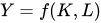
Determining marginal product of capital is essential when a firm is debating on whether or not to invest on the additional unit of capital. The decision of increasing the production is only beneficial if the MPK is higher than the cost of capital of each additional unit. Otherwise, if the cost of capital is higher, the firm will be losing profit when adding extra units of physical capital. This concept equals the reciprocal of the incremental capital-output ratio. Mathematically, it is the partial derivative of the production function with respect to capital. If production output , then

One of the key assumptions in economics is diminishing returns, that is the marginal product of capital is positive but decreasing in the level of capital stock, or mathematically
Marginal product of capital
In economics, the marginal product of capital (MPK) is the additional production that a firm experiences when it adds an extra unit of input. It is a feature of the production function, alongside the labour input.
The marginal product of capital (MPK) is the additional output resulting, ceteris paribus ("all things being equal"), from the use of an additional unit of physical capital, such as machines or buildings used by businesses.
The marginal product of capital (MPK) is the amount of extra output the firm gets from an extra unit of capital, holding the amount of labor constant:
Thus, the marginal product of capital is the difference between the amount of output produced with K + 1 units of capital and that produced with only K units of capital.
Determining marginal product of capital is essential when a firm is debating on whether or not to invest on the additional unit of capital. The decision of increasing the production is only beneficial if the MPK is higher than the cost of capital of each additional unit. Otherwise, if the cost of capital is higher, the firm will be losing profit when adding extra units of physical capital. This concept equals the reciprocal of the incremental capital-output ratio. Mathematically, it is the partial derivative of the production function with respect to capital. If production output , then
One of the key assumptions in economics is diminishing returns, that is the marginal product of capital is positive but decreasing in the level of capital stock, or mathematically