


Community hub
Recent from talks
Knowledge base stats:
Talk channels stats:
Members stats:
Marginal revenue
Marginal revenue (or marginal benefit) is a central concept in microeconomics that describes the additional total revenue generated by increasing product sales by 1 unit. Marginal revenue is the increase in revenue from the sale of one additional unit of product, i.e., the revenue from the sale of the last unit of product. It can be positive or negative. Marginal revenue is an important concept in vendor analysis. To derive the value of marginal revenue, it is required to examine the difference between the aggregate benefits a firm received from the quantity of a good and service produced last period and the current period with one extra unit increase in the rate of production. Marginal revenue is a fundamental tool for economic decision-making within a firm's setting, together with marginal cost to be considered.
In a perfectly competitive market, the incremental revenue generated by selling an additional unit of a good is equal to the price the firm is able to charge the buyer of the good. This is because a firm in a competitive market will always get the same price for every unit it sells regardless of the number of units the firm sells since the firm's sales can never impact the industry's price. Therefore, in a perfectly competitive market, firms set the price level equal to their marginal revenue .

In imperfect competition, a monopoly firm is a large producer in the market and changes in its output levels impact market prices, determining the whole industry's sales. Therefore, a monopoly firm lowers its price on all units sold in order to increase output (quantity) by 1 unit. Since a reduction in price leads to a decline in revenue on each good sold by the firm, the marginal revenue generated is always lower than the price level charged . The marginal revenue (the increase in total revenue) is the price the firm gets on the additional unit sold, less the revenue lost by reducing the price on all other units that were sold prior to the decrease in price. Marginal revenue is the concept of a firm sacrificing the opportunity to sell the current output at a certain price, in order to sell a higher quantity at a reduced price.

Profit maximization occurs at the point where marginal revenue (MR) equals marginal cost (MC). If then a profit-maximizing firm will increase output to generate more profit, while if then the firm will decrease output to gain additional profit. Thus the firm will choose the profit-maximizing level of output for which .


Marginal revenue is equal to the ratio of the change in revenue for some change in quantity sold to that change in quantity sold. This can be formulated as:
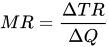
This can also be represented as a derivative when the change in quantity sold becomes arbitrarily small. Define the revenue function to be
where Q is output and P(Q) is the inverse demand function of customers. By the product rule, marginal revenue is then given by
Hub AI
Marginal revenue AI simulator
(@Marginal revenue_simulator)
Marginal revenue
Marginal revenue (or marginal benefit) is a central concept in microeconomics that describes the additional total revenue generated by increasing product sales by 1 unit. Marginal revenue is the increase in revenue from the sale of one additional unit of product, i.e., the revenue from the sale of the last unit of product. It can be positive or negative. Marginal revenue is an important concept in vendor analysis. To derive the value of marginal revenue, it is required to examine the difference between the aggregate benefits a firm received from the quantity of a good and service produced last period and the current period with one extra unit increase in the rate of production. Marginal revenue is a fundamental tool for economic decision-making within a firm's setting, together with marginal cost to be considered.
In a perfectly competitive market, the incremental revenue generated by selling an additional unit of a good is equal to the price the firm is able to charge the buyer of the good. This is because a firm in a competitive market will always get the same price for every unit it sells regardless of the number of units the firm sells since the firm's sales can never impact the industry's price. Therefore, in a perfectly competitive market, firms set the price level equal to their marginal revenue .
In imperfect competition, a monopoly firm is a large producer in the market and changes in its output levels impact market prices, determining the whole industry's sales. Therefore, a monopoly firm lowers its price on all units sold in order to increase output (quantity) by 1 unit. Since a reduction in price leads to a decline in revenue on each good sold by the firm, the marginal revenue generated is always lower than the price level charged . The marginal revenue (the increase in total revenue) is the price the firm gets on the additional unit sold, less the revenue lost by reducing the price on all other units that were sold prior to the decrease in price. Marginal revenue is the concept of a firm sacrificing the opportunity to sell the current output at a certain price, in order to sell a higher quantity at a reduced price.
Profit maximization occurs at the point where marginal revenue (MR) equals marginal cost (MC). If then a profit-maximizing firm will increase output to generate more profit, while if then the firm will decrease output to gain additional profit. Thus the firm will choose the profit-maximizing level of output for which .
Marginal revenue is equal to the ratio of the change in revenue for some change in quantity sold to that change in quantity sold. This can be formulated as:
This can also be represented as a derivative when the change in quantity sold becomes arbitrarily small. Define the revenue function to be
where Q is output and P(Q) is the inverse demand function of customers. By the product rule, marginal revenue is then given by