Hubbry Logo
search
logo
1897531

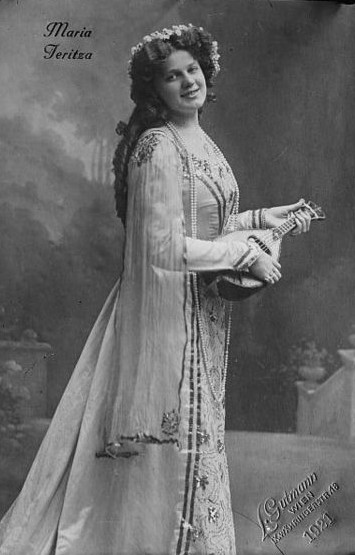
Maria Jeritza

logo
Community Hub0 Subscribers
Read side by side
from Wikipedia

Maria Jeritza (born Marie Jedličková; 6 October 1887 – 10 July 1982) was a dramatic soprano,[1][2] long associated with the Vienna State Opera (1912–1934 and 1950–1953) and the Metropolitan Opera (1921–1932 and 1951). Her rapid rise to fame, beauty and personality earned her the nickname "The Moravian Thunderbolt".

Key Information

Biography

[edit]

Jeritza was born in Brno, Moravia, then part of the Austria-Hungary, in 1887 as Marie Jedličková. She was trained at the Brno Conservatory, and later was a pupil of Estelle Liebling in New York City.[3] In 1910, she made her debut as Elsa, in Wagner's Lohengrin, at Olomouc. The Emperor Franz Josef heard her and immediately ordered that she be offered a contract at the Imperial Hofoper, Vienna.

She created the roles of Blanchefleur in Kienzl's opera Der Kuhreigen (1911), Ariadne in Strauss's Ariadne auf Naxos (1912), the Empress in his Die Frau ohne Schatten (1919), and Hariette/Juliette in Korngold's Die tote Stadt (Hamburg, 1920), though later became famous for her leading role of Marietta/Marie in the same opera in its January 1921 Vienna premiere, which was also the role in which she debuted at the Metropolitan Opera on 19 November 1921.

On 16 November 1926, she starred in the title role of Puccini's Turandot in its North American premiere at the Metropolitan, where she also created the title or leading soprano roles in Janáček's Jenůfa (1924), Wolf-Ferrari's I gioielli della Madonna (1925), Korngold's Violanta (1927), Richard Strauss's Die Ägyptische Helena (1928), and Suppé's Boccaccio (1931) and Donna Juanita (1932).

She was as popular at the Metropolitan as in Vienna, especially as Tosca, Carmen and Massenet's Thaïs. She appeared in an early sound film Grossfürstin Alexandra for which Franz Lehár wrote the song 'Du und ich sind für einander bestimmt'.

Jeritza made a number of 78-rpm recordings which testify to the high quality of her voice. Many of these recordings have been released on CD.

Personal life and death

[edit]

After a two-year marriage to a man named Friedrich Wiener, she married an Austrian, Leopold Salvator Freiherr Popper von Podhragy (1886-1986). She married her third husband in 1935, Hollywood mogul Winfield R. Sheehan, who died in 1945. In 1948, she married New Jersey businessman Irving Seery and moved to a mansion in the Forest Hill neighborhood of Newark, New Jersey, where she lived until her death in 1982, at the age of 94 in Orange, New Jersey. She was buried at Holy Cross Cemetery in North Arlington, New Jersey.

References

[edit]
[edit]
Revisions and contributorsEdit on WikipediaRead on Wikipedia
from Grokipedia
''Maria Jeritza'' is a Moravian soprano known for her glamorous stage presence, powerful spinto voice, and commanding portrayals in operas by Giacomo Puccini and Richard Strauss during opera's golden age in the early 20th century. [1] [2] She was a leading prima donna at the Vienna State Opera from 1912 to 1935 and the Metropolitan Opera from 1921 to 1932, celebrated for her beauty, theatrical intensity, and signature role as Tosca, where she famously sang "Vissi d'arte" prostrate on the floor—a dramatic choice endorsed by Puccini himself. [1] [2] Born Marie Jedličková on October 6, 1887, in Brno, Moravia (then part of Austria-Hungary, now in the Czech Republic), Jeritza trained at the local conservatory before making her breakthrough in Vienna. [1] She created key roles for Richard Strauss, including the title role in both versions of Ariadne auf Naxos and the Empress in Die Frau ohne Schatten, and performed the title role in the North American premiere of Puccini's Turandot at the Metropolitan Opera in 1926. [1] Nicknamed "The Moravian Thunderbolt," she excelled in a wide repertoire that included works by Wagner, Massenet, and Mascagni, though she focused on spinto and dramatic parts rather than the heaviest Wagnerian roles. [1] [3] After retiring from regular performances, Jeritza settled permanently in the United States, where she lived until her death on July 10, 1982, in Orange, New Jersey, at the age of 94. [2] Her legacy endures as one of the era's most magnetic and idolized opera stars, whose vivid acting and vocal radiance defined the romantic heroines of her time. [1] [2]

Early life

Birth and family background

Maria Jeritza was born Marie Jedličková on October 6, 1887, in Brno, Moravia, then part of the Austro-Hungarian Empire and now in the Czech Republic. [4] [5] She grew up in Brno, in the Moravian region known for its cultural and linguistic mix of Czech and German influences.

Education and early training

Maria Jeritza received her early vocal training at the conservatory in her native city of Brno. [1] Her studies in Brno laid the groundwork for her future operatic career.

Early career

Debut and initial engagements

Maria Jeritza made her professional operatic debut in 1910 at the Stadttheater in Olomouc (then Olmütz, Moravia), performing the role of Elsa in Wagner's Lohengrin.[6] Her work at the Olomouc theater demonstrated her dramatic soprano capabilities and stage presence, attracting attention from opera professionals and paving the way for her advancement to more prominent venues in Vienna.

Vienna Volksoper period

Maria Jeritza was engaged by the Vienna Volksoper in 1912 after impressing director Rainer Simons during an audition in which she sang Micaela's aria from Carmen; Simons halted her performance mid-aria and immediately offered her a contract.[7][6] She made her debut there as Elisabeth in Tannhäuser.[6] Described as "the girl for everything," she quickly became valued for her versatility and ability to learn and perform a broad range of roles on short notice in the theater's demanding schedule.[7] Her repertoire at the Volksoper included Elsa in Lohengrin, the title role in Manon, Micaela in Carmen, Tosca in Tosca, Senta in Der fliegende Holländer, Minnie in La fanciulla del West, and others.[7] She created the role of Lygia in Jean Nouguès's Quo Vadis and Nydia in Carlo Perosi's Pompeii, and she sang the title role in the first Vienna production of Puccini's Manon Lescaut.[7] In 1912, while still under contract, she was released for a guest engagement to create the title role in the original version of Richard Strauss's Ariadne auf Naxos in Stuttgart.[7] Her work at the Volksoper attracted notice from the Vienna Hofoper, resulting in her debut there as Chrysis in Max Oberleithner's Aphrodite in 1912 while still formally bound to the Volksoper.[7] The Hofoper paid a contractual forfeit to secure her unconditional release in 1913, marking the end of her Volksoper period and her transition to the Court Opera.[7]

Vienna State Opera

Appointment and breakthrough

Maria Jeritza's appointment to the Vienna Court Opera (Hofoper, later the State Opera) came in 1912, following her engagements at the Vienna Volksoper. [8] [7] Her breakthrough was catalyzed by an enthusiastic endorsement from Emperor Franz Joseph during a summer guest appearance in Bad Ischl in August 1912, where she performed Rosalinde in Johann Strauss II's Die Fledermaus and encored the Czardas multiple times at the Emperor's insistence. [8] [7] The Emperor expressed strong surprise and displeasure that she was not already singing at the Hofoper, stating to the Intendant, "I cannot understand why I have not heard her at the Hofoper! Here is a delightful young creature, with a wonderful voice, an admirable actress and I hear her only by chance. Do the singers at the Hofoper have to be middle-aged or old?" [7] This imperial intervention prompted her immediate engagement at the Hofoper. [8] Her debut on the Hofoper stage occurred later in 1912 in the title role of Max Oberleithner's now-obscure opera Aphrodite, which marked her formal entry into the company despite her Volksoper contract requiring a buyout that was finalized only in 1913. [7] [2] These early appearances at the Hofoper quickly established her reputation, leading to her rapid rise to prominence as a leading soprano in the ensemble. [8]

Signature roles and world premieres

Maria Jeritza was closely associated with the music of Richard Strauss at the Vienna State Opera, where she created leading roles in two of his major operas.[1] She sang the title role in the revised version of Ariadne auf Naxos, premiered in Vienna on October 4, 1916, appearing alongside Lotte Lehmann as the Composer.[9] Jeritza then created the Empress (die Kaiserin) in Strauss's Die Frau ohne Schatten, which received its world premiere at the Vienna State Opera on October 10, 1919, with Lehmann as the Dyer's Wife in a production that bridged prewar and postwar operatic worlds.[10] She also created the dual role of Marietta/Marie in Erich Wolfgang Korngold's Die tote Stadt, premiered in Vienna on December 4, 1920, a part that became one of her most celebrated interpretations and showcased her dramatic versatility.[11] Among her signature roles in Vienna were Tosca, Salome, and Octavian in Der Rosenkavalier, where her powerful spinto soprano voice, flamboyant acting, and striking stage presence—often described as that of the "Moravian Thunderbolt"—made her a commanding figure in the dramatic repertory.[1] Her portrayals combined vocal brilliance with theatrical magnetism and physical beauty, establishing her as a leading dramatic soprano of her era at the house.[1] She additionally excelled in Puccini roles such as Minnie in La fanciulla del West and Turandot, further solidifying her reputation for intense, larger-than-life characterizations.[1]

Major productions and reputation

Maria Jeritza achieved her greatest artistic triumphs and lasting reputation at the Vienna State Opera, where she was a dominant figure from 1912 to 1935. [11] She collaborated closely with composer and conductor Richard Strauss, appearing in the world premiere cast of Die Frau ohne Schatten in 1919 and later performing in revivals he conducted, including a celebrated Salome in 1929 that marked the high point of an otherwise lackluster season. [12] [13] Strauss personally persuaded her to take the lead in the Vienna premiere of Die ägyptische Helena in 1928, which proved a triumph for her despite vocal challenges in the role. [12] She also worked with conductor Franz Schalk, among other prominent figures at the house. [14] Her peak years in the 1910s and 1920s saw her command the stage through a combination of striking physical beauty, powerful dramatic soprano voice, and exceptional acting ability. [14] Contemporary accounts praised her as "intensive, ardent and alive," highlighting her rare versatility as a performer who excelled equally as singer, actor, and dancer—most notably in her complete execution of the Dance of the Seven Veils in Salome. [13] The Viennese public adored her, claiming her as their own and revering her as a great artist whose presence could transform a season. [13] Her glamorous and temperamental persona further contributed to her status as one of the era's most magnetic singing actresses at the Vienna State Opera. [14]

Metropolitan Opera and American career

Debut and initial seasons

Maria Jeritza made her Metropolitan Opera debut on November 19, 1921, singing the dual roles of Marietta and Marie in the United States and company premiere of Erich Wolfgang Korngold's Die tote Stadt. [15] [6] Her engagement followed her established fame as a leading soprano at the Vienna State Opera. [15] She rapidly became a sensation with New York audiences and critics, who praised her vital personality, beauty, magnetism, and radiant fresh voice. [6] Two weeks after her debut, Jeritza achieved a breakthrough with her interpretation of the title role in Puccini's Tosca, where she famously sang "Vissi d'arte" lying prone on the stage after her confrontation with Scarpia. [15] One critic described her Tosca as a triumph that occurs only once or twice in a generation, noting how she gripped feelings and set pulses racing in a way no previous interpreter had. [15] In her inaugural 1921–1922 season, she also sang Santuzza in Cavalleria Rusticana, Sieglinde in Die Walküre, and Elsa in Lohengrin, drawing sold-out houses and boosting ticket sales for Die tote Stadt. [15] Over the following seasons into the mid-1920s, Jeritza solidified her position as one of the Met's most glamorous stars since Geraldine Farrar, captivating audiences with her dramatic flair and statuesque presence. [6] In 1924 she created the title role in the U.S. premiere of Leoš Janáček's Jenůfa (sung in German), further showcasing her affinity for Moravian and Czech repertoire. [16] Her early Met engagements emphasized her versatility across dramatic and verismo works, earning her acclaim as a singing actress of exceptional stage authority. [15]

Key roles and performances

Maria Jeritza established herself as one of the Metropolitan Opera's leading dramatic sopranos during the 1920s and early 1930s, captivating audiences with her powerful voice, striking beauty, and intense stage presence. Her portrayal of Tosca in Puccini's opera, given shortly after her company debut, created an immediate sensation, with critics noting that no previous interpreter had so gripped the feelings and set pulses racing. [15] She introduced a famous dramatic innovation by singing the aria "Vissi d'arte" while lying prone on the floor following her confrontation with Scarpia, a choice that highlighted her commitment to realistic passion in performance. [15] This triumph solidified her status as a must-see phenomenon, drawing sold-out houses and boosting attendance for her other appearances that season. [15] Jeritza excelled in verismo and dramatic repertoire, including Santuzza in Mascagni's Cavalleria Rusticana, Sieglinde in Wagner's Die Walküre, and Elsa in Lohengrin, all presented to enthusiastic crowds following her Tosca success. [15] In 1926, she created the title role in the United States premiere of Puccini's Turandot on November 16, earning acclaim for her amazing prodigality of tone and ability to dominate the demanding vocal and dramatic challenges, including managing an elaborate 20-foot costume train. [17] The role became closely associated with her, remaining her personal property through the production's four seasons in the repertoire until 1930, and her partnership with tenor Giacomo Lauri-Volpi contributed to a season-record box-office premiere. [17] [18] She also starred in the U.S. premiere of Janáček's Jenůfa in 1924, singing the title role in a German-language production conducted by Artur Bodanzky and featuring Margarete Matzenauer as Kostelnička, though the work received lukewarm critical response and was withdrawn after one season. [16] In 1929, Jeritza appeared as Minnie in a new production of Puccini's La Fanciulla del West, collaborating with Giovanni Martinelli as Dick Johnson and Lawrence Tibbett as Jack Rance. [19] Her performances across these roles underscored her versatility and magnetism, making her a central figure in the Met's dramatic and verismo offerings throughout her primary tenure.

Return engagement and final appearances

Maria Jeritza made a triumphant return to the Metropolitan Opera on February 22, 1951, after an absence of nineteen years, performing the role of Rosalinde in a special benefit performance of Die Fledermaus restaged by Rudolf Bing. [20] At age 63, she displayed her characteristic personal magnetism, grace, wit, and charm, though her vocal resources had naturally diminished from her prime years. [20] Her entrance, magnificently gowned and bejeweled, prompted Conductor Eugene Ormandy to halt the orchestra for nearly a minute amid cheers of "Maria!" from the audience, followed by a deep curtsy and prolonged ovations with multiple curtain calls. [20] The event evoked the old Viennese style of her earlier triumphs, and backstage celebrations with admirers, including European barons, recalled the glamour of her heyday. [20] This single appearance marked Jeritza's final engagement at the Metropolitan Opera. [1] Around the same period, she also resumed performances at the Vienna State Opera from 1950 to 1953, though these were limited in scope compared to her earlier decades there. [1] Her late-career activity remained sparse overall, as she had gradually shifted toward retirement following her primary operatic years, with the 1951 benefit serving as a sentimental and much-celebrated one-off event in the United States. [9] [20]

Personal life

Marriages and relationships

Maria Jeritza was married three times. Her first marriage was to Austrian Baron Leopold von Popper, with the union lasting until their divorce in 1935 amid reported differences in interests, as the Baron was involved in politics while Jeritza prioritized her operatic career.[6][21] The divorce was finalized shortly before her next marriage, with Jeritza noting that the Baron responded considerately to the news.[22] In 1935, she married Winfield R. Sheehan, a prominent Hollywood motion-picture producer and executive.[22] The couple honeymooned in Europe following the wedding, visiting locations including France, Switzerland, Austria, and others.[22] This marriage ended with Sheehan's death in 1945.[6] Her third marriage was to Irving Peter Seery, a Newark businessman and umbrella manufacturer who was an admirer of opera. They wed in Manhattan on April 19, 1948; it was her third marriage and his first.[23] Seery died in 1966.[24] No children resulted from any of her marriages, and no other significant romantic relationships are documented in reliable sources.

Later life and residence in the United States

Maria Jeritza moved to the United States in 1935 following her marriage to Winfield R. Sheehan. She settled permanently in Orange, New Jersey, where she lived for decades.[2] By 1943, she had resided long enough to become eligible for naturalization and subsequently became a naturalized United States citizen, as confirmed in later records describing her as a citizen living in New Jersey.[25][26] In her later years, she maintained a private life in her New Jersey home, remaining socially active by serving as a hostess for functions at her residence well into her eighties.[2] She owned property in Austria prior to the war but pursued her life exclusively in the United States thereafter.[26]

Later years and death

Retirement from the stage

Maria Jeritza gradually withdrew from active stage performances in the early 1950s, following a series of isolated appearances after World War II in Vienna and New York. [27] Her engagements during this period included seasons with the Vienna State Opera from 1950 to 1953 and a guest appearance at the Metropolitan Opera in 1951, marking the end of her operatic career on stage. No formal farewell performance or specific reason for retirement, such as health issues, is documented in available sources, though her age—she was in her mid-60s—aligned with typical transitions for sopranos of her era. After leaving the stage, Jeritza settled into private life in Newark, New Jersey, where she resided for the remainder of her years. [28] During the postwar period, she contributed to fundraising efforts aimed at repairing the war-damaged Vienna State Opera House and the Cathedral of Prague, reflecting continued ties to her European artistic heritage despite her retirement from performing. [28] No evidence indicates she pursued teaching, coaching, or other professional musical activities in retirement.

Final years and death

Maria Jeritza died on July 10, 1982, at the age of 94 after a long illness at St. Mary's Hospital in Orange, New Jersey. [2] She had resided in Newark, New Jersey, since her marriage in 1948 and lived there accompanied by her private secretary until her death. [9] Funeral arrangements included a service at 9:30 a.m. on the following Wednesday at the Spatola Funeral Home, 240 Mount Prospect Avenue, in Newark, followed by a mass. [2] She was buried at Holy Cross Cemetery and Mausoleum in North Arlington, New Jersey, in the family plot of her late husband Irving Seery. [28] The New York Times obituary described her as the "golden girl of opera's 'golden age'" and quoted a Metropolitan Opera veteran calling her a "genuine 24-carat prima donna of the old school." [2]

Legacy

Recordings and discography

Maria Jeritza made a series of commercial recordings primarily during the 1920s for the Victor Talking Machine Company in Camden, New Jersey, capturing her dramatic soprano voice in arias and songs that reflected her signature stage roles. [29] These 78 rpm discs featured excerpts from operas by Puccini and Strauss, along with lieder, and remain her principal audio legacy, as she did not participate in any complete opera recordings. Her most celebrated recordings include "Vissi d'arte" from Giacomo Puccini's Tosca (Victor 87316, recorded 1922), showcasing her expressive phrasing and dramatic intensity, and the aria "Ebben? Ne andrò lontana" from Alfredo Catalani's La Wally. She also committed to disc several Richard Strauss songs, such as "Zueignung" (Op. 10 No. 1) and "Morgen!" (Op. 27 No. 4), recorded in 1925–1926, which highlight her lyrical capabilities and affinity for the composer's music. Another significant item is "Mariettas Lied zur Laute" from Erich Wolfgang Korngold's Die tote Stadt (Victor 6863), recorded in 1921, reflecting her association with the work's world premiere in 1920. Additional Victor sides encompassed excerpts from Der Rosenkavalier (including "Die Liebe" and other scenes), "Pace, pace, mio Dio" from Verdi's La forza del destino, and various other arias and songs. Earlier in her career, she recorded several titles for the Odeon and Polydor labels in Europe, though these are fewer in number and less widely circulated today. Jeritza's recordings have been reissued on LP and CD compilations by specialist labels including Preiser Records, Marston Records, and Romophone, often grouped under titles such as "Maria Jeritza: The Complete Victor Recordings" or similar collections that preserve her acoustic and early electrical-era performances for modern audiences. These reissues typically include transfers from the original 78 rpm masters and provide the primary means through which her recorded artistry is accessible today.

Influence and posthumous reputation

Maria Jeritza's posthumous reputation centers on her role as a charismatic stage actress-singer whose dramatic flair and physical presence often overshadowed purely vocal considerations, establishing her as a model for integrating theatricality into operatic performance. [30] Critics have noted that while her surviving recordings frequently appear "dull" and lacking in poetry, characterization, or idiomatic style, they fail to preserve the "sheer genius" of her theatrical work and the greater fullness her voice displayed in the theater. [30] This gap has led to regret that she did not perform in the video era, when her celebrated beauty and magnetic stage command could have been fully documented. [30] Her influence is particularly evident in her interpretations of Richard Strauss's operas, where she was favored by the composer for premieres and key revivals, reflecting her ability to embody his dramatic ideals. [7] Strauss personally coached her at home for roles such as Ariadne in Ariadne auf Naxos and the Empress in Die Frau ohne Schatten, which she created at the Vienna premiere in 1919 after the role was reassigned to her; he valued dramatic personality over strict note accuracy, reportedly stating that "the right personality outweighs some wrong notes." [7] Jeritza also sang Salome under Strauss's baton in Vienna in 1922, and her success in these works contributed to perceptions of her as a leading exponent of Strauss's heroines, blending silvery tone with vivid acting. [7] As a dramatic soprano, Jeritza set a precedent for performers who prioritized stage impact and visual allure alongside vocalism, influencing subsequent generations in roles requiring strong theatrical commitment. [2] Her portrayal of Tosca, especially the prostrate staging of "Vissi d'arte," remained widely imitated decades after her performances, demonstrating her enduring effect on dramatic interpretation and staging practices in opera. [2] Modern assessments often portray her as the epitome of the glamorous prima donna of opera's "golden age," admired more for her live charisma and acting than for recorded evidence alone. [30][2]

Honors and memorials

Maria Jeritza received several significant honors from Austrian institutions in recognition of her contributions to opera. She was awarded the title of Kammersängerin in 1913 and became an Ehrenmitglied (honorary member) of the Vienna State Opera in 1923. [31] She also held honorary memberships at La Scala in Milan, the Metropolitan Opera in New York, and the Teatro Colón in Buenos Aires. [31] Later recognitions included the Ehrenring der Stadt Wien in 1967 and the Großes Goldenes Ehrenzeichen der Republik Österreich in 1976. [31] She was further named Ehrenbürgerin (honorary citizen) of Unterach am Attersee, where she owned a villa and spent many summers between 1925 and 1951. [31] A memorial to her legacy exists in Unterach am Attersee, where a street is named Jeritzastraße in her honor. [31]

References

User Avatar
No comments yet.