Recent from talks
Nothing was collected or created yet.
Jenůfa
View on Wikipedia| Jenůfa | |
|---|---|
| Opera by Leoš Janáček | |
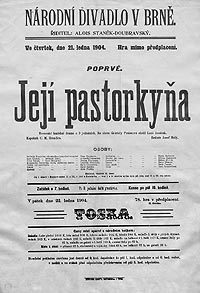
![]() Poster for the premiere, 1904 | |
| Native title | Její pastorkyňa (Her Stepdaughter) |
| Librettist | Janáček |
| Language | Czech |
| Based on | Její pastorkyňa by Gabriela Preissová |
| Premiere | 21 January 1904 |
Její pastorkyňa (Her Stepdaughter; commonly known as Jenůfa (ⓘ)) is an opera in three acts by Leoš Janáček to a Czech libretto by the composer, based on the play Její pastorkyňa by Gabriela Preissová. It was first performed at the National Theatre, Brno on 21 January 1904. Composed between 1896 and 1902,[1] it is among the first operas written in prose.[2]
The first of Janáček's operas in which his distinctive voice can clearly be heard, it is a grim story of infanticide and redemption. Like the playwright's original work, it is known for its unsentimental realism. While today it is heard in the composer's original version, Jenůfa's early popularity was due to a revised version by Karel Kovařovic, altering what was considered its eccentric style and orchestration. Thus altered, it was well-received, first in Prague, and particularly after its Vienna première also worldwide.[3] More than 70 years passed before audiences again heard it in Janáček's original version.
Janáček wrote an overture to the opera, but decided not to use it. It was partly based on a song called Žárlivec (The jealous man). It is now performed as a concert piece under the title Žárlivost (Jealousy), JW 6/10.[4]
The composer dedicated the work to the memory of his daughter Olga (d. 1903), as he did his choral composition the Elegy on the Death of Daughter Olga.
Roles
[edit]| Role | Voice type | Premiere Cast, 21 January 1904 (Conductor: Cyril Metoděj Hrazdira) | |
|---|---|---|---|
| Jenůfa | Soprano | Marie Kabeláčová | |
| Laca Klemeň | Tenor | Alois Staněk-Doubravský | |
| Števa Buryja | Bohdan Procházka | ||
| Kostelnička Buryjovka | Soprano | Leopoldina Hanusová-Svobodová[5] | |
| Grandmother Buryjovka | Contralto | Věra Pivoňková | |
| Stárek, the Mill foreman | Baritone | Karel Benýško | |
| Mayor | bass | Alois Pivoňka | |
| Mayor's wife | Mezzo-soprano | Ema Kučerová | |
| Karolka | Růžena Kasperová[6] | ||
| Chorus:Recruits, servants, girls, villagers, musicians | |||
Synopsis
[edit]- Place: A Moravian village
- Time: the nineteenth century
The plot depends on a tangled set of village relationships. Before the opera begins, the mill-owner Grandmother Buryja had two sons. The elder married the widow of a man named Klemeň, became stepfather to her son Laca, and had a son of his own with her, Števa. The younger married twice, and had a daughter, Jenůfa, with his first wife. When the opera opens, Grandmother Buryja's sons and their wives have died, except for the Kostelnička (the sacristan or sextoness of the village church),[7] the younger son's second wife and Jenůfa's stepmother.[8] Custom dictates that Števa alone, as the elder son's only child, will inherit the mill, leaving his half-brother Laca and cousin Jenůfa to earn their livings.
Act 1
[edit]Jenůfa, Laca, and Grandmother Buryja wait for Števa to return home. Jenůfa, in love with Števa and secretly pregnant with his child, worries that he may have been drafted into the army. Laca, in love with Jenůfa, expresses bitterness against his half-brother's favored position at home. As he complains he plays with a knife and, finding it blunt, gives it to the mill foreman to be sharpened.
The foreman informs the family that Števa has not been drafted, to Jenůfa's relief and Laca's increased frustration. The others leave, and Jenůfa waits to greet Števa. He appears with a group of soldiers, drunk and boasting of his prowess with the girls. He calls for music and drags the miserable Jenůfa into dancing with him.
The Kostelnička steps into this rowdy scene, silences the musicians and, shocked by Števa's behavior, forbids him to marry Jenůfa until he can stay sober for one full year. The soldiers and the family leave Števa and Jenůfa alone, and she begs him to love her, but he, unaware of her pregnancy, gives her casual answers and leaves.
Laca returns, as bitter as ever. He attempts to goad Jenůfa into criticizing Števa, but she takes her lover's side despite everything. Laca rages that Števa would never even look at her if it weren't for her rosy cheeks, then slashes her across the cheek with his knife.
Act 2
[edit]Months later, it is winter. The baby has been born, but Števa has not yet come to visit his child. Jenůfa's face is still disfigured, but she is happy in her love for the baby. While Jenůfa sleeps, the Kostelnička summons Števa and demands that he take responsibility. He answers that while he will provide money in secret, no one must know the baby is his. His love for Jenůfa died when Laca spoiled her beauty, and he is now engaged to marry Karolka, the mayor's pretty daughter.
Števa leaves, and Laca enters. He still doesn't know the truth about the baby, and when the Kostelnička tells him, his first reaction is disgust at the thought of taking Števa's child under his wing. Fearful that Jenůfa will be left with no one to marry, Kostelnička hastily lies that the baby is dead. Laca leaves, and the Kostelnička is faced with the necessity of making the lie true. She wraps the baby in a shawl and leaves the house.
Jenůfa wakes up and says a prayer for her child's future, but the Kostelnička, returning, tells her that the baby died while she slept. Laca appears and comforts Jenůfa gently, asking that they spend the rest of their lives together. Seeing the tenderness of the couple, the Kostelnička tries to convince herself that she has acted for the best.
Act 3
[edit]It is now spring, and Laca and Jenůfa's wedding day. All seems right again, except that the Kostelnička is a nervous wreck. Števa and Karolka visit, and a chorus of village girls sings a wedding song. Just then, screams are heard. The body of the baby has been discovered in the mill-stream under the melting ice. Jenůfa immediately says that the baby is hers, and in her grief appears guilty of the murder. The village is ready to exact immediate justice against Jenůfa, but the Kostelnička calms them and says that the crime is hers. Hearing the whole story, Jenůfa forgives her stepmother. The crowd takes the Kostelnička off to jail. Jenůfa and Laca are left alone. Jenůfa asks Laca to leave her, as she cannot expect him to marry her now. He replies that he will not leave her, and that he wishes to spend the rest of his life with her.
Noted arias
[edit]- "In a moment" [Co chvíla] (Kostelnička)
- Jenůfa's prayer (Jenůfa)
- Finale [Odesli] (Jenůfa, Laca)
Recordings
[edit]- 1951: Stepanka Jelinkova, Beno Blachut, Ivo Žídek, Marta Krásová, Miloslava Fidlerova, Milada Čadikovičová, Karel Kalaš, Marie Musilova, Vladimir Jedenactik, Milada Šubrtová, Prague National Theatre Chorus, Prague National Theatre Orchestra, conducted by Jaroslav Vogel, Supraphon, recorded at the Dvořák Hall of the Rudolfinum, Prague 2 CDs
- 1969: Libuše Domaninskayá, Vilém Přibyl, Ivo Žídek, Naděžda Kniplová, Marie Mrázová, Jindřich Jindrák, Marta Bohácová, Prague National Theatre Chorus, Prague National Theatre Orchestra, conducted by Bohumil Gregor, Supraphon, recorded Zofin Hall, Prague, June 1969. Label: HMV; EMI CD reissue 2011
- 1974: Magda Olivero, Jeda Valtriani, Nicola Zaccaria, Margherita Benetti, Giuseppe Morresi, Grace Bumbry, Maria Grazia Allegri, Nella Verri, Silvana Zanolli, Renato Cioni, Jerzy Semkow (Conductor); La Scala Orchestra and Chorus. Recorded at the Teatro alla Scala, Milano, 1974. Label: Myto
- 1977: Gabriela Beňačková, Nadĕžda Kniplová, Vilém Přibyl, Vladimír Krejčík, Anna Barová, Karel Berman and others; Brno Janáček Opera Chorus, Brno Janáček Opera Orchestra, conducted by František Jílek. Recorded at the Janáček Opera House, Brno, 1977/78. Label: Supraphon 10 2751-2 612, 2CDs
- 1980: Soňa Červená, Sena Jurinac, Willard White, Elisabeth Söderström, John del Carlo, Gwendolyn Jones, Sara Ganz, Susan Quittmeyer, Pamela South, William Lewis; San Francisco Opera Orchestra and Chorus, conducted by Albert Rosen. Recorded at the War Memorial Opera House, San Francisco, October 1, 1980 (as on the accompanying material, but possibly the performance of October 10, which was broadcast). Label: Gala
- 1983: Elisabeth Söderström, Wieslaw Ochman, Peter Dvorský, Eva Randová, Václav Zítek, Dalibor Jedlička, Ivana Mixová, Lucia Popp, Marie Mrazová; Vienna Philharmonic Orchestra, Vienna State Opera Chorus, conducted by Charles Mackerras, recorded Sofiensaal, Vienna, April 1982. Label: Decca
- 1988: Gabriela Benackova, Leonie Rysanek, Wieslaw Ochman, Peter Kazaras; Opera Orchestra of New York, conducted by Eve Queler. Recorded at Carnegie Hall, March 30, 1988. Label: BIS.
- 2002: Karita Mattila, Anja Silja, Eva Randová, Jerry Hadley, Jorma Silvasti; Orchestra of the Royal Opera House, Covent Garden, conducted by Bernard Haitink, recorded at the Royal Opera, Covent Garden, London, 10–18 October 2001. Label: Erato Records
- 2003: Elizabeth Vaughan, Dame Josephine Barstow, Janice Watson, Peter Wedd, Nigel Robson, Chorus and Orchestra of Welsh National Opera, conducted by Sir Charles Mackerras. Recorded at Brangwyn Hall, Swansea, United Kingdom, July 2003. Label: Chandos
- 2009: Amanda Roocroft, Deborah Polaski, Miroslav Dvorský, Nikolai Schukoff, Mette Ejsing, Károly Szemerédy, Miguel Sola, Marta Mathéu, Marta Ubieta, Elena Poesina; Teatro Real Orchestra and Chorus, conducted by Ivor Bolton; Stage Director: Stéphane Braunschweig. Recorded at the Teatro Real, Madrid, 2009. Label: Opus Arte (DVD)
- 2014: Gal James (Jenůfa), Iris Vermillion (Kostelnička Buryjovka), Dunja Vejzović (Stařenka Buryjovka), Aleš Briscein (Laca Klemeň), Taylan Reinhard (Števa Buryja) and others, Choir and Singschul' of the Graz Opera, Graz Philharmonic Orchestra, Dirk Kaftan, conductor, recorded live during staged performances at Graz Opera, Graz, Austria, 7, 17, 21 – 22 May 2014; Oehms Classics OC 962; 2 CDs
References
[edit]Notes
- ^ The description of the Universal Edition German-translated vocal score, 1944 republication, gives 1894–1903 instead- see OCLC 475447489.
- ^ Kundera 2004, p. 54
- ^ Štědroň 2006, p. 12
- ^ Jealousy, Classical Archives
- ^ Drlíková 2004, pp. 1—9
- ^ Štědroň 1946, pp. 153—154
- ^ "Kostelnička".
- ^ Janá?Ek, Leoš (January 2002). Jen?fa. Courier Corporation. ISBN 978-0-486-42433-0.
Sources
- Drlíková, Eva (2004). Leoš Janáček, Život a dílo v datech a obrazech / Chronology of his life and work. Brno: Opus Musicum. ISBN 80-903211-1-9.(in Czech and English)
- Holden, Amanda (Ed.) (2001), The New Penguin Opera Guide, New York: Penguin Putnam. ISBN 0-14-029312-4
- Kundera, Milan (2004). Můj Janáček (in Czech). Brno: Atlantis. ISBN 80-7108-256-2.
- Tyrrell, John (2007), Janáček: Years of a Life: (1914-1928) Tsar of the Forests, Vol. 2. London: 2007 (Two-volume biography of the composer by the leading authority.)
- Štědroň, Miloš (Trans. Ted Whang) (2006), Jenůfa (Brno Janáček Opera Chorus and Orchestra, conductor František Jílek) (CD). Leoš Janáček. Prague: Supraphon. SU 3869-2.
{{cite AV media notes}}: CS1 maint: others in cite AV media (notes) (link) - Štědroň, Bohumír (1946). Janáček ve vzpomínkách a dopisech (in Czech). Prague: Topičova edice.
External links
[edit]- Gavin Plumley's Leoš Janáček site, information on Jenůfa (site dead 2021-10-26)
Jenůfa
View on GrokipediaBackground and composition
Literary origins
Její pastorkyňa (Her Stepdaughter), the primary literary source for Leoš Janáček's opera Jenůfa, is a realist drama written by Czech author Gabriela Preissová (née Sekerová, 1862–1946), a prose writer and playwright known for her depictions of rural life.[6] The play premiered at Prague's National Theatre in the fall of 1890 and was published the following year.[7] Set in a Moravian village, it addresses themes of infanticide, social ostracism, and redemption amid the harsh realities of peasant existence.[8] Preissová's narrative centers on the protagonist Jenůfa, an unwed mother facing societal judgment, and her stepmother Kostelnička, whose desperate act of infanticide to protect her stepdaughter's honor underscores the play's exploration of women's oppression in a patriarchal rural community.[6] These elements culminate in Jenůfa's path to forgiveness, offering a glimmer of moral redemption against a backdrop of communal hypocrisy and isolation.[7] The play's unflinching realism in portraying taboo subjects like illegitimacy and violence scandalized audiences and critics, who decried its gritty exposure of village mores and gender constraints, prompting Preissová to withdraw from adult fiction for a time.[9] Janáček, drawn to the drama's authentic reflection of Moravian folk culture and its veristic style, resolved to adapt it into an opera following a 1894 performance he attended in Brno.[7] This choice aligned with his longstanding fascination with regional speech patterns, customs, and realism, marking his inaugural operatic venture from a prose source rather than a traditional libretto.[10] In the resulting work, Janáček preserved essential plot threads from Preissová's text, including the stepmother's infanticide and Jenůfa's forgiving response, to ground the opera in its dramatic origins.[8]Composition history
Janáček began composing Jenůfa in late 1894, completing the prelude on December 31 of that year, with the bulk of the work spanning from 1896 to 1903.[11] The opera's creation was marked by interruptions due to personal tragedies, including the death of his daughter Olga from typhoid fever in February 1903, shortly after he finished Act III on January 25; Janáček performed excerpts for her bedside before her passing and dedicated the work to her memory.[12] Despite these setbacks, he persisted, finalizing the orchestration by early 1903.[13] The composition drew heavily on Moravian folk music, which Janáček had studied extensively, incorporating its modal structures and rhythmic vitality to evoke the rural setting and emotional intensity of the story.[14] Central to his approach was the innovative "speech melody" technique, where he notated the natural inflections and rhythms of spoken Czech to shape vocal lines, creating a realistic dramatic flow rather than traditional operatic verse.[15] This method, developed from his ethnographic research starting in the 1890s, aligned with broader realist influences from Russian literature and naturalism, emphasizing authentic human expression over stylized forms.[16] Janáček faced significant challenges during the process, including the opera's unconventional style, which led to its rejection by the Prague National Theatre in April 1903, as the management deemed it unsuitable for performance.[1] Undeterred, he revised sections to deepen emotional nuance, adapting Gabriela Preissová's original prose play into a libretto that retained its stark dialogue while enhancing musical integration.[17] These efforts culminated in preparations for a Brno premiere, with the score ready by mid-1903.[18]Premiere and revisions
First performance
The world premiere of Leoš Janáček's opera Jenůfa (originally titled Její pastorkyňa) occurred on 21 January 1904 at the National Theatre in Brno, conducted by the composer's student Cyril Metoděj Hrazdira and directed by Josef Malý.[19][20] The production was mounted in a converted dance hall due to limited facilities, employing a modest orchestra of 29 players that omitted instruments such as harp, cor anglais, and bass clarinet from the score.[20] Staging emphasized realism to depict Moravian village life, featuring simple sets including a mill with a rotating wheel; a xylophone was placed onstage to simulate the mill's mechanical sounds during key scenes.[20] The cast highlighted emerging Czech talent, with Marie Kabeláčová (later replaced by Růžena Kašparová) portraying the title role of Jenůfa, Alois Staněk-Doubravský as Laca Klemeň, and Růžena Kašparová also taking on the role of Karolka in subsequent shows.[20][21] The premiere elicited an enthusiastic response from the Brno audience, who hoisted Janáček onstage in celebration, and garnered positive local press for its dramatic intensity and folk-inspired authenticity.[7][20] However, reception was mixed, with some reviewers decrying the score as an "unbearable racket" and a "chaos of notes" due to its departure from conventional operatic forms, including the absence of extended arias in favor of speech-like recitatives.[20] Despite these critiques, the opera achieved modest local success, receiving nine performances in its debut season and additional revivals through 1906 and 1910, establishing Janáček's reputation as a leading figure in Czech opera.[7]Kovařovic cuts and revisions
The 1916 Prague premiere of Jenůfa took place at the National Theatre, where intendant and conductor Karel Kovařovic implemented significant editorial changes to adapt the opera for Prague audiences. These revisions aimed to soften the work's intense drama, particularly by excising explicit references to the infanticide central to the plot, thereby mitigating the story's raw confrontation with moral and social taboos.[22] Kovařovic personally oversaw the excisions, removing approximately 10 minutes of material to align the opera with contemporary tastes for more restrained emotional expression. Among the cuts were portions of the Kostelnička's pivotal monologue "Co chvíla" in Act II, which delves into her psychological turmoil, as well as ensemble passages that heightened the communal tension. These alterations, known as the "Kovařovic cuts," streamlined the score and became the prevailing version for international performances, including the 1918 Vienna premiere in German translation at the Court Opera, remaining standard practice until the mid-1950s.[23][22] Janáček initially granted reluctant approval to Kovařovic's modifications, viewing them as a necessary compromise to secure the opera's exposure beyond Brno. However, he later championed the restoration of his original intentions, expressing dissatisfaction with the diluted intensity. The full version, incorporating Janáček's revisions, was reinstated in the 1918 Brno edition, marking a key step toward reclaiming the opera's unedited form.[22] While the cuts enabled Jenůfa's broader dissemination across German-speaking theaters and facilitated its early international acclaim, they ultimately tempered the opera's unflinching realism, postponing appreciation of Janáček's innovative dramatic structure for decades.[23]Roles and characters
Principal roles
The principal roles in Leoš Janáček's opera Jenůfa demand singers capable of conveying deep emotional intensity within the composer's speech-inspired melodic lines, often requiring a blend of lyrical expressiveness and dramatic power to suit the Moravian folk influences and psychological depth of the characters.[24] Jenůfa (soprano) is the innocent and vulnerable protagonist, whose dramatic function centers on embodying youthful purity and resilience amid personal turmoil; the role calls for a lyrical soprano with an expressive upper register and sustained high tessitura to navigate her emotional arias, highlighting her inner conflict and growth.[25][26][27] Kostelnička Buryjovka (dramatic soprano or mezzo-soprano) serves as the stern stepmother and widow, functioning dramatically as a figure of rigid morality and inner torment that drives key conflicts; vocally, it requires a powerful, intense instrument with a wide range—from low G♯3/Ab3 to high A♯5/B♭5—to convey her authoritative presence and climactic emotional outbursts.[28][27][29] Laca Klemeň (tenor) portrays the jealous and initially volatile suitor whose dramatic arc involves transformation from impulsive passion to steadfast devotion; the role suits a lyric tenor with agility for declamatory passages that reflect his evolving emotional volatility.[30][27] Števa Buryja (tenor) represents the charismatic yet irresponsible lover, serving a lighter dramatic function as a foil to the more complex principals through his superficial charm; it demands a brighter, more straightforward tenor voice with endurance for the role's demanding tessitura, emphasizing his carefree demeanor.[30][27][31] Grandma Buryjovka (contralto) acts as the wise, folksy family matriarch, providing grounding counsel and comic relief in her dramatic role; the part requires a rich contralto timbre to evoke traditional Moravian warmth and authority in her limited but pivotal scenes.[30][27]Premiere cast
The premiere of Jenůfa on 21 January 1904 at the National Theatre in Brno featured a cast of local Czech singers from the Brno opera ensemble, whose performances contributed to the opera's authentic portrayal of Moravian rural life and folk traditions.[1] The production was conducted by Cyril Metoděj Hrazdira, a student of Janáček, who ensured a dedicated and precise rendition despite the orchestra's limited size of about 29 players.[20][32] The principal roles were sung as follows:| Role | Voice Type | Singer |
|---|---|---|
| Jenůfa | Soprano | Růžena Kašparová (replacing the indisposed Marie Kabeláčová) |
| Kostelnička Buryjovka | Mezzo-soprano | Leopoldina Svobodová |
| Laca Klemeň | Tenor | Alois Staněk-Doubravský |
| Števa Buryja | Tenor | Bohdan Procházka |
| Grandmother Buryjovka | Contralto | Věra Pivoňková |

