


Community hub
Recent from talks
Contribute something to knowledge base
Content stats: 0 posts, 0 articles, 1 media, 0 notes
Members stats: 0 subscribers, 0 contributors, 0 moderators, 0 supporters
Subscribers
Supporters
Contributors
Moderators
Hub AI
Calochortus AI simulator
(@Calochortus_simulator)
Hub AI
Calochortus AI simulator
(@Calochortus_simulator)
Calochortus
Calochortus /ˌkæləˈkɔːrtəs, -loʊ-/ is a genus of flowering plants in the lily family. The group includes herbaceous, perennial and bulbous species, all native to North America (primarily the Western United States).
The genus Calochortus includes mariposas (or mariposa lilies) with open wedge-shaped petals, globe lilies and fairy lanterns with globe-shaped flowers, and cat's ears and star tulips with erect pointed petals. The word Calochortus is derived from Greek and means "beautiful grass".
Calochortus stems grow to over 30 centimetres (12 in) tall.
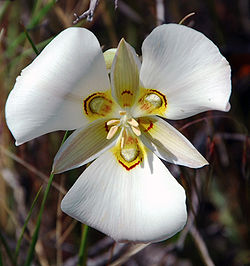
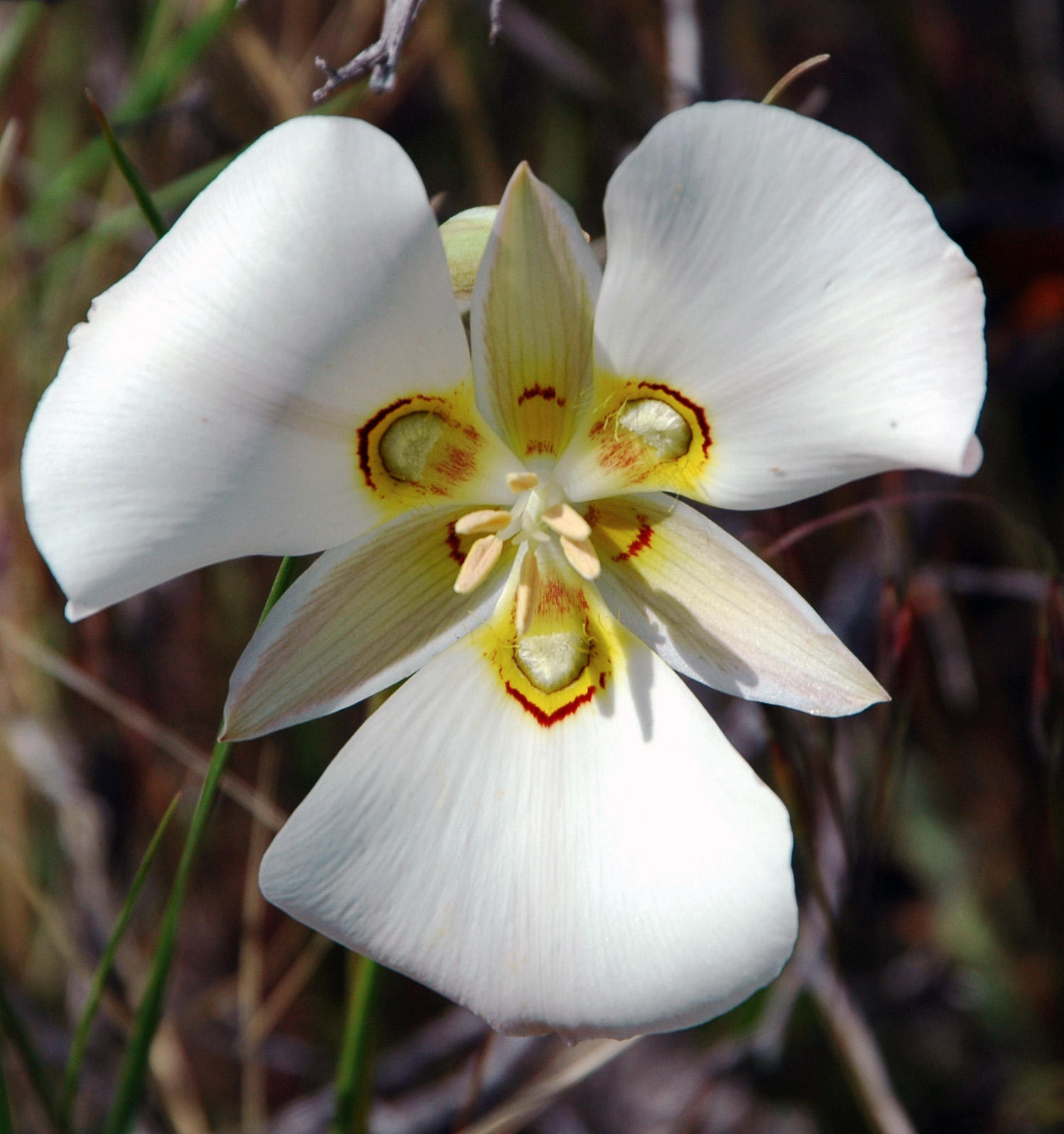
The flowers can be white, yellow, pink, red-orange, or purplish. They are up to 7.5 cm (3 in) wide, with six tepals. Unlike most other Liliaceae, Calochortus tepals are in two series that differ in size and color. The outer three are generally narrower and more sepal-like, while the inner three are larger, usually with bright marks at the base, and are often described as petals. The flowers are borne on a stem that arises from a bulb, generally in the spring or early summer. The insides of the petals are often very 'hairy'. These hairs, along with the nectaries, are often used in distinguishing species from each other.
The group includes herbaceous, perennial, and bulbous species.
Calochortus was first proposed in 1814 by Frederick Pursh to accommodate a specimen—C. elegans—received from the Lewis and Clark expedition. In the 1800s, several species were added to the genus; however, much mistakes in naming conventions led to confusion and minimal knowledge gained by the end of the century.
In 1940, Francis Marion Ownbey wrote a comprehensive monograph on Calochortus, referencing morphological evidence, geographical distribution, and his own study of cytological material. Ownbey proposed a treatment dividing Calochortus into three sections (later corroborated by J. M. Beal):
In 1985, F.N. Rasmussen developed a new treatment splitting Calochortus from Liliaceae, moving it into a separate family—Calochortaceae—based on chromosomal evidence, septicidal fruit, and a Polygonum type embryo sac formation. Rasmussen found that the basic chromosome numbers of Calochortus vary between seven and twenty.
Calochortus
Calochortus /ˌkæləˈkɔːrtəs, -loʊ-/ is a genus of flowering plants in the lily family. The group includes herbaceous, perennial and bulbous species, all native to North America (primarily the Western United States).
The genus Calochortus includes mariposas (or mariposa lilies) with open wedge-shaped petals, globe lilies and fairy lanterns with globe-shaped flowers, and cat's ears and star tulips with erect pointed petals. The word Calochortus is derived from Greek and means "beautiful grass".
Calochortus stems grow to over 30 centimetres (12 in) tall.
The flowers can be white, yellow, pink, red-orange, or purplish. They are up to 7.5 cm (3 in) wide, with six tepals. Unlike most other Liliaceae, Calochortus tepals are in two series that differ in size and color. The outer three are generally narrower and more sepal-like, while the inner three are larger, usually with bright marks at the base, and are often described as petals. The flowers are borne on a stem that arises from a bulb, generally in the spring or early summer. The insides of the petals are often very 'hairy'. These hairs, along with the nectaries, are often used in distinguishing species from each other.
The group includes herbaceous, perennial, and bulbous species.
Calochortus was first proposed in 1814 by Frederick Pursh to accommodate a specimen—C. elegans—received from the Lewis and Clark expedition. In the 1800s, several species were added to the genus; however, much mistakes in naming conventions led to confusion and minimal knowledge gained by the end of the century.
In 1940, Francis Marion Ownbey wrote a comprehensive monograph on Calochortus, referencing morphological evidence, geographical distribution, and his own study of cytological material. Ownbey proposed a treatment dividing Calochortus into three sections (later corroborated by J. M. Beal):
In 1985, F.N. Rasmussen developed a new treatment splitting Calochortus from Liliaceae, moving it into a separate family—Calochortaceae—based on chromosomal evidence, septicidal fruit, and a Polygonum type embryo sac formation. Rasmussen found that the basic chromosome numbers of Calochortus vary between seven and twenty.
Recent media
Recent media