Hubbry Logo
CalochortusCalochortusMain
Open search
Calochortus
Community hub
Calochortus
logo
8 pages, 0 posts
0 subscribers
Be the first to start a discussion here.
Calochortus
Calochortus
from Wikipedia

Calochortus
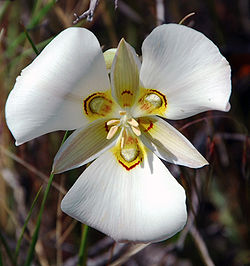
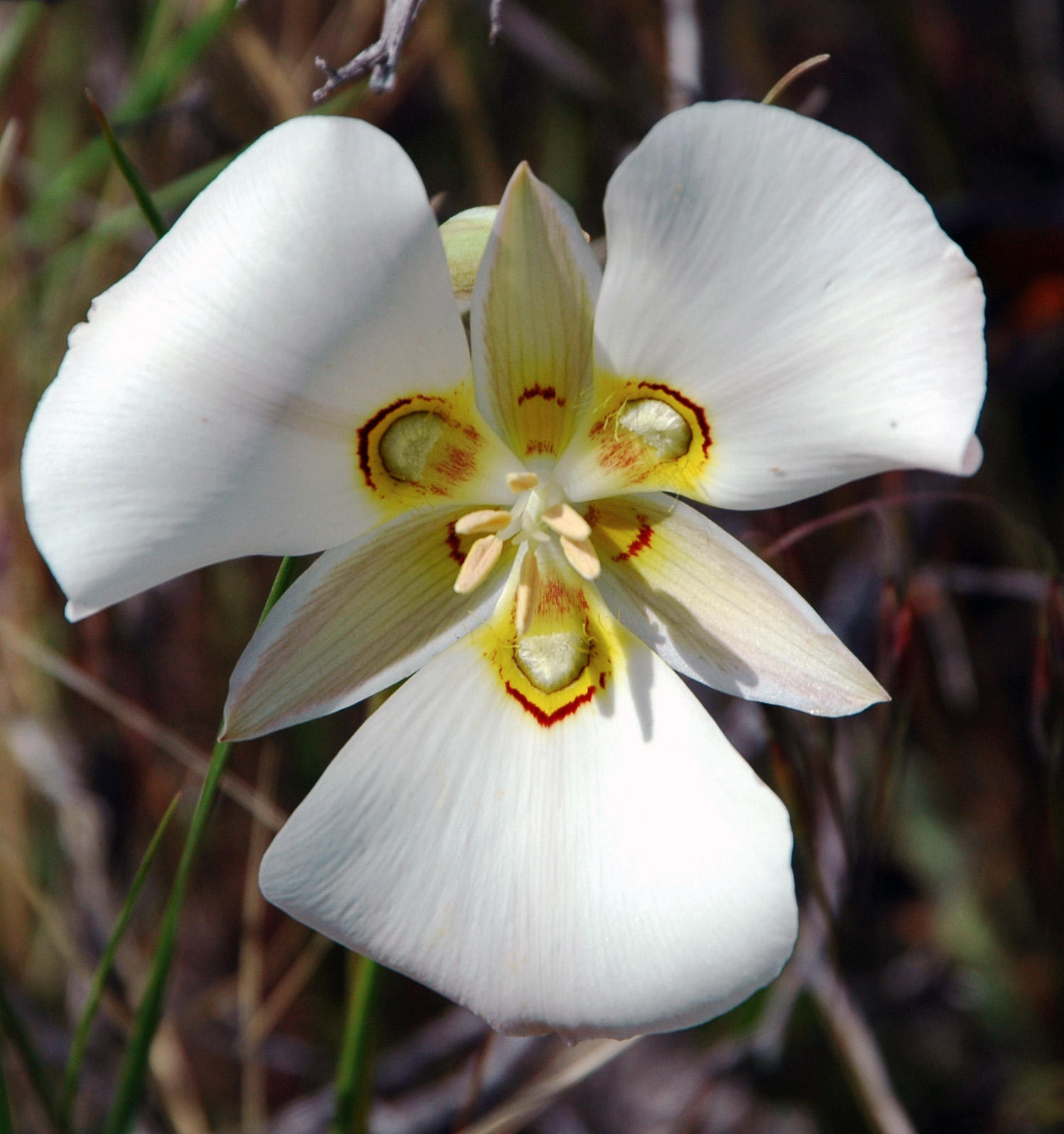
Sego Lily (Calochortus nuttallii)
Scientific classification Edit this classification
Kingdom: Plantae
Clade: Tracheophytes
Clade: Angiosperms
Clade: Monocots
Order: Liliales
Family: Liliaceae
Subfamily: Calochortoideae
Genus: Calochortus
Pursh
Type species
Calochortus elegans
Synonyms[2]
  • Cyclobothra D.Don
  • Mariposa (Alph.Wood) Hoover

Calochortus /ˌkæləˈkɔːrtəs, -l-/[3][4] is a genus of flowering plants in the lily family. The group includes herbaceous, perennial and bulbous species, all native to North America (primarily the Western United States).

The genus Calochortus includes mariposas (or mariposa lilies) with open wedge-shaped petals, globe lilies and fairy lanterns with globe-shaped flowers, and cat's ears and star tulips with erect pointed petals. The word Calochortus is derived from Greek and means "beautiful grass".

Description

[edit]

Calochortus stems grow to over 30 centimetres (12 in) tall.[5]

The flowers can be white, yellow, pink, red-orange, or purplish. They are up to 7.5 cm (3 in) wide,[5] with six tepals. Unlike most other Liliaceae, Calochortus tepals are in two series that differ in size and color.[6] The outer three are generally narrower and more sepal-like, while the inner three are larger, usually with bright marks at the base,[7] and are often described as petals.[8] The flowers are borne on a stem that arises from a bulb, generally in the spring or early summer. The insides of the petals are often very 'hairy'. These hairs, along with the nectaries, are often used in distinguishing species from each other.[9]

The group includes herbaceous, perennial, and bulbous species.[9][10]

Taxonomy

[edit]

History

[edit]

Calochortus was first proposed in 1814 by Frederick Pursh to accommodate a specimen—C. elegans—received from the Lewis and Clark expedition. [11] In the 1800s, several species were added to the genus; however, much mistakes in naming conventions led to confusion and minimal knowledge gained by the end of the century. [11]

In 1940, Francis Marion Ownbey wrote a comprehensive monograph on Calochortus, referencing morphological evidence, geographical distribution, and his own study of cytological material. Ownbey proposed a treatment dividing Calochortus into three sections (later corroborated by J. M. Beal[12]):

  1. Eucalochortus
    • Ten basic chromosomes and two known cases of tetraploidy
    • Includes subsections Pulchelli, Eleganti, Nudi, Nitidi
  2. Mariposa
    • Basic chromosome numbers between six and nine
    • Includes subsections Venusti, Macrocarpi, Nuttalliani, Gunnisoniani
  3. Cyclobothra
    • Nine basic chromosomes
    • Includes subsection Weediani

In 1985, F.N. Rasmussen developed a new treatment splitting Calochortus from Liliaceae, moving it into a separate family—Calochortaceae—based on chromosomal evidence, septicidal fruit, and a Polygonum type embryo sac formation.[13] Rasmussen found that the basic chromosome numbers of Calochortus vary between seven and twenty.

Subdivision update

[edit]

In the late 1990s and early 2000s, Thomas B. Patterson and Thomas J. Givnish gathered additional evidence to create a new Calochortus treatment, subdividing it into seven sections and providing reasoning behind Calochortus being separate from Liliaceae. In 1999, Patterson used cpDNA (specifically rbcL and ndhF sequences) isolated from frozen or silica dried leaf tissue to develop a molecular phylogeny, finding that Calochortus should be divided into seven major clades based on geographic location:[14]

  • Bay Area
  • Pacific Northwest
  • San Diego
  • Great Basin- Rocky Mountains
  • Coast Ranges- Sierra Nevada
  • Southwestern California
  • Central Mexico

Patterson also determined at the time that concerted convergence and phylogenetic niche conservatism may have confounded the idea that Calochortaceae (Calochortus) and Liliaceae are closely related. In 2002, Patterson and Givnish expanded on these arguments, showing that concerted convergence was demonstrated through independent evolution of characteristics such as bulbs and showy flowers and the distinct differences of these appearing as a result of survival in specific habitats.[15] Regarding phylogenetic niche conservatism, Patterson and Givnish make the argument that this phenomenon is present in the plesiomorphic characteristics of rhizomes, inconspicuous flowers, berries, broad leaves, and reticulate venation.

In 2004, Patterson and Givnish made the shift to lump Calochortus within Liliaceae within their paper per the recommendations of Bremer et al. (2003)[16] and Bremer, Chase, and Stevens (1998).[17] Using similar DNA collection techniques to Patterson (1999), Patterson and Givnish developed a more detailed molecular phylogeny, comparing the seven recently determined sections to Ownbey's original three and finding that Ownbey's Eucalochortus section is monophyletic, Mariposa is paraphyletic, and Cyclobothra is polyphyletic.[18] As a result of their research, Patterson and Givnish (2004) found that the two main factors of Calochortus speciation are:

  1. Poor dispersal caused by heavy, passively dispersed seeds
  2. Chromosomal evolution allowing different clades to "double up" and radiate sympatrically without hybridizing

Serpentine tolerance

[edit]

Within Calochortus, almost one-third of species are characterized by ultramafic (form serpentine soils) habitat preferences or specific edaphic requirements, with several being endemic to their environments.[19] Thus, scientists have used serpentine tolerance in understanding evolutionary relationships within the genus. For instance, Patterson and Givnish (2004) created a serpentine tolerance phylogeny. 18 serpentine tolerant species were found (classified by occurring in whole or in part on serpentine soils) and the largest presence of tolerance was found in the Bay Area and Pacific Northwest clades—areas with unusually high numbers of serpentine rocks at the Earth's surface.[18] In addition, Patterson and Givnish (2004) found that 11 out of 18 species displayed only two origins of serpentine tolerance in evolutionary history.

Species

[edit]

The genus contains the following species:[2][20][21][22][23]


Image Scientific name Subspecies Distribution
Calochortus albus white globelily CA, Baja California
Calochortus amabilis Diogenes' lantern CA
Calochortus ambiguus doubting mariposa lily UT AZ NM Sonora
Calochortus amoenus purple globelily CA
Calochortus apiculatus pointed-tip mariposa lily British Columbia, Alberta, WA OR ID MT WY
Calochortus argillosus CA
Calochortus aureus golden mariposa lily UT CO AZ NM
Calochortus balsensis Oaxaca, Guerrero
Calochortus barbatus yellow globe lily from Chihuahua to Oaxaca
Calochortus bruneaunis Bruneau mariposa lily CA OR NV UT ID MT
Calochortus catalinae Santa Catalina mariposa lily — (threatened by development) CA
Calochortus cernuus Morelos
Calochortus ciscoensis UT
Calochortus clavatus club-hair mariposa lily
  • Calochortus clavatus var. avius -rare,
  • Calochortus clavatus var. gracilis
  • Calochortus clavatus ssp. clavatus
  • Calochortus clavatus ssp. pallidus
  • Calochortus clavatus ssp. recurvifoliusrare
CA
Calochortus coeruleus beavertail grass CA
Calochortus concolor golden-bowl mariposa lily CA, Baja California
Calochortus coxii Cox's mariposa lily OR
Calochortus dunnii Dunn's mariposa lily — rare CA, Baja California
Calochortus elegans northwestern mariposa lily; star tulip
  • Calochortus elegans var. elegans elegant mariposa lily
  • Calochortus elegans var. nanus
  • Calochortus elegans var. oreophilus elegant mariposa lily
  • Calochortus elegans var. selwayensis Selway mariposa lily
CA OR WA ID MT
Calochortus eurycarpus white mariposa lily OR WA NV ID MT WY
Calochortus excavatus Inyo mariposa lily (threatened by groundwater development) - CA
Calochortus exilis Hidalgo
Calochortus fimbriatus late-blooming mariposa lily — rare CA
Calochortus flexuosus winding mariposa lily CA NV UT CO AZ NM Baja California, Sonora
Calochortus foliosus Michoacán
Calochortus fuscus Mexico
Calochortus greenei Green's mariposa lily — rare CA OR
Calochortus ghiesbreghtii Mexico, Guatemala
Calochortus gunnisonii Gunnison's mariposa lily
  • Calochortus gunnisonii var. gunnisonii
  • Calochortus gunnisonii var. perpulcher
ID MT WY SD NE CO UT AZ NM
Calochortus hartwegii Aguascalientes, Nayarit, Jalisco
Calochortus howellii Howell's mariposa lily OR
Calochortus indecorus Sexton Mountain mariposa lily OR - extinct
Calochortus invenustus plain mariposa lily CA NV
Calochortus kennedyi desert mariposa lily
  • Calochortus kennedyi var. kennedyi
  • Calochortus kennedyi var. munzii
CA NV AZ Sonora, Chihuahua
Calochortus leichtlinii smokey mariposa CA NV OR
Calochortus longibarbatus longbeard mariposa lily
  • Calochortus longibarbatus var. longibarbatus — (threatened by grazing)
  • Calochortus longibarbatus var. peckii
CA OR WA
Calochortus luteus yellow mariposa lily CA
Calochortus lyallii Lyall's mariposa lily WA, British Columbia
Calochortus macrocarpus sagebrush mariposa lily
  • Calochortus macrocarpus var. macrocarpus
  • Calochortus macrocarpus var. maculosus Nez Perce mariposa lily
CA NV OR WA ID MT, British Columbia
Calochortus marcellae Nuevo León, Coahuila, Tamaulipas
Calochortus mendozae Querétaro, San Luis Potosí
Calochortus minimus Sierran mariposa lily CA
Calochortus monanthus Shasta River mariposa lily CA (presumed extinct)
Calochortus monophyllus yellow startulip CA OR
Calochortus nigrescens Oaxaca
Calochortus nitidus broad-fruit mariposa lily WA OR ID
Calochortus nudus naked mariposa lily CA OR
Calochortus nuttallii sego lily, (state flower of Utah) ND SD NE MT ID CO UT NV AZ NM
Calochortus obispoensis San Luis mariposa lily CA
Calochortus palmeri Palmer's mariposa lily
  • Calochortus palmeri var. munzii Munz's mariposa lily
  • Calochortus palmeri var. palmeri — rare
CA
Calochortus panamintensis Panamint Mountain mariposa lily — rare CA NV
Calochortus persistens Siskiyou mariposa lily — rare CA OR
Calochortus plummerae Plummer's mariposa lily — rare CA
Calochortus pringlei Morelos, Puebla, Jalisco, Oaxaca
Calochortus pulchellus Mount Diablo globelily CA
Calochortus raichei Cedars mariposa lily CA
Calochortus simulans San Luis Obispo mariposa lily CA
Calochortus spatulatus Mexico
Calochortus splendens splendid mariposa lily CA, Baja California
Calochortus striatus alkali mariposa lily CA NV
Calochortus subalpinus subalpine mariposa lily, Cascade mariposa lily, cat's ear lily WA OR
Calochortus superbus superb mariposa CA
Calochortus syntrophus Callahan's mariposa lily CA
Calochortus tiburonensis Tiburon mariposa CA
Calochortus tolmiei Tolmie's star-tulip, hairy pussy ears CA OR WA
Calochortus umbellatus Oakland mariposa lily CA
Calochortus umpquaensis Umpqua mariposa lily OR
Calochortus uniflorus mariposa 'Cupido' CA OR
Calochortus venustulus Mexico
Calochortus venustus butterfly mariposa, white mariposa CA
Calochortus vestae Vesta's mariposa, Coast Range mariposa CA
Calochortus weedii Weed's mariposa CA, Baja Calilfornia
Calochortus westonii Shirley Meadow star-tulip, Weston's mariposa CA

Etymology

[edit]

The word Calochortus is derived from Greek and means "beautiful grass".[9]

Distribution and habitat

[edit]

Calochortus includes approximately 70 species distributed from southwestern British Columbia, through California and Mexico, to northern Guatemala and eastwards to New Mexico, Nebraska and the Dakotas. Calochortus is the most widely dispersed genus of Liliaceae on the North American Pacific Coast.[6] Of these, 28 species are endemic to California.[24]

The plants grow in open areas in partial shade over a wide range of elevations.[5] T. B. Patterson's phylogenetic analysis indicated highly localized speciation, with different floral syndromes being strongly linked to specific habitats, as follows:[25]

Uses

[edit]

Culinary

[edit]

The bulbs of many species were eaten by Native Americans, being eaten raw or gathered in the fall and boiled. The flower buds were eaten young and fresh.[26] They were eaten by Mormon settlers, especially in 1848 as a famine food when their cultivated crops were attacked by crickets.[5] The bulbs are a starchy food source similar to a potato tuber.[11]: 384 

Some Native Americans called Calochortus "sego". They used it as food, in ceremonies and as a traditional medicinal plant.[26]

Cultivation

[edit]

Some Calochortus species are cultivated as ornamental plants by specialty nurseries and botanic gardens to sell.[27] The bulbs are planted for their flowers, in traditional, native plant, and wildlife gardens; in rock gardens; and in potted container gardens for those needing unwatered Summer dormancy.

See also

[edit]

Notes

[edit]
[edit]
Revisions and contributorsEdit on WikipediaRead on Wikipedia
from Grokipedia
Calochortus is a comprising approximately 74 species of bulbous herbaceous in the lily family (), native to western from southern through the western to northern . These , commonly known as mariposa lilies, globe tulips, star tulips, or fairy lanterns, are distinguished by their showy, upright flowers that typically bloom in spring or early summer, featuring three petals and three sepals in vibrant colors such as , , , orange, purple, or red, often with intricate markings or hairs on the inner surfaces. The name Calochortus derives from the Greek words kalos (beautiful) and chortos (grass), alluding to the genus's slender, grass-like leaves and attractive blooms. Belonging to the Liliaceae family, Calochortus species share characteristics with other lilies, including parallel-veined leaves, flowers with parts in threes, and growth from underground bulbs, though they differ in their more varied floral forms compared to true tulips or fritillaries. The genus exhibits remarkable floral diversity, grouped into four main syndromes: mariposa lilies with open, wedge-shaped petals; globe tulips and fairy lanterns with more closed, globular or lantern-like flowers; cat's ears with small, hairy petals; and star tulips with erect, pointed petals. This variation supports diverse pollination strategies, attracting bees, butterflies, and other insects, while the plants' bulbous nature allows them to persist in seasonal environments. Calochortus species thrive in full sun and well-drained soils, such as loamy, sandy, or rocky substrates with neutral , often in grasslands, open woodlands, meadows, or habitats at elevations from to montane zones. They are particularly diverse in , with additional concentrations in the , and are adapted to drought through deep bulbs that store water and nutrients. Culturally, Calochortus holds significance as a source, with edible bulbs historically harvested by and early settlers, such as the who relied on the Sego lily (C. nuttallii) during famines. C. nuttallii is the state flower of , symbolizing resilience, and several species face conservation challenges due to habitat loss, though many are cultivated ornamentally despite their tricky propagation from bulbs.

Morphology and Description

General Characteristics

Calochortus is a of approximately 70 of flowering in the family, known for their delicate and graceful appearance. The name derives from the Greek words kalos, meaning "beautiful," and chortos, meaning "grass," alluding to the plants' attractive, grass-like foliage. These herbaceous perennials typically emerge from underground bulbs with membranous or fibrous-reticulate coats, producing one to several erect stems that range from 10 to 60 cm in height; the stems are often scapose or leafy, simple or branched, and may bear bulblets in the axils of lower leaves. The leaves of Calochortus species are generally sessile and linear to lanceolate in shape, with a single basal that is solitary and may persist or wither by the time of flowering; cauline leaves, if present, are fewer in number, reduced in size, and often absent higher on the stem. These basal leaves are typically V-shaped to flat in cross-section, glabrous or , and rarely hairy, contributing to the plant's slender, grass-like habit. The genus encompasses a variety of common names that reflect the diversity in flower forms, including mariposa lilies, globe lilies, fairy lanterns, cat's ears, and star tulips. As bulbous perennials, Calochortus plants follow a seasonal life cycle where they produce foliage in spring, flower in late spring to summer, and enter afterward, relying on their underground storage organs for survival through dry periods. Flower colors range from white and yellow to purple and red, with tepals often featuring distinctive glands and hairs, though specific variations are detailed elsewhere.

Flower and Bulb Structure

Calochortus species produce showy flowers characterized by six segments, or tepals, with three outer sepals that are typically narrower and lanceolate to ovate, measuring 1-4 cm in length, and three inner petals that are broader and often longer, up to 5 cm, frequently clawed at the base and adorned with adaxial hairs, basal glands, or colorful spots that attract pollinators. The petals exhibit a range of colors including white, yellow, pink, lavender, purple, and blue, with variations such as streaking or blotches in some species like C. venustus. The androecium consists of six stamens with widened basal filaments and linear to oblong anthers that are basifixed or pseudobasifixed. The is typically terminal, forming monochasiate or umbellate clusters on scapose or branched stems, bearing one to many flowers that bloom from spring to early summer; bracts subtend the pedicels, and the shape varies from globose and closed to broadly campanulate and open. Flowers may be solitary or in umbel-like arrangements, with peduncles up to several centimeters long. Underground, Calochortus arise from bulbs coated in membranous or fibrous-reticulate tunics, typically 1-3 cm in diameter, which serve as perennating organs and can produce bulblets in leaf axils for ; these bulbs enter after flowering and require well-drained for persistence. Unlike true corms, the storage organs are bulbs, though some species exhibit scaly bases resembling corm-like structures. Following , the develops into a loculicidal or septicidal capsule that is three-locular and often three-angled or winged, linear to globular in shape and 1-7 cm long, containing numerous seeds arranged in two rows per locule. The seeds are flat or irregular, typically 1-2 mm wide, with a hexagonally reticulate coat that aids in dispersal, though many species show limited wing development. Morphological variations in flowers include nodding, globular forms in species like C. albus (fairy lanterns), where the perianth is closed and pendulous, contrasting with erect, tulip-like blooms in species such as C. nuttallii, featuring open, campanulate s up to 5 cm wide; these differences correlate with subgeneric groupings and pollinator adaptations.

Distribution and Habitat

Geographic Range

The genus Calochortus encompasses approximately 74 species distributed across western and , ranging from southwestern in southward through the , , and into northern . The distribution extends eastward to regions including , , and the Dakotas, though populations become sparser beyond the Pacific states. Isolated occurrences mark the , with additional disjunct populations in , reflecting the genus's broad but patchy spread. Centers of diversity are concentrated in and , where the highest species richness occurs, particularly within the California Floristic Province. hosts the majority of species, with up to 10 co-occurring in small grid cells in areas like the and Bay Area. Endemism is pronounced, with about 40% of species restricted to specific locales such as the California Floristic Province, underscoring localized driven by geographic barriers. Historically, Calochortus originated around 44 million years ago, with crown group diversification beginning approximately 10 million years ago in regions spanning the , , and Sierra Nevada. Subsequent diversification pulses occurred around 3–5 million years ago, coinciding with geological events including the uplift of the Sierra Nevada and Coast Ranges, , and climatic shifts that promoted adaptive radiations across the western landscape. This biogeographic history explains the genus's current patterns of and regional concentrations.

Habitat Preferences

Calochortus species predominantly inhabit regions characterized by Mediterranean to semi-arid climates, featuring cool, wet winters and dry summers, which support their bulbous growth habit. These plants occur across a wide elevational gradient, from in coastal areas to over 3,000 meters in montane zones, allowing adaptation to varied temperature regimes and patterns. They thrive in well-drained soils, including sandy, loamy, and rocky substrates that prevent waterlogging during their active growth period, with a preference for open, sunny exposures to maximize light for . While many species favor neutral to slightly alkaline conditions, a notable subset—approximately 40% of the —specializes in or ultramafic soils, though this is explored in greater detail elsewhere. Microhabitats for Calochortus are diverse, encompassing deserts, grasslands, shrublands, meadows, vernal pools, springs, montane woodlands, and forest understories, where they often occupy edges or clearings for optimal establishment. These environments typically provide seasonal moisture from winter rains, prompting emergence in spring followed by in summer to endure . Many species are disturbance-dependent, favoring post-fire landscapes or disturbed sites that reduce competition and facilitate and nutrient release.

Taxonomy

Historical Classification

The genus Calochortus was first formally described in 1814 by Frederick Pursh in his Flora Americae Septentrionalis, based on specimens collected during the (1804–1806), with Calochortus elegans designated as the from collections made near the headwaters of the Kooskoosky River in present-day . Pursh derived the generic name from the Greek words kalos (beautiful) and chortos (grass), reflecting the plant's attractive foliage and overall form. Early European botanists, such as , , and Carl Sigismund Kunth, had previously misidentified some Calochortus species as Fritillaria in 1816, assigning names like Fritillaria purpurea and Fritillaria barbata due to shared bulbous habits and floral similarities, which contributed to initial taxonomic uncertainty. Throughout the , additional species were described by explorers and botanists expanding knowledge of western North American , including , who provided early detailed accounts in works such as his 1834 descriptions of species like Calochortus luteus (later adjusted in nomenclature). Other contributors included David Douglas, who documented species such as Calochortus macrocarpus and Calochortus nitidus during his 1820s expeditions in the . The genus was consistently placed within the family, aligned with other bulbous perennials based on morphological features like tunicated bulbs and six-parted flowers. These descriptions accumulated amid ongoing challenges, as the superficial resemblances to genera like —particularly in underground structures and growth habits—led to periodic reclassifications and synonymy issues in regional s. A pivotal advancement came in 1940 with Marion Ownbey's comprehensive monograph, which synthesized prior observations and recognized 58 species along with 13 varieties, establishing a morphological framework for the . Ownbey divided Calochortus into three sections—Calochortus (characterized by bearded inner surfaces), Eucalochortus (unbearded petals with various types), and Cyclobothra (globose, nodding flowers)—further subdivided into 12 subsections to address variability in hairiness, morphology, and structure. This classification, grounded in extensive studies and field observations, resolved many earlier confusions and served as the foundational taxonomic treatment until mid-20th-century refinements.

Modern Phylogeny

Molecular phylogenetic studies of Calochortus began in the late 1990s and early 2000s, primarily utilizing chloroplast DNA (cpDNA) sequences to elucidate evolutionary relationships within the . Patterson and Givnish (2002, 2003) analyzed sequences from multiple cpDNA regions, including rbcL, ndhF, trnL-trnF, psbA-trnH, and rpl16, across 64–67 , confirming the of Calochortus with strong bootstrap support (≥95% for key nodes). Their parsimony-based analyses resolved seven major clades, each characterized by high geographic cohesion and limited inter-clade dispersal, reflecting peripatric driven by isolation in heterogeneous landscapes. These clades correspond to distinct regions, such as the Bay Area, , San Diego, Central Valley, Great Basin-Rocky Mountains, southern California-Southwest, and Central . Key findings from these cpDNA phylogenies highlight how divergence in Calochortus is closely tied to geographic isolation, with basal clades centered in southern ranges, including Central (clade encompassing ~13 species), and progressively derived clades radiating northward, such as those in (e.g., Bay Area and Central Valley clades with ~10–12 species each). This pattern suggests an origin in the southern portions of the genus's range during the to (~3–10 million years ago), followed by adaptive radiations facilitated by chromosomal changes and ecological shifts in the California Floristic Province. The studies also noted instances of hybridization, such as potential in species like C. tiburonensis, and in some lineages, contributing to and . Currently, approximately 70–74 are recognized in Calochortus, with no major taxonomic revisions to species counts or generic boundaries since the 2003 cpDNA framework, though infrageneric groupings have been refined based on these clades. A more recent study incorporating 294 low-copy nuclear loci alongside sequences has corroborated the and geographic structure but refined the resolution to six major clades, including a basal Rocky Mountain-Great Basin group, while identifying four independent tetraploid events. Despite advances, knowledge gaps persist, particularly in earlier cpDNA-focused work that was limited to maternally inherited markers and potentially underestimated hybridization due to lack of nuclear data; ongoing research continues to explore reticulate and using genome-wide approaches. Subgeneric sections largely align with these phylogenetic clades, providing a foundation for updated .

Subgeneric Divisions

Ownbey's 1940 classification divides the genus Calochortus into three sections based on morphological traits such as petal hairiness, gland types, and flower form, a framework that has been largely retained and evaluated through molecular data. These sections, further subdivided into 12 subsections, reflect evolutionary patterns corroborated by phylogenetic studies, with no major revisions to sectional boundaries since 2003. The sections correspond to floral syndromes observed in the and align broadly with the geographic clades identified in cpDNA and nuclear analyses. Section Calochortus includes northern species with bearded inner tepals, often densely hairy. This monophyletic section encompasses species like C. nuttallii (the state flower, with white to lilac blooms and a central yellow spot) and is primarily distributed in the and , aligning with the and Great Basin-Rocky Mountain clades. Section Eucalochortus comprises species with unbearded petals featuring various nectary glands, showing high diversity in floral markings and forms. This section is paraphyletic and includes the diverse "mariposa" lilies with open, wedge-shaped petals, as well as other groups like cat's ears and star tulips; it corresponds to multiple clades, particularly those in (e.g., Bay Area, Central Valley, ). Section Cyclobothra features species with globose or nodding flowers, often sparsely bearded or naked tepals, adapted to arid southwestern environments. This polyphyletic section aligns with southern clades, including those in the Southwest U.S. and Central , with yellow or white upright flowers.

Ecology

Serpentine Soil Adaptations

Approximately one-third of Calochortus species, such as C. coxii and C. howellii, are tolerant of or endemic to (ultramafic) soils, which are characterized by high concentrations of magnesium and like , , and iron, coupled with low availability and poor calcium-to-magnesium ratios. These soils pose significant physiological challenges, including and nutrient deficiencies, yet select Calochortus taxa have evolved specialized tolerances that enable persistence in these edaphically extreme environments. Key adaptations include efficient sequestration or exclusion of , enabling ionic balance and prevention of cellular damage. Additionally, many -adapted exhibit suited to the shallow, well-drained, and seasonally arid conditions of serpentine outcrops, facilitated by bulbous underground structures and basal leaves that conserve water during dry periods. These traits reflect evolutionary convergence, with serpentine arising independently at least five to seven times across multiple clades, driven by the patchy distribution of serpentine substrates that promote geoedaphic . Such adaptations are particularly evident in on chromosomal and phylogenetic patterns, where studies demonstrate that tolerance evolved from non-tolerant ancestors in response to heterogeneity, enhancing diversification in heterogeneous landscapes. Distribution of these adapted is concentrated on outcrops in the California Floristic Province, including the , Coast Ranges, and southern Oregon's Siskiyou and , where C. coxii is restricted to a narrow serpentine ridge and C. howellii occupies dry, rocky slopes in the Illinois Valley.

Pollination and Reproduction

Calochortus species exhibit a generalist system, primarily relying on vectors attracted to the colorful s and specialized glands. Pollinators include a diverse array of from multiple orders, such as bees that collect from anthers, beetles that feed on petal glands, , and flies, with visitor assemblages varying by site and season more than between . Although some , like Calochortus tiburonensis, are self-compatible and capable of , via these insect pollinators is predominant, promoting . Wind pollination is rare across the genus, as floral structures are adapted for animal-mediated transfer rather than anemophily. Reproduction in Calochortus is predominantly sexual, occurring through the production of within dehiscent capsules that develop after . Each flower typically yields a capsule containing numerous flat or irregular , which mature in late summer following spring or blooming. Asexual reproduction via offsets occurs in many , where new bulbs form at the base of the parent , allowing clonal , though this is less common than seed production and varies by such as Calochortus elegans. The life cycle is complex, featuring subterranean bulbs that can enter , with seedlings often exhibiting delayed or to synchronize with favorable conditions. Seed dispersal is limited, primarily occurring over short distances through or splash, as seeds are relatively large, unwinged, and lack specialized structures for long-distance transport. In species like Calochortus albus, most seeds fall within 15 cm to 2 m of the parent plant, contributing to localized and clustered populations. Flowering is typically synchronized with activity in spring to summer, but plants can enter multi-year periods—often 1 year but up to 4 years—in response to or other environmental stressors, reducing reproductive output in unfavorable years. Despite these adaptations, research on specificity and factors affecting set in isolated populations remains limited, highlighting gaps in understanding across the .

Threats and Conservation

Calochortus species face significant threats from and modification, primarily driven by , agricultural expansion, activities, , and road construction, which fragment and degrade their native ranges. and deer grazing further exacerbate these risks through direct herbivory and trampling, while invasive non-native species compete for resources and alter soil conditions in habitats. adds to these pressures by potentially shifting phenological timing, such as flowering periods, which could disrupt and reproduction, though comprehensive data on these impacts remain limited. Approximately 20 Calochortus species are globally threatened, with many endemics classified as rare or endangered due to their narrow distributions and specialized requirements. For instance, C. tiburonensis (Tiburon mariposa lily) is federally listed as threatened under the U.S. Endangered Species Act and holds a California Native Plant Society (CNPS) rank of 1B.1, indicating it is rare, threatened, or endangered in and elsewhere. C. umpquaensis (Umpqua mariposa lily) is critically imperiled (G1 rank by NatureServe) and listed as endangered by the Department of Agriculture. In , C. lyallii (Lyall's mariposa lily) is designated as special concern by the Committee on the Status of Endangered Wildlife in Canada (COSEWIC). Conservation efforts for Calochortus emphasize population monitoring, habitat restoration, and ex situ preservation to mitigate declines. Organizations like the Institute for Applied Ecology conduct long-term monitoring of species such as C. coxii and C. greenei, assessing trends and threats to inform management strategies. Seed banking programs, including those by the Center for Plant Conservation, store orthodox seeds of taxa like C. coxii and C. umpquaensis for potential reintroduction and genetic preservation. Ex situ cultivation supports reintroduction efforts, as seen in outplanting trials for C. persistens and related serpentine endemics to restore degraded sites. Despite these initiatives, gaps persist in understanding climate change effects on Calochortus phenology and long-term viability, particularly for California's many CNPS 1B-ranked endemics that require updated assessments following 2020. Notable cases include C. indecorus (Sexton Mountain mariposa lily), which is presumed extinct after failed searches at its original serpentine site in , highlighting the vulnerability of narrow endemics to habitat loss.

Uses

Culinary Applications

Calochortus bulbs have been harvested as a by Native American tribes in and the , where they served as a reliable source of nutrition during seasonal gatherings. Tribes such as the in dug the bulbs from open understories of coniferous forests and woodlands between May and late using hardwood digging sticks, often replanting smaller bulblets to ensure regeneration and tilling the soil to promote future growth. These bulbs were consumed raw for their crisp texture, roasted or baked to develop a richer flavor, boiled for milder preparations like soups, or steamed and mashed into cakes, , or biscuits that could be dried for storage. The starchy, mildly nutty to sweet taste of the bulbs, reminiscent of young potatoes or parsnips, made them a favored geophyte , providing essential energy in traditional diets. Historical records document the reliance on Calochortus nuttallii bulbs by Mormon settlers in during periods of famine in the mid-19th century, particularly around when crop failures due to cricket infestations threatened starvation. Paiute and tribes taught the settlers to harvest these bulbs, known as "sego lilies" from the Shoshone word sego, using sharpened sticks to extract them from the soil. The pioneers relished the bulbs raw, roasted, boiled into porridge, or dried for later use, with their sweet, butternut-like flavor offering vital sustenance that described as a "heaven-sent source of ." This practice helped sustain communities through harsh winters and contributed to the designation of the sego lily as 's state flower in 1911. Nutritionally, Calochortus bulbs are high in complex carbohydrates and fiber, making them an efficient energy source comparable to tubers like potatoes, though their small size—typically 1–2 cm in diameter and buried 5–10 cm deep—required labor-intensive collection in patches to yield sufficient quantities. Harvesting was traditionally managed sustainably by indigenous groups through selective digging that preserved plant populations, but early settler practices often lacked such care. Today, overharvesting by non-indigenous collectors has contributed to population declines in many species, rendering Calochortus bulbs rare in the wild and not commercially cultivated for food due to conservation concerns and protected status in several regions.

Horticultural Cultivation

Calochortus are propagated primarily through or divisions, though both methods require patience due to their slow establishment. should be sown in fall or early winter for , with cold stratification at around 32°F (0°C) for 6 weeks recommended for those from colder regions to mimic natural conditions and promote . may be necessary for hard-coated , and typically take 3 to 5 years to mature and bloom from . division involves separating offsets in autumn after foliage dies back, planting them 3 to 4 inches deep and spaced 3 to 4 inches apart; this method allows for faster flowering but yields fewer initially. Vegetative via bulbils in axils is possible in select like C. uniflorus and C. vestae. Optimal growing conditions replicate the plants' native dry, well-drained habitats, with sandy or gritty soil amended with or to ensure sharp drainage. Full sun to partial shade is ideal, though shade-loving types such as fairy lanterns (C. albus) perform better under dappled light, and full sun works in cooler or foggy climates. Moderate watering—about once weekly during active growth—is essential, but soil must remain dry during the summer period, which lasts several months. Depending on the , cultivation is suitable in USDA zones 3–10; in non-native regions outside suitable zones, cultivation in pots, rock gardens, or xeriscapes is preferred to manage moisture and provide winter or indoor storage for bulbs in colder areas; some benefit from winter chill hours similar to their high-elevation origins. Challenges in cultivation include high susceptibility to bulb rot and damping-off diseases when soils stay wet, particularly during or in heavy clay. Pests such as slugs, burrowing like gophers, and occasionally lily leaf beetles can damage foliage or bulbs, necessitating protective measures like barriers or rodent-proof planting. The plants' finicky nature means they may disappear after one or two seasons in mismatched conditions, such as wet winters, and seedlings are especially vulnerable to overwatering. Calochortus bulbs and seeds are available from specialty nurseries specializing in native and rare bulbs, such as Rare Bulbs or Brent and Becky's Bulbs, often at low cost (e.g., $0.25 per bulb). Seeds can be sourced through exchanges like the North American Rock Garden Society Seedex. These plants are favored in native gardens and rockeries across the , where they enhance and aesthetic appeal. For success, avoid over-fertilizing native soils but apply a dilute bulb fertilizer (e.g., 1 teaspoon per 5 gallons of water) sparingly during spring growth in soilless potting mixes to support development. lightly with or for weed suppression and to maintain dryness, and plant in hot, south-facing microclimates for heat-tolerant species. Beginners may start with more adaptable varieties like C. venustus or C. luteus, experimenting with local adaptations such as deeper planting (5 inches) in wooden boxes for better drainage in humid areas.

References

Add your contribution
Related Hubs
User Avatar
No comments yet.