Hubbry Logo
M117 bombM117 bombMain
Open search
M117 bomb
Community hub
M117 bomb
logo
8 pages, 0 posts
0 subscribers
Be the first to start a discussion here.
M117 bomb
M117 bomb
from Wikipedia

The M117 is an air-dropped demolition bomb[1] used by United States military forces. The weapon dates back to the Korean War of the early 1950s. Although it has a nominal weight of 750 pounds (340 kg) its actual weight, depending on fuze and retardation options, can be around 820 pounds (372 kg). The bomb's explosive content is typically 386 pounds (175 kg) of Tritonal[1] or 377 pounds (171 kg) of Minol in the case of the M117A1E2[5] due to their higher density and detonation velocity compared to TNT. Demolition bombs rely on time delayed fuzes which allow the bomb to burrow into a building or other structure before detonating. The M117 can be configured with a conical low-drag tail for medium and high altitude deliveries or a high-drag tail fin for low-altitude drops, delaying the bombs hitting their targets ensuring bombers are out of the blast zone before detonation.[6] The M117 was the basis for the BOLT-117, the world's first laser-guided bomb.[7]

Key Information

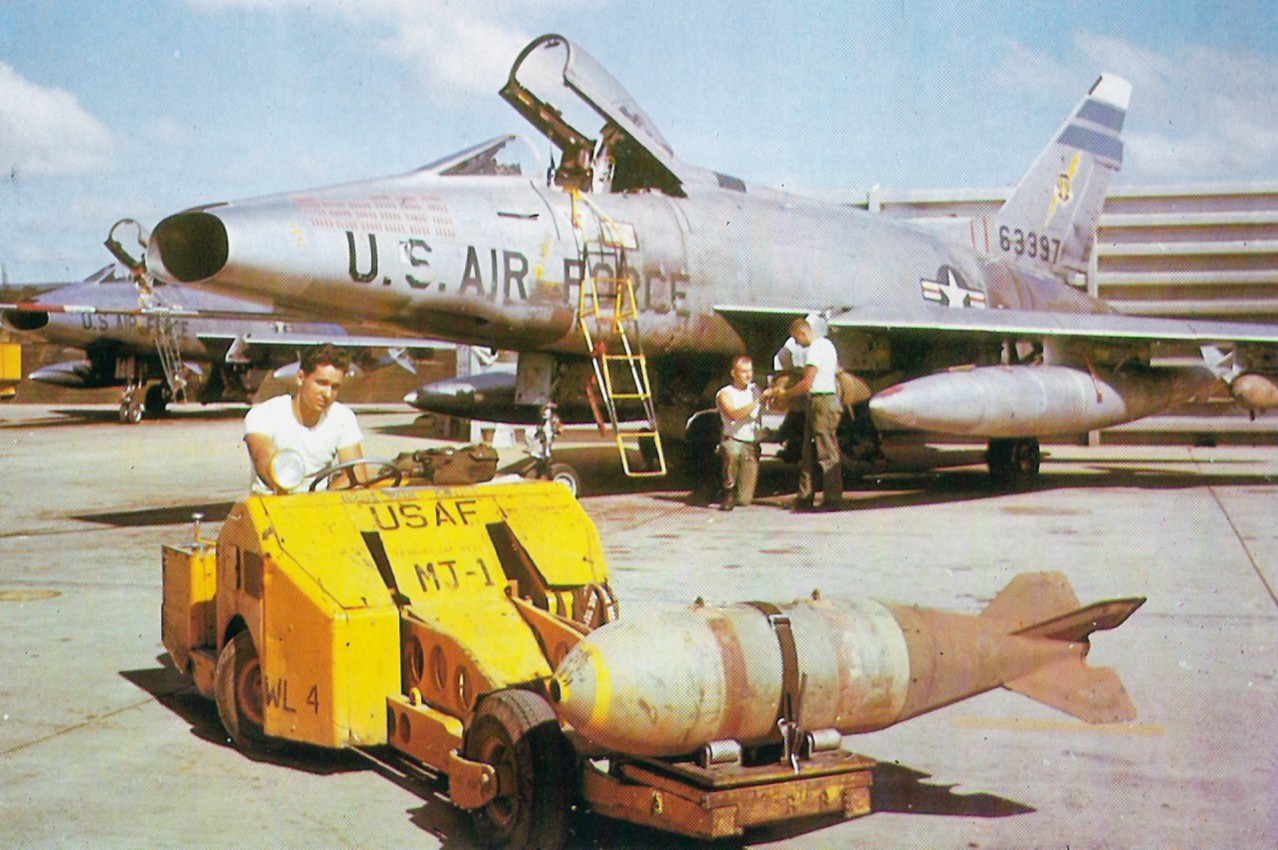
An F-100D of the 308th TFS, being loaded with Mk 117 750 lb bombs at Tuy Hoa, South Vietnam, in early 1966

History and use

[edit]

From the 1950s through the early 1970s the M117 was a standard aircraft weapon, carried by the F-100 Super Sabre, F-104 Starfighter, F-105 Thunderchief, B-57 Canberra, F-111, F-5, A-1 Skyraider, A-4 Skyhawk and F-4 Phantom. The M117 series was used extensively during the Vietnam War, and B-52G Stratofortress aircraft dropped 44,600 M117 and M117R bombs during Operation Desert Storm.[6][8]

The B-52 Stratofortress was the last American aircraft to use the bomb; tactical aircraft had mostly switched to using the Mark 80-series bombs, particularly the Mark 82 (500 pounds (227 kg)) or Mark 84 (2,000 pounds (907 kg)) bombs and their guided equivalents. On 26 June 2015, the last Mk 117 in PACAF inventory was dropped by a B-52H crew on an island near Andersen AFB, Guam.[9]

The Iranian Air Force modified the MIM-23 Hawk missiles with M117 bombs for its warheads due to a shortage of AGM-65 Maverick missiles during the Iran-Iraq war.[10]

In October 2023, during the Gaza war, the Israeli Air Force released images and footage showing F-16Is armed with M117 bombs, with a description suggesting that M117 bombs were used in airstrikes in the Gaza Strip. The bombs appear to be unguided, as there are no visible GPS-guided JDAM kits or laser-guidance kits installed.[4]

Variants

[edit]
M117A1
  • The M117A1 is essentially the same bomb as the M117 with the exception of the following components which have been removed: center lug, two spring washers utilized to hold the electrical fuzes in the nose and base and a ring receptacle lock utilized in the electrical fuze cable assembly.[5]
M117A1E1
M117A1E2
  • The M117A1E2 is identical to the M117A1 with the exception that the explosive filler Minol II(377 pounds (171 kg)) is used instead of Tritonal.[5] Minol II was used in an effort to offset the shortages of TNT in the late 1960s, however, problems developed during the storage of M117 bombs filled with Minol II, especially in hot, tropical areas which caused the explosive filler to expand and ooze or extrude through the joints of the bomb. While determined safe to handle, the extruded material required maintainers to clean the bombs before transportation or usage. The U.S. Navy refused to use M117 bombs with the Minol II filler citing, "Because of the proximity of crew quarters to the ships’ magazines where explosives are stored and the necessity of handling ordnance on rolling and pitching vessels, the Navy has regarded Minol II as being a potential hazard to the safety of its ships ’ crews and thus has not approved its use aboard ship."[11]
M117A1E3
M117A2
M117A3
M117D
  • "The M117D (D – Destructor) looks similar to the M117R but uses a magnetic influence fuze, which enables the bomb to function as a mine. The M117D is released in a high-drag configuration for a ground implant or shallow water mining. It detonates when an object passing near the bomb triggers the fuze."[6]
M117R
  • The M117R (R – Retarded) uses a special fin assembly providing either high-drag or low-drag release options. For low altitude deliveries, the tail assembly opens four large drag plates which rapidly slow the bomb and allow the aircraft to escape its blast.[6]
MC-1
  • The M117 was the basis of the MC-1 chemical warfare bomb, which had the body cavity filled with sarin nerve gas. The MC-1 was never used by the U.S. in combat and was eliminated from the U.S. stockpile in June, 2006.[7]

Tail Assemblies

[edit]
BSU-85/B
  • Air-inflatable retarder
BSU-93/B
  • Air-inflatable retarder
M131/M131A1
  • Early low-drag conical tail assembly utilized for high-altitude bomb drops.
MAU-91A/B
  • High-drag tail assembly utilized to drastically reduce the free-fall speed of the M117 and when utilized in low-level bombing, allowed bomber aircraft sufficient time to exit the blast area before bomb detonation. M117 bombs utilizing this style tail assembly were designated M117R.
MAU-103A/B
  • Low-drag conical tail assembly which began service with the M117 in the 1970s.[12]
[edit]

References

[edit]
[edit]
Revisions and contributorsEdit on WikipediaRead on Wikipedia
from Grokipedia
The M117 is a 750-pound nominal weight, high-explosive general-purpose demolition bomb, air-dropped from aircraft such as the B-52 Stratofortress, and utilized by military forces since its introduction in the mid-1950s. Containing approximately 403 pounds of or Minol-2 explosive filler, the unguided weapon features a steel casing designed for fragmentation and blast effects, with configurable options including nose, tail, proximity, or magnetic influence types for varied detonation modes. Variants such as the M117R incorporate retardation kits with drag plates for low-altitude toss-bombing deliveries, while the M117D variant functions as a ground-deployable destructor mine. The M117 saw extensive combat deployment during the , particularly in B-52 Arc Light missions from 1965 to 1973 and the Linebacker II campaign in December 1972, as well as in Operation Desert Storm in 1991, targeting infrastructure and troop concentrations through high-altitude free-fall or retarded drops. Its simple mechanical construction, lacking electronic guidance or fuses, facilitated and reliable performance in sustained bombing operations, though it required manual assembly and aerodynamic tail fins for stability. By 2016, remaining stockpiles were expended in training drops, marking the end of its service in the U.S. inventory as modern precision-guided munitions superseded unguided general-purpose bombs.

Design and Technical Specifications

Physical Dimensions and Construction

The M117 is a 750-pound (340 kg) general-purpose featuring a forged body designed to balance penetration, fragmentation, and blast effects. The casing is constructed from high-strength alloys, such as 1025 or 1035 variants, machined to form a cylindrical body with a conical and tapered aft section for aerodynamic integration with tail fins. The bomb body measures 16 inches (41 cm) in diameter, with a length of approximately 75 inches (191 cm) excluding fins, extending to 84 inches (213 cm) when equipped with the standard MAU-103 low-drag tail fin assembly. Total filled weight ranges from 799 to 826 pounds (362 to 375 kg), depending on exact explosive loading and minor manufacturing variations. The relatively thin-walled construction—typically around 0.25 to 0.5 inches thick in unmodified sections—prioritizes capacity over deep penetration, distinguishing it from armor-piercing designs. Suspension lugs are welded to the body for mounting, and the includes provisions for wells at the nose and tail, with the aft section threaded for attachment. This modular construction allows compatibility with various tail kits, including retarded variants for low-altitude delivery.

Warhead Composition and Explosive Yield

The warhead of the M117 bomb features a thin-walled forged casing designed to maximize internal volume for filler, prioritizing blast and demolition effects over fragmentation or penetration. The standard filler is , an mixture consisting of 80 percent trinitrotoluene (TNT) and 20 percent powdered aluminum, which augments the detonation's energy release through the aluminum's combustion, yielding greater air-blast overpressure compared to TNT alone. The total explosive weight is 386 pounds (175 kg). Certain production variants, including the M117A1E2, employed Minol II as an alternative filler to reduce costs, substituting for TNT while maintaining comparable blast performance; this resulted in a slightly lower filler weight of approximately 377 pounds (171 kg) due to differences. The configuration's design emphasizes high-order detonation for structural disruption, with empirical tests confirming its suitability as a substitute in series like the Mk 82. No publicly declassified data specifies a precise TNT-equivalent yield for the M117, though the aluminum augmentation typically increases effective blast energy by 10-30 percent over pure TNT masses of equivalent weight, depending on environmental factors like altitude and target medium.

Fuzing and Arming Systems

The M117 bomb utilizes mechanical impact fuzes installed in nose and/or tail positions to initiate detonation upon ground contact, with options for instantaneous or short-delay action to penetrate targets before exploding. Primary nose fuzes include the AN-M103A1, a vane-operated model that arms via airstream-driven rotation of an arming vane after release, providing selective instantaneous or delay functions after a safety interval. The M164 nose fuze, similarly mechanical and impact-activated, offers instantaneous detonation or a 0.01-second delay, with an explosive train for each mode and arming via wind-driven vane withdrawal of internal safeties. Arming mechanisms incorporate safety features to prevent premature , including arming wires threaded through components and aircraft racks; upon bomb release, the wire is retained by the rack, freeing the arming vane to spin in the airflow and progressively remove blocking pins or vanes after a mechanical delay calibrated for safe separation distance. This delay, typically seconds-long and adjustable via arming stem length or vane gearing, accounts for factors like release altitude, airspeed, and dive angle to ensure arming only post-drop. Tail fuzing, when employed for through-penetration or dual-fuze redundancy, follows analogous wind-vane arming but may integrate electric initiators in configurations using arming wires for release. Later service life saw compatibility with electronic fuzes like the FMU-139 series, which support nose or tail mounting on M117 bodies and provide programmable impact, delay, or point-initiating base-detonating modes via electronic safe-and-arm devices replacing mechanical vanes. These systems enhance reliability over mechanical predecessors but retain arming wire interfaces for aircraft integration, with internal accelerometers or environmental sensors ensuring arming only under free-fall conditions. Fuzing selection depends on mission profile, with studies recommending specific arming times—e.g., 2-5 seconds for low-drag M117 drops from medium altitudes—to minimize hang-fire risks.

Development and Variants

Origins and Initial Production

The M117 general-purpose bomb was developed by the United States Air Force in the early 1950s as a standardized aerial demolition munition optimized for jet-era delivery platforms. Its design emphasized a low-drag aerodynamic profile with a conical nose and tail fin assembly suitable for medium- and high-altitude drops, addressing limitations of World War II-era predecessors in terms of stability and terminal velocity. The bomb's steel casing housed approximately 385 pounds of TNT or equivalent high explosive, providing a balance of blast radius and fragmentation for unarmored targets such as structures, vehicles, and troop concentrations. Initial production commenced around 1951–1952 to support ongoing operations in the (1950–1953), where the M117 saw its first combat deployments from aircraft like the and early jet bombers. The weapon's introduction reflected causal priorities in munitions engineering: enhancing explosive yield per unit weight while minimizing aerodynamic drag to extend standoff range amid escalating air defense threats from Soviet-supplied systems. Production scaled rapidly through U.S. government arsenals and contractors, though exact quantities for the inaugural lots remain classified or undocumented in open sources; by the mid-1950s, stockpiles exceeded demands for Korea, enabling surplus for training and later conflicts. Early variants retained a basic arming and fuzing system compatible with mechanical or electrical detonators, prioritizing simplicity and reliability over advanced retardation for free-fall trajectories. This foundational configuration influenced subsequent modifications, such as blunt-nose adaptations tested in the early to improve penetration against hardened surfaces, underscoring the iterative nature of its production lineage.

Key Variants and Modifications

The primary modification to the M117 bomb involved adaptations to its tail fin assemblies to enable compatibility with varying release altitudes and velocities, particularly during low-level attacks in the era. The baseline M117 configuration retained a low-drag, conical tail fin optimized for medium- and high-altitude free-fall deliveries, originating from its initial production in the early . This design prioritized ballistic stability over retardation, with the fin providing minimal aerodynamic drag to achieve predictable trajectories from elevated release points. To address risks associated with and dive-bombing tactics, where aircraft operated at low altitudes and high speeds to evade ground fire, the M117R retarded variant was introduced. This modification incorporated high-drag retarding fin kits, such as the MAU-91/B "Snakeye" assembly, which featured deployable petals that extended post-release to decelerate the bomb, extending the time-of-fall by approximately 10-15 seconds and allowing the delivery aircraft to climb away from the detonation zone. The retardation mechanism reduced , minimizing premature ground impact while preserving the bomb's 750-pound explosive payload for area effects; testing confirmed effective performance from releases at Mach numbers up to 0.95. Over 100,000 M117R units were produced and deployed extensively from platforms like the F-4 Phantom and A-7 Corsair, with the fin kit interchangeable on existing M117 bodies. In the , further refinements included the MAU-103/A/B low-drag tail fin, which featured an increased span of 22 inches for enhanced stability in upgraded aircraft configurations, replacing earlier low-drag designs without altering the . This assembly maintained compatibility with the M117R designation when paired with retardation needs but emphasized streamlined for precision in non-retarded drops. Experimental modifications, such as the BLU-14/B with a blunt nose for improved penetration and resistance, were evaluated in the but did not enter widespread service as a distinct variant. These changes collectively extended the M117's operational lifespan into the late , with final U.S. disposals occurring in 2015.

Tail Fin and Deployment Configurations

The M117 bomb employs modular tail fin assemblies to adapt to diverse aerial delivery profiles, ensuring aerodynamic stability and controlled descent trajectories. The baseline configuration incorporates a low-drag, conical tail fin designed for medium- and high-altitude free-fall deployments, which minimizes aerodynamic resistance to achieve greater ballistic range and precision from elevated release points typical of strategic bombers like the B-52. This fin assembly, integral to the bomb's design since its introduction during the era, features streamlined vanes that promote straight-line flight paths post-release, with deployment occurring immediately upon separation from the aircraft's or external racks. In contrast, the M117R variant integrates a specialized high-drag tail fin for low-altitude tactical deliveries, such as dive-bombing or toss-bombing maneuvers executed by fighter-bombers including the F-100 and F-4 Phantom. This retarded configuration deploys folding or extended drag-inducing elements—often via assemblies like the MAU-91—to significantly slow the bomb's , providing the aircraft with additional time to egress the blast radius and reducing vulnerability to ground fire during low-level attacks. The retardation mechanism activates shortly after release, typically through pyrotechnic or mechanical deployment, altering the bomb's from approximately 0.2 in standard mode to over 1.0 in retarded mode, as inferred from comparative aerodynamics. Such adaptations were critical for operations, where low-altitude runs exposed pilots to intense anti-aircraft defenses. These tail fin options interface with standard suspension lugs and arming wires, compatible with multiple types via universal bomb racks, though deployment sequencing requires precise and altitude parameters—generally 200-400 knots and above 5,000 feet for low-drag, versus under 500 feet for retarded—to prevent premature instability or malfunctions. No guided tail kits were standard for the M117, preserving its , gravity-drop ethos, though evaluations noted the retarded fin's role in enhancing without compromising the 750-pound class payload's impact velocity.

Operational History and Employment

Korean War Introduction

The M117 bomb entered U.S. military service during the (1950–1953) as a 750-pound general-purpose unguided demolition weapon, designed for air-dropped employment against ground targets. Its basic configuration, featuring low-drag tail fins, supported deliveries from medium and high altitudes, which became increasingly necessary after the introduction of Soviet MiG-15 fighters in late 1950 compelled U.S. bombers to operate beyond effective enemy interceptor range. Primarily utilized by U.S. Air Force B-29 Superfortress heavy bombers and fighter-bombers such as the F-84 Thunderjet, the M117 provided enhanced blast effects relative to comparable-weight general-purpose bombs, prioritizing fragmentation and overpressure for demolishing infrastructure like bridges, rail lines, and troop concentrations. This aligned with the war's emphasis on campaigns, where U.S. forces expended hundreds of thousands of tons of ordnance to disrupt North Korean and Chinese supply routes following the Chinese intervention in October 1950. Initial production and fielding occurred in the early , transitioning from II-era stockpiles to address demands for more reliable high-altitude ordnance amid evolving tactical requirements.

Vietnam War Applications

The M117 bomb saw extensive employment by aircraft during the , functioning as a versatile general-purpose demolition weapon in both tactical and strategic saturation bombing operations. Introduced to Vietnam theater operations from its prior service, the bomb was delivered from high-altitude strategic bombers and low-level fighter-bombers alike, targeting enemy troop concentrations, supply routes, and infrastructure from 1965 onward. In tactical roles, the M117 was a primary ordnance for fighter-bombers conducting and armed under , which began on March 2, 1965, and continued intermittently until October 1968. The , operating from bases in , frequently carried loads of up to six M117 bombs per sortie, employing the standard low-drag configuration for medium- and high-altitude drops against North Vietnamese military targets such as bridges, barracks, and logistics depots. The retarded M117R variant, featuring a tail braking for low-altitude toss or dive-bombing deliveries, enhanced accuracy and survivability in contested , allowing pilots to evade ground fire during release. Strategically, B-52 Stratofortress bombers utilized the M117 in massive Arc Light missions, initiating on June 18, 1965, with saturation strikes against suspected base areas in . A single B-52F could release strings of up to 51 M117 bombs from its internal bays during high-altitude runs, contributing to the disruption of enemy sanctuaries and infiltration routes along the . These operations escalated in 1966-1968, with B-52s flying thousands of sorties that integrated M117 drops alongside other munitions to achieve area denial effects through blast and fragmentation. The bomb's deployment persisted into later phases, including Operations Linebacker I and II in 1972, where it supported renewed bombing of to interdict supplies and compel negotiations, demonstrating its enduring utility despite the introduction of precision-guided alternatives. Overall, the M117's reliability in varied delivery profiles and fuzing options—such as impact, delay, or proximity settings—made it a staple for achieving destructive effects against hardened and dispersed targets, though its unguided nature limited precision in urban or defended areas.

Later Conflicts and Training Uses

The M117 bomb saw limited operational deployment in the Persian Gulf War of 1991, where B-52G Stratofortress aircraft loaded clusters of the 750-pound general-purpose munitions for bombing missions against Iraqi targets, leveraging their blast and fragmentation effects for area suppression. These sorties contributed to the coalition's strategic air campaign under Operation Desert Storm, though precision-guided alternatives increasingly supplanted unguided bombs like the M117 in subsequent phases. Post-Gulf War, the M117 remained in U.S. inventories primarily for purposes, simulating conventional bombing tactics with live ordnance drops to maintain crew proficiency in high-altitude delivery and retarded configurations. By the mid-2010s, as stocks dwindled amid modernization efforts favoring guided munitions, the service conducted final disposals through operational exercises; on July 7, 2015, a B-52H from the 20th Expeditionary Bomb Squadron expended the last serviceable M117 in stocks during a drop off Guam's coast, coordinated with munitions specialists from the 36th Munitions Squadron. Similar depletions occurred at in 2016, where remaining units were assembled and expended by B-52s to clear legacy stockpiles while fulfilling requirements. These activities marked the effective of the M117 from active U.S. military use, with no verified deployments in later conflicts such as Operations Enduring Freedom or Iraqi Freedom.

Military Effectiveness and Tactical Analysis

Blast Effects and Target Destruction

The M117 bomb employs a high-explosive fill of , a composition of 80% trinitrotoluene (TNT) and 20% aluminum powder, which enhances and blast energy compared to pure TNT. This fill, comprising a substantial portion of the bomb's 750-pound total weight, generates a supersonic upon , characterized by peak overpressures that diminish with distance according to inverse cube scaling in the far field. The thin casing, optimized for rupture rather than penetration, fragments into high-velocity shrapnel, combining blast and secondary effects to maximize area coverage against surface targets. In target destruction, the primary blast inflicts structural damage through dynamic , capable of collapsing unreinforced and within proximity to the point, while the reflected wave off surfaces amplifies in confined environments. Fragmentation extends the effective casualty zone, with pieces traveling at velocities exceeding 1,000 meters per second, penetrating and light armor. Empirical tests demonstrate the M117's efficacy in cratering and asphalt, forming depressions approximately 10-20 feet in diameter depending on soil density and impact angle, thereby disrupting routes and revetments. The design prioritizes blast over deep burial, rendering it suitable for demolishing above-ground installations like warehouses, vehicles, and troop concentrations, though effectiveness diminishes against hardened underground facilities.

Comparative Performance Against Alternatives

The M117 bomb, weighing approximately 750 pounds with a design optimized for through a relatively thin casing, prioritized and structural disruption over fragmentation or deep penetration, distinguishing it from balanced general-purpose alternatives like the Mk 82 (500 pounds). This configuration allowed for a higher explosive-to-total-weight , enhancing its effectiveness against semi-hardened targets such as wooden bridges, dumps, and earthen bunkers common in scenarios, where the blast wave could propagate further in low-density environments compared to the Mk 82's more contained effects suited to troop suppression. In operational terms, the M117's greater per-unit yield reduced the number of sorties required for target neutralization relative to lighter bombs, though aircraft like the F-100 or B-52 could carry twice as many Mk 82s (e.g., 84 versus 42), favoring the smaller variant for saturation bombing of dispersed enemy positions. Against heavier general-purpose bombs such as the Mk 83 (1,000 pounds) or Mk 84 (2,000 pounds), the M117 traded raw explosive mass for versatility in medium-altitude, delivery from tactical fighters, maintaining ballistic stability with low-drag fins while avoiding the excessive overkill and reduced counts associated with larger ordnance on the same platforms. Penetration tests indicated the M117's nose design supported and moderate burial for delayed fuzing, adequate for unfortified revetments but inferior to thicker-cased Mk 84 variants against , where the latter's increased momentum and fill enabled deeper burial and higher shock transmission. In comparison to non-general-purpose alternatives like cluster dispensers (e.g., CBU series) or incendiaries prevalent in , the M117 excelled in predictable, single-point for precise , minimizing dud rates in contested while delivering omnidirectional blast without reliance on submunition dispersion, which risked incomplete coverage against mobile or concealed forces; however, clusters provided superior area- against personnel over 1-2 acres, rendering the M117 less optimal for ambushes but preferable for chokepoint . Empirical assessments from operations underscored this: 750-pound class bombs like the M117 achieved higher confirmed target destruction rates per strike on logistic nodes than 500-pound equivalents, albeit at higher collateral in fragmented due to uncontained blast .

Strategic Contributions to U.S. Objectives

The M117 bomb played a pivotal role in U.S. efforts during the , where its deployment from medium and high-altitude platforms targeted enemy supply lines, bridges, rail yards, and troop concentrations to disrupt North Korean and Chinese logistics. By increasing the cost of enemy offensives through sustained attacks on infrastructure, such as the Wonsan marshalling yard, the M117 supported broader strategic objectives of punishing aggression and stabilizing front lines after initial setbacks in 1950, contributing to the eventual by weakening the communist forces' sustainment capabilities. In the , the M117's extensive use—totaling thousands of tons dropped by B-52 Stratofortress bombers and tactical aircraft—advanced U.S. goals of attrition and graduated pressure on by interdicting the and destroying war-sustaining infrastructure, thereby reducing infiltration rates of personnel and materiel into . During (1965–1968), over 500,000 tons of munitions, including M117 general-purpose bombs, were expended across more than 500,000 sorties to target supply routes and limit enemy reinforcement, aligning with strategies aimed at compelling to negotiate and halt support for the southern insurgency. Logistical adaptations, such as Project Special Express initiated on October 15, 1965, ensured M117 availability despite early shortages that canceled 367 by April 1966, enabling high sortie rates (e.g., 13,000 in December 1965) and 148,751 tons of munitions dropped that year to sustain pressure. This contributed to strategic aims by eroding North Vietnamese morale and , as evidenced by operational reports linking bombing to reduced enemy operational tempo, though political restrictions and enemy countermeasures limited overall decisiveness. In later applications, such as (December 18–29, 1972), M117 variants supported intensified bombing that pressured toward the by targeting remaining military assets, demonstrating the bomb's enduring utility in achieving escalation-for-deescalation objectives despite evolving threats.

Controversies, Criticisms, and Rebuttals

Claims of Excessive Civilian Harm

Critics of the U.S. aerial bombardment during the , particularly anti-war activists and segments of the international community, have alleged that general-purpose bombs like the M117, deployed against military and infrastructure targets, resulted in disproportionate civilian harm due to inaccuracies inherent in free-fall delivery amid North Vietnamese tactics of co-locating forces with populated areas. These claims often frame the overall bombing campaigns, such as (1965–1968), as indiscriminate, with the M117's 750-pound explosive fill contributing to blast radii that extended into civilian zones when targeting roads, bridges, and supply depots near villages. Declassified CIA assessments indicate that bombing in caused approximately 6,000 civilian casualties in 1965 alone, rising to about 11,900 in the first nine months of 1966, though these figures encompass all ordnance types and do not isolate M117-specific impacts. Such allegations gained traction through North Vietnamese state media and Western reporting, which portrayed U.S. strikes as terror bombing, citing instances where errant or fragmented munitions struck non-combatants; however, specific documented incidents directly attributing excessive deaths to M117 deployments remain limited, with broader estimates placing total North Vietnamese civilian fatalities from U.S. air operations between 30,000 and 65,000 over the war. Military historians have noted that the bomb's widespread use—phased in from the era and employed by aircraft like the F-105 Thunderchief—exacerbated perceptions of overkill, especially as pilots faced electronic warfare interference reducing delivery precision to margins exceeding 100 meters in contested environments. These critiques, echoed in analyses, contend that alternatives like precision-guided munitions, unavailable at scale until later conflicts, could have mitigated collateral effects, though contemporaneous technology constraints and enemy air defenses are acknowledged by some sources as complicating factors. Attribution of excessiveness often relies on aggregated data rather than granular M117 incident logs, with claims amplified by outlets sympathetic to Hanoi narratives; for instance, a 1967 New York Times report highlighted discrepancies in casualty reporting, where North Vietnamese figures emphasized civilian tolls to underscore alleged U.S. brutality. Empirical reviews, including those from U.S. defense retrospectives, reveal that while the M117 was a staple in tactical strikes, its role in civilian harm was intertwined with strategic necessities like interdicting the , where civilian porters and infiltrators blurred combatant lines, prompting assertions from detractors that the bomb's area-effect lethality inherently favored quantity over discrimination.

Specific Incident Analyses

During , from December 18 to 29, 1972, U.S. B-52 Stratofortress bombers, operating primarily from bases in and , conducted intensive raids on military and industrial targets in and , , dropping over 15,000 tons of ordnance, including significant quantities of M117 general-purpose bombs configured for high-altitude radar-directed delivery. The campaign aimed to disrupt North Vietnamese logistics, air defenses, and command infrastructure to compel concessions in stalled Paris peace talks, with M117 bombs selected for their blast and fragmentation effects against hardened surface targets like rail yards, power plants, and SAM sites. B-52 crews flew 729 sorties, releasing strings of up to 108 M117s per aircraft in area-saturation patterns to compensate for blind radar bombing amid poor weather and heavy antiaircraft defenses. North Vietnamese authorities reported 1,624 total deaths, including 1,318 civilians in alone, attributing widespread destruction to indiscriminate bombing, though these figures originate from state-controlled sources potentially inflated for purposes and do not differentiate between and losses or account for interspersed assets in urban zones. U.S. assessments emphasized precise target nomination via intelligence, with over 90% of strikes hitting objectives, and civilian casualties resulting from North 's tactic of colocating defenses—such as SAM batteries and installations—near populated areas to exploit for political leverage. Empirical analysis of assessments post-mission confirmed high destruction of intended , like the Yen Vien and Gia Lam airfield, with M117 fragmentation patterns effective against dispersed enemy positions, though inaccuracies from offsets (up to 1,000 meters) contributed to fringe impacts. A notable sub-incident occurred on December 22, 1972, when B-52s targeting Bach Mai airfield— a key military hub hosting MiG operations and logistics—unintentionally struck the adjacent Bach Mai Hospital with over 100 bombs, killing 28 staff and an undetermined number of patients. U.S. investigations concluded the hospital was not a designated target, attributing the deviation to navigational errors in bombing and the facility's proximity (under 1 km) to the airfield, which North Vietnamese forces had not evacuated despite prior warnings. Critics, including anti-war groups, cited this as evidence of disproportionate force, but military reviews upheld the strike's legality under , noting the airfield's valid military value outweighed foreseeable collateral given evacuation opportunities and the absence of human shields prohibitions in customary at the time. The M117's 750-pound explosive fill amplified in the error zone, yet comparative data from prior Rolling Thunder operations showed similar unguided munitions yielded lower per-tonne civilian impact when targets were urban-integrated. Overall, Linebacker II's employment of M117 bombs achieved strategic disruption—destroying 70% of Hanoi's and forcing back to negotiations—while civilian harm, though tragic, aligned with the causal realities of 1970s-era unguided bombing against a defender leveraging for protection, rather than deliberate targeting. Independent post-war analyses, discounting biased North Vietnamese tallies, estimate civilian deaths at under 1,000 for the campaign, a fraction relative to the 20,000+ tons delivered and far below exaggerated claims, underscoring the operation's restraint compared to precedents like WWII . No evidence supports systemic overuse of M117 for punitive ends; instead, its selection reflected doctrinal emphasis on maximizing effect with available , rebutting narratives of excess by highlighting verified target efficacy and minimal deviation from proportionality principles.

Defense of Proportionality and Necessity

The employment of the M117 750-pound fulfilled by enabling precise of North Vietnamese logistics, including truck convoys, supply depots, and bridges along the , thereby disrupting enemy sustainment without the higher human costs associated with expanded ground offensives. U.S. assessments, such as those from the CIA, documented that air campaigns utilizing such ordnance cumulatively constrained North Vietnam's offensive capabilities by destroying , with over 15,000 tons of bombs dropped in targeted operations like Linebacker II alone achieving measurable degradation of military assets. This aligned with doctrinal principles permitting regulated force essential for mission accomplishment, as the M117's blast and fragmentation effects proved effective against hardened and mobile targets, outperforming alternatives in efficiency during constraints like the 1966 bomb shortages. Proportionality was maintained, per U.S. Department of Defense assertions, through adherence to rules of engagement that restricted strikes to legitimate military objectives, ensuring expected incidental civilian harm remained incidental to the anticipated advantages of severing enemy supply lines vital to sustaining invasions of South Vietnam. In Linebacker II (December 18–29, 1972), B-52 Stratofortress drops of M117 bombs on Hanoi and Haiphong infrastructure exemplified this balance, with minimized collateral damage relative to the operation's intensity—dropping 20,000 tons of ordnance—yielding strategic coercion that prompted negotiations while avoiding broader area bombardment. Empirical reviews confirmed the campaign's compliance with just war proportionality, as civilian casualties, estimated at 1,624 despite urban proximity, were proportionate to the destruction of war-sustaining industries and air defenses that had previously enabled North Vietnamese aggression. Defenders further contended that alternatives, such as cluster munitions or escalated infantry assaults, would have amplified both and civilian risks given the era's targeting inaccuracies, whereas the M117's design facilitated controlled demolition yielding high kill rates on without necessitating occupation of contested terrain. Post-operation data underscored necessity by linking successes to reduced enemy infiltration rates, validating the bomb's role in achieving U.S. objectives like bolstering South Vietnamese defenses amid political constraints on escalation.

References

Add your contribution
Related Hubs
User Avatar
No comments yet.