
Recent from talks
Gulf War
Knowledge base stats:
Talk channels stats:
Members stats:
Gulf War
The Gulf War was an armed conflict between Iraq and a 42-country coalition led by the United States. The coalition's efforts against Iraq were carried out in two key phases: Operation Desert Shield, which marked the military buildup from August 1990 to January 1991; and Operation Desert Storm, which began with the aerial bombing campaign against Iraq on 17 January 1991 and came to a close with the American-led liberation of Kuwait on 28 February 1991.
On 2 August 1990, Iraq, governed by Saddam Hussein, invaded neighboring Kuwait and fully occupied the country within two days. The invasion was primarily over disputes regarding Kuwait's alleged slant drilling in Iraq's Rumaila oil field, as well as to cancel Iraq's large debt to Kuwait from the recently ended Iran-Iraq War. After Iraq briefly occupied Kuwait under a rump puppet government known as the Republic of Kuwait, it split Kuwait's sovereign territory into the Saddamiyat al-Mitla' District in the north, which was absorbed into Iraq's existing Basra Governorate, and the Kuwait Governorate in the south, which became Iraq's 19th governorate.
The invasion of Kuwait was met with immediate international condemnation, including the adoption of UN Security Council Resolution 660, which demanded Iraq's immediate withdrawal from Kuwait, and the imposition of comprehensive international sanctions against Iraq with the adoption of UN Security Council Resolution 661. British prime minister Margaret Thatcher and US president George H. W. Bush deployed troops and equipment into Saudi Arabia and urged other countries to send their own forces. Many countries joined the American-led coalition forming the largest military alliance since World War II. The bulk of the coalition's military power was from the United States, with Saudi Arabia, the United Kingdom, and Egypt as the largest lead-up contributors, in that order.
United Nations Security Council Resolution 678, adopted on 29 November 1990, gave Iraq an ultimatum, expiring on 15 January 1991, to implement Resolution 660 and withdraw from Kuwait, with member-states empowered to use "all necessary means" to force Iraq's compliance. Initial efforts to dislodge the Iraqis from Kuwait began with aerial and naval bombardment of Iraq on 17 January, which continued for five weeks. As the Iraqi military struggled against the coalition attacks, Iraq fired missiles at Israel to provoke an Israeli military response, with the expectation that such a response would lead to the withdrawal of several Muslim-majority countries from the coalition. The provocation was unsuccessful; Israel did not retaliate and Iraq continued to remain at odds with most Muslim-majority countries. Iraqi missile barrages against coalition targets in Saudi Arabia were also largely unsuccessful, and on 24 February 1991, the coalition launched a major ground assault into Iraqi-occupied Kuwait. The offensive was a decisive victory for the coalition, who liberated Kuwait and promptly began to advance past the Iraq–Kuwait border into Iraqi territory. A hundred hours after the beginning of the ground campaign, the coalition ceased its advance into Iraq and declared a ceasefire. Aerial and ground combat was confined to Iraq, Kuwait, and areas straddling the Iraq–Saudi Arabia border.
The conflict marked the introduction of live news broadcasts from the front lines of the battle, principally by the American network CNN. It has also earned the nickname Video Game War, after the daily broadcast of images from cameras onboard American military aircraft during Operation Desert Storm. The Gulf War has also gained fame for some of the largest tank battles in American military history: the Battle of Medina Ridge, the Battle of Norfolk, and the Battle of 73 Easting.
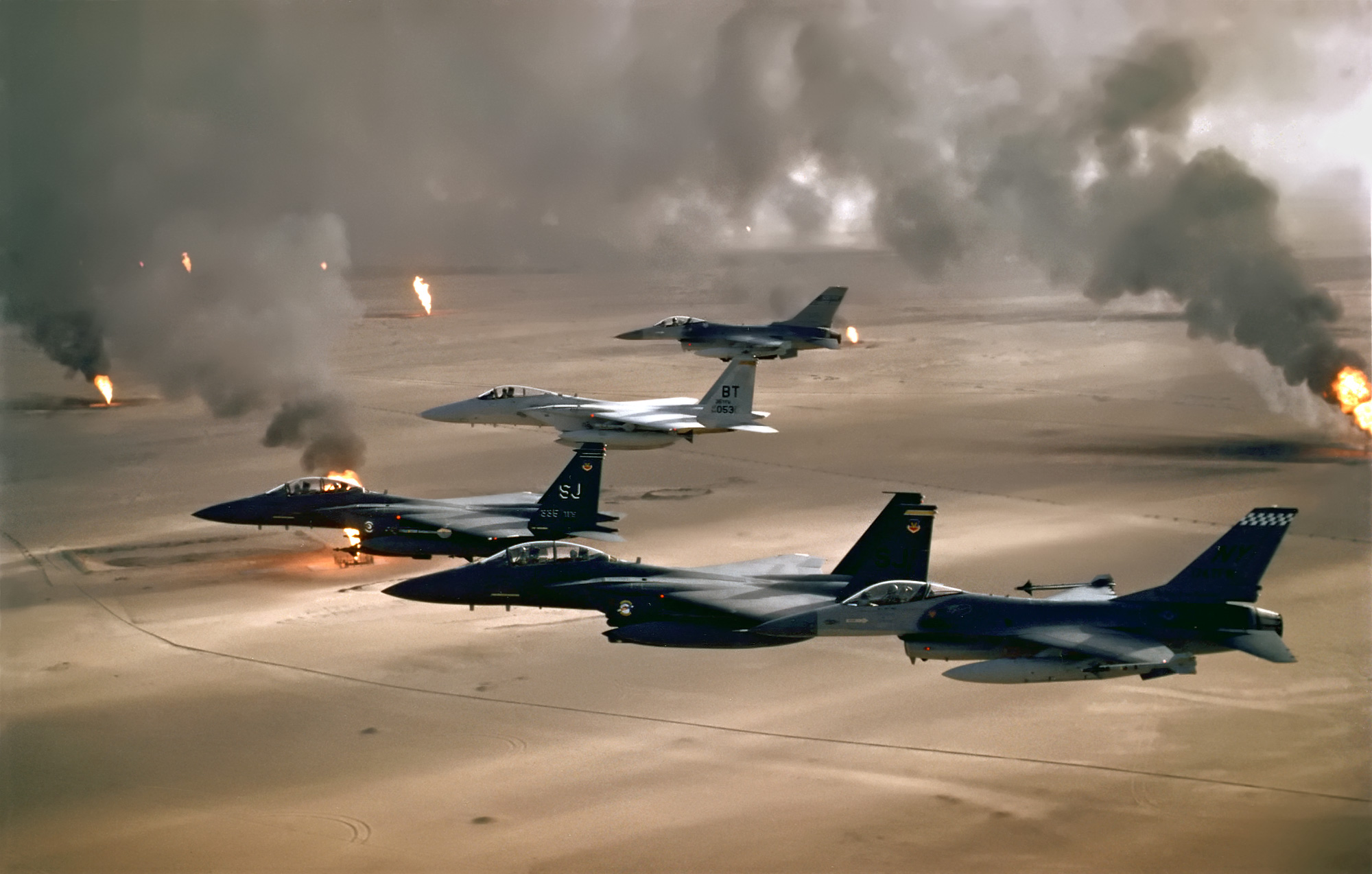
The conflict's environmental impact included Iraqi forces causing over six hundred oil well fires and the largest oil spill in history until that point. US bombing and post-war demolition of Iraqi chemical weapons facilities were concluded to be the primary cause of Gulf War syndrome, experienced by over 40% of US veterans.
The war is also known under other names, such as the Second Gulf War (not to be confused with the 2003 Iraq War, also referred to as such), Persian Gulf War, Kuwait War, or Iraq War before the term "Iraq War" became identified with the 2003 Iraq War (also known in the US as "Operation Iraqi Freedom"). The war was named Umm al-Ma'arik ("mother of all battles") by Iraqi officials. After the US invasion of Iraq in 2003, the Gulf War of 1990–1991 is often known as the "First Iraq War".
The following names have been used to describe the conflict itself: Gulf War and Persian Gulf War are the most common terms for the conflict used within western countries, though it may also be called the First Gulf War (to distinguish it from the 2003 invasion of Iraq and the subsequent Iraq War). Some authors have called it the Second Gulf War to distinguish it from the Iran–Iraq War. Liberation of Kuwait (Arabic: تحرير الكويت) (taḥrīr al-kuwayt) is the term used by Kuwait and most of the coalition's Arab states, including Saudi Arabia, Bahrain, Egypt, and the United Arab Emirates. Terms in other languages include French: la Guerre du Golfe and Guerre du Koweït (War of Kuwait); German: Golfkrieg (Gulf War) and Zweiter Golfkrieg (Second Gulf War).[citation needed]
Hub AI
Gulf War AI simulator
(@Gulf War_simulator)
Gulf War
The Gulf War was an armed conflict between Iraq and a 42-country coalition led by the United States. The coalition's efforts against Iraq were carried out in two key phases: Operation Desert Shield, which marked the military buildup from August 1990 to January 1991; and Operation Desert Storm, which began with the aerial bombing campaign against Iraq on 17 January 1991 and came to a close with the American-led liberation of Kuwait on 28 February 1991.
On 2 August 1990, Iraq, governed by Saddam Hussein, invaded neighboring Kuwait and fully occupied the country within two days. The invasion was primarily over disputes regarding Kuwait's alleged slant drilling in Iraq's Rumaila oil field, as well as to cancel Iraq's large debt to Kuwait from the recently ended Iran-Iraq War. After Iraq briefly occupied Kuwait under a rump puppet government known as the Republic of Kuwait, it split Kuwait's sovereign territory into the Saddamiyat al-Mitla' District in the north, which was absorbed into Iraq's existing Basra Governorate, and the Kuwait Governorate in the south, which became Iraq's 19th governorate.
The invasion of Kuwait was met with immediate international condemnation, including the adoption of UN Security Council Resolution 660, which demanded Iraq's immediate withdrawal from Kuwait, and the imposition of comprehensive international sanctions against Iraq with the adoption of UN Security Council Resolution 661. British prime minister Margaret Thatcher and US president George H. W. Bush deployed troops and equipment into Saudi Arabia and urged other countries to send their own forces. Many countries joined the American-led coalition forming the largest military alliance since World War II. The bulk of the coalition's military power was from the United States, with Saudi Arabia, the United Kingdom, and Egypt as the largest lead-up contributors, in that order.
United Nations Security Council Resolution 678, adopted on 29 November 1990, gave Iraq an ultimatum, expiring on 15 January 1991, to implement Resolution 660 and withdraw from Kuwait, with member-states empowered to use "all necessary means" to force Iraq's compliance. Initial efforts to dislodge the Iraqis from Kuwait began with aerial and naval bombardment of Iraq on 17 January, which continued for five weeks. As the Iraqi military struggled against the coalition attacks, Iraq fired missiles at Israel to provoke an Israeli military response, with the expectation that such a response would lead to the withdrawal of several Muslim-majority countries from the coalition. The provocation was unsuccessful; Israel did not retaliate and Iraq continued to remain at odds with most Muslim-majority countries. Iraqi missile barrages against coalition targets in Saudi Arabia were also largely unsuccessful, and on 24 February 1991, the coalition launched a major ground assault into Iraqi-occupied Kuwait. The offensive was a decisive victory for the coalition, who liberated Kuwait and promptly began to advance past the Iraq–Kuwait border into Iraqi territory. A hundred hours after the beginning of the ground campaign, the coalition ceased its advance into Iraq and declared a ceasefire. Aerial and ground combat was confined to Iraq, Kuwait, and areas straddling the Iraq–Saudi Arabia border.
The conflict marked the introduction of live news broadcasts from the front lines of the battle, principally by the American network CNN. It has also earned the nickname Video Game War, after the daily broadcast of images from cameras onboard American military aircraft during Operation Desert Storm. The Gulf War has also gained fame for some of the largest tank battles in American military history: the Battle of Medina Ridge, the Battle of Norfolk, and the Battle of 73 Easting.
The conflict's environmental impact included Iraqi forces causing over six hundred oil well fires and the largest oil spill in history until that point. US bombing and post-war demolition of Iraqi chemical weapons facilities were concluded to be the primary cause of Gulf War syndrome, experienced by over 40% of US veterans.
The war is also known under other names, such as the Second Gulf War (not to be confused with the 2003 Iraq War, also referred to as such), Persian Gulf War, Kuwait War, or Iraq War before the term "Iraq War" became identified with the 2003 Iraq War (also known in the US as "Operation Iraqi Freedom"). The war was named Umm al-Ma'arik ("mother of all battles") by Iraqi officials. After the US invasion of Iraq in 2003, the Gulf War of 1990–1991 is often known as the "First Iraq War".
The following names have been used to describe the conflict itself: Gulf War and Persian Gulf War are the most common terms for the conflict used within western countries, though it may also be called the First Gulf War (to distinguish it from the 2003 invasion of Iraq and the subsequent Iraq War). Some authors have called it the Second Gulf War to distinguish it from the Iran–Iraq War. Liberation of Kuwait (Arabic: تحرير الكويت) (taḥrīr al-kuwayt) is the term used by Kuwait and most of the coalition's Arab states, including Saudi Arabia, Bahrain, Egypt, and the United Arab Emirates. Terms in other languages include French: la Guerre du Golfe and Guerre du Koweït (War of Kuwait); German: Golfkrieg (Gulf War) and Zweiter Golfkrieg (Second Gulf War).[citation needed]
Recent media