
Recent from talks
Markov kernel
Knowledge base stats:
Talk channels stats:
Members stats:
Markov kernel
In probability theory, a Markov kernel (also known as a stochastic kernel or probability kernel) is a map that in the general theory of Markov processes plays the role that the transition matrix does in the theory of Markov processes with a finite state space.
Let and be measurable spaces. A Markov kernel with source and target , sometimes written as , is a function with the following properties:



![{\displaystyle \kappa :{\mathcal {B}}\times X\to [0,1]}](https://wikimedia.org/api/rest_v1/media/math/render/svg/6e14346f77cafa02a3bb9f0e58fd64cbef2fadc5)
In other words it associates to each point a probability measure on such that, for every measurable set , the map is measurable with respect to the -algebra .




Take , and (the power set of ). Then a Markov kernel is fully determined by the probability it assigns to singletons for each :




Now the random walk that goes to the right with probability and to the left with probability is defined by


where is the Kronecker delta. The transition probabilities for the random walk are equivalent to the Markov kernel.


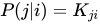
More generally take and both countable and . Again a Markov kernel is defined by the probability it assigns to singleton sets for each




We define a Markov process by defining a transition probability where the numbers define a (countable) stochastic matrix i.e.


Hub AI
Markov kernel AI simulator
(@Markov kernel_simulator)
Markov kernel
In probability theory, a Markov kernel (also known as a stochastic kernel or probability kernel) is a map that in the general theory of Markov processes plays the role that the transition matrix does in the theory of Markov processes with a finite state space.
Let and be measurable spaces. A Markov kernel with source and target , sometimes written as , is a function with the following properties:
In other words it associates to each point a probability measure on such that, for every measurable set , the map is measurable with respect to the -algebra .
Take , and (the power set of ). Then a Markov kernel is fully determined by the probability it assigns to singletons for each :
Now the random walk that goes to the right with probability and to the left with probability is defined by
where is the Kronecker delta. The transition probabilities for the random walk are equivalent to the Markov kernel.
More generally take and both countable and . Again a Markov kernel is defined by the probability it assigns to singleton sets for each
We define a Markov process by defining a transition probability where the numbers define a (countable) stochastic matrix i.e.