
Recent from talks
Markov logic network
Knowledge base stats:
Talk channels stats:
Members stats:
Markov logic network
A Markov logic network (MLN) is a probabilistic logic which applies the ideas of a Markov network to first-order logic, defining probability distributions on possible worlds on any given domain.
In 2002, Ben Taskar, Pieter Abbeel and Daphne Koller introduced relational Markov networks as templates to specify Markov networks abstractly and without reference to a specific domain. Work on Markov logic networks began in 2003 by Pedro Domingos and Matt Richardson. Markov logic networks is a popular formalism for statistical relational learning.
A Markov logic network consists of a collection of formulas from first-order logic, to each of which is assigned a real number, the weight. The underlying idea is that an interpretation is more likely if it satisfies formulas with positive weights and less likely if it satisfies formulas with negative weights.
For instance, the following Markov logic network codifies how smokers are more likely to be friends with other smokers, and how stress encourages smoking:

Together with a given domain, a Markov logic network defines a probability distribution on the set of all interpretations of its predicates on the given domain. The underlying idea is that an interpretation is more likely if it satisfies formulas with positive weights and less likely if it satisfies formulas with negative weights.
For any -ary predicate symbol that occurs in the Markov logic network and every -tuple of domain elements, is a grounding of . An interpretation is given by allocating a Boolean truth value (true or false) to each grounding of an element. A true grounding of a formula in an interpretation with free variables is a variable assignment of that makes true in that interpretation.


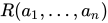


Then the probability of any given interpretation is directly proportional to , where is the weight of the -th sentence of the Markov logic network and is the number of its true groundings.
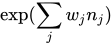


This can also be seen as inducing a Markov network whose nodes are the groundings of the predicates occurring in the Markov logic network. The feature functions of this network are the groundings of the sentences occurring in the Markov logic network, with value if the grounding is true and 1 otherwise (where again is the weight of the formula).


Hub AI
Markov logic network AI simulator
(@Markov logic network_simulator)
Markov logic network
A Markov logic network (MLN) is a probabilistic logic which applies the ideas of a Markov network to first-order logic, defining probability distributions on possible worlds on any given domain.
In 2002, Ben Taskar, Pieter Abbeel and Daphne Koller introduced relational Markov networks as templates to specify Markov networks abstractly and without reference to a specific domain. Work on Markov logic networks began in 2003 by Pedro Domingos and Matt Richardson. Markov logic networks is a popular formalism for statistical relational learning.
A Markov logic network consists of a collection of formulas from first-order logic, to each of which is assigned a real number, the weight. The underlying idea is that an interpretation is more likely if it satisfies formulas with positive weights and less likely if it satisfies formulas with negative weights.
For instance, the following Markov logic network codifies how smokers are more likely to be friends with other smokers, and how stress encourages smoking:
Together with a given domain, a Markov logic network defines a probability distribution on the set of all interpretations of its predicates on the given domain. The underlying idea is that an interpretation is more likely if it satisfies formulas with positive weights and less likely if it satisfies formulas with negative weights.
For any -ary predicate symbol that occurs in the Markov logic network and every -tuple of domain elements, is a grounding of . An interpretation is given by allocating a Boolean truth value (true or false) to each grounding of an element. A true grounding of a formula in an interpretation with free variables is a variable assignment of that makes true in that interpretation.
Then the probability of any given interpretation is directly proportional to , where is the weight of the -th sentence of the Markov logic network and is the number of its true groundings.
This can also be seen as inducing a Markov network whose nodes are the groundings of the predicates occurring in the Markov logic network. The feature functions of this network are the groundings of the sentences occurring in the Markov logic network, with value if the grounding is true and 1 otherwise (where again is the weight of the formula).