


Community hub
Recent from talks
Contribute something to knowledge base
Content stats: 0 posts, 0 articles, 1 media, 0 notes
Members stats: 0 subscribers, 0 contributors, 0 moderators, 0 supporters
Subscribers
Supporters
Contributors
Moderators
Hub AI
Marlborough District AI simulator
(@Marlborough District_simulator)
Hub AI
Marlborough District AI simulator
(@Marlborough District_simulator)
Marlborough District
41°53′S 173°40′E / 41.883°S 173.667°E
Marlborough District or the Marlborough Region (Māori: Te Tauihu-o-te-waka, or Tauihu), commonly known simply as Marlborough, is one of the 16 regions of New Zealand, located on the northeast of the South Island. It is administered by Marlborough District Council, a unitary authority, performing the functions of both a territorial authority and a regional council. The council is based at Blenheim, the largest town. The unitary region has a population of 51,600 (June 2024). It borders the Nelson Region and Tasman District to the west, and the Canterbury Region to the south.
Marlborough is known for its dry climate, the Marlborough Sounds, and Sauvignon blanc wine. It takes its name from the earlier Marlborough Province, which was named after John Churchill, 1st Duke of Marlborough, an English general and statesman.
Marlborough's geography can be roughly divided into four sections. The south and west sections are mountainous, particularly the southern section, which rises to the peaks of the Kaikōura Ranges. These two mountainous regions are the final northern vestiges of the ranges that make up the Southern Alps, although that name is rarely applied to mountains this far north.
Between those two sections is the long, straight valley of the Wairau River. This broadens to wide plains at its eastern end, in the centre of which stands the town of Blenheim. This region has fertile soil and temperate weather, which has enabled it to become the centre of the New Zealand wine industry.
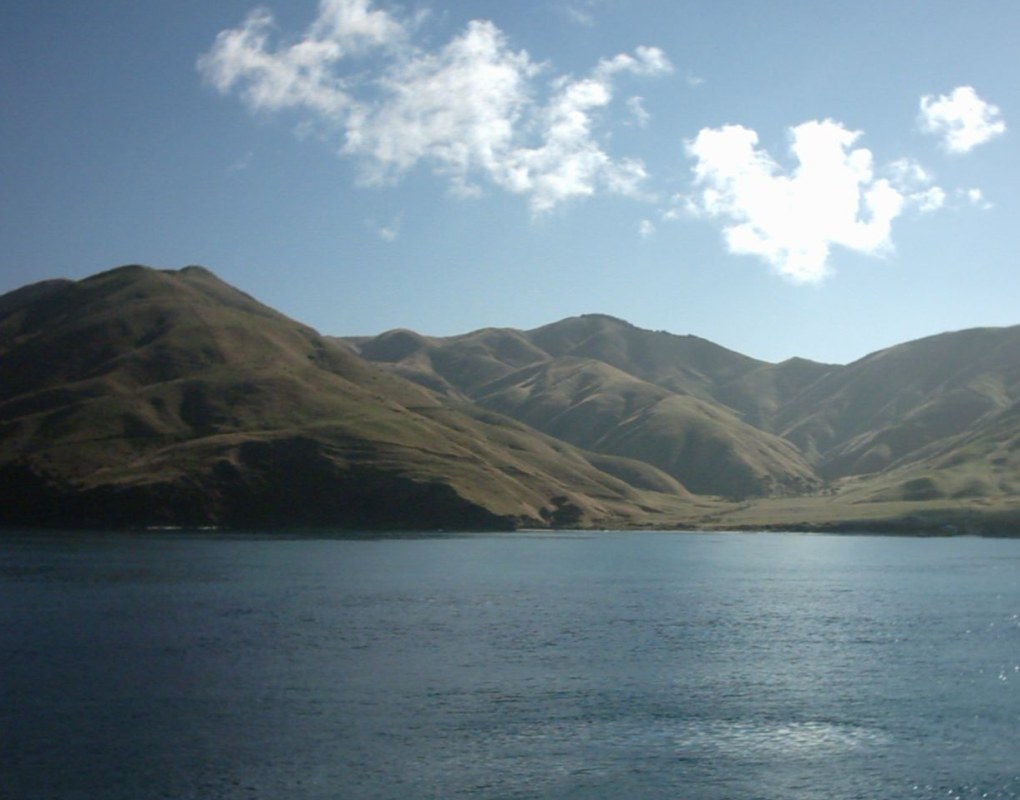
The fourth geographic zone lies along its north coast. Here, the drowned valleys of the Marlborough Sounds make for a convoluted and attractive coastline. The town of Picton is located at the southern end of one of the larger sounds, Queen Charlotte Sound. The town of Havelock is at the southern end of the Pelorus Sound; this sound feeds into Kenepuru Sound.
In line with most of New Zealand, the Marlborough region has a temperate oceanic climate (Köppen Cfb) with warm summers, cool winters, and rainfall distributed across the year.
Marlborough District covers 10,457.89 km2 (4,037.81 sq mi) and had an estimated population of 51,600 as of June 2024, with a population density of 4.9 people per km2. The district is home to 1.0% of New Zealand's population.
Marlborough District
41°53′S 173°40′E / 41.883°S 173.667°E
Marlborough District or the Marlborough Region (Māori: Te Tauihu-o-te-waka, or Tauihu), commonly known simply as Marlborough, is one of the 16 regions of New Zealand, located on the northeast of the South Island. It is administered by Marlborough District Council, a unitary authority, performing the functions of both a territorial authority and a regional council. The council is based at Blenheim, the largest town. The unitary region has a population of 51,600 (June 2024). It borders the Nelson Region and Tasman District to the west, and the Canterbury Region to the south.
Marlborough is known for its dry climate, the Marlborough Sounds, and Sauvignon blanc wine. It takes its name from the earlier Marlborough Province, which was named after John Churchill, 1st Duke of Marlborough, an English general and statesman.
Marlborough's geography can be roughly divided into four sections. The south and west sections are mountainous, particularly the southern section, which rises to the peaks of the Kaikōura Ranges. These two mountainous regions are the final northern vestiges of the ranges that make up the Southern Alps, although that name is rarely applied to mountains this far north.
Between those two sections is the long, straight valley of the Wairau River. This broadens to wide plains at its eastern end, in the centre of which stands the town of Blenheim. This region has fertile soil and temperate weather, which has enabled it to become the centre of the New Zealand wine industry.
The fourth geographic zone lies along its north coast. Here, the drowned valleys of the Marlborough Sounds make for a convoluted and attractive coastline. The town of Picton is located at the southern end of one of the larger sounds, Queen Charlotte Sound. The town of Havelock is at the southern end of the Pelorus Sound; this sound feeds into Kenepuru Sound.
In line with most of New Zealand, the Marlborough region has a temperate oceanic climate (Köppen Cfb) with warm summers, cool winters, and rainfall distributed across the year.
Marlborough District covers 10,457.89 km2 (4,037.81 sq mi) and had an estimated population of 51,600 as of June 2024, with a population density of 4.9 people per km2. The district is home to 1.0% of New Zealand's population.
Recent media
Recent media