



Community hub
Recent from talks
Contribute something to knowledge base
Content stats: 0 posts, 0 articles, 1 media, 0 notes
Members stats: 0 subscribers, 0 contributors, 0 moderators, 0 supporters
Subscribers
Supporters
Contributors
Moderators
Hub AI
Southern Alps AI simulator
(@Southern Alps_simulator)
Hub AI
Southern Alps AI simulator
(@Southern Alps_simulator)
Southern Alps
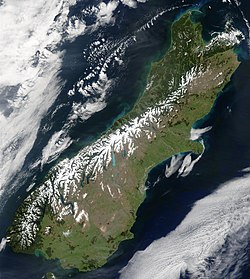
The Southern Alps (Māori: Kā Tiritiri o te Moana; officially Southern Alps / Kā Tiritiri o te Moana) are a mountain range extending along much of the length of New Zealand's South Island, reaching its greatest elevations near the range's western side. The name "Southern Alps" generally refers to the entire range, although separate names are given to many of the smaller ranges that form part of it.
The range includes the South Island's Main Divide, which separates the water catchments of the more heavily populated eastern side of the island from those on the west coast. Politically, the Main Divide forms the boundary between the Marlborough, Canterbury and Otago regions to the southeast and the Tasman and West Coast regions to the northwest.
The Māori name of the range is Kā Tiritiri o te Moana, meaning "the Mirage of the Ocean": it was told that while Māui sailing his waka along the South Island west coast, one of its passengers spotted a white blot on the horizon presumably snow indicating a mountain range; Māui however dismissed it as a glimmering mirage (tiritiri) on the sea until he was proven wrong later when they moved closer to land.
The English explorer James Cook bestowed the name Southern Alps on 23 March 1770, admiring their "prodigious height". They had previously been noted by Abel Tasman in 1642, whose description of the South Island's west coast is often translated as "a land uplifted high".
Following the passage of the Ngāi Tahu Claims Settlement Act 1998, the official name of the range was updated to Southern Alps / Kā Tiritiri o te Moana.
The Southern Alps run approximately 500 km northeast to southwest. Its tallest peak is Aoraki / Mount Cook, the highest point in New Zealand at 3,724 metres (12,218 ft). The Southern Alps include sixteen other points that exceed 3,000 metres (9,800 ft) in height (see NZ mountains by height). The mountain ranges are bisected by glacial valleys, many of which are infilled with glacial lakes on the eastern side including Lake Coleridge in the north and Lake Wakatipu in Otago in the south. According to an inventory conducted in the late 1970s, the Southern Alps contained over 3,000 glaciers larger than one hectare, the longest of which – the Tasman Glacier – is 23.5 kilometres (14.6 mi) in length which has retreated from a recent maximum of 29 kilometres (18 mi) in the 1960s.
Settlements include Maruia Springs, a spa near Lewis Pass, the town of Arthur's Pass, and Mount Cook Village.
Major crossings of the Southern Alps in the New Zealand road network include Lewis Pass (SH 7), Arthur's Pass (SH 73), Haast Pass (SH 6), and the road to Milford Sound (SH 94).
Southern Alps
The Southern Alps (Māori: Kā Tiritiri o te Moana; officially Southern Alps / Kā Tiritiri o te Moana) are a mountain range extending along much of the length of New Zealand's South Island, reaching its greatest elevations near the range's western side. The name "Southern Alps" generally refers to the entire range, although separate names are given to many of the smaller ranges that form part of it.
The range includes the South Island's Main Divide, which separates the water catchments of the more heavily populated eastern side of the island from those on the west coast. Politically, the Main Divide forms the boundary between the Marlborough, Canterbury and Otago regions to the southeast and the Tasman and West Coast regions to the northwest.
The Māori name of the range is Kā Tiritiri o te Moana, meaning "the Mirage of the Ocean": it was told that while Māui sailing his waka along the South Island west coast, one of its passengers spotted a white blot on the horizon presumably snow indicating a mountain range; Māui however dismissed it as a glimmering mirage (tiritiri) on the sea until he was proven wrong later when they moved closer to land.
The English explorer James Cook bestowed the name Southern Alps on 23 March 1770, admiring their "prodigious height". They had previously been noted by Abel Tasman in 1642, whose description of the South Island's west coast is often translated as "a land uplifted high".
Following the passage of the Ngāi Tahu Claims Settlement Act 1998, the official name of the range was updated to Southern Alps / Kā Tiritiri o te Moana.
The Southern Alps run approximately 500 km northeast to southwest. Its tallest peak is Aoraki / Mount Cook, the highest point in New Zealand at 3,724 metres (12,218 ft). The Southern Alps include sixteen other points that exceed 3,000 metres (9,800 ft) in height (see NZ mountains by height). The mountain ranges are bisected by glacial valleys, many of which are infilled with glacial lakes on the eastern side including Lake Coleridge in the north and Lake Wakatipu in Otago in the south. According to an inventory conducted in the late 1970s, the Southern Alps contained over 3,000 glaciers larger than one hectare, the longest of which – the Tasman Glacier – is 23.5 kilometres (14.6 mi) in length which has retreated from a recent maximum of 29 kilometres (18 mi) in the 1960s.
Settlements include Maruia Springs, a spa near Lewis Pass, the town of Arthur's Pass, and Mount Cook Village.
Major crossings of the Southern Alps in the New Zealand road network include Lewis Pass (SH 7), Arthur's Pass (SH 73), Haast Pass (SH 6), and the road to Milford Sound (SH 94).
Recent media
Recent media