



Community hub
Recent from talks
Knowledge base stats:
Talk channels stats:
Members stats:
Martin B-10
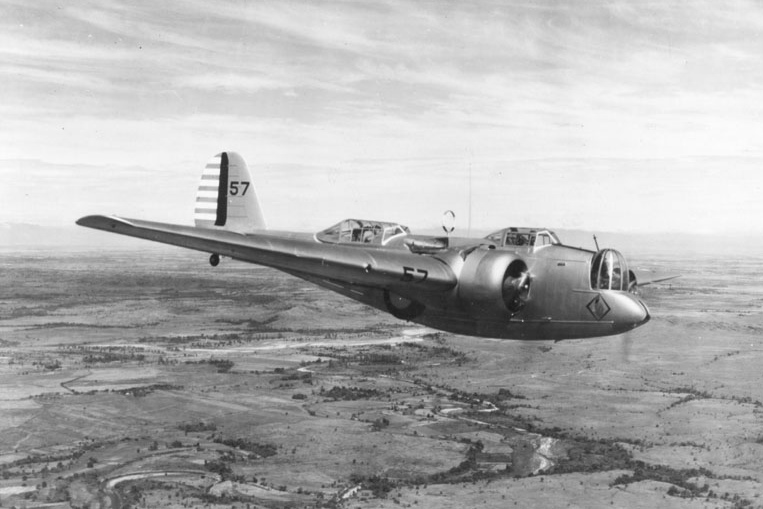
The Martin B-10 is a bomber aircraft designed by the Glenn L. Martin Company. It was the first all-metal monoplane bomber to be regularly used by the United States Army Air Corps, having entered service in June 1934. It was also the first mass-produced bomber whose performance was superior to that of the Army's pursuit aircraft of the time.
The B-10 served as the airframe for the B-12, B-13, B-14, A-15 and O-45 designations using Pratt & Whitney engines instead of Wright Cyclones. A total of 348 of all versions were built. The largest users were the US, with 166, and the Netherlands, with 121.
The B-10 began a revolution in bomber design. Its all-metal monoplane airframe, along with its features of closed cockpits, rotating gun turrets (almost simultaneously with the 1933 British Boulton & Paul Overstrand biplane bomber's own enclosed nose-turret), retractable landing gear, internal bomb bay, and full engine cowlings, became the standard for bomber designs worldwide for decades. It made all existing bombers completely obsolete. Martin received the 1932 Collier Trophy for designing the XB-10.
The B-10 began as the Martin Model 123, a private venture by the Glenn L. Martin Company of Baltimore, Maryland. It had a crew of four: pilot, copilot, nose gunner and fuselage gunner. As in previous bombers, the four crew compartments were open, but it had a number of design innovations as well.
These innovations included a deep belly for an internal bomb bay and retractable main landing gear. Its 600 hp (450 kW) Wright SR-1820-E Cyclone engines provided sufficient power. The Model 123 first flew on 16 February 1932 and was delivered for testing to the U.S. Army on 20 March as the XB-907. After testing it was sent back to Martin for redesigning and was rebuilt as the XB-10.
The XB-10 delivered to the Army had major differences from the original aircraft. Where the Model 123 had Townend rings, the XB-10 had full NACA cowlings to decrease drag. It also sported a pair of 675 hp (503 kW) Wright R-1820-19 engines, and an 8 feet (2.4 m) increase in the wingspan, along with an enclosed nose turret. When the XB-10 flew during trials in June, it recorded a speed of 197 mph (317 km/h) at 6,000 ft (1,829 m). This was an impressive performance for 1932.
Following the success of the XB-10, a number of changes were made, including reduction to a three-man crew and addition of canopies for all crew positions. The Army ordered 48 of these on 17 January 1933. The first 14 aircraft were designated YB-10 and delivered to Wright Field, starting in November 1933, and used in the Army Air Corps Mail Operation. The production model of the XB-10, the YB-10, was very similar to its prototype.[citation needed]
In 1935, the Army ordered an additional 103 aircraft designated B-10B. These had only minor changes from the YB-10. Shipments began in July 1935. B-10Bs served with the 2d Bomb Group at Langley Field, the 9th Bomb Group at Mitchel Field, the 19th Bomb Group at March Field, the 6th Composite Group in the Panama Canal Zone, and the 4th Composite Group in the Philippines. In addition to conventional duties in the bomber role, some modified YB-10s and B-12As were operated for a time on large twin floats for coastal patrol.
Hub AI
Martin B-10 AI simulator
(@Martin B-10_simulator)
Martin B-10
The Martin B-10 is a bomber aircraft designed by the Glenn L. Martin Company. It was the first all-metal monoplane bomber to be regularly used by the United States Army Air Corps, having entered service in June 1934. It was also the first mass-produced bomber whose performance was superior to that of the Army's pursuit aircraft of the time.
The B-10 served as the airframe for the B-12, B-13, B-14, A-15 and O-45 designations using Pratt & Whitney engines instead of Wright Cyclones. A total of 348 of all versions were built. The largest users were the US, with 166, and the Netherlands, with 121.
The B-10 began a revolution in bomber design. Its all-metal monoplane airframe, along with its features of closed cockpits, rotating gun turrets (almost simultaneously with the 1933 British Boulton & Paul Overstrand biplane bomber's own enclosed nose-turret), retractable landing gear, internal bomb bay, and full engine cowlings, became the standard for bomber designs worldwide for decades. It made all existing bombers completely obsolete. Martin received the 1932 Collier Trophy for designing the XB-10.
The B-10 began as the Martin Model 123, a private venture by the Glenn L. Martin Company of Baltimore, Maryland. It had a crew of four: pilot, copilot, nose gunner and fuselage gunner. As in previous bombers, the four crew compartments were open, but it had a number of design innovations as well.
These innovations included a deep belly for an internal bomb bay and retractable main landing gear. Its 600 hp (450 kW) Wright SR-1820-E Cyclone engines provided sufficient power. The Model 123 first flew on 16 February 1932 and was delivered for testing to the U.S. Army on 20 March as the XB-907. After testing it was sent back to Martin for redesigning and was rebuilt as the XB-10.
The XB-10 delivered to the Army had major differences from the original aircraft. Where the Model 123 had Townend rings, the XB-10 had full NACA cowlings to decrease drag. It also sported a pair of 675 hp (503 kW) Wright R-1820-19 engines, and an 8 feet (2.4 m) increase in the wingspan, along with an enclosed nose turret. When the XB-10 flew during trials in June, it recorded a speed of 197 mph (317 km/h) at 6,000 ft (1,829 m). This was an impressive performance for 1932.
Following the success of the XB-10, a number of changes were made, including reduction to a three-man crew and addition of canopies for all crew positions. The Army ordered 48 of these on 17 January 1933. The first 14 aircraft were designated YB-10 and delivered to Wright Field, starting in November 1933, and used in the Army Air Corps Mail Operation. The production model of the XB-10, the YB-10, was very similar to its prototype.[citation needed]
In 1935, the Army ordered an additional 103 aircraft designated B-10B. These had only minor changes from the YB-10. Shipments began in July 1935. B-10Bs served with the 2d Bomb Group at Langley Field, the 9th Bomb Group at Mitchel Field, the 19th Bomb Group at March Field, the 6th Composite Group in the Panama Canal Zone, and the 4th Composite Group in the Philippines. In addition to conventional duties in the bomber role, some modified YB-10s and B-12As were operated for a time on large twin floats for coastal patrol.