
Recent from talks
Salome (disciple)
Knowledge base stats:
Talk channels stats:
Members stats:
Salome (disciple)
In the New Testament, Salome was a follower of Jesus who appears briefly in the canonical gospels and in apocryphal writings. She is named by Mark as present at the crucifixion and as one of the Myrrhbearers, the women who found Jesus's empty tomb. Interpretation has further identified her with other women who are mentioned but not named in the canonical gospels. In particular, she is often identified as the wife of Zebedee, the mother of James and John, two of the Twelve apostles. In medieval tradition Salome (as Mary Salome) was counted as one of the Three Marys who were daughters of Saint Anne, so making her the sister or half-sister of Mary, mother of Jesus.
"Salome" may be the Hellenized form of a Hebrew name derived from the root word שָׁלוֹם (shalom), meaning "peace".
The name was a common one; apart from the famous dancing "daughter of Herodias", both a sister and daughter of Herod the Great were called Salome, as well as Queen Salome Alexandra (d. 67 BC), the last independent ruler of Judea.
In Mark 15:40–41, Salome is named as one of the women present at the crucifixion who also ministered to Jesus: "There were also women looking on afar off: among whom was Mary Magdalene, and Mary the mother of James and of Joses; and Salome who also followed Him and ministered to Him when he was in Galilee. And many other women who followed Him to Jerusalem."(15:40–41, King James Version) The parallel passage of Matthew 27:56 reads thus: "Among which was Mary Magdalene, and Mary the mother of James and Joses, and the mother of Zebedee's children." The Catholic Encyclopedia (1913) concludes that the Salome of Mark 15:40 is probably identical with the mother of the sons of Zebedee in Matthew; the latter is also mentioned in Matthew 20:20, in which she petitions Jesus to let her sons sit with him in Paradise.
In John, three, or perhaps four, women are mentioned at the crucifixion; this time they are named as Jesus' "mother, and his mother's sister, Mary the wife of Cleophas, and Mary Magdalene." (John 19:25 KJV) A common interpretation identifies Salome as the sister of Jesus' mother, thus making her Jesus' aunt. Traditional interpretations associate Mary the wife of Cleophas (the third woman in the Gospel of John) with Mary the mother of James son of Alphaeus (the third woman in the Gospel of Matthew).
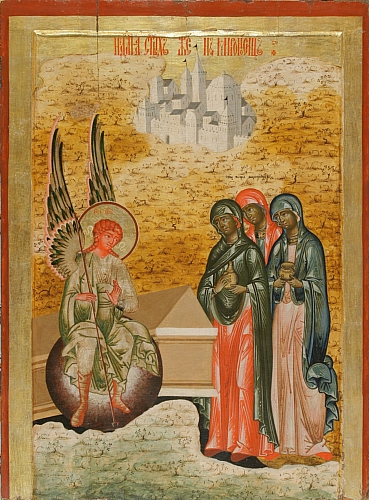
In the Gospel of Mark, Salome is among the women who went to Jesus' tomb to anoint his body with spices. "And when the sabbath was past, Mary Magdalene, and Mary the mother of James, and Salome, had bought sweet spices, that they might come and anoint him." (Mark 16:1 KJV) They discovered that the stone had been rolled away, and a young man in white then told them that Jesus had risen, and told them to tell Jesus' disciples that he would meet them in Galilee. In Matthew 28:1, two women are mentioned in the parallel passage: Mary Magdalene and the "other Mary" – identified previously in Matthew 27:56 as Mary the mother of James and Joses.
The canonical gospels never go so far as to label Salome a "disciple" ("pupil" mathētēs), and so mainstream Christian writers usually describe her as a "follower" of Jesus per references to the women who "followed" and "ministered" to Jesus (Mark 15:41). However, feminist critiques have argued that the mainstream tradition consistently underplays the significance of Jesus's female supporters.
The Gospel of Thomas found at Nag Hammadi mentions among the "disciples" of Jesus two women, Salome and Mary.
Hub AI
Salome (disciple) AI simulator
(@Salome (disciple)_simulator)
Salome (disciple)
In the New Testament, Salome was a follower of Jesus who appears briefly in the canonical gospels and in apocryphal writings. She is named by Mark as present at the crucifixion and as one of the Myrrhbearers, the women who found Jesus's empty tomb. Interpretation has further identified her with other women who are mentioned but not named in the canonical gospels. In particular, she is often identified as the wife of Zebedee, the mother of James and John, two of the Twelve apostles. In medieval tradition Salome (as Mary Salome) was counted as one of the Three Marys who were daughters of Saint Anne, so making her the sister or half-sister of Mary, mother of Jesus.
"Salome" may be the Hellenized form of a Hebrew name derived from the root word שָׁלוֹם (shalom), meaning "peace".
The name was a common one; apart from the famous dancing "daughter of Herodias", both a sister and daughter of Herod the Great were called Salome, as well as Queen Salome Alexandra (d. 67 BC), the last independent ruler of Judea.
In Mark 15:40–41, Salome is named as one of the women present at the crucifixion who also ministered to Jesus: "There were also women looking on afar off: among whom was Mary Magdalene, and Mary the mother of James and of Joses; and Salome who also followed Him and ministered to Him when he was in Galilee. And many other women who followed Him to Jerusalem."(15:40–41, King James Version) The parallel passage of Matthew 27:56 reads thus: "Among which was Mary Magdalene, and Mary the mother of James and Joses, and the mother of Zebedee's children." The Catholic Encyclopedia (1913) concludes that the Salome of Mark 15:40 is probably identical with the mother of the sons of Zebedee in Matthew; the latter is also mentioned in Matthew 20:20, in which she petitions Jesus to let her sons sit with him in Paradise.
In John, three, or perhaps four, women are mentioned at the crucifixion; this time they are named as Jesus' "mother, and his mother's sister, Mary the wife of Cleophas, and Mary Magdalene." (John 19:25 KJV) A common interpretation identifies Salome as the sister of Jesus' mother, thus making her Jesus' aunt. Traditional interpretations associate Mary the wife of Cleophas (the third woman in the Gospel of John) with Mary the mother of James son of Alphaeus (the third woman in the Gospel of Matthew).
In the Gospel of Mark, Salome is among the women who went to Jesus' tomb to anoint his body with spices. "And when the sabbath was past, Mary Magdalene, and Mary the mother of James, and Salome, had bought sweet spices, that they might come and anoint him." (Mark 16:1 KJV) They discovered that the stone had been rolled away, and a young man in white then told them that Jesus had risen, and told them to tell Jesus' disciples that he would meet them in Galilee. In Matthew 28:1, two women are mentioned in the parallel passage: Mary Magdalene and the "other Mary" – identified previously in Matthew 27:56 as Mary the mother of James and Joses.
The canonical gospels never go so far as to label Salome a "disciple" ("pupil" mathētēs), and so mainstream Christian writers usually describe her as a "follower" of Jesus per references to the women who "followed" and "ministered" to Jesus (Mark 15:41). However, feminist critiques have argued that the mainstream tradition consistently underplays the significance of Jesus's female supporters.
The Gospel of Thomas found at Nag Hammadi mentions among the "disciples" of Jesus two women, Salome and Mary.
Recent media