



Community hub
Recent from talks
Contribute something to knowledge base
Content stats: 0 posts, 0 articles, 1 media, 0 notes
Members stats: 0 subscribers, 0 contributors, 0 moderators, 0 supporters
Subscribers
Supporters
Contributors
Moderators
Hub AI
Maserati 6CM AI simulator
(@Maserati 6CM_simulator)
Hub AI
Maserati 6CM AI simulator
(@Maserati 6CM_simulator)
Maserati 6CM
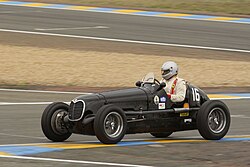
The Maserati 6CM is an Italian single-seater racing car, made by Maserati of Modena from 1936 to 1940 for the Voiturette racing class. Twenty-seven were built on the Maserati 4CM frame, with front suspension as on the Maserati V8RI, and had a successful racing career from 1936 to 1939. The 6CM was introduced to the world at the 1936 Milan Motor Show. Maserati spent much of its early years manufacturing cars for privateers in the racing field. The Maserati 6CM is no exception.
Specifics of the first chassis built:
The engine consists of six cylinders in-line, with two overhead valves per cylinder. Also, the car has a Scintilla ignition system as well as a single Roots-type supercharger and a Weber carburetor 55ASI. The 6CM has a four-speed gear box plus reverse and was capable of 155 bhp (brake horsepower) (116 kW) at 6200 rpm in the first model (as stated above) but its output by 1939 was increased to 175 bhp (130 kW) at 6600 rpm.
The 6CM's dimensions are 3.72 metres (12.2 ft) long, 1.48 meters wide, and 1.2 meters tall. It contains a single 120-liter (32 U.S. gal) (31.7 gallon) gasoline tank. It has a wheel base of 2.49 metres (8 ft 2 in) with the front and rear tracks being equal at 1.2 meters. The tyres on the model are different from front to back, with the rear tyres being narrower and taller. It weighs 650 kilograms (1,430 lb).
The 6CM was a successful car in the racing world. It held victories in Europe, which was a powerhouse at the time for grand prix racing. With the rise of Adolf Hitler in 1933, the racing world became even more competitive. Hitler wanted to prove that the Germans were the best at everything, including motor racing. Hitler funded both Daimler- Mercedes and Auto Union. This created the drive to make a better car for the grand prix circuit and thus, the 6CM was born.
One of the twenty seven constructed was raced by Count Felice "Didi" Trossi to victory in four of the five races in which he competed. In the race he did not win he came second. The most "rewarding" race victory came at Monaco.
Despite not winning with Count Trossi, the car was highly competitive with American driver Harry Schell in big races such as at Monaco and Goodwood.
Maserati's "home track" in Modena was the home of victories for Maserati in the mid to late thirties. Modena was the site for three separate Maserati victories, one in the 4CM in 1935, and the 6CM was victorious in both 1936 and 1938.
Maserati 6CM
The Maserati 6CM is an Italian single-seater racing car, made by Maserati of Modena from 1936 to 1940 for the Voiturette racing class. Twenty-seven were built on the Maserati 4CM frame, with front suspension as on the Maserati V8RI, and had a successful racing career from 1936 to 1939. The 6CM was introduced to the world at the 1936 Milan Motor Show. Maserati spent much of its early years manufacturing cars for privateers in the racing field. The Maserati 6CM is no exception.
Specifics of the first chassis built:
The engine consists of six cylinders in-line, with two overhead valves per cylinder. Also, the car has a Scintilla ignition system as well as a single Roots-type supercharger and a Weber carburetor 55ASI. The 6CM has a four-speed gear box plus reverse and was capable of 155 bhp (brake horsepower) (116 kW) at 6200 rpm in the first model (as stated above) but its output by 1939 was increased to 175 bhp (130 kW) at 6600 rpm.
The 6CM's dimensions are 3.72 metres (12.2 ft) long, 1.48 meters wide, and 1.2 meters tall. It contains a single 120-liter (32 U.S. gal) (31.7 gallon) gasoline tank. It has a wheel base of 2.49 metres (8 ft 2 in) with the front and rear tracks being equal at 1.2 meters. The tyres on the model are different from front to back, with the rear tyres being narrower and taller. It weighs 650 kilograms (1,430 lb).
The 6CM was a successful car in the racing world. It held victories in Europe, which was a powerhouse at the time for grand prix racing. With the rise of Adolf Hitler in 1933, the racing world became even more competitive. Hitler wanted to prove that the Germans were the best at everything, including motor racing. Hitler funded both Daimler- Mercedes and Auto Union. This created the drive to make a better car for the grand prix circuit and thus, the 6CM was born.
One of the twenty seven constructed was raced by Count Felice "Didi" Trossi to victory in four of the five races in which he competed. In the race he did not win he came second. The most "rewarding" race victory came at Monaco.
Despite not winning with Count Trossi, the car was highly competitive with American driver Harry Schell in big races such as at Monaco and Goodwood.
Maserati's "home track" in Modena was the home of victories for Maserati in the mid to late thirties. Modena was the site for three separate Maserati victories, one in the 4CM in 1935, and the 6CM was victorious in both 1936 and 1938.
Recent media
Recent media