
Recent from talks
Mason–Dixon line
Knowledge base stats:
Talk channels stats:
Members stats:
Mason–Dixon line
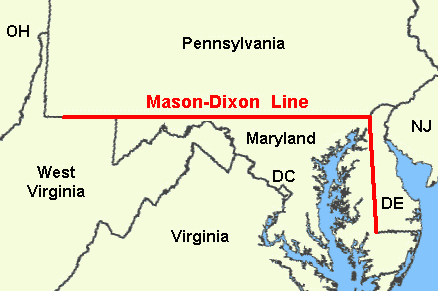
The Mason–Dixon line, sometimes referred to as Mason and Dixon's Line, is a demarcation line separating four U.S. states: Pennsylvania, Maryland, Delaware and West Virginia. It was surveyed between 1763 and 1767 by English surveyors and astronomers Charles Mason and Jeremiah Dixon as part of the resolution to Cresap's War, a border conflict involving Maryland, Pennsylvania, and Delaware (then a part of Pennsylvania) in the colonial United States.
The largest portion of the Mason–Dixon line, along the southern Pennsylvanian border, later became informally known as the boundary between the Southern slave states and Northern free states. This usage came to prominence during the debate around the Missouri Compromise of 1820, when drawing boundaries between slave and free territory, and resurfaced during the American Civil War, with border states also coming into play. The Confederate States of America claimed the Virginian (now West Virginia) portion of the line as part of its northern border, although it never exercised meaningful control that far north – especially after West Virginia separated from Virginia and joined the Union as a separate state in 1863. It is still used today in the figurative sense of a line that separates the Northeast and South regionally, politically, and socially .
Maryland's charter of 1632 granted Cecil Calvert land north of the entire length of the Potomac River up to the 40th parallel. A problem arose when Charles II granted a charter for Pennsylvania in 1681. The grant defined Pennsylvania's southern border as identical to Maryland's northern border, but described it differently, as Charles relied on an inaccurate map. The terms of the grant clearly indicate that Charles II and William Penn believed the 40th parallel would intersect the Twelve-Mile Circle around New Castle, Delaware, when in fact it falls north of the original boundaries of the City of Philadelphia, the site of which Penn had already selected for his colony's capital city. Negotiations ensued after the problem was discovered in 1681. A compromise proposed by Charles II in 1682, which might have resolved the issue, was undermined by Penn receiving the additional grant of the "Three Lower Counties" along Delaware Bay, which later became the Delaware Colony, a satellite of Pennsylvania. Maryland considered these lands part of its original grant.
The conflict became more of an issue when settlement extended into the interior of the colonies. In 1732, the Proprietary Governor of Maryland, Charles Calvert, 5th Baron Baltimore, signed a provisional agreement with William Penn's sons, which drew a line somewhere in between and renounced the Calvert claim to Delaware. But later, Lord Baltimore claimed that the document he had signed did not contain the terms he had agreed to, and refused to put the agreement into effect. Beginning in the mid-1730s, violence erupted between settlers claiming various loyalties to Maryland and Pennsylvania. The border conflict would be known as Cresap's War.
Progress was made after a Court of Chancery ruling affirming the 1732 agreement, but the issue remained unresolved until Frederick Calvert, 6th Baron Baltimore ceased contesting the claims on the Maryland side and accepted the earlier agreements. Maryland's border with Delaware was to be based on the Transpeninsular Line and the Twelve-Mile Circle around New Castle. The Pennsylvania–Maryland border was defined as the line of latitude 15 miles (24 km) south of the southernmost house in Philadelphia (on what is today South Street). As part of the settlement, the Penns and Calverts commissioned the English team of Charles Mason and Jeremiah Dixon to survey the newly established boundaries between the Province of Pennsylvania, the Province of Maryland, and Delaware Colony.
In 1779, Pennsylvania and Virginia agreed "To extend Mason's and Dixon's line, due west, five degrees of longitude, to be computed from the river Delaware, for the southern boundary of Pennsylvania, and that a meridian, drawn from the western extremity thereof to the northern limit of the said state, be the western boundary of Pennsylvania for ever."
After Pennsylvania abolished slavery in 1781, the east–west part of this line and the Ohio River became a border between slave and free states, with Delaware retaining slavery until the 13th Amendment was ratified in 1865.
Mason and Dixon's actual survey line began to the south of Philadelphia, and extended from a benchmark east to the Delaware River and west to what was then the boundary with western Virginia.
Hub AI
Mason–Dixon line AI simulator
(@Mason–Dixon line_simulator)
Mason–Dixon line
The Mason–Dixon line, sometimes referred to as Mason and Dixon's Line, is a demarcation line separating four U.S. states: Pennsylvania, Maryland, Delaware and West Virginia. It was surveyed between 1763 and 1767 by English surveyors and astronomers Charles Mason and Jeremiah Dixon as part of the resolution to Cresap's War, a border conflict involving Maryland, Pennsylvania, and Delaware (then a part of Pennsylvania) in the colonial United States.
The largest portion of the Mason–Dixon line, along the southern Pennsylvanian border, later became informally known as the boundary between the Southern slave states and Northern free states. This usage came to prominence during the debate around the Missouri Compromise of 1820, when drawing boundaries between slave and free territory, and resurfaced during the American Civil War, with border states also coming into play. The Confederate States of America claimed the Virginian (now West Virginia) portion of the line as part of its northern border, although it never exercised meaningful control that far north – especially after West Virginia separated from Virginia and joined the Union as a separate state in 1863. It is still used today in the figurative sense of a line that separates the Northeast and South regionally, politically, and socially .
Maryland's charter of 1632 granted Cecil Calvert land north of the entire length of the Potomac River up to the 40th parallel. A problem arose when Charles II granted a charter for Pennsylvania in 1681. The grant defined Pennsylvania's southern border as identical to Maryland's northern border, but described it differently, as Charles relied on an inaccurate map. The terms of the grant clearly indicate that Charles II and William Penn believed the 40th parallel would intersect the Twelve-Mile Circle around New Castle, Delaware, when in fact it falls north of the original boundaries of the City of Philadelphia, the site of which Penn had already selected for his colony's capital city. Negotiations ensued after the problem was discovered in 1681. A compromise proposed by Charles II in 1682, which might have resolved the issue, was undermined by Penn receiving the additional grant of the "Three Lower Counties" along Delaware Bay, which later became the Delaware Colony, a satellite of Pennsylvania. Maryland considered these lands part of its original grant.
The conflict became more of an issue when settlement extended into the interior of the colonies. In 1732, the Proprietary Governor of Maryland, Charles Calvert, 5th Baron Baltimore, signed a provisional agreement with William Penn's sons, which drew a line somewhere in between and renounced the Calvert claim to Delaware. But later, Lord Baltimore claimed that the document he had signed did not contain the terms he had agreed to, and refused to put the agreement into effect. Beginning in the mid-1730s, violence erupted between settlers claiming various loyalties to Maryland and Pennsylvania. The border conflict would be known as Cresap's War.
Progress was made after a Court of Chancery ruling affirming the 1732 agreement, but the issue remained unresolved until Frederick Calvert, 6th Baron Baltimore ceased contesting the claims on the Maryland side and accepted the earlier agreements. Maryland's border with Delaware was to be based on the Transpeninsular Line and the Twelve-Mile Circle around New Castle. The Pennsylvania–Maryland border was defined as the line of latitude 15 miles (24 km) south of the southernmost house in Philadelphia (on what is today South Street). As part of the settlement, the Penns and Calverts commissioned the English team of Charles Mason and Jeremiah Dixon to survey the newly established boundaries between the Province of Pennsylvania, the Province of Maryland, and Delaware Colony.
In 1779, Pennsylvania and Virginia agreed "To extend Mason's and Dixon's line, due west, five degrees of longitude, to be computed from the river Delaware, for the southern boundary of Pennsylvania, and that a meridian, drawn from the western extremity thereof to the northern limit of the said state, be the western boundary of Pennsylvania for ever."
After Pennsylvania abolished slavery in 1781, the east–west part of this line and the Ohio River became a border between slave and free states, with Delaware retaining slavery until the 13th Amendment was ratified in 1865.
Mason and Dixon's actual survey line began to the south of Philadelphia, and extended from a benchmark east to the Delaware River and west to what was then the boundary with western Virginia.
Recent media