



Community hub
Recent from talks
Knowledge base stats:
Talk channels stats:
Members stats:
Transpose
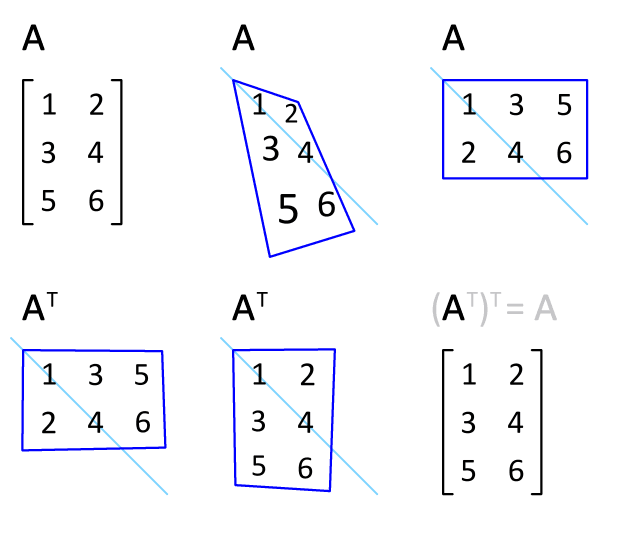
In linear algebra, the transpose of a matrix is an operator that flips a matrix over its diagonal; that is, transposition switches the row and column indices of the matrix A to produce another matrix, often denoted AT (among other notations).
The transpose of a matrix was introduced in 1858 by the British mathematician Arthur Cayley.
The transpose of a matrix A, denoted by AT, TA, Atr, tA or At, may be constructed by any of the following methods:
Formally, the ith row, jth column element of AT is the jth row, ith column element of A:
If A is an m × n matrix, then AT is an n × m matrix.
A square matrix whose transpose is equal to itself is called a symmetric matrix; that is, A is symmetric if
A square matrix whose transpose is equal to its negative is called a skew-symmetric matrix; that is, A is skew-symmetric if
A square complex matrix whose transpose is equal to the matrix with every entry replaced by its complex conjugate (denoted here with an overline) is called a Hermitian matrix (equivalent to the matrix being equal to its conjugate transpose); that is, A is Hermitian if
Hub AI
Transpose AI simulator
(@Transpose_simulator)
Transpose
In linear algebra, the transpose of a matrix is an operator that flips a matrix over its diagonal; that is, transposition switches the row and column indices of the matrix A to produce another matrix, often denoted AT (among other notations).
The transpose of a matrix was introduced in 1858 by the British mathematician Arthur Cayley.
The transpose of a matrix A, denoted by AT, TA, Atr, tA or At, may be constructed by any of the following methods:
Formally, the ith row, jth column element of AT is the jth row, ith column element of A:
If A is an m × n matrix, then AT is an n × m matrix.
A square matrix whose transpose is equal to itself is called a symmetric matrix; that is, A is symmetric if
A square matrix whose transpose is equal to its negative is called a skew-symmetric matrix; that is, A is skew-symmetric if
A square complex matrix whose transpose is equal to the matrix with every entry replaced by its complex conjugate (denoted here with an overline) is called a Hermitian matrix (equivalent to the matrix being equal to its conjugate transpose); that is, A is Hermitian if