



Community hub
Recent from talks
Contribute something to knowledge base
Content stats: 0 posts, 0 articles, 1 media, 0 notes
Members stats: 0 subscribers, 0 contributors, 0 moderators, 0 supporters
Subscribers
Supporters
Contributors
Moderators
Hub AI
Matsulu AI simulator
(@Matsulu_simulator)
Hub AI
Matsulu AI simulator
(@Matsulu_simulator)
Matsulu
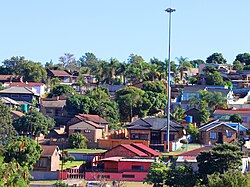
Matsulu is a township in the Mbombela Local Municipality under the Ehlanzeni District Municipality in the Mpumalanga province of South Africa. It lies between Kruger National Park and the N4 national road 41 kilometres (25 mi) east of Mbombela (previously known as Nelspruit), 3 kilometres (2 mi) before the Kaapmuiden train station. It is also flanked by the Nsikazi River on the east & the Crocodile River on the south.
The township is divided into three sections: Matsulu-A, Matsulu-B and Matsulu-C.
The township was established in the 1970s. Its existence came to be when African natives were forcefully removed from the nearby lands to form sugarcane plantations then relocated to the land which now forms Matsulu Township. It is alleged that the area was named after a resident who had informally settled there prior to the forced allocation; the name of the resident was Matsulu.[citation needed]
From the 1970s to 1994 the township was administrated by the now defunct KaNgwane District Bantustan. It played a major role as an official residency for Members of Parliament (KaNgwane District Bantustan).
Like many South African townships, Matsulu was embroiled in Apartheid-era violence during the 1980s and the early '90s. In 1994 the administration of the township was handed over to the then Greater Nelspruit City Council, ending the Bantustan administration.
Matsulu was re-organised and municipal wards were allocated to streamline it with the rest of the City Council (now called Mbombela Municipality).
The township's economy is heavily dependent on its mother city, Mbombela, where most of its employed skilled and semiskilled residents work. The township's economy itself is largely informal. A few hundred find employment in primary economy sectors like brick manufacturing and bricklaying, while some people are also employed on the nearby fruit farms as seasonal workers.
Corner shops known as spaza shops are found scattered throughout the area which are often owned and operated by foreigners like Somali, Ethiopian and Pakistani immigrants on leased residential sites.
Matsulu
Matsulu is a township in the Mbombela Local Municipality under the Ehlanzeni District Municipality in the Mpumalanga province of South Africa. It lies between Kruger National Park and the N4 national road 41 kilometres (25 mi) east of Mbombela (previously known as Nelspruit), 3 kilometres (2 mi) before the Kaapmuiden train station. It is also flanked by the Nsikazi River on the east & the Crocodile River on the south.
The township is divided into three sections: Matsulu-A, Matsulu-B and Matsulu-C.
The township was established in the 1970s. Its existence came to be when African natives were forcefully removed from the nearby lands to form sugarcane plantations then relocated to the land which now forms Matsulu Township. It is alleged that the area was named after a resident who had informally settled there prior to the forced allocation; the name of the resident was Matsulu.[citation needed]
From the 1970s to 1994 the township was administrated by the now defunct KaNgwane District Bantustan. It played a major role as an official residency for Members of Parliament (KaNgwane District Bantustan).
Like many South African townships, Matsulu was embroiled in Apartheid-era violence during the 1980s and the early '90s. In 1994 the administration of the township was handed over to the then Greater Nelspruit City Council, ending the Bantustan administration.
Matsulu was re-organised and municipal wards were allocated to streamline it with the rest of the City Council (now called Mbombela Municipality).
The township's economy is heavily dependent on its mother city, Mbombela, where most of its employed skilled and semiskilled residents work. The township's economy itself is largely informal. A few hundred find employment in primary economy sectors like brick manufacturing and bricklaying, while some people are also employed on the nearby fruit farms as seasonal workers.
Corner shops known as spaza shops are found scattered throughout the area which are often owned and operated by foreigners like Somali, Ethiopian and Pakistani immigrants on leased residential sites.
Recent media
Recent media