



Community hub
Recent from talks
Contribute something to knowledge base
Content stats: 0 posts, 0 articles, 1 media, 0 notes
Members stats: 0 subscribers, 0 contributors, 0 moderators, 0 supporters
Subscribers
Supporters
Contributors
Moderators
Hub AI
Matzah AI simulator
(@Matzah_simulator)
Hub AI
Matzah AI simulator
(@Matzah_simulator)
Matzah
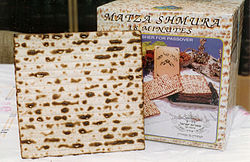
Matzah, matzo, or maẓẓah (Hebrew: מַצָּה, romanized: maṣṣā; IPA: [maˈt͡sa], pl.: matzot or Ashk. matzos) is an unleavened flatbread that is part of Jewish cuisine and forms an integral element of the Passover festival, during which chametz (leavening agent and five grains deemed by halakha to be self-leavening) is forbidden.
According to the Torah, God commanded the Israelites (modernly, Jews and Samaritans) to eat only unleavened bread during the seven-day Passover festival. Matzah can be either soft like a pita or a crisp variety, widely produced commercially because of its long shelf life. The soft matzah only keeps for a day or so unless frozen; very limited commercial production, only in the period leading up to Passover, is available. Some versions of the crisp type are available all year.
Matzah meal and matzah cake meal is crisp matzah that has been ground. The cake meal has a very fine near flour-like consistency, useful in baking, while the standard matzah meal is somewhat coarser and used in cooking. Matzah meal is used to make matzah balls (kneidles/kneidlach), the principal ingredient of kneydlach soup (often translated as "matzah ball soup"). Sephardic Jews typically cook with matzah itself rather than matzah meal.
Matzah that is kosher for Passover is limited in Ashkenazi tradition to plain matzah made from flour and water. The flour may be made from whole or refined grain, but must be made from one of five grains: wheat, spelt, barley, rye, or oat. Some Sephardic communities allow matzah to be made with eggs or fruit juice to be used throughout the holiday, while Ashkenazi Jews do not use such matzah on Passover, except in special circumstances, as for the sick and elderly.
Matzah is mentioned in the Torah several times in relation to The Exodus from Egypt:
That night, they are to eat the meat, roasted in the fire; they are to eat it with matzah and maror.
— Exodus 12:8
From the evening of the fourteenth day of the first month until the evening of the twenty-first day, you are to eat matzah.
Matzah
Matzah, matzo, or maẓẓah (Hebrew: מַצָּה, romanized: maṣṣā; IPA: [maˈt͡sa], pl.: matzot or Ashk. matzos) is an unleavened flatbread that is part of Jewish cuisine and forms an integral element of the Passover festival, during which chametz (leavening agent and five grains deemed by halakha to be self-leavening) is forbidden.
According to the Torah, God commanded the Israelites (modernly, Jews and Samaritans) to eat only unleavened bread during the seven-day Passover festival. Matzah can be either soft like a pita or a crisp variety, widely produced commercially because of its long shelf life. The soft matzah only keeps for a day or so unless frozen; very limited commercial production, only in the period leading up to Passover, is available. Some versions of the crisp type are available all year.
Matzah meal and matzah cake meal is crisp matzah that has been ground. The cake meal has a very fine near flour-like consistency, useful in baking, while the standard matzah meal is somewhat coarser and used in cooking. Matzah meal is used to make matzah balls (kneidles/kneidlach), the principal ingredient of kneydlach soup (often translated as "matzah ball soup"). Sephardic Jews typically cook with matzah itself rather than matzah meal.
Matzah that is kosher for Passover is limited in Ashkenazi tradition to plain matzah made from flour and water. The flour may be made from whole or refined grain, but must be made from one of five grains: wheat, spelt, barley, rye, or oat. Some Sephardic communities allow matzah to be made with eggs or fruit juice to be used throughout the holiday, while Ashkenazi Jews do not use such matzah on Passover, except in special circumstances, as for the sick and elderly.
Matzah is mentioned in the Torah several times in relation to The Exodus from Egypt:
That night, they are to eat the meat, roasted in the fire; they are to eat it with matzah and maror.
— Exodus 12:8
From the evening of the fourteenth day of the first month until the evening of the twenty-first day, you are to eat matzah.
Recent media
Recent media