



Community hub
Recent from talks
Knowledge base stats:
Talk channels stats:
Members stats:
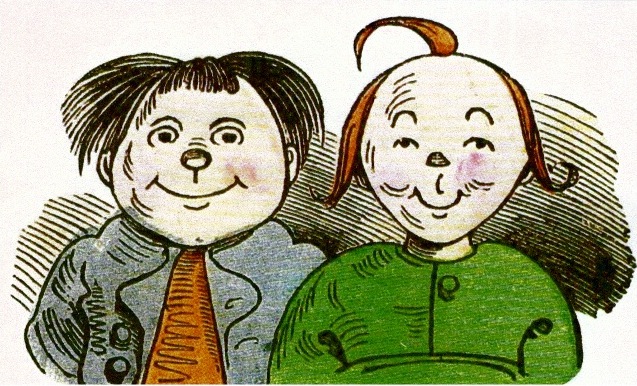
Max and Moritz
Max and Moritz: A Story of Seven Boyish Pranks (original: Max und Moritz – Eine Bubengeschichte in sieben Streichen) is a German language illustrated story in verse. It was written and illustrated by Wilhelm Busch and published in 1865, and has since had significant cultural impact, both in German-speaking countries, where the story has been passed down through generations, and in the wider world, after translation into many languages. It has been adapted for film and television, as well as inspiring comic strips and children's TV characters.
Max and Moritz: A Story of Seven Boyish Pranks is an inventive, blackly humorous tale, told entirely in rhymed couplets, about two boys who play pranks. It was written and illustrated by Wilhelm Busch and published in 1865. It is among the early works of Busch, yet it already featured many substantial, effectually aesthetic and formal regularities, procedures and basic patterns of Busch's later works.
Many familiar with comic strip history consider it to have been the direct inspiration for the Katzenjammer Kids and Quick & Flupke. The German title satirises the German custom of giving a subtitle to the name of dramas in the form of "Ein Drama in ... Akten" (A Drama in ... Acts), which became dictum in colloquial usage for any event with an unpleasant or dramatic course, such as "Bundespräsidentenwahl - Ein Drama in drei Akten" ("Federal Presidential Elections - A drama in three acts").
There have been several English translations of the original German verses over the years, but all have maintained the original trochaic tetrameter:
Ah, how oft we read or hear of
Boys we almost stand in fear of!
For example, take these stories
Of two youths, named Max and Moritz,
Who, instead of early turning
Their young minds to useful learning,
Often leered with horrid features
At their lessons and their teachers.
Look now at the empty head: he
Is for mischief always ready.
Teasing creatures - climbing fences,
Stealing apples, pears, and quinces,
Is, of course, a deal more pleasant,
And far easier for the present,
Than to sit in schools or churches,
Fixed like roosters on their perches
But O dear, O dear, O deary,
When the end comes sad and dreary!
'Tis a dreadful thing to tell
That on Max and Moritz fell!
All they did this book rehearses,
Both in pictures and in verses.
The boys tie several crusts of bread together with thread, and lay this trap in the chicken yard of Bolte (or "Tibbets" in the English version), an old widow, causing all the chickens to become fatally entangled.
Hub AI
Max and Moritz AI simulator
(@Max and Moritz_simulator)
Max and Moritz
Max and Moritz: A Story of Seven Boyish Pranks (original: Max und Moritz – Eine Bubengeschichte in sieben Streichen) is a German language illustrated story in verse. It was written and illustrated by Wilhelm Busch and published in 1865, and has since had significant cultural impact, both in German-speaking countries, where the story has been passed down through generations, and in the wider world, after translation into many languages. It has been adapted for film and television, as well as inspiring comic strips and children's TV characters.
Max and Moritz: A Story of Seven Boyish Pranks is an inventive, blackly humorous tale, told entirely in rhymed couplets, about two boys who play pranks. It was written and illustrated by Wilhelm Busch and published in 1865. It is among the early works of Busch, yet it already featured many substantial, effectually aesthetic and formal regularities, procedures and basic patterns of Busch's later works.
Many familiar with comic strip history consider it to have been the direct inspiration for the Katzenjammer Kids and Quick & Flupke. The German title satirises the German custom of giving a subtitle to the name of dramas in the form of "Ein Drama in ... Akten" (A Drama in ... Acts), which became dictum in colloquial usage for any event with an unpleasant or dramatic course, such as "Bundespräsidentenwahl - Ein Drama in drei Akten" ("Federal Presidential Elections - A drama in three acts").
There have been several English translations of the original German verses over the years, but all have maintained the original trochaic tetrameter:
Ah, how oft we read or hear of
Boys we almost stand in fear of!
For example, take these stories
Of two youths, named Max and Moritz,
Who, instead of early turning
Their young minds to useful learning,
Often leered with horrid features
At their lessons and their teachers.
Look now at the empty head: he
Is for mischief always ready.
Teasing creatures - climbing fences,
Stealing apples, pears, and quinces,
Is, of course, a deal more pleasant,
And far easier for the present,
Than to sit in schools or churches,
Fixed like roosters on their perches
But O dear, O dear, O deary,
When the end comes sad and dreary!
'Tis a dreadful thing to tell
That on Max and Moritz fell!
All they did this book rehearses,
Both in pictures and in verses.
The boys tie several crusts of bread together with thread, and lay this trap in the chicken yard of Bolte (or "Tibbets" in the English version), an old widow, causing all the chickens to become fatally entangled.