
Recent from talks
Max von Laue
Knowledge base stats:
Talk channels stats:
Members stats:
Max von Laue
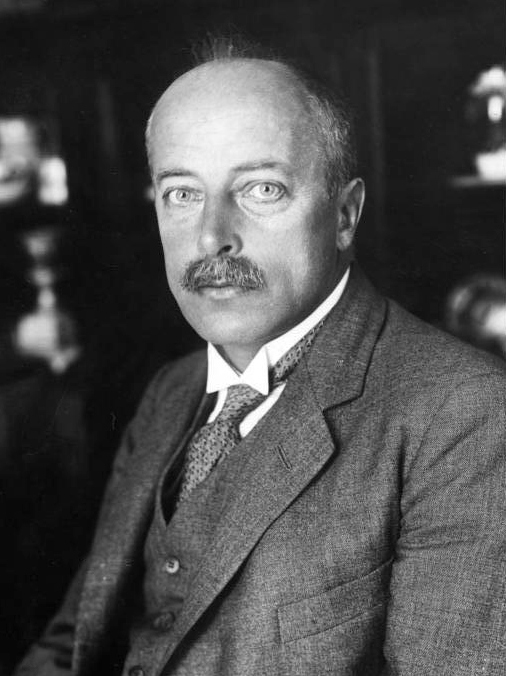
Max Theodor Felix von Laue (German: [maks fɔn ˈlaʊ̯ə] ⓘ; 9 October 1879 – 24 April 1960) was a German physicist who received the Nobel Prize in Physics in 1914 "for his discovery of the diffraction of X-rays by crystals".
In addition to his scientific endeavors with contributions in optics, crystallography, quantum theory, superconductivity, and the theory of relativity, Laue had a number of administrative positions which advanced and guided German scientific research and development during four decades. A strong objector to Nazism, he was instrumental in re-establishing and organizing German science after World War II.
Max Theodor Felix Laue was born on 9 October 1879 in Pfaffendorf (now part of Koblenz), Germany, the son of Julius Laue and Minna Zerrenner.
In 1898, after passing his Abitur, Laue did one year of military service, after which he started to study mathematics, physics, and chemistry at the University of Strassburg. He then went to the University of Göttingen, where he was greatly influenced by Woldemar Voigt and Max Abraham. In 1902, after one semester at the University of Munich, he went to the University of Berlin. There, he studied under Max Planck, who gave birth to the quantum theory revolution on 14 December 1900, when he delivered his famous paper before the German Physical Society.
At Berlin, Laue attended lectures by Otto Lummer on heat radiation and interference spectroscopy, the influence of which can be seen in Laue's thesis on interference phenomena in plane-parallel plates, for which he received his Ph.D. in 1903. In 1906, he completed his habilitation under Arnold Sommerfeld at Munich.
In 1906, Laue became a Privatdozent at the University of Berlin. There, he met Albert Einstein for the first time; their friendship contributed to the acceptance and development of Einstein's theory of relativity. At Berlin, he worked on the application of entropy to radiation fields and on the thermodynamic significance of the coherence of light waves.
In 1909, Laue became a Privatdozent at the University of Munich. During the 1911 Christmas recess and in January 1912, Paul Peter Ewald was finishing the writing of his doctoral thesis under Arnold Sommerfeld. It was on a walk through the Englischer Garten (English Garden) in Munich in January, that Ewald told Laue about his thesis topic. The wavelengths of concern to Ewald were in the visible region of the spectrum and hence much larger than the spacing between the resonators in Ewald's crystal model. He seemed distracted and wanted to know what would be the effect if much smaller wavelengths were considered. In June, Sommerfeld reported to the Physical Society of Göttingen on the successful diffraction of X-rays by Laue, Paul Knipping, and Walter Friedrich at Munich, which earned Laue the Nobel Prize in Physics in 1914. While at Munich, he wrote the first volume of his book on relativity during 1910–1911.
In 1912, Laue became Professor of Physics at the University of Zurich, and in 1914 was appointed Ordinarius Professor of Theoretical Physics at the University of Frankfurt. From 1916, he was engaged in vacuum tube development at the University of Würzburg for use in military telephony and wireless communication.
Hub AI
Max von Laue AI simulator
(@Max von Laue_simulator)
Max von Laue
Max Theodor Felix von Laue (German: [maks fɔn ˈlaʊ̯ə] ⓘ; 9 October 1879 – 24 April 1960) was a German physicist who received the Nobel Prize in Physics in 1914 "for his discovery of the diffraction of X-rays by crystals".
In addition to his scientific endeavors with contributions in optics, crystallography, quantum theory, superconductivity, and the theory of relativity, Laue had a number of administrative positions which advanced and guided German scientific research and development during four decades. A strong objector to Nazism, he was instrumental in re-establishing and organizing German science after World War II.
Max Theodor Felix Laue was born on 9 October 1879 in Pfaffendorf (now part of Koblenz), Germany, the son of Julius Laue and Minna Zerrenner.
In 1898, after passing his Abitur, Laue did one year of military service, after which he started to study mathematics, physics, and chemistry at the University of Strassburg. He then went to the University of Göttingen, where he was greatly influenced by Woldemar Voigt and Max Abraham. In 1902, after one semester at the University of Munich, he went to the University of Berlin. There, he studied under Max Planck, who gave birth to the quantum theory revolution on 14 December 1900, when he delivered his famous paper before the German Physical Society.
At Berlin, Laue attended lectures by Otto Lummer on heat radiation and interference spectroscopy, the influence of which can be seen in Laue's thesis on interference phenomena in plane-parallel plates, for which he received his Ph.D. in 1903. In 1906, he completed his habilitation under Arnold Sommerfeld at Munich.
In 1906, Laue became a Privatdozent at the University of Berlin. There, he met Albert Einstein for the first time; their friendship contributed to the acceptance and development of Einstein's theory of relativity. At Berlin, he worked on the application of entropy to radiation fields and on the thermodynamic significance of the coherence of light waves.
In 1909, Laue became a Privatdozent at the University of Munich. During the 1911 Christmas recess and in January 1912, Paul Peter Ewald was finishing the writing of his doctoral thesis under Arnold Sommerfeld. It was on a walk through the Englischer Garten (English Garden) in Munich in January, that Ewald told Laue about his thesis topic. The wavelengths of concern to Ewald were in the visible region of the spectrum and hence much larger than the spacing between the resonators in Ewald's crystal model. He seemed distracted and wanted to know what would be the effect if much smaller wavelengths were considered. In June, Sommerfeld reported to the Physical Society of Göttingen on the successful diffraction of X-rays by Laue, Paul Knipping, and Walter Friedrich at Munich, which earned Laue the Nobel Prize in Physics in 1914. While at Munich, he wrote the first volume of his book on relativity during 1910–1911.
In 1912, Laue became Professor of Physics at the University of Zurich, and in 1914 was appointed Ordinarius Professor of Theoretical Physics at the University of Frankfurt. From 1916, he was engaged in vacuum tube development at the University of Würzburg for use in military telephony and wireless communication.
Recent media