


Community hub
Recent from talks
Contribute something to knowledge base
Content stats: 0 posts, 0 articles, 1 media, 0 notes
Members stats: 0 subscribers, 0 contributors, 0 moderators, 0 supporters
Subscribers
Supporters
Contributors
Moderators
Hub AI
Maya ceramics AI simulator
(@Maya ceramics_simulator)
Hub AI
Maya ceramics AI simulator
(@Maya ceramics_simulator)
Maya ceramics
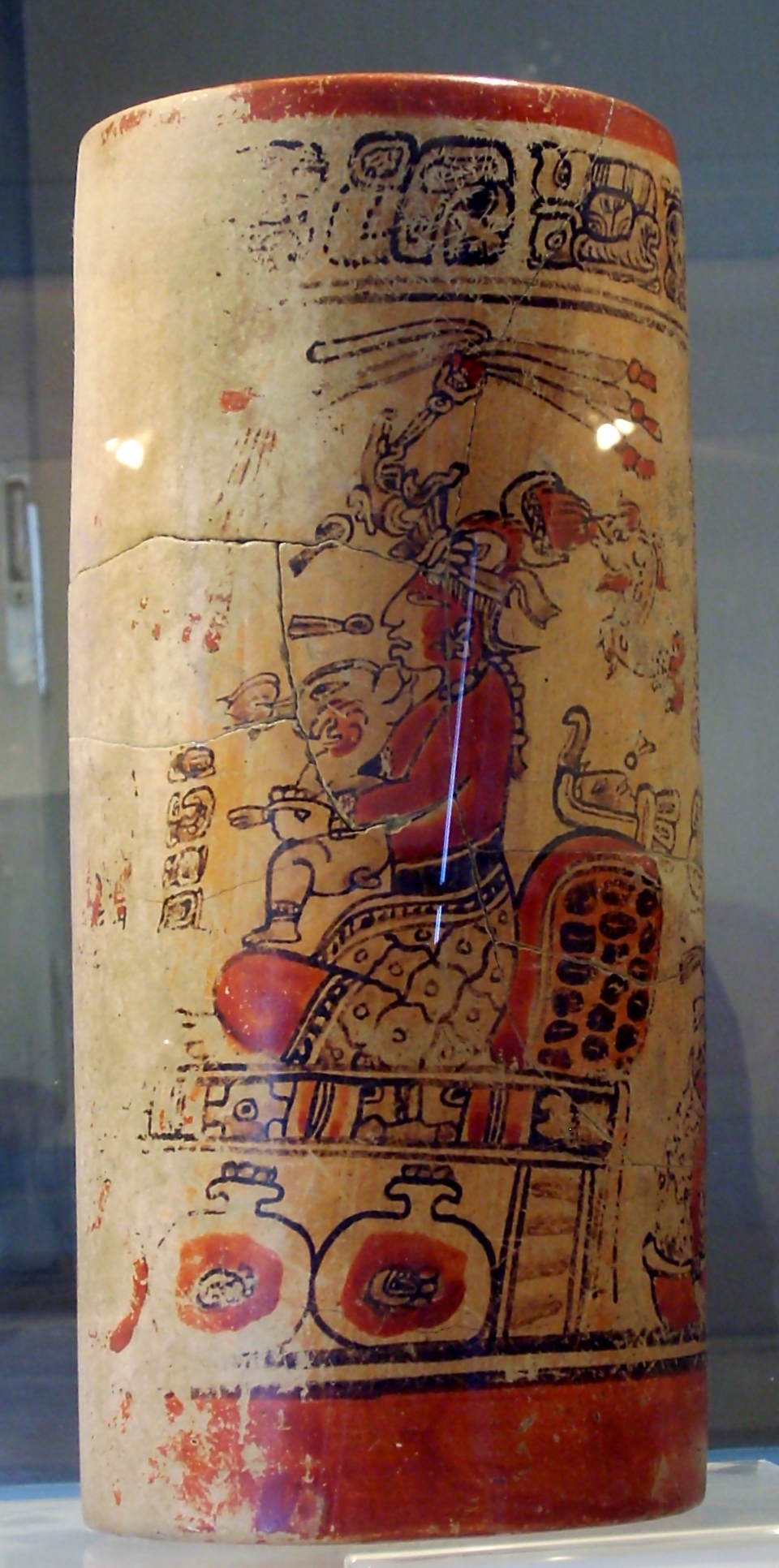
Maya ceramics are ceramics produced in the Pre-Columbian Maya culture of Mesoamerica. The vessels used different colors, sizes, and had varied purposes. Vessels for the elite could be painted with very detailed scenes, while utilitarian vessels were undecorated or much simpler. Elite pottery, usually in the form of straight-sided beakers called "vases", used for drinking, was placed in burials, giving a number of survivals in good condition. Individual examples include the Princeton Vase and the Fenton Vase.
Used for a plethora of daily activities, such as the storage of food and beverages, ceramics were also a canvas of commemoration. There were three main types of ceramics used in daily life: bowls, plates, and cylinders. They were often monochrome, meaning that only one type of mineral slip was used. Polychrome pottery was more complex in nature and therefore more commonly used by the elite. Not only was polychrome pottery used as decoration, it was also used as a form of social currency—a physical display of status and others' approval.
As time progressed, various features were added to ceramics to go beyond the fundamental needs of vessels; For example, pellets were put in larger bowls to not only serve as something to hold food, but would also become instruments used in the same feasts.
Archaeological evidence has been found that suggests ceramics were used for industrial purposes. The discovery of highly uniform ceramic cylinders along with tools used in the production of salt indicate that the ceramics were used to mass-produce salt from brine.
Surveys of Maya ceramics a major part of the ongoing controversy over the degree of elite political control over aspects the subsistence economy, the extent of economic centralization, and how it reinforces power (a common debate in the archaeology of complex societies).
As defined and used by Southwestern archaeologists, a ware is "a large grouping of pottery types which has little temporal or spatial implication but consists of stylistically varied types that are similar technologically and in method of manufacture", and "a defined ware is a ceramic assemblage in which all attributes of paste composition (with the possible exception of temper) and of surface finish remain constant." Generally each pottery classification and terminology system then becomes rather specific to a particular archaeological site and/or period.
A classification system can be epistemologically useful:
What does a ceramic system “mean”? Most obviously, it means that Postclassic Petén potters recognized and adhered to a decorative canon—a set of rules—for design structure, layout, and colors. Vessel forms and proportions varied from ware to ware and settlement to settlement, but the principles that structured what kinds of decoration were to be applied, and where and how, were strictly adhered to in at least three production resource-groups (minimally defined by paste compositions) throughout the lakes area (approximately seventy-five kilometers east–west) over three hundred years. In addition, we were eventually able to successfully predict the decorative types we would find (which would otherwise be a process of categorization) in each ceramic group.
Maya ceramics
Maya ceramics are ceramics produced in the Pre-Columbian Maya culture of Mesoamerica. The vessels used different colors, sizes, and had varied purposes. Vessels for the elite could be painted with very detailed scenes, while utilitarian vessels were undecorated or much simpler. Elite pottery, usually in the form of straight-sided beakers called "vases", used for drinking, was placed in burials, giving a number of survivals in good condition. Individual examples include the Princeton Vase and the Fenton Vase.
Used for a plethora of daily activities, such as the storage of food and beverages, ceramics were also a canvas of commemoration. There were three main types of ceramics used in daily life: bowls, plates, and cylinders. They were often monochrome, meaning that only one type of mineral slip was used. Polychrome pottery was more complex in nature and therefore more commonly used by the elite. Not only was polychrome pottery used as decoration, it was also used as a form of social currency—a physical display of status and others' approval.
As time progressed, various features were added to ceramics to go beyond the fundamental needs of vessels; For example, pellets were put in larger bowls to not only serve as something to hold food, but would also become instruments used in the same feasts.
Archaeological evidence has been found that suggests ceramics were used for industrial purposes. The discovery of highly uniform ceramic cylinders along with tools used in the production of salt indicate that the ceramics were used to mass-produce salt from brine.
Surveys of Maya ceramics a major part of the ongoing controversy over the degree of elite political control over aspects the subsistence economy, the extent of economic centralization, and how it reinforces power (a common debate in the archaeology of complex societies).
As defined and used by Southwestern archaeologists, a ware is "a large grouping of pottery types which has little temporal or spatial implication but consists of stylistically varied types that are similar technologically and in method of manufacture", and "a defined ware is a ceramic assemblage in which all attributes of paste composition (with the possible exception of temper) and of surface finish remain constant." Generally each pottery classification and terminology system then becomes rather specific to a particular archaeological site and/or period.
A classification system can be epistemologically useful:
What does a ceramic system “mean”? Most obviously, it means that Postclassic Petén potters recognized and adhered to a decorative canon—a set of rules—for design structure, layout, and colors. Vessel forms and proportions varied from ware to ware and settlement to settlement, but the principles that structured what kinds of decoration were to be applied, and where and how, were strictly adhered to in at least three production resource-groups (minimally defined by paste compositions) throughout the lakes area (approximately seventy-five kilometers east–west) over three hundred years. In addition, we were eventually able to successfully predict the decorative types we would find (which would otherwise be a process of categorization) in each ceramic group.
Recent media
Recent media