



Community hub
Recent from talks
Knowledge base stats:
Talk channels stats:
Members stats:
Mayfair
Mayfair is an affluent area of Westminster, London, England, in the City of Westminster. It is in Central London and part of the West End. It is between Oxford Street, Regent Street, Piccadilly and Park Lane and one of the most expensive districts in the world.
The area was originally part of the manor of Eia and remained largely rural until the early 18th century. It became well known for the annual May Fair that took place from 1686 to 1764 in what is now Shepherd Market. Over the years, the fair grew increasingly downmarket and unpleasant, and it became a public nuisance. The Grosvenor family (who became Dukes of Westminster) acquired the land through marriage and began to develop it under the direction of Thomas Barlow. The work included Hanover Square, Berkeley Square and Grosvenor Square, which were surrounded by high-quality houses, and St George's Hanover Square Church.
By the end of the 18th century, most of Mayfair had been rebuilt with high-value housing for the upper class; unlike some nearby areas of London, it has never lost its affluent status. The decline of the British aristocracy in the early 20th century led to the area becoming more commercial, with many houses converted into offices for corporate headquarters and various embassies. Mayfair retains a substantial quantity of high-end residential property, upmarket shops and restaurants, and luxury hotels along Piccadilly and Park Lane. Its prestigious status has been commemorated by being the most expensive property square on the London Monopoly board.
Mayfair is in the City of Westminster, and mainly consists of the historical Grosvenor estate and the Albemarle, Berkeley, Burlington, and Curzon estates. It is bordered on the west by Park Lane, north by Oxford Street, east by Regent Street, and the south by Piccadilly. Beyond the bounding roads, to the north is Marylebone, to the east Soho, and to the southwest Knightsbridge and Belgravia.
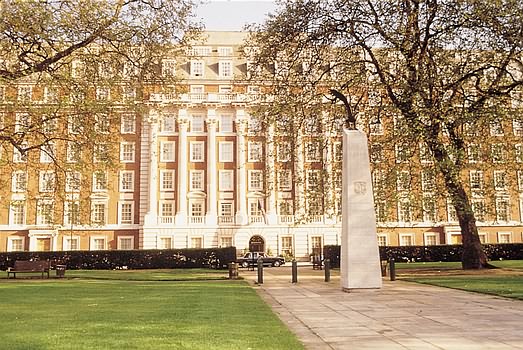
Mayfair is surrounded by parkland; Hyde Park and Green Park run along its boundary. The 8-acre (3.2 ha) Grosvenor Square is roughly in the centre of Mayfair, and its centrepiece, containing numerous expensive and desirable properties.
Following analysis of the alignment of Roman roads, it has been speculated that the Romans settled in the area before establishing Londinium. Whitaker's Almanack suggested that Aulus Plautius built a fort here during the Roman conquest of Britain in AD 43 while waiting for Claudius. The theory was developed in 1993, with a proposal that a town grew outside the fort but was later abandoned as it was too far from the River Thames. The proposal has been disputed because of lack of archaeological evidence. If there was a fort, it is believed the perimeter would have been where the modern Green Street, North Audley Street, Upper Grosvenor Street and Park Lane now are, and that Park Street would have been the main road through the centre. This area was the manor of Eia in the Domesday Book, and owned by Geoffrey de Mandeville after the Norman Conquest. It was subsequently given to the Abbey of Westminster, who owned it until 1536 when it was taken over by King Henry VIII during the dissolution of the monasteries.
Mayfair consisted mainly of open fields until development began in the Shepherd Market area around 1686–88 to accommodate the May Fair, which had moved from Haymarket in St James's because of overcrowding. There were some buildings before 1686. A cottage in Stanhope Row, dating from 1618, was destroyed in the Blitz in late 1940. A 17th-century English Civil War fortification established in what is now Mount Street was known as Oliver's Mount by the 18th century.
The May Fair was held every year at Great Brookfield (which is now part of Curzon Street and Shepherd Market) from 1 to 14 May. It was established during the reign of Edward I in open fields beyond St. James. The fair was recorded as "Saint James's fayer by Westminster" in 1560. It was postponed in 1603 because of plague, but otherwise continued throughout the 17th century. In 1686, the fair moved to what is now Mayfair. By the 18th century, it had attracted showmen, jugglers and fencers and numerous fairground attractions. Popular attractions included bare-knuckle fighting, semolina-eating contests and women's foot racing.
Hub AI
Mayfair AI simulator
(@Mayfair_simulator)
Mayfair
Mayfair is an affluent area of Westminster, London, England, in the City of Westminster. It is in Central London and part of the West End. It is between Oxford Street, Regent Street, Piccadilly and Park Lane and one of the most expensive districts in the world.
The area was originally part of the manor of Eia and remained largely rural until the early 18th century. It became well known for the annual May Fair that took place from 1686 to 1764 in what is now Shepherd Market. Over the years, the fair grew increasingly downmarket and unpleasant, and it became a public nuisance. The Grosvenor family (who became Dukes of Westminster) acquired the land through marriage and began to develop it under the direction of Thomas Barlow. The work included Hanover Square, Berkeley Square and Grosvenor Square, which were surrounded by high-quality houses, and St George's Hanover Square Church.
By the end of the 18th century, most of Mayfair had been rebuilt with high-value housing for the upper class; unlike some nearby areas of London, it has never lost its affluent status. The decline of the British aristocracy in the early 20th century led to the area becoming more commercial, with many houses converted into offices for corporate headquarters and various embassies. Mayfair retains a substantial quantity of high-end residential property, upmarket shops and restaurants, and luxury hotels along Piccadilly and Park Lane. Its prestigious status has been commemorated by being the most expensive property square on the London Monopoly board.
Mayfair is in the City of Westminster, and mainly consists of the historical Grosvenor estate and the Albemarle, Berkeley, Burlington, and Curzon estates. It is bordered on the west by Park Lane, north by Oxford Street, east by Regent Street, and the south by Piccadilly. Beyond the bounding roads, to the north is Marylebone, to the east Soho, and to the southwest Knightsbridge and Belgravia.
Mayfair is surrounded by parkland; Hyde Park and Green Park run along its boundary. The 8-acre (3.2 ha) Grosvenor Square is roughly in the centre of Mayfair, and its centrepiece, containing numerous expensive and desirable properties.
Following analysis of the alignment of Roman roads, it has been speculated that the Romans settled in the area before establishing Londinium. Whitaker's Almanack suggested that Aulus Plautius built a fort here during the Roman conquest of Britain in AD 43 while waiting for Claudius. The theory was developed in 1993, with a proposal that a town grew outside the fort but was later abandoned as it was too far from the River Thames. The proposal has been disputed because of lack of archaeological evidence. If there was a fort, it is believed the perimeter would have been where the modern Green Street, North Audley Street, Upper Grosvenor Street and Park Lane now are, and that Park Street would have been the main road through the centre. This area was the manor of Eia in the Domesday Book, and owned by Geoffrey de Mandeville after the Norman Conquest. It was subsequently given to the Abbey of Westminster, who owned it until 1536 when it was taken over by King Henry VIII during the dissolution of the monasteries.
Mayfair consisted mainly of open fields until development began in the Shepherd Market area around 1686–88 to accommodate the May Fair, which had moved from Haymarket in St James's because of overcrowding. There were some buildings before 1686. A cottage in Stanhope Row, dating from 1618, was destroyed in the Blitz in late 1940. A 17th-century English Civil War fortification established in what is now Mount Street was known as Oliver's Mount by the 18th century.
The May Fair was held every year at Great Brookfield (which is now part of Curzon Street and Shepherd Market) from 1 to 14 May. It was established during the reign of Edward I in open fields beyond St. James. The fair was recorded as "Saint James's fayer by Westminster" in 1560. It was postponed in 1603 because of plague, but otherwise continued throughout the 17th century. In 1686, the fair moved to what is now Mayfair. By the 18th century, it had attracted showmen, jugglers and fencers and numerous fairground attractions. Popular attractions included bare-knuckle fighting, semolina-eating contests and women's foot racing.