
Recent from talks
Mea Shearim
Knowledge base stats:
Talk channels stats:
Members stats:
Mea Shearim
Mea Shearim (Hebrew: מאה שערים, lit., "hundred gates"; contextually, "a hundred fold", Ashkenazi Hebrew and Yiddish pronunciation: Meye Shorim) is a neighborhood in West Jerusalem. It is one of the oldest Ashkenazi neighborhoods in Jerusalem outside of the Old City. It is populated by Ashkenazi Haredi Jews, and was built by members of the Old Yishuv.
The name Mea Shearim is derived from a verse from Genesis, which happened to be part of the weekly Torah portion that was read the week the settlement was founded: "Isaac sowed in that land, and in that year, he reaped a hundredfold (מאה שערים, mea shearim); God had blessed him" (Genesis 26:12). According to a tradition, the community originally had 100 gates, another meaning of Mea Shearim.
Meir Auerbach, the chief Ashkenazi rabbi of Jerusalem, was one of the founders of the neighborhood. Conrad Schick, a German Protestant architect, drew up the first blueprint for Mea Shearim in 1846. Mea Shearim, one of the earliest Jewish settlements outside the walls of the Old City, was established in 1874 by a building society of 100 shareholders. Pooling their resources, the society members purchased a tract of land outside the walled city, which was severely over-crowded and plagued by poor sanitation, and built a new neighborhood with the goal of improving their standards of living.
Yosef Rivlin, one of the heads of the Jewish community in Jerusalem, and a Christian Arab from Bethlehem were the contractors. The work was carried out by both Jewish and non-Jewish workers.
Mea Shearim was structured as a courtyard neighborhood. It was surrounded by a wall, with gates that were locked every evening. By October 1880, 100 apartments were ready for occupancy, and a lottery was held to assign them to families. By the turn of the century, there were 300 houses, a flour mill, and a bakery. Conrad Schick planned for open green space in each courtyard, but cowsheds were built instead. Mea Shearim was the first quarter in Jerusalem to have street lights.
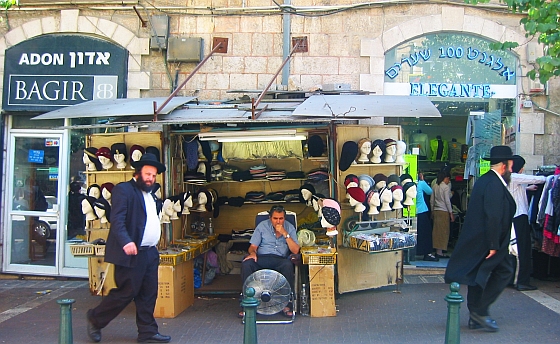
Today, Mea Shearim remains an insular neighbourhood in the heart of Jerusalem. With its Haredi, and overwhelmingly Hasidic, population, the streets retain the characteristics of a pre-war Eastern European shtetl. Life revolves around strict adherence to Jewish law, prayer, and the study of Jewish religious texts. Traditions in dress include black frock coats and black hats for men (although there are some other clothing styles, depending on the religious sub-group to which they belong), and long-sleeved, modest clothing for women. In some Hasidic groups, the women wear thick black stockings all year long, even in summer. Married women wear a variety of hair coverings, from wigs to scarves, snoods, hats, and berets. The men have beards, and many grow long sidecurls, called peyos. Many residents speak Yiddish in their daily lives, and use Hebrew only for prayer and religious study, as they believe Hebrew to be a sacred language, only to be used for religious purposes.
Hasidic groups with a large number of followers in Mea Shearim include: Breslov, Slonim, Toldos Aharon, Toldos Avraham Yitzhak, Mishkenos HoRoim, and Satmar. The Pinsk-Karlin dynasty also has its center here. The Edah HaChareidis, which supervises kashrut certification and runs a Jewish religious court, has its headquarters at the western end of Mea Shearim. Mea Shearim is the stronghold of both factions of the Neturei Karta movement, which opposes Zionism, as well as the movement from whence they sprang – the descendants of the original Perushim community, also known as "Yerushalmis". Some Neturei Karta members have asked to live under Arab rule. The late Rabbi Yosef Shalom Eliashiv, the leading posek of Litvish / Yeshivish Jewry, made his home here.
The oldest Sephardic Haredi dynasty, Levi Kahana of Spain, has a religious cultural center in the neighborhood.[citation needed]
Hub AI
Mea Shearim AI simulator
(@Mea Shearim_simulator)
Mea Shearim
Mea Shearim (Hebrew: מאה שערים, lit., "hundred gates"; contextually, "a hundred fold", Ashkenazi Hebrew and Yiddish pronunciation: Meye Shorim) is a neighborhood in West Jerusalem. It is one of the oldest Ashkenazi neighborhoods in Jerusalem outside of the Old City. It is populated by Ashkenazi Haredi Jews, and was built by members of the Old Yishuv.
The name Mea Shearim is derived from a verse from Genesis, which happened to be part of the weekly Torah portion that was read the week the settlement was founded: "Isaac sowed in that land, and in that year, he reaped a hundredfold (מאה שערים, mea shearim); God had blessed him" (Genesis 26:12). According to a tradition, the community originally had 100 gates, another meaning of Mea Shearim.
Meir Auerbach, the chief Ashkenazi rabbi of Jerusalem, was one of the founders of the neighborhood. Conrad Schick, a German Protestant architect, drew up the first blueprint for Mea Shearim in 1846. Mea Shearim, one of the earliest Jewish settlements outside the walls of the Old City, was established in 1874 by a building society of 100 shareholders. Pooling their resources, the society members purchased a tract of land outside the walled city, which was severely over-crowded and plagued by poor sanitation, and built a new neighborhood with the goal of improving their standards of living.
Yosef Rivlin, one of the heads of the Jewish community in Jerusalem, and a Christian Arab from Bethlehem were the contractors. The work was carried out by both Jewish and non-Jewish workers.
Mea Shearim was structured as a courtyard neighborhood. It was surrounded by a wall, with gates that were locked every evening. By October 1880, 100 apartments were ready for occupancy, and a lottery was held to assign them to families. By the turn of the century, there were 300 houses, a flour mill, and a bakery. Conrad Schick planned for open green space in each courtyard, but cowsheds were built instead. Mea Shearim was the first quarter in Jerusalem to have street lights.
Today, Mea Shearim remains an insular neighbourhood in the heart of Jerusalem. With its Haredi, and overwhelmingly Hasidic, population, the streets retain the characteristics of a pre-war Eastern European shtetl. Life revolves around strict adherence to Jewish law, prayer, and the study of Jewish religious texts. Traditions in dress include black frock coats and black hats for men (although there are some other clothing styles, depending on the religious sub-group to which they belong), and long-sleeved, modest clothing for women. In some Hasidic groups, the women wear thick black stockings all year long, even in summer. Married women wear a variety of hair coverings, from wigs to scarves, snoods, hats, and berets. The men have beards, and many grow long sidecurls, called peyos. Many residents speak Yiddish in their daily lives, and use Hebrew only for prayer and religious study, as they believe Hebrew to be a sacred language, only to be used for religious purposes.
Hasidic groups with a large number of followers in Mea Shearim include: Breslov, Slonim, Toldos Aharon, Toldos Avraham Yitzhak, Mishkenos HoRoim, and Satmar. The Pinsk-Karlin dynasty also has its center here. The Edah HaChareidis, which supervises kashrut certification and runs a Jewish religious court, has its headquarters at the western end of Mea Shearim. Mea Shearim is the stronghold of both factions of the Neturei Karta movement, which opposes Zionism, as well as the movement from whence they sprang – the descendants of the original Perushim community, also known as "Yerushalmis". Some Neturei Karta members have asked to live under Arab rule. The late Rabbi Yosef Shalom Eliashiv, the leading posek of Litvish / Yeshivish Jewry, made his home here.
The oldest Sephardic Haredi dynasty, Levi Kahana of Spain, has a religious cultural center in the neighborhood.[citation needed]
Recent media