


Community hub
Recent from talks
Contribute something to knowledge base
Content stats: 0 posts, 0 articles, 1 media, 0 notes
Members stats: 0 subscribers, 0 contributors, 0 moderators, 0 supporters
Subscribers
Supporters
Contributors
Moderators
Hub AI
Medical laboratory AI simulator
(@Medical laboratory_simulator)
Hub AI
Medical laboratory AI simulator
(@Medical laboratory_simulator)
Medical laboratory
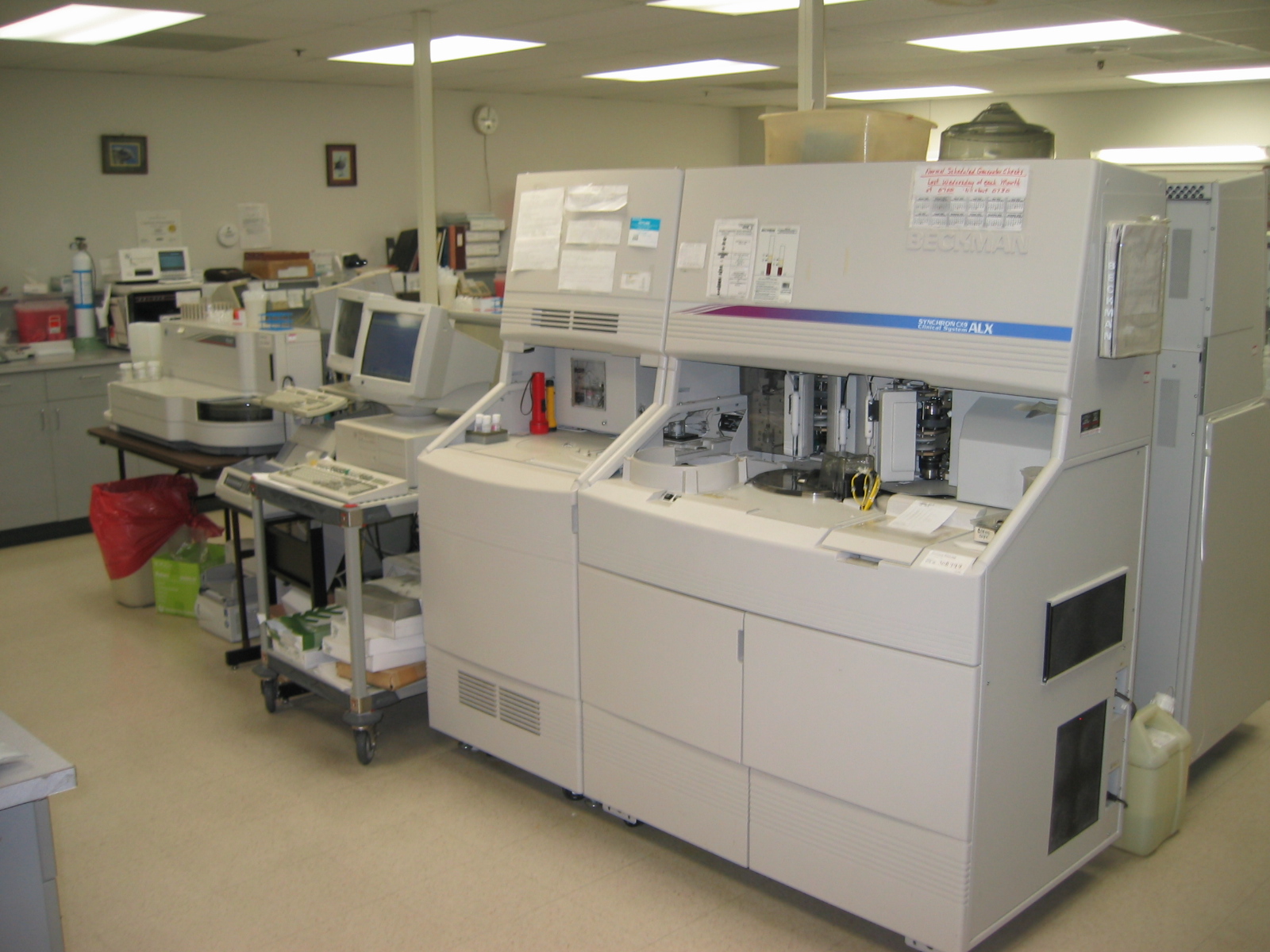
A medical laboratory or clinical laboratory is a laboratory where tests are conducted out on clinical specimens to obtain information about the health of a patient to aid in diagnosis, treatment, and prevention of disease. Clinical medical laboratories are an example of applied science, as opposed to research laboratories that focus on basic science, such as found in some academic institutions.
Medical laboratories vary in size and complexity and so offer a variety of testing services. More comprehensive services can be found in acute-care hospitals and medical centers, where 70% of clinical decisions are based on laboratory testing. Doctors offices and clinics, as well as skilled nursing and long-term care facilities, may have laboratories that provide more basic testing services. Commercial medical laboratories operate as independent businesses and provide testing that is otherwise not provided in other settings due to low test volume or complexity.
In hospitals and other patient-care settings, laboratory medicine is provided by the Department of Pathology and Medical Laboratory, and generally divided into two sections, each of which will be subdivided into multiple specialty areas. The two sections are:
Layouts of clinical laboratories in health institutions vary greatly from one facility to another. For instance, some health facilities have a single laboratory for the microbiology section, while others have a separate lab for each specialty area.
The testing in the laboratory is traditionally categorized by the clinical purpose of the test, which determines how the test should be used throughout the spectrum of diagnosis and care. There are four major categories namely screening tests, diagnostic tests, monitoring tests and follow-up tests.
Screening tests are offered to the asymptomatic people to reveal possible diseases. On the contrary, diagnostic tests are used to prove or disapprove certain conditions. To follow the course of the disease or the reaction to treatment, monitoring tests are presented. Lastly, there are tests during the follow-up to determine the results following treatment.
The following is an example of a typical breakdown of the responsibilities of each area:
The staff of clinical laboratories may include:
Medical laboratory
A medical laboratory or clinical laboratory is a laboratory where tests are conducted out on clinical specimens to obtain information about the health of a patient to aid in diagnosis, treatment, and prevention of disease. Clinical medical laboratories are an example of applied science, as opposed to research laboratories that focus on basic science, such as found in some academic institutions.
Medical laboratories vary in size and complexity and so offer a variety of testing services. More comprehensive services can be found in acute-care hospitals and medical centers, where 70% of clinical decisions are based on laboratory testing. Doctors offices and clinics, as well as skilled nursing and long-term care facilities, may have laboratories that provide more basic testing services. Commercial medical laboratories operate as independent businesses and provide testing that is otherwise not provided in other settings due to low test volume or complexity.
In hospitals and other patient-care settings, laboratory medicine is provided by the Department of Pathology and Medical Laboratory, and generally divided into two sections, each of which will be subdivided into multiple specialty areas. The two sections are:
Layouts of clinical laboratories in health institutions vary greatly from one facility to another. For instance, some health facilities have a single laboratory for the microbiology section, while others have a separate lab for each specialty area.
The testing in the laboratory is traditionally categorized by the clinical purpose of the test, which determines how the test should be used throughout the spectrum of diagnosis and care. There are four major categories namely screening tests, diagnostic tests, monitoring tests and follow-up tests.
Screening tests are offered to the asymptomatic people to reveal possible diseases. On the contrary, diagnostic tests are used to prove or disapprove certain conditions. To follow the course of the disease or the reaction to treatment, monitoring tests are presented. Lastly, there are tests during the follow-up to determine the results following treatment.
The following is an example of a typical breakdown of the responsibilities of each area:
The staff of clinical laboratories may include:
Recent media
Recent media