
Recent from talks
MeerKAT
Knowledge base stats:
Talk channels stats:
Members stats:
MeerKAT
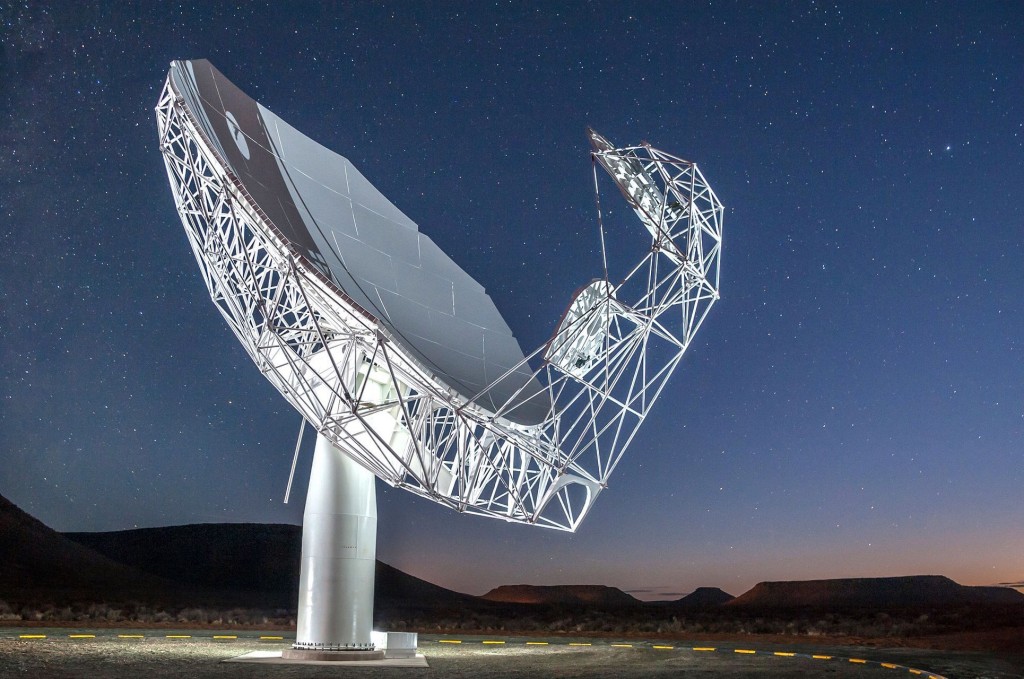
MeerKAT, originally the Karoo Array Telescope, is a radio telescope consisting of 64 antennas in the Meerkat National Park, in the Northern Cape of South Africa. In 2003, South Africa submitted an expression of interest to host the Square Kilometre Array (SKA) Radio Telescope in Africa, and the locally designed and built MeerKAT was incorporated into the first phase of the SKA. MeerKAT was launched in 2018. MeerKAT is located inside a radio quiet zone within the park.
Along with the Hydrogen Epoch of Reionization Array (HERA), also in South Africa, and two radio telescopes in Western Australia, the Australian SKA Pathfinder (ASKAP) and the Murchison Widefield Array (MWA), the MeerKAT is one of four precursors to the final SKA.
MeerKAT was originally planned to contain 20 receptors, and was known as the Karoo Array Telescope. However, the South African government increased the budget to allow for 64 receptors, which prompted the rename to MeerKAT, meaning “more of KAT”.
Construction of the 64-dish MeerKAT array took place from 2014 to 2018 and was one of the largest scientific projects in South Africa. The telescope was officially inaugurated by Deputy President David Mabuza on July 13, 2018. In 2023, the MeerKAT team were awarded the Royal Astronomical Society's 2023 Group Achievement Award because of breakthrough observations in just a short period of operation, including large-scale radio bubbles around Sagittarius A, and radio afterglow from a neutron star merger event.
The MeerKAT is a precursor for the Square Kilometer Array (SKA) telescope, as are the Hydrogen Epoch of Reionization Array (HERA), the Australian SKA Pathfinder (ASKAP) and the Murchison Widefield Array (MWA). MeerKAT will be incorporated into SKA-Mid, a 197-dish array.
It is located on the SKA site in the Karoo, and is a pathfinder for SKA-mid technologies and science. It was designed by engineers within the South Africa Radio Astronomy Observatory and South African industries, and most of the hardware and software was sourced in South Africa. It comprises 64 antennas, each 13.5m in diameter, equipped with cryogenic receivers. The antennas have positions for four receivers, and one of the three vacant positions will be filled by S-band receivers provided by the Max Planck Institute for Radio Astronomy (MPIfR). The array configuration has 61% of the antennas located within a 1 km diameter circle, and the remaining 39% distributed out to a radius of 4 km.[citation needed]
The receiver outputs are digitised immediately at the antenna, and the digital data streams are transported to the Karoo Array Processor Building (KAPB) via buried optical fibres. The antenna signals are processed by the Correlator/Beamformer (CBF) digital signal processor. Data from the CBF is passed on to the Science Processor computer cluster and disk storage modules. The MeerKAT antenna data is also made available to a number of user-supplied digital backends via the CBF, including pulsar and fast radio burst (FRB) search engines, a precision pulsar timing system, and a SETI signal processor. A time and frequency reference (TFR) system provides clock and absolute time signals required by the digitisers and other telescope subsystems. This TFR system comprises two hydrogen maser clocks, two rubidium atomic clocks, a precise crystal oscillator, and a set of GNSS receiver systems for time transfer with UTC.[citation needed]
The massive computing and digital signal-processing systems located at the KAPB are housed in a large shielded chamber (or Faraday cage) to prevent radio signals from the equipment interfering with the sensitive radio receivers. The KAPB itself is partially buried below ground level to provide additional radio frequency interference (RFI) protection, and to provide temperature stability. The KAPB also houses a power conditioning facility for the entire site, including three diesel rotary UPS units that provide an uninterrupted power supply to the whole site.
Hub AI
MeerKAT AI simulator
(@MeerKAT_simulator)
MeerKAT
MeerKAT, originally the Karoo Array Telescope, is a radio telescope consisting of 64 antennas in the Meerkat National Park, in the Northern Cape of South Africa. In 2003, South Africa submitted an expression of interest to host the Square Kilometre Array (SKA) Radio Telescope in Africa, and the locally designed and built MeerKAT was incorporated into the first phase of the SKA. MeerKAT was launched in 2018. MeerKAT is located inside a radio quiet zone within the park.
Along with the Hydrogen Epoch of Reionization Array (HERA), also in South Africa, and two radio telescopes in Western Australia, the Australian SKA Pathfinder (ASKAP) and the Murchison Widefield Array (MWA), the MeerKAT is one of four precursors to the final SKA.
MeerKAT was originally planned to contain 20 receptors, and was known as the Karoo Array Telescope. However, the South African government increased the budget to allow for 64 receptors, which prompted the rename to MeerKAT, meaning “more of KAT”.
Construction of the 64-dish MeerKAT array took place from 2014 to 2018 and was one of the largest scientific projects in South Africa. The telescope was officially inaugurated by Deputy President David Mabuza on July 13, 2018. In 2023, the MeerKAT team were awarded the Royal Astronomical Society's 2023 Group Achievement Award because of breakthrough observations in just a short period of operation, including large-scale radio bubbles around Sagittarius A, and radio afterglow from a neutron star merger event.
The MeerKAT is a precursor for the Square Kilometer Array (SKA) telescope, as are the Hydrogen Epoch of Reionization Array (HERA), the Australian SKA Pathfinder (ASKAP) and the Murchison Widefield Array (MWA). MeerKAT will be incorporated into SKA-Mid, a 197-dish array.
It is located on the SKA site in the Karoo, and is a pathfinder for SKA-mid technologies and science. It was designed by engineers within the South Africa Radio Astronomy Observatory and South African industries, and most of the hardware and software was sourced in South Africa. It comprises 64 antennas, each 13.5m in diameter, equipped with cryogenic receivers. The antennas have positions for four receivers, and one of the three vacant positions will be filled by S-band receivers provided by the Max Planck Institute for Radio Astronomy (MPIfR). The array configuration has 61% of the antennas located within a 1 km diameter circle, and the remaining 39% distributed out to a radius of 4 km.[citation needed]
The receiver outputs are digitised immediately at the antenna, and the digital data streams are transported to the Karoo Array Processor Building (KAPB) via buried optical fibres. The antenna signals are processed by the Correlator/Beamformer (CBF) digital signal processor. Data from the CBF is passed on to the Science Processor computer cluster and disk storage modules. The MeerKAT antenna data is also made available to a number of user-supplied digital backends via the CBF, including pulsar and fast radio burst (FRB) search engines, a precision pulsar timing system, and a SETI signal processor. A time and frequency reference (TFR) system provides clock and absolute time signals required by the digitisers and other telescope subsystems. This TFR system comprises two hydrogen maser clocks, two rubidium atomic clocks, a precise crystal oscillator, and a set of GNSS receiver systems for time transfer with UTC.[citation needed]
The massive computing and digital signal-processing systems located at the KAPB are housed in a large shielded chamber (or Faraday cage) to prevent radio signals from the equipment interfering with the sensitive radio receivers. The KAPB itself is partially buried below ground level to provide additional radio frequency interference (RFI) protection, and to provide temperature stability. The KAPB also houses a power conditioning facility for the entire site, including three diesel rotary UPS units that provide an uninterrupted power supply to the whole site.
Recent media