Recent from talks
Nothing was collected or created yet.
Search for extraterrestrial intelligence
View on Wikipedia
The search for extraterrestrial intelligence (usually shortened as SETI) is an expression that refers to the diverse efforts and scientific projects intended to detect extraterrestrial signals, or any evidence of intelligent life beyond Earth.
Researchers use methods such as monitoring electromagnetic radiation, searching for optical signals, and investigating potential extraterrestrial artifacts for any signs of transmission from civilizations present on other planets.[1][2][3] Some initiatives have also attempted to send messages to hypothetical alien civilizations, such as NASA's Golden Record.[4]
Modern SETI research began in the early 20th century after the advent of radio, expanding with projects like Project Ozma, the Wow! signal detection, and the Breakthrough Listen initiative; a $100 million, 10-year attempt to detect signals from nearby stars, announced in 2015 by Stephen Hawking and Yuri Milner. Since the 1980s, international efforts have been ongoing, with community led projects such as SETI@home and Project Argus, engaging in analyzing data.[5] While SETI remains a respected scientific field, it often gets compared to conspiracy theory, UFO research, bringing unwarranted skepticism from the public, despite its reliance on rigorous scientific methods and verifiable data and research. Similar studies on Unidentified Aerial Phenomena (UAP) such as the Avi Loeb's Galileo Project have brought further attention to SETI research.
Despite decades of searching, no confirmed evidence of alien intelligence has been found, bringing criticism onto SETI for being 'overly hopeful'. Critics argue that SETI is speculative and unfalsifiable, while supporters see it as a crucial step in addressing the Fermi Paradox and understanding extraterrestrial technosignature.[6]
History
[edit]Early work
[edit]There have been many earlier searches for extraterrestrial intelligence within the Solar System. In 1896, Nikola Tesla suggested that an extreme version of his wireless electrical transmission system could be used to contact beings on Mars.[7] In 1899, while conducting experiments at his Colorado Springs experimental station, he thought he had detected a signal from Mars since an odd repetitive static signal seemed to cut off when Mars set in the night sky. Analysis of Tesla's research has led to a range of explanations including:
- Tesla simply misunderstood the new technology he was working with,[8]
- that he may have been observing signals from Marconi's European radio experiments,
- and even speculation that he could have picked up naturally occurring radio noise caused by a moon of Jupiter (Io) moving through the magnetosphere of Jupiter.[9]
In the early 1900s, Guglielmo Marconi, Lord Kelvin and David Peck Todd also stated their belief that radio could be used to contact Martians, with Marconi stating that his stations had also picked up potential Martian signals.[10][11]
On August 21–23, 1924, Mars entered an opposition closer to Earth than at any time in the century before or the next 80 years.[12] In the United States, a "National Radio Silence Day" was promoted during a 36-hour period from August 21–23, with all radios quiet for five minutes on the hour, every hour. At the United States Naval Observatory, a radio receiver was lifted 3 kilometres (1.9 miles) above the ground in a dirigible tuned to a wavelength between 8 and 9 km, using a "radio-camera" developed by Amherst College and Charles Francis Jenkins. The program was led by David Peck Todd with the military assistance of Admiral Edward W. Eberle (Chief of Naval Operations), with William F. Friedman (chief cryptographer of the United States Army), assigned to translate any potential Martian messages.[13][14]
A 1959 paper by Philip Morrison and Giuseppe Cocconi first pointed out the possibility of searching the microwave spectrum. It proposed frequencies and a set of initial targets.[15][16]
In 1960, Cornell University astronomer Frank Drake performed the first modern SETI experiment, named "Project Ozma" after the Queen of Oz in L. Frank Baum's fantasy books.[17] Drake used a radio telescope 26 metres (85 ft) in diameter at Green Bank, West Virginia, to examine the stars Tau Ceti and Epsilon Eridani near the 1.420 gigahertz marker frequency, a region of the radio spectrum dubbed the "water hole" due to its proximity to the hydrogen and hydroxyl radical spectral lines. A 400 kilohertz band around the marker frequency was scanned using a single-channel receiver with a bandwidth of 100 hertz. He found nothing of interest.
Soviet scientists took a strong interest in SETI during the 1960s and performed a number of searches with omnidirectional antennas in the hope of picking up powerful radio signals. Soviet astronomer Iosif Shklovsky wrote the pioneering book in the field, Universe, Life, Intelligence (1962), which was expanded upon by American astronomer Carl Sagan as the best-selling book Intelligent Life in the Universe (1966).[18]
In the March 1955 issue of Scientific American, John D. Kraus described an idea to scan the cosmos for natural radio signals using a flat-plane radio telescope equipped with a parabolic reflector. Within two years, his concept was approved for construction by Ohio State University. With a total of US$71,000 (equivalent to $794,880 in 2024) in grants from the National Science Foundation, construction began on an 8-hectare (20-acre) plot in Delaware, Ohio. This Ohio State University Radio Observatory telescope was called "Big Ear". Later, it began the world's first continuous SETI program, called the Ohio State University SETI program.
In 1971, NASA funded a SETI study that involved Drake, Barney Oliver of Hewlett-Packard Laboratories, and others. The resulting report proposed the construction of an Earth-based radio telescope array with 1,500 dishes known as "Project Cyclops". The price tag for the Cyclops array was US$10 billion. Cyclops was not built, but the report[19] formed the basis of much SETI work that followed.

The Ohio State SETI program gained fame on August 15, 1977, when Jerry Ehman, a project volunteer, witnessed a startlingly strong signal received by the telescope. He quickly circled the indication on a printout and scribbled the exclamation "Wow!" in the margin. Dubbed the Wow! signal, it is considered by some to be the best candidate for a radio signal from an artificial, extraterrestrial source ever discovered, but it has not been detected again in several additional searches.[20]
On 24 May 2023, a test extraterrestrial signal, in the form of a "coded radio signal from Mars", was transmitted to radio telescopes on Earth, according to a report in The New York Times.[21]
Sentinel, META, and BETA
[edit]In 1980, Carl Sagan, Bruce Murray, and Louis Friedman founded the U.S. Planetary Society, partly as a vehicle for SETI studies.[3]
In the early 1980s, Harvard University physicist Paul Horowitz took the next step and proposed the design of a spectrum analyzer specifically intended to search for SETI transmissions. Traditional desktop spectrum analyzers were of little use for this job, as they sampled frequencies using banks of analog filters and so were restricted in the number of channels they could acquire. However, modern integrated-circuit digital signal processing (DSP) technology could be used to build autocorrelation receivers to check far more channels. This work led in 1981 to a portable spectrum analyzer named "Suitcase SETI" that had a capacity of 131,000 narrow band channels. After field tests that lasted into 1982, Suitcase SETI was put into use in 1983 with the 26-meter (85 ft) Harvard/Smithsonian radio telescope at Oak Ridge Observatory in Harvard, Massachusetts. This project was named "Sentinel" and continued into 1985.
Even 131,000 channels were not enough to search the sky in detail at a fast rate, so Suitcase SETI was followed in 1985 by Project "META", for "Megachannel Extra-Terrestrial Assay". The META spectrum analyzer had a capacity of 8.4 million channels and a channel resolution of 0.05 hertz. An important feature of META was its use of frequency Doppler shift to distinguish between signals of terrestrial and extraterrestrial origin. The project was led by Horowitz with the help of the Planetary Society, and was partly funded by movie maker Steven Spielberg. A second such effort, META II, was begun in Argentina in 1990, to search the southern sky, receiving an equipment upgrade in 1996–1997.[22][23]
The follow-on to META was named "BETA", for "Billion-channel Extraterrestrial Assay", and it commenced observation on October 30, 1995. The heart of BETA's processing capability consisted of 63 dedicated fast Fourier transform (FFT) engines, each capable of performing a 222-point complex FFTs in two seconds, and 21 general-purpose personal computers equipped with custom digital signal processing boards. This allowed BETA to receive 250 million simultaneous channels with a resolution of 0.5 hertz per channel. It scanned through the microwave spectrum from 1.400 to 1.720 gigahertz in eight hops, with two seconds of observation per hop. An important capability of the BETA search was rapid and automatic re-observation of candidate signals, achieved by observing the sky with two adjacent beams, one slightly to the east and the other slightly to the west. A successful candidate signal would first transit the east beam, and then the west beam and do so with a speed consistent with Earth's sidereal rotation rate. A third receiver observed the horizon to veto signals of obvious terrestrial origin. On March 23, 1999, the 26-meter radio telescope on which Sentinel, META and BETA were based was blown over by strong winds and seriously damaged.[24] This forced the BETA project to cease operation.
MOP and Project Phoenix
[edit]
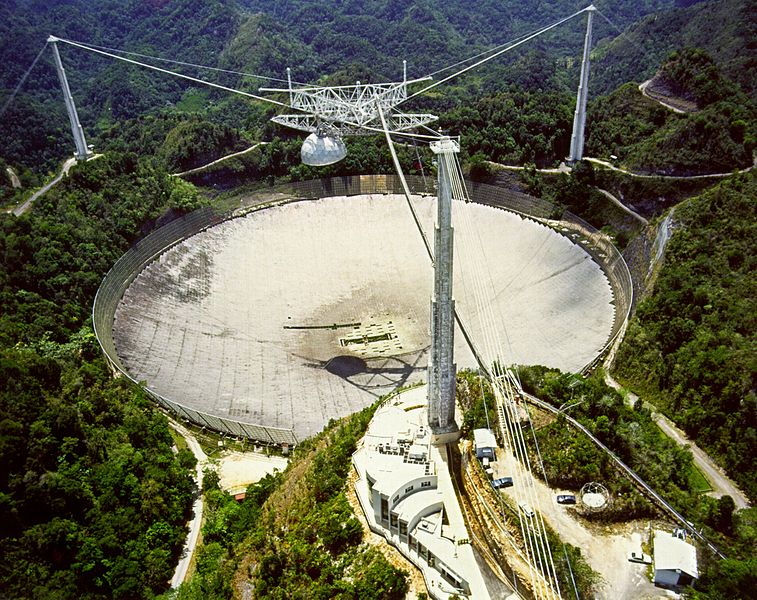
In 1978, the NASA SETI program had been heavily criticized by Senator William Proxmire, and funding for SETI research was removed from the NASA budget by Congress in 1981;[26] however, funding was restored in 1982, after Carl Sagan talked with Proxmire and convinced him of the program's value.[26] In 1992, the U.S. government funded an operational SETI program, in the form of the NASA Microwave Observing Program (MOP). MOP was planned as a long-term effort to conduct a general survey of the sky and also carry out targeted searches of 800 specific nearby stars. MOP was to be performed by radio antennas associated with the NASA Deep Space Network, as well as the 140-foot (43 m) radio telescope of the National Radio Astronomy Observatory at Green Bank, West Virginia and the 1,000-foot (300 m) radio telescope at the Arecibo Observatory in Puerto Rico. The signals were to be analyzed by spectrum analyzers, each with a capacity of 15 million channels. These spectrum analyzers could be grouped together to obtain greater capacity. Those used in the targeted search had a bandwidth of 1 hertz per channel, while those used in the sky survey had a bandwidth of 30 hertz per channel.
MOP drew the attention of the United States Congress, where the program met opposition[27] and canceled one year after its start.[26] SETI advocates continued without government funding, and in 1995 the nonprofit SETI Institute of Mountain View, California resurrected the MOP program under the name of Project "Phoenix", backed by private sources of funding. In 2012 it cost around $2 million per year to maintain SETI research at the SETI Institute and around 10 times that to support different SETI activities globally.[28] Project Phoenix, under the direction of Jill Tarter, was a continuation of the targeted search program from MOP and studied roughly 1,000 nearby Sun-like stars until approximately 2015.[29] From 1995 through March 2004, Phoenix conducted observations at the 64-meter (210 ft) Parkes radio telescope in Australia, the 140-foot (43 m) radio telescope of the National Radio Astronomy Observatory in Green Bank, West Virginia, and the 1,000-foot (300 m) radio telescope at the Arecibo Observatory in Puerto Rico. The project observed the equivalent of 800 stars over the available channels in the frequency range from 1200 to 3000 MHz. The search was sensitive enough to pick up transmitters with 1 GW EIRP to a distance of about 200 light-years.
Ongoing radio searches
[edit]
Many radio frequencies penetrate Earth's atmosphere quite well, and this led to radio telescopes that investigate the cosmos using large radio antennas. Furthermore, human endeavors emit considerable electromagnetic radiation as a byproduct of communications such as television and radio. These signals would be easy to recognize as artificial due to their repetitive nature and narrow bandwidths. Earth has been sending radio waves from broadcasts into space for over 100 years.[30] These signals have reached over 1,000 stars, most notably Vega, Aldebaran, Barnard's Star, Sirius, and Proxima Centauri. If intelligent alien life exists on any planet orbiting these nearby stars, these signals could be heard and deciphered, even though some of the signal is garbled by the Earth's ionosphere.
Many international radio telescopes are currently[when?] being used for radio SETI searches, including the Low Frequency Array (LOFAR) in Europe, the Murchison Widefield Array (MWA) in Australia, and the Lovell Telescope in the United Kingdom.[31]
Allen Telescope Array
[edit]The SETI Institute collaborated with the Radio Astronomy Laboratory at the Berkeley SETI Research Center to develop a specialized radio telescope array for SETI studies, similar to a mini-cyclops array. Formerly known as the One Hectare Telescope (1HT), the concept was renamed the "Allen Telescope Array" (ATA) after the project's benefactor, Paul Allen. Its sensitivity is designed to be equivalent to a single large dish more than 100 meters in diameter, if fully completed. Presently[when?], the array has 42 operational dishes at the Hat Creek Radio Observatory in rural northern California.[32][33]
The full array (ATA-350) is planned to consist of 350 or more offset-Gregorian radio dishes, each 6.1 meters (20 feet) in diameter. These dishes are the largest producible with commercially available satellite television dish technology. The ATA was planned for a 2007 completion date, at a cost of US$25 million. The SETI Institute provided money for building the ATA while University of California, Berkeley designed the telescope and provided operational funding. The first portion of the array (ATA-42) became operational in October 2007 with 42 antennas. The DSP system planned for ATA-350 is extremely ambitious. Completion of the full 350 element array will depend on funding and the technical results from ATA-42.
ATA-42 (ATA) is designed to allow multiple observers simultaneous access to the interferometer output at the same time. Typically, the ATA snapshot imager (used for astronomical surveys and SETI) is run in parallel with a beamforming system (used primarily for SETI).[34] ATA also supports observations in multiple synthesized pencil beams at once, through a technique known as "multibeaming". Multibeaming provides an effective filter for identifying false positives in SETI, since a very distant transmitter must appear at only one point on the sky.[35][36][37]
SETI Institute's Center for SETI Research (CSR) uses ATA in the search for extraterrestrial intelligence, observing 12 hours a day, 7 days a week. From 2007 to 2015, ATA identified hundreds of millions of technological signals. So far, all these signals have been assigned the status of noise or radio frequency interference because a) they appear to be generated by satellites or Earth-based transmitters, or b) they disappeared before the threshold time limit of ~1 hour.[38][39] Researchers in CSR are working on ways to reduce the threshold time limit, and to expand ATA's capabilities for detection of signals that may have embedded messages.[40]
Berkeley astronomers used the ATA to pursue several science topics, some of which might have transient SETI signals,[41][42][43] until 2011, when the collaboration between the University of California, Berkeley and the SETI Institute was terminated.
CNET published an article and pictures about the Allen Telescope Array (ATA) on December 12, 2008.[44][45]
In April 2011, the ATA entered an 8-month "hibernation" due to funding shortfalls. Regular operation of the ATA resumed on December 5, 2011.[46][47]
In 2012, the ATA was revitalized with a $3.6 million donation by Franklin Antonio, co-founder and Chief Scientist of QUALCOMM Incorporated.[48] This gift supported upgrades of all the receivers on the ATA dishes to have (2× to 10× over the range 1–8 GHz) greater sensitivity than before and supporting observations over a wider frequency range from 1–18 GHz, though initially the radio frequency electronics only go to 12 GHz. As of July 2013, the first of these receivers was installed and proven, with full installation on all 42 antennas being expected for June 2017. ATA is well suited to the search for extraterrestrial intelligence (SETI) and to discovery of astronomical radio sources, such as heretofore unexplained non-repeating, possibly extragalactic, pulses known as fast radio bursts or FRBs.[49][50]
SERENDIP
[edit]SERENDIP (Search for Extraterrestrial Radio Emissions from Nearby Developed Intelligent Populations) is a SETI program launched in 1979 by the Berkeley SETI Research Center.[51][52] SERENDIP takes advantage of ongoing "mainstream" radio telescope observations as a "piggy-back" or "commensal" program, using large radio telescopes including the NRAO 90m telescope at Green Bank and, formerly, the Arecibo 305m telescope. Rather than having its own observation program, SERENDIP analyzes deep space radio telescope data that it obtains while other astronomers are using the telescopes. The most recently deployed SERENDIP spectrometer, SERENDIP VI, was installed at both the Arecibo Telescope and the Green Bank Telescope in 2014–2015.[53]
Breakthrough Listen
[edit]Breakthrough Listen is a ten-year initiative with $100 million funding begun in July 2015 to actively search for intelligent extraterrestrial communications in the universe, in a substantially expanded way, using resources that had not previously been extensively used for the purpose.[54][55][56][3] It has been described as the most comprehensive search for alien communications to date.[55] The science program for Breakthrough Listen is based at Berkeley SETI Research Center,[57][58] located in the Astronomy Department[59] at the University of California, Berkeley.
Announced in July 2015, the project is observing for thousands of hours every year on two major radio telescopes, the Green Bank Observatory in West Virginia, and the Parkes Observatory in Australia.[60] Previously, only about 24 to 36 hours of telescope time per year were used in the search for alien life.[55] Furthermore, the Automated Planet Finder at Lick Observatory is searching for optical signals coming from laser transmissions. The massive data rates from the radio telescopes (24 GB/s at Green Bank) necessitated the construction of dedicated hardware at the telescopes to perform the bulk of the analysis.[61] Some of the data are also analyzed by volunteers in the SETI@home volunteer computing network.[60] Founder of modern SETI Frank Drake was one of the scientists on the project's advisory committee.[62][54][55]
In October 2019, Breakthrough Listen started a collaboration with scientists from the TESS team (Transiting Exoplanet Survey Satellite) to look for signs of advanced extraterrestrial life. Thousands of new planets found by TESS will be scanned for technosignatures by Breakthrough Listen partner facilities across the globe. Data from TESS monitoring of stars will also be searched for anomalies.[63]
FAST
[edit]China's 500 meter Aperture Spherical Telescope (FAST) lists detecting interstellar communication signals as part of its science mission. It is funded by the National Development and Reform Commission (NDRC) and managed by the National Astronomical observatories (NAOC) of the Chinese Academy of Sciences (CAS). FAST is the first radio observatory built with SETI as a core scientific goal.[64] FAST consists of a fixed 500 m (1,600 ft) diameter spherical dish constructed in a natural depression sinkhole caused by karst processes in the region. It is the world's largest filled-aperture radio telescope.[65] According to its website, FAST can search to 28 light-years, and is able to reach 1,400 stars. If the transmitter's radiated power were to be increased to 1,000,000 MW, FAST would be able to reach one million stars. This is compared to the former Arecibo 305 meter telescope detection distance of 18 light-years.[66]
On 14 June 2022, astronomers, working with China's FAST telescope, reported the possibility of having detected artificial (presumably alien) signals, but cautioned that further studies were required to determine if a natural radio interference may be the source.[67] More recently, on 18 June 2022, Dan Werthimer, chief scientist for several SETI-related projects, reportedly noted, "These signals are from radio interference; they are due to radio pollution from earthlings, not from E.T.".[68]
UCLA
[edit]Since 2016, University of California Los Angeles (UCLA) undergraduate and graduate students have been participating in radio searches for technosignatures with the Green Bank Telescope. Targets include the Kepler field, TRAPPIST-1, and solar-type stars.[69] The search is sensitive to Arecibo-class transmitters located within 420 light years of Earth and to transmitters that are 1,000 times more powerful than Arecibo located within 13,000 light years of Earth.[70]
Community SETI projects
[edit]
SETI@home
[edit]The SETI@home project used volunteer computing to analyze signals acquired by the SERENDIP project.
SETI@home was conceived by David Gedye along with Craig Kasnoff and is a popular volunteer computing project that was launched by the Berkeley SETI Research Center at the University of California, Berkeley, in May 1999. It was originally funded by The Planetary Society and Paramount Pictures, and later by the state of California. The project is run by director David P. Anderson and chief scientist Dan Werthimer. Any individual could become involved with SETI research by downloading the Berkeley Open Infrastructure for Network Computing (BOINC) software program, attaching to the SETI@home project, and allowing the program to run as a background process that uses idle computer power. The SETI@home program itself ran signal analysis on a "work unit" of data recorded from the central 2.5 MHz wide band of the SERENDIP IV instrument. After computation on the work unit was complete, the results were then automatically reported back to SETI@home servers at University of California, Berkeley. By June 28, 2009, the SETI@home project had over 180,000 active participants volunteering a total of over 290,000 computers. These computers gave SETI@home an average computational power of 617 teraFLOPS.[71] In 2004 radio source SHGb02+14a set off speculation in the media that a signal had been detected but researchers noted the frequency drifted rapidly and the detection on three SETI@home computers fell within random chance.[72][73]
By 2010, after 10 years of data collection, SETI@home had listened to that one frequency at every point of over 67 percent of the sky observable from Arecibo with at least three scans (out of the goal of nine scans), which covers about 20 percent of the full celestial sphere.[74] On March 31, 2020, with 91,454 active users, the project stopped sending out new work to SETI@home users, bringing this particular SETI effort to an indefinite hiatus.[75]
SETI Net
[edit]SETI Network was the only fully operational private search system.[76] The SETI Net station consisted of off-the-shelf, consumer-grade electronics to minimize cost and to allow this design to be replicated as simply as possible. It had a 3-meter parabolic antenna that could be directed in azimuth and elevation, an LNA that covered 100 MHz of the 1420 MHz spectrum, a receiver to reproduce the wideband audio, and a standard personal computer as the control device and for deploying the detection algorithms. The antenna could be pointed and locked to one sky location in Ra and DEC which enabling the system to integrate on it for long periods. The Wow! signal area was monitored for many long periods. All search data was collected and is available on the Internet archive.
SETI Net started operation in the early 1980s as a way to learn about the science of the search, and developed several software packages for the amateur SETI community. It provided an astronomical clock, a file manager to keep track of SETI data files, a spectrum analyzer optimized for amateur SETI, remote control of the station from the Internet, and other packages.
SETI Net went dark and was decommissioned on 2021-12-04. The collected data is available on their website.
The SETI League and Project Argus
[edit]Founded in 1994 in response to the United States Congress cancellation of the NASA SETI program, The SETI League, Incorporated is a membership-supported nonprofit organization with 1,500 members in 62 countries. This grass-roots alliance of amateur and professional radio astronomers is headed by executive director emeritus H. Paul Shuch, the engineer credited with developing the world's first commercial home satellite TV receiver. Many SETI League members are licensed radio amateurs and microwave experimenters. Others are digital signal processing experts and computer enthusiasts.
The SETI League pioneered the conversion of backyard satellite TV dishes 3 to 5 m (10–16 ft) in diameter into research-grade radio telescopes of modest sensitivity.[77] The organization concentrates on coordinating a global network of small, amateur-built radio telescopes under Project Argus, an all-sky survey seeking to achieve real-time coverage of the entire sky.[78] Project Argus was conceived as a continuation of the all-sky survey component of the late NASA SETI program (the targeted search having been continued by the SETI Institute's Project Phoenix). There are currently 143 Project Argus radio telescopes operating in 27 countries. Project Argus instruments typically exhibit sensitivity on the order of 10−23 Watts/square metre, or roughly equivalent to that achieved by the Ohio State University Big Ear radio telescope in 1977, when it detected the landmark "Wow!" candidate signal.[79]
The name "Argus" derives from the mythical Greek guard-beast who had 100 eyes, and could see in all directions at once. In the SETI context, the name has been used for radio telescopes in fiction (Arthur C. Clarke, "Imperial Earth"; Carl Sagan, "Contact"), was the name initially used for the NASA study ultimately known as "Cyclops," and is the name given to an omnidirectional radio telescope design being developed at the Ohio State University.[80]
Optical experiments
[edit]While most SETI sky searches have studied the radio spectrum, some SETI researchers have considered the possibility that alien civilizations might be using powerful lasers for interstellar communications at optical wavelengths.[81][82][83] The idea was first suggested by R. N. Schwartz and Charles Hard Townes in a 1961 paper published in the journal Nature titled "Interstellar and Interplanetary Communication by Optical Masers". However, the 1971 Cyclops study discounted the possibility of optical SETI, reasoning that construction of a laser system that could outshine the bright central star of a remote star system would be too difficult. In 1983, Townes published a detailed study of the idea in the United States journal Proceedings of the National Academy of Sciences,[84] which was met with interest by the SETI community.
There are two problems with optical SETI. The first problem is that lasers are highly "monochromatic", that is, they emit light only on one frequency, making it troublesome to figure out what frequency to look for.[85] However, emitting light in narrow pulses results in a broad spectrum of emission; the spread in frequency becomes higher as the pulse width becomes narrower, making it easier to detect an emission.
The other problem is that while radio transmissions can be broadcast in all directions, lasers are highly directional. Interstellar gas and dust is almost transparent to near infrared, so these signals can be seen from greater distances, but the extraterrestrial laser signals would need to be transmitted in the direction of Earth in order to be detected.[86][87]
Optical SETI supporters have conducted paper studies[88] of the effectiveness of using contemporary high-energy lasers and a ten-meter diameter mirror as an interstellar beacon. The analysis shows that an infrared pulse from a laser, focused into a narrow beam by such a mirror, would appear thousands of times brighter than the Sun to a distant civilization in the beam's line of fire. The Cyclops study proved incorrect in suggesting a laser beam would be inherently hard to see.
Such a system could be made to automatically steer itself through a target list, sending a pulse to each target at a constant rate. This would allow targeting of all Sun-like stars within a distance of 100 light-years. The studies have also described an automatic laser pulse detector system with a low-cost, two-meter mirror made of carbon composite materials, focusing on an array of light detectors. This automatic detector system could perform sky surveys to detect laser flashes from civilizations attempting contact.
Several optical SETI experiments are now in progress. A Harvard-Smithsonian group that includes Paul Horowitz designed a laser detector and mounted it on Harvard's 155-centimeter (61-inch) optical telescope. This telescope is currently being used for a more conventional star survey, and the optical SETI survey is "piggybacking" on that effort. Between October 1998 and November 1999, the survey inspected about 2,500 stars. Nothing that resembled an intentional laser signal was detected, but efforts continue. The Harvard-Smithsonian group is now working with Princeton University to mount a similar detector system on Princeton's 91-centimeter (36-inch) telescope. The Harvard and Princeton telescopes will be "ganged" to track the same targets at the same time, with the intent being to detect the same signal in both locations as a means of reducing errors from detector noise.
The Harvard-Smithsonian SETI group led by Professor Paul Horowitz built a dedicated all-sky optical survey system along the lines of that described above, featuring a 1.8-meter (72-inch) telescope. The new optical SETI survey telescope is being set up at the Oak Ridge Observatory in Harvard, Massachusetts.
The University of California, Berkeley, home of SERENDIP and SETI@home, is also conducting optical SETI searches and collaborates with the NIROSETI program. The optical SETI program at Breakthrough Listen was initially directed by Geoffrey Marcy, an extrasolar planet hunter, and it involves examination of records of spectra taken during extrasolar planet hunts for a continuous, rather than pulsed, laser signal. This survey uses the Automated Planet Finder 2.4-m telescope at the Lick Observatory, situated on the summit of Mount Hamilton, east of San Jose, California.[89] The other Berkeley optical SETI effort is being pursued by the Harvard-Smithsonian group and is being directed by Dan Werthimer of Berkeley, who built the laser detector for the Harvard-Smithsonian group. This survey uses a 76-centimeter (30-inch) automated telescope at Leuschner Observatory and an older laser detector built by Werthimer.
The SETI Institute also runs a program called 'Laser SETI' with an instrument composed of several cameras that continuously survey the entire night sky searching for millisecond singleton laser pulses of extraterrestrial origin.[90][91]
In January 2020, two Pulsed All-sky Near-infrared Optical SETI (PANOSETI) project telescopes were installed in the Lick Observatory Astrograph Dome. The project aims to commence a wide-field optical SETI search and continue prototyping designs for a full observatory. The installation can offer an "all-observable-sky" optical and wide-field near-infrared pulsed technosignature and astrophysical transient search for the northern hemisphere.[92][83]
In May 2017, astronomers reported studies related to laser light emissions from stars, as a way of detecting technology-related signals from an alien civilization. The reported studies included Tabby's Star (designated KIC 8462852 in the Kepler Input Catalog), an oddly dimming star in which its unusual starlight fluctuations may be the result of interference by an artificial megastructure, such as a Dyson swarm, made by such a civilization. No evidence was found for technology-related signals from KIC 8462852 in the studies.[93][94][95]
Quantum communications
[edit]In a 2020 paper, Berera examined sources of decoherence in the interstellar medium and made the observation that quantum coherence of photons in certain frequency bands could be sustained to interstellar distances. It was suggested this would allow for quantum communication at these distances. [96]
In a 2021 preprint, astronomer Michael Hipke described for the first time how one could search for quantum communication transmissions sent by ETI using existing telescope and receiver technology. He also provides arguments for why future searches of ETI should also target interstellar quantum communication networks.[97][98]
A 2022 paper by Arjun Berera and Jaime Calderón-Figueroa noted that interstellar quantum communication by other civilizations could be possible and may be advantageous, identifying some potential challenges and factors for detecting technosignatures. They may, for example, use X-ray photons for remotely established quantum communication and quantum teleportation as the communication mode.[99][100]
Search for extraterrestrial artifacts
[edit]The possibility of using interstellar messenger probes in the search for extraterrestrial intelligence was first suggested by Ronald N. Bracewell in 1960 (see Bracewell probe), and the technical feasibility of this approach was demonstrated by the British Interplanetary Society's starship study Project Daedalus in 1978. Starting in 1979, Robert Freitas advanced arguments[101][102][103] for the proposition that physical space-probes are a superior mode of interstellar communication to radio signals (see Voyager Golden Record).
In recognition that any sufficiently advanced interstellar probe in the vicinity of Earth could easily monitor the terrestrial Internet, 'Invitation to ETI' was established by Allen Tough in 1996, as a Web-based SETI experiment inviting such spacefaring probes to establish contact with humanity. The project's 100 signatories includes prominent physical, biological, and social scientists, as well as artists, educators, entertainers, philosophers and futurists. H. Paul Shuch, executive director emeritus of The SETI League, serves as the project's Principal Investigator.
Inscribing a message in matter and transporting it to an interstellar destination can be enormously more energy efficient than communication using electromagnetic waves if delays larger than light transit time can be tolerated.[104] That said, for simple messages such as "hello," radio SETI could be far more efficient.[105] If energy requirement is used as a proxy for technical difficulty, then a solarcentric Search for Extraterrestrial Artifacts (SETA)[106] may be a useful supplement to traditional radio or optical searches.[107][108]
Much like the "preferred frequency" concept in SETI radio beacon theory, the Earth-Moon or Sun-Earth libration orbits[109] might therefore constitute the most universally convenient parking places for automated extraterrestrial spacecraft exploring arbitrary stellar systems. A viable long-term SETI program may be founded upon a search for these objects.
In 1979, Freitas and Valdes conducted a photographic search of the vicinity of the Earth-Moon triangular libration points L4 and L5, and of the solar-synchronized positions in the associated halo orbits, seeking possible orbiting extraterrestrial interstellar probes, but found nothing to a detection limit of about 14th magnitude.[109] The authors conducted a second, more comprehensive photographic search for probes in 1982[110] that examined the five Earth-Moon Lagrangian positions and included the solar-synchronized positions in the stable L4/L5 libration orbits, the potentially stable nonplanar orbits near L1/L2, Earth-Moon L3, and also L2 in the Sun-Earth system. Again no extraterrestrial probes were found to limiting magnitudes of 17–19th magnitude near L3/L4/L5, 10–18th magnitude for L1/L2, and 14–16th magnitude for Sun-Earth L2.
In June 1983, Valdes and Freitas used the 26 m radiotelescope at Hat Creek Radio Observatory to search for the tritium hyperfine line at 1516 MHz from 108 assorted astronomical objects, with emphasis on 53 nearby stars including all visible stars within a 20 light-year radius. The tritium frequency was deemed highly attractive for SETI work because (1) the isotope is cosmically rare, (2) the tritium hyperfine line is centered in the SETI water hole region of the terrestrial microwave window, and (3) in addition to beacon signals, tritium hyperfine emission may occur as a byproduct of extensive nuclear fusion energy production by extraterrestrial civilizations. The wideband- and narrowband-channel observations achieved sensitivities of 5–14×10−21 W/m2/channel and 0.7–2×10⁻²⁴ W/m2/channel, respectively, but no detections were made.[111]
Others have speculated that we might find traces of past civilizations in our very own Solar System, on planets like Venus or Mars, although the traces would be found most likely underground.[112][113]
Technosignatures
[edit]Technosignatures, including all signs of technology, are a recent avenue in the search for extraterrestrial intelligence.[114][3] Technosignatures may originate from various sources, from megastructures such as Dyson spheres[115][116] and space mirrors or space shaders[117] to the atmospheric contamination created by an industrial civilization,[118] or city lights on extrasolar planets, and may be detectable in the future with large hypertelescopes.[119]
Technosignatures can be divided into three broad categories: astroengineering projects, signals of planetary origin, and spacecraft within and outside the Solar System.
An astroengineering installation such as a Dyson sphere, designed to convert all of the incident radiation of its host star into energy, could be detected through the observation of an infrared excess from a solar analog star,[120] or by the star's apparent disappearance in the visible spectrum over several years.[121] After examining some 100,000 nearby large galaxies, a team of researchers has concluded that none of them display any obvious signs of highly advanced technological civilizations.[122][123]
Another hypothetical form of astroengineering, the Shkadov thruster, moves its host star by reflecting some of the star's light back on itself, and would be detected by observing if its transits across the star abruptly end with the thruster in front.[124] Asteroid mining within the Solar System is also a detectable technosignature of the first kind.[125]
Individual extrasolar planets can be analyzed for signs of technology. Avi Loeb of the Center for Astrophysics | Harvard & Smithsonian has proposed that persistent light signals on the night side of an exoplanet can be an indication of the presence of cities and an advanced civilization.[126][127] In addition, the excess infrared radiation[119][128] and chemicals[129][130] produced by various industrial processes or terraforming efforts[131] may point to intelligence.
Light and heat detected from planets need to be distinguished from natural sources to conclusively prove the existence of civilization on a planet. However, as argued by the Colossus team,[132] a civilization heat signature should be within a "comfortable" temperature range, like terrestrial urban heat islands, i.e., only a few degrees warmer than the planet itself. In contrast, such natural sources as wild fires, volcanoes, etc. are significantly hotter, so they will be well distinguished by their maximum flux at a different wavelength.
Other than astroengineering, technosignatures such as artificial satellites around exoplanets, particularly such in geostationary orbit, might be detectable even with today's technology and data, and would allow, similar to fossils on Earth, to find traces of extrasolar life from long ago.[133]
Extraterrestrial craft are another target in the search for technosignatures. Magnetic sail interstellar spacecraft should be detectable over thousands of light-years of distance through the synchrotron radiation they would produce through interaction with the interstellar medium; other interstellar spacecraft designs may be detectable at more modest distances.[134] In addition, robotic probes within the Solar System are also being sought with optical and radio searches.[135][136]
For a sufficiently advanced civilization, hyper energetic neutrinos from Planck scale accelerators should be detectable at a distance of many Mpc.[137]
Fermi paradox
[edit]Italian physicist Enrico Fermi suggested in the 1950s that if technologically advanced civilizations are common in the universe, then they should be detectable in one way or another. According to those who were there, Fermi either asked "Where are they?" or "Where is everybody?"[138]
The Fermi paradox is commonly understood as asking why extraterrestrials have not visited Earth,[139] but the same reasoning applies to the question of why signals from extraterrestrials have not been heard. The SETI version of the question is sometimes referred to as "the Great Silence".
The Fermi paradox can be stated more completely as follows:
The size and age of the universe incline us to believe that many technologically advanced civilizations must exist. However, this belief seems logically inconsistent with our lack of observational evidence to support it. Either (1) the initial assumption is incorrect and technologically advanced intelligent life is much rarer than we believe, or (2) our current observations are incomplete, and we simply have not detected them yet, or (3) our search methodologies are flawed and we are not searching for the correct indicators, or (4) it is the nature of intelligent life to destroy itself.
There are multiple explanations proposed for the Fermi paradox,[140] ranging from analyses suggesting that intelligent life is rare (the "Rare Earth hypothesis"), to analyses suggesting that although extraterrestrial civilizations may be common, they would not communicate with us, would communicate in a way we have not discovered yet, could not travel across interstellar distances, or destroy themselves before they master the technology of either interstellar travel or communication.
The German astrophysicist and radio astronomer Sebastian von Hoerner suggested[141] that the average duration of civilization was 6,500 years. After this time, according to him, it disappears for external reasons (the destruction of life on the planet, the destruction of only rational beings) or internal causes (mental or physical degeneration). According to his calculations, on a habitable planet (one in three million stars) there is a sequence of technological species over a time distance of hundreds of millions of years, and each of them "produces" an average of four technological species. With these assumptions, the average distance between civilizations in the Milky Way is 1,000 light years.[142][143][144]
Science writer Timothy Ferris has posited that since galactic societies are most likely only transitory, an obvious solution is an interstellar communications network, or a type of library consisting mostly of automated systems. They would store the cumulative knowledge of vanished civilizations and communicate that knowledge through the galaxy. Ferris calls this the "Interstellar Internet", with the various automated systems acting as network "servers". If such an Interstellar Internet exists, the hypothesis states, communications between servers are mostly through narrow-band, highly directional radio or laser links. Intercepting such signals is, as discussed earlier, very difficult. However, the network could maintain some broadcast nodes in hopes of making contact with new civilizations.
Although somewhat dated in terms of "information culture" arguments, not to mention the obvious technological problems of a system that could work effectively for billions of years and requires multiple lifeforms agreeing on certain basics of communications technologies, this hypothesis is actually testable (see below).
Difficulty of detection
[edit]A significant problem is the vastness of space. Despite piggybacking on the world's most sensitive radio telescope, astronomer and initiator of SERENDIP Charles Stuart Bowyer noted the then world's largest instrument could not detect random radio noise emanating from a civilization like ours,[citation needed] which has been leaking radio and TV signals for less than 100 years.[145] For SERENDIP and most other SETI projects to detect a signal from an extraterrestrial civilization, the civilization would have to be beaming a powerful signal directly at us. It also means that Earth civilization will only be detectable within a distance of 100 light-years.[146]
Post-detection disclosure protocol
[edit]The International Academy of Astronautics (IAA) has a long-standing SETI Permanent Study Group (SPSG, formerly called the IAA SETI Committee), which addresses matters of SETI science, technology, and international policy. The SPSG meets in conjunction with the International Astronautical Congress (IAC), held annually at different locations around the world, and sponsors two SETI Symposia at each IAC. In 2005, the IAA established the SETI: Post-Detection Science and Technology Taskgroup (chairman, Professor Paul Davies) "to act as a Standing Committee to be available to be called on at any time to advise and consult on questions stemming from the discovery of a putative signal of extraterrestrial intelligent (ETI) origin."[147]
However, the protocols mentioned apply only to radio SETI rather than for METI (Active SETI).[148] The intention for METI is covered under the SETI charter "Declaration of Principles Concerning Sending Communications with Extraterrestrial Intelligence".
In October 2000 astronomers Iván Almár and Jill Tarter presented a paper to The SETI Permanent Study Group in Rio de Janeiro, Brazil which proposed a scale (modelled after the Torino scale) which is an ordinal scale between zero and ten that quantifies the impact of any public announcement regarding evidence of extraterrestrial intelligence;[149] the Rio scale has since inspired the 2005 San Marino Scale (in regard to the risks of transmissions from Earth) and the 2010 London Scale (in regard to the detection of extraterrestrial life).[150] The Rio scale itself was revised in 2018.[151]
The SETI Institute does not officially recognize the Wow! signal as of extraterrestrial origin as it was unable to be verified, although in a 2020 Twitter post the organization stated that ''an astronomer might have pinpointed the host star''.[152] The SETI Institute has also publicly denied that the candidate signal Radio source SHGb02+14a is of extraterrestrial origin.[153][154] Although other volunteering projects such as Zooniverse credit users for discoveries, there is currently no crediting or early notification by SETI@Home following the discovery of a signal.
Some people, including Steven M. Greer,[155] have expressed cynicism that the general public might not be informed in the event of a genuine discovery of extraterrestrial intelligence due to significant vested interests. Some, such as Bruce Jakosky[156] have also argued that the official disclosure of extraterrestrial life may have far reaching and as yet undetermined implications for society, particularly for the world's religions.
Active SETI
[edit]Active SETI, also known as messaging to extraterrestrial intelligence (METI), consists of sending signals into space in the hope that they will be detected by an alien intelligence.
Realized interstellar radio message projects
[edit]In November 1974, a largely symbolic attempt was made at the Arecibo Observatory to send a message to other worlds. Known as the Arecibo Message, it was sent towards the globular cluster M13, which is 25,000 light-years from Earth. Further IRMs Cosmic Call, Teen Age Message, Cosmic Call 2, and A Message From Earth were transmitted in 1999, 2001, 2003 and 2008 from the Evpatoria Planetary Radar.
Debate
[edit]
Whether or not to attempt to contact extraterrestrials has attracted significant academic debate in the fields of space ethics and space policy.[157][158][159] Physicist Stephen Hawking, in his book A Brief History of Time, suggests that "alerting" extraterrestrial intelligences to our existence is foolhardy, citing humankind's history of treating its own kind harshly in meetings of civilizations with a significant technology gap, e.g., the extermination of Tasmanian aborigines. He suggests, in view of this history, that we "lay low".[160] In one response to Hawking, in September 2016, astronomer Seth Shostak sought to allay such concerns.[161] Astronomer Jill Tarter also disagrees with Hawking, arguing that aliens developed and long-lived enough to communicate and travel across interstellar distances would have evolved a cooperative and less violent intelligence. She however thinks it is too soon for humans to attempt active SETI and that humans should be more advanced technologically first but keep listening in the meantime.[162]
Criticism
[edit]As various SETI projects have progressed, some have criticized early claims by researchers as being too "euphoric". For example, Peter Schenkel, while remaining a supporter of SETI projects, wrote in 2006 that:
[i]n light of new findings and insights, it seems appropriate to put excessive euphoria to rest and to take a more down-to-earth view [...] We should quietly admit that the early estimates—that there may be a million, a hundred thousand, or ten thousand advanced extraterrestrial civilizations in our galaxy—may no longer be tenable.[1]
Critics claim that the existence of extraterrestrial intelligence has no good Popperian criteria for falsifiability, as explained in a 2009 editorial in Nature, which said:
Seti... has always sat at the edge of mainstream astronomy. This is partly because, no matter how scientifically rigorous its practitioners try to be, SETI can't escape an association with UFO believers and other such crackpots. But it is also because SETI is arguably not a falsifiable experiment. Regardless of how exhaustively the Galaxy is searched, the null result of radio silence doesn't rule out the existence of alien civilizations. It means only that those civilizations might not be using radio to communicate.[6]
Nature added that SETI was "marked by a hope, bordering on faith" that aliens were aiming signals at us, that a hypothetical alien SETI project looking at Earth with "similar faith" would be "sorely disappointed", despite our many untargeted radar and TV signals, and our few targeted Active SETI radio signals denounced by those fearing aliens, and that it had difficulties attracting even sympathetic working scientists and government funding because it was "an effort so likely to turn up nothing".[6]
However, Nature also added, "Nonetheless, a small SETI effort is well worth supporting, especially given the enormous implications if it did succeed" and that "happily, a handful of wealthy technologists and other private donors have proved willing to provide that support".[6]
Supporters of the Rare Earth Hypothesis argue that advanced lifeforms are likely to be very rare, and that, if that is so, then SETI efforts will be futile.[163][164][165] However, the Rare Earth Hypothesis itself faces many criticisms.[165]
In 1993, Roy Mash stated that "Arguments favoring the existence of extraterrestrial intelligence nearly always contain an overt appeal to big numbers, often combined with a covert reliance on generalization from a single instance" and concluded that "the dispute between believers and skeptics is seen to boil down to a conflict of intuitions which can barely be engaged, let alone resolved, given our present state of knowledge".[166] In response, in 2012, Milan M. Ćirković, then research professor at the Astronomical Observatory of Belgrade and a research associate of the Future of Humanity Institute at the University of Oxford,[167] said that Mash was unrealistically over-reliant on excessive abstraction that ignored the empirical information available to modern SETI researchers.[168]
George Basalla, Emeritus Professor of History at the University of Delaware,[169] is a critic of SETI who argued in 2006 that "extraterrestrials discussed by scientists are as imaginary as the spirits and gods of religion or myth",[170][171] and was in turn criticized by Milan M. Ćirković[167] for, among other things, being unable to distinguish between "SETI believers" and "scientists engaged in SETI", who are often sceptical (especially about quick detection), such as Freeman Dyson and, at least in their later years, Iosif Shklovsky and Sebastian von Hoerner, and for ignoring the difference between the knowledge underlying the arguments of modern scientists and those of ancient Greek thinkers.[171]
Massimo Pigliucci, Professor of Philosophy at CUNY – City College,[172] asked in 2010 whether SETI is "uncomfortably close to the status of pseudoscience" due to the lack of any clear point at which negative results cause the hypothesis of Extraterrestrial Intelligence to be abandoned,[173] before eventually concluding that SETI is "almost-science", which is described by Milan M. Ćirković[167] as Pigliucci putting SETI in "the illustrious company of string theory, interpretations of quantum mechanics, evolutionary psychology and history (of the 'synthetic' kind done recently by Jared Diamond)", while adding that his justification for doing so with SETI "is weak, outdated, and reflecting particular philosophical prejudices similar to the ones described above in Mash[166] and Basalla[170]".[174]
Richard Carrigan, a particle physicist at the Fermi National Accelerator Laboratory near Chicago, Illinois, suggested that passive SETI could also be dangerous and that a signal released onto the Internet could act as a computer virus.[175] Computer security expert Bruce Schneier dismissed this possibility as a "bizarre movie-plot threat".[176]
Ufology
[edit]Ufologist Stanton Friedman has often criticized SETI researchers for, among other reasons, what he sees as their unscientific criticisms of Ufology,[177][178] but, unlike SETI, Ufology has generally not been embraced by academia as a scientific field of study,[179][180] and it is usually characterized as a partial[181] or total[182][183] pseudoscience. In a 2016 interview, Jill Tarter pointed out that it is still a misconception that SETI and UFOs are related.[184] She states, "SETI uses the tools of the astronomer to attempt to find evidence of somebody else's technology coming from a great distance. If we ever claim detection of a signal, we will provide evidence and data that can be independently confirmed. UFOs—none of the above."[184] The Galileo Project headed by Harvard astronomer Avi Loeb is one of the few scientific efforts to study UFOs or UAPs.[185] Loeb criticized that the study of UAP is often dismissed and not sufficiently studied by scientists and should shift from "occupying the talking points of national security administrators and politicians" to the realm of science.[186] The Galileo Project's position after the publication of the 2021 UFO Report by the U.S. Intelligence community is that the scientific community needs to "systematically, scientifically and transparently look for potential evidence of extraterrestrial technological equipment".[187]
See also
[edit]- Alien language – Hypothetical language of extraterrestrial beings
- Arecibo message – Radio message sent into space in 1974
- Astrobiology – Science concerned with life in the universe
- Astrobiology Science and Technology for Exploring Planets – Former NASA program
- Breakthrough Listen – Initiative to search for intelligent extraterrestrial life
- BLC1 – Narrowband radio signal detected in April and May 2019
- Communication with extraterrestrial intelligence – Branch of SETI
- Darwin Mission – 2007 European study concept of an array of space observatories a suggested mission involving a constellation of spacecraft to directly detect Earth-like planets
- Detecting Earth from distant star-based systems – Detecting Earth as an exoplanet – e.g. detectability to SETI programs by extraterrestrials
- First contact (science fiction) – Science fiction theme about the first meeting between humans and extraterrestrial life
- Hypothetical life forms inside stars
- Kardashev scale – Measure of a civilization's evolution
- Metalaw – Concept of space law closely related to the scientific Search for Extraterrestrial Intelligence
- Nexus for Exoplanet System Science – Dedicated to the search for life on exoplanets
- OpenSonATA Open SETI on the Allen Telescope Array
- Potential cultural impact of extraterrestrial contact – Topic in futurism
- Quiet and loud aliens – Concept in astrobiology
- Radio signal from HD 164595 – Star in the constellation of Hercules potential SETI signal
- SETIcon – Public conventions on the search for extraterrestrial intelligence
- setiQuest
- Xenoarchaeology – Hypothetical form of archaeology of remnants of alien civilizations
References
[edit]- ^ a b Schenkel, Peter (May–June 2006). "SETI Requires a Skeptical Reappraisal". Skeptical Inquirer. Vol. 30, no. 3. Archived from the original on 2009-11-05. Retrieved June 28, 2009.
- ^ Moldwin, Mark (November 2004). "Why SETI is science and UFOlogy is not" (PDF). Skeptical Inquirer. Archived (PDF) from the original on 2022-06-21. Retrieved 2022-06-11.
- ^ a b c d Johnson, Steven (28 June 2017). "Greetings, E.T. (Please Don't Murder Us.)". New York Times. Archived from the original on 19 July 2018. Retrieved 28 June 2017.
- ^ "Golden Record Overview - NASA Science". 2024-03-07. Retrieved 2025-02-07.
- ^ Katz, Gregory (July 20, 2015). "Searching for ET: Hawking to look for extraterrestrial intelligence". AP News. Archived from the original on July 22, 2015. Retrieved July 20, 2015.
- ^ a b c d "SETI at 50". Nature. 416 (7262): 316. 2009. Bibcode:2009Natur.461..316.. doi:10.1038/461316a. PMID 19759575.
Indeed, SETI is marked by a hope, bordering on faith, that not only are there civilizations broadcasting out there, but that they are somehow intent on beaming their signals at Earth. An alien SETI project relying on a similar faith in Earth would be sorely disappointed. It's true that a random mix of radar and television signals has been expanding outwards from Earth at the speed of light for the past 70 years. But there have been only a few short-lived attempts to target radio messages at other stars – with each attempt arousing concerns over alien reprisals. Understandably, many scientists who support SETI in spirit have instead pursued astronomical targets more likely to offer positive data – and tenure. Governments have also been averse to funding an effort so likely to turn up nothing.
- ^ Seifer, Marc J. (1996). "Martian Fever (1895–1896)". Wizard: the life and times of Nikola Tesla: biography of a genius. Secaucus, New Jersey: Carol Pub. p. 157. ISBN 978-1-55972-329-9. OCLC 33865102.
- ^ Spencer, John (1991). The UFO Encyclopedia. New York: Avon Books. ISBN 978-0-380-76887-5. OCLC 26211869.
- ^ W. Bernard Carlson, Tesla: Inventor of the Electrical Age, Princeton University Press – 2013, pp. 276–278.
- ^ Corum, Kenneth L.; James F. Corum (1996). Nikola Tesla and the electrical signals of planetary origin (PDF). pp. 1, 6, 14. OCLC 68193760. Archived (PDF) from the original on 2010-11-29. Retrieved 2010-08-23.
- ^ Brown, Michael (2005). "Radio Mars: The Transformation of Marconi's Popular Image, 1919–1922". In Winn, J. Emmett; Brinson, Susan (eds.). Transmitting the past: historical and cultural perspectives on broadcasting. University of Alabama Press. ISBN 0-8173-1453-9. OCLC 56198770.
- ^ Lasker, Jacques. "A Primer on Mars Oppositions". Archived from the original on 2011-11-13. Retrieved 2014-01-01.
- ^ Dick, Steven (1999). The Biological Universe: The Twentieth Century Extraterrestrial Life Debate. Cambridge University Press. ISBN 978-0-521-34326-8.
- ^ Prepare for Contact Archived 2018-10-21 at the Wayback Machine. Letters of Note (2009-11-06). Retrieved on 2011-10-14.
- ^ Cocconi, Giuseppe & Philip Morrison (1959). "Searching for interstellar communications". Nature. 184 (4690): 844–846. Bibcode:1959Natur.184..844C. doi:10.1038/184844a0. S2CID 4220318. Archived from the original on 2008-05-09. Retrieved 2012-07-03.
- ^ "Cosmic Search Vol. 1, No. 1". Archived from the original on 23 October 2008. Retrieved 1 October 2014.
- ^ "Science: Project Ozma – TIME". 2011-02-20. Archived from the original on 2011-02-20. Retrieved 2023-10-06.
- ^ Sagan, Carl; Shklovskii, Iosif (1966). Intelligent Life in the Universe. Pan Books. ISBN 978-0-330-25125-9.
- ^ "Project Cyclops: A Design Study of a System for Detecting Extraterrestrial Intelligent Life" (PDF). NASA. 1971. Archived from the original (PDF) on September 20, 2015. Retrieved October 12, 2014.
- ^ Gray, Robert H. (2012). The Elusive WOW: Searching for Extraterrestrial Intelligence. Chicago, Illinois: Palmer Square Press. ISBN 978-0-9839584-4-4.
- ^ Overbye, Dennis (24 May 2023). "This Is Not an Extraterrestrial Signal. This Is Just a Test. – You too could be Jodie Foster as astronomers organize a practice run in communicating with aliens". The New York Times. Archived from the original on 24 May 2023. Retrieved 24 May 2023.
- ^ Lemarchand, Guillermo. "Progress in the Search for Ultra-Narrow Band Extraterrestrial Arti cial Signals from Argentina" (PDF). Argentina en el Proyecto SETI.
- ^ Lemarchand, Guillermo. "15 Years Developing SETI from a Developing Country" (PDF). Argentina en el Proyecto SETI.
- ^ MacRobert, Alan M. (29 March 2009). "SETI Searches Today". Sky and Telescope. Archived from the original on 16 April 2021. Retrieved 16 April 2021.
- ^ Wolfe, J. H.; et al. (1979). "CP-2156, Chapter 5.5. SETI – The Search for Extraterrestrial Intelligence: Plans and Rationale". NASA. Archived from the original on September 16, 2009. Retrieved July 1, 2009.
- ^ a b c Garber, S. J. (1999). "Searching for Good Science – the Cancellation of NASA's SETI Program". Journal of the British Interplanetary Society. 52 (1): 3. Bibcode:1999JBIS...52....3G.
- ^ "Ear to the Universe Is Plugged by Budget Cutters". The New York Times. October 7, 1993. Archived from the original on May 12, 2013. Retrieved May 23, 2010.
- ^ "Searching for Intelligent Aliens: Q&A with SETI Astronomer Jill Tarter". Space.com. May 22, 2012. Archived from the original on August 14, 2012. Retrieved August 5, 2012.
- ^ Shostak, Seth (2021). "Project Phoenix". SETI Institute.
- ^ "How Far Radio Signals have travelled". Science Alert. Jan 20, 2021. Archived from the original on January 26, 2021. Retrieved Jan 20, 2021.
- ^ Siemion, Andrew (September 29, 2015). "Prepared Statement by Andrew Siemion – Hearing on Astrobiology Status Report – House Committee on Science, Space, and Technology". SpaceRef.com. Archived from the original on October 23, 2015. Retrieved October 19, 2015.
- ^ "Allen Telescope Array General Overview". SETI Institute. Archived from the original on 2006-04-28. Retrieved 2006-06-12.
- ^ Welch, Jack; et al. (August 2009). "The Allen Telescope Array: The First Widefield, Panchromatic, Snapshot Radio Camera for Radio Astronomy and SETI". Proceedings of the IEEE. 97 (8): 1438–1447. arXiv:0904.0762. Bibcode:2009IEEEP..97.1438W. doi:10.1109/JPROC.2009.2017103. S2CID 7486677.
- ^ Gutierrez-Kraybill, Colby; et al. (2010). "Commensal observing with the Allen Telescope array: Software command and control". In Radziwill, Nicole M.; Bridger, Alan (eds.). Software and Cyberinfrastructure for Astronomy. Proceedings of the SPIE. Vol. 7740. pp. 77400Z. arXiv:1010.1567. Bibcode:2010SPIE.7740E..0ZG. doi:10.1117/12.857860. S2CID 119183681.
- ^ Harp, G. R. "Customized beam forming at the Allen Telescope Array." ATA Memo Series 51 (2002), available at http://www.seti.org/sites/default/files/ATA-memo-series/memo51.pdf Archived 2015-09-24 at the Wayback Machine.
- ^ Barott, William C.; et al. (2011). "Real-time beamforming using high-speed FPGAs at the Allen Telescope Array". Radio Science. 46 (1) 2010RS004442: n/a. Bibcode:2011RaSc...46.1016B. doi:10.1029/2010RS004442. Archived from the original on 2019-12-21. Retrieved 2019-09-20.
- ^ Harp, G. R. (2013). "Using Multiple Beams to Distinguish Radio Frequency Interference from SETI Signals". Radio Science. 40 (5): n/a. arXiv:1309.3826. Bibcode:2005RaSc...40.5S18H. doi:10.1029/2004RS003133. S2CID 117428022.
- ^ Tarter, Jill; et al. (2011). "The first SETI observations with the Allen telescope array". Acta Astronautica. 68 (3–4): 340–346. Bibcode:2011AcAau..68..340T. doi:10.1016/j.actaastro.2009.08.014.
- ^ Backus, Peter R.; Allen Telescope Array Team (2010). "The ATA Galactic Center Survey: SETI Observations in 2009". American Astronomical Society. 215: 403.02. Bibcode:2010AAS...21540302B.
- ^ Harp, Gerald R., et al. A new class of SETI beacons that contain information. Communication with Extraterrestrial Intelligence. State University of New York Press, 2011.
- ^ Croft, Steve; et al. (2010). "The Allen Telescope Array Twenty-Centimeter Survey—A 690 Deg2, 12 Epoch Radio Data Set. I. Catalog and Long-Duration Transient Statistics". The Astrophysical Journal. 719 (1): 45–58. arXiv:1006.2003. Bibcode:2010ApJ...719...45C. doi:10.1088/0004-637X/719/1/45. S2CID 118641366.
- ^ Siemion, Andrew P. V.; et al. (2012). "The Allen Telescope Array Fly's Eye Survey for Fast Radio Transients". The Astrophysical Journal. 744 (2): 109. arXiv:1109.2659. Bibcode:2012ApJ...744..109S. doi:10.1088/0004-637X/744/2/109. S2CID 118713622.
- ^ Siemion, Andrew; et al. (2011). "Results from the Fly's Eye Fast Radio Transient Search at the Allen Telescope Array". American Astronomical Society. 217: 240.06. Bibcode:2011AAS...21724006S.
- ^ Terdiman, Daniel. (2008-12-12) SETI's large-scale telescope scans the skies | Geek Gestalt – CNET News Archived 2014-02-01 at the Wayback Machine. News.cnet.com. Retrieved on 2011-10-14.
- ^ Rendering of 350 image – Photos: Searching the heavens for life – CNET News. News.cnet.com (2008-12-12). Retrieved on 2011-10-14.
- ^ The Great Beyond. Nature Blogs, ed. (25 April 2011). "SETI scope suspends search". Archived from the original on 2 May 2011. Retrieved 26 April 2011.
- ^ "SETI Search Resumes at Allen Telescope Array". SETI Institute. Archived from the original on 2011-12-08. Retrieved 2019-07-24.
- ^ Arthur, Damon. "New Hat Creek receivers will let SETI delve deeper into space". Archived from the original on 2014-03-30.
- ^ Siemion, Andrew P. V.; Bower, Geoffrey C.; Foster, Griffin; McMahon, Peter L.; Wagner, Mark I.; Werthimer, Dan; Backer, Don; Cordes, Jim; van Leeuwen, Joeri (2011-12-20). "The Allen Telescope Array Fly's Eye Survey for Fast Radio Transients". The Astrophysical Journal. 744 (2): 109. arXiv:1109.2659. doi:10.1088/0004-637x/744/2/109. ISSN 0004-637X. S2CID 118713622.
- ^ Harp, G. R.; Richards, Jon; Tarter, Jill C.; Dreher, John; Jordan, Jane; Shostak, Seth; Smolek, Ken; Kilsdonk, Tom; Wilcox, Bethany R.; Wimberly, M. K. R.; Ross, John; Barott, W. C.; Ackermann, R. F.; Blair, Samantha (2016-11-22). "Seti Observations of Exoplanets with the Allen Telescope Array". The Astronomical Journal. 152 (6): 181. arXiv:1607.04207. Bibcode:2016AJ....152..181H. doi:10.3847/0004-6256/152/6/181. ISSN 1538-3881. S2CID 118561727.
- ^ "SERENDIP". UC Berkeley. Archived from the original on 2017-07-09. Retrieved 2006-08-20.
- ^ Werthimer, Dan; Anderson, David; Bowyer, C. Stuart; Cobb, Jeff; Heien, Eric; Korpela, Eric J.; Lampton, Michael L.; Lebofsky, Matt; Marcy, Geoff W.; McGarry, Meghan; Treffers, Dick (2001). "Berkeley radio and optical SETI programs: SETI@home, SERENDIP, and SEVENDIP". In Kingsley, Stuart A.; Bhathal, Ragbir (eds.). The Search for Extraterrestrial Intelligence (SETI) in the Optical Spectrum III. Proceedings of the SPIE. Vol. 4273. pp. 104–109. Bibcode:2001SPIE.4273..104W. doi:10.1117/12.435384. S2CID 122003925.
- ^ "Mid June Update (Jun 23 2015)". setiathome.berkeley.edu. Retrieved 2023-02-01.
- ^ a b Feltman, Rachel (20 July 2015). "Stephen Hawking announces $100 million hunt for alien life". Washington Post. Archived from the original on 22 July 2015. Retrieved 20 July 2015.
- ^ a b c d Merali, Zeeya (2015). "Search for extraterrestrial intelligence gets a $100-million boost". Nature. 523 (7561): 392–3. Bibcode:2015Natur.523..392M. doi:10.1038/nature.2015.18016. PMID 26201576.
- ^ Rundle, Michael (20 July 2015). "$100m Breakthrough Listen is 'largest ever' search for alien civilisations". Wired UK. Archived from the original on 22 July 2015. Retrieved 20 July 2015.
- ^ "Berkeley SETI". seti.berkeley.edu. Archived from the original on 2017-09-24. Retrieved 2017-09-21.
- ^ "Breakthrough Initiatives". breakthroughinitiatives.org. Archived from the original on 2017-09-30. Retrieved 2017-09-21.
- ^ "Breakthrough Listen Initiative – News from Department of Astronomy". astro.berkeley.edu. Archived from the original on 2017-09-09. Retrieved 2017-09-21.
- ^ a b Sample, Ian (20 July 2015). "Anybody out there? $100m radio wave project to scan far regions for alien life". The Guardian. Archived from the original on 20 July 2015. Retrieved 20 July 2015.
- ^ MacMahon, David H. E.; Price, Danny C.; Lebofsky, Matthew; Siemion, Andrew P. V.; Croft, Steve; DeBoer, David; Enriquez, J. Emilio; Gajjar, Vishal; Hellbourg, Gregory (2017-07-19). "The Breakthrough Listen Search for Intelligent Life: A Wideband Data Recorder System for the Robert C. Byrd Green Bank Telescope". Publications of the Astronomical Society of the Pacific. 130 (986): 044502. arXiv:1707.06024. Bibcode:2018PASP..130d4502M. doi:10.1088/1538-3873/aa80d2. S2CID 59378232.
- ^ "Breakthrough Initiatives". breakthroughinitiatives.org. Archived from the original on 2017-09-04. Retrieved 2017-09-22.
- ^ "Breakthrough Initiatives". breakthroughinitiatives.org. Archived from the original on 2019-11-09. Retrieved 2019-11-12.
- ^ "What Happens If China Makes First Contact?". The Atlantic. 8 November 2017. Archived from the original on 5 June 2018. Retrieved 5 June 2018.
- ^ Brinks, Elias (11 July 2016). "China Opens the Aperture to the Cosmos". The Conversation. U.S. News & World Report. Archived from the original on 26 August 2016. Retrieved 12 August 2016.
- ^ "Science SETI, FAST website". Archived from the original on 2017-10-17. Retrieved 2017-02-19.
- ^ Byrd, Deborah (4 June 2022). "Has China's FAST telescope detected alien intelligence?". Earth & Sky. Archived from the original on 15 June 2022. Retrieved 15 June 2022.
- ^ Overbye, Dennis (18 June 2022). "A Chinese Telescope Did Not Find an Alien Signal. The Search Continues. China's astronomers have been initiated into the search for extraterrestrial intelligence with the kind of false alarm that others in the field have experienced for decades". The New York Times. Archived from the original on 16 January 2023. Retrieved 19 June 2022.
- ^ "Researchers Just Scanned 14 Worlds From the Kepler Mission for "Technosignatures", Evidence of Advanced Civilizations". Universe Today. 9 February 2018. Archived from the original on 2018-02-10. Retrieved 2020-05-02.
- ^ Margot, Jean-Luc; Greenberg, Adam H.; Pinchuk, Pavlo; Shinde, Akshay; Alladi, Yashaswi; MN, Srinivas Prasad; Bowman, M. Oliver; Fisher, Callum; Gyalay, Szilard; McKibbin, Willow; Miles, Brittany; Nguyen, Donald; Power, Conor; Ramani, Namrata; Raviprasad, Rashmi; Santana, Jesse; Lynch, Ryan S. (25 April 2018). "A Search for Technosignatures from 14 Planetary Systems in the Field with the Green Bank Telescope at 1.15–1.73 GHz". The Astronomical Journal. 155 (5): 209. arXiv:1802.01081. Bibcode:2018AJ....155..209M. doi:10.3847/1538-3881/aabb03. S2CID 13710050.
- ^ de Zutter, Willy. "SETI@home – Credit Overview". BOINCstats. Archived from the original on December 15, 2009. Retrieved June 28, 2009.
- ^ Whitehouse, David (2004-09-02). "Astronomers deny ET signal report". BBC News. Archived from the original on 2006-06-15. Retrieved 24 April 2013.
- ^ Alexander, Amir (2004-09-02). "SETI@home Leaders Deny Reports of Likely Extraterrestrial Signal". The Planetary Society. Archived from the original on 2011-07-26. Retrieved 2006-06-12.
- ^ Alan M. MacRobert. "SETI Searches Today" Archived 2014-01-03 at the Wayback Machine. Sky and Telescope (2010?).
- ^ Overbye, Dennis (2020-03-23). "The Search for E.T. Goes on Hold, for Now". The New York Times. ISSN 0362-4331. Archived from the original on 2020-04-07. Retrieved 2020-03-23.
- ^ "Searching For Extraterrestrial Intelligence (SETI) with a HackRF". rtl-sdr.com. 2020-11-27. Archived from the original on 2022-05-29. Retrieved 2022-05-30.
- ^ Chown, Marcus (April 1997). "The Alien Spotters". New Scientist: 28. Archived from the original on 2023-01-16. Retrieved 2008-04-13.
- ^ Shuch, H. Paul. "The SETI League, Inc.: Project Argus". Archived from the original on 2014-12-29. Retrieved 2014-12-30.
- ^ "Project Argus and the Challenge of Real-Time All-Sky SETI". www.setileague.org. Archived from the original on 2019-11-28. Retrieved 2019-12-13.
- ^ Shostak, Seth (2006-07-19). "The Future of SETI". Sky & Telescope. Archived from the original on 2019-05-24. Retrieved 2019-12-13.
- ^ Kingsley, Stuart A. (1993-08-06). "The search for extraterrestrial intelligence (SETI) in the optical spectrum: A review". In Kingsley, Stuart A (ed.). The Search for Extraterrestrial Intelligence (SETI) in the Optical Spectrum. Proceedings of the SPIE. Vol. 1867. pp. 75–113. doi:10.1117/12.150129. S2CID 119615013.
- ^ Schuetz, Marlin; Vakoch, Douglas A.; Shostak, Seth; Richards, Jon (2016-06-24). "Optical Seti Observations of the Anomalous Star Kic 8462852". The Astrophysical Journal. 825 (1): L5. arXiv:1512.02388. Bibcode:2016ApJ...825L...5S. doi:10.3847/2041-8205/825/1/l5. ISSN 2041-8213. S2CID 119194869.
- ^ a b Wright, Shelley A.; Horowitz, Paul; Maire, Jérôme; Chaim-Weismann, Samuel A.; Cosens, Maren; Drake, Frank D.; Howard, Andrew W.; Marcy, Geoffrey W.; Siemion, Andrew P. V.; Stone, Remington P. S.; Treffers, Richard R.; Uttamchandani, Avinash; Werthimer, Dan (2018-07-23). "Panoramic optical and near-infrared SETI instrument: Overall specifications and science program". In Simard, Luc; Evans, Christopher J; Takami, Hideki (eds.). Ground-based and Airborne Instrumentation for Astronomy VII. Proceedings of the SPIE. Vol. 10702. p. 201. arXiv:1808.05772. Bibcode:2018SPIE10702E..5IW. doi:10.1117/12.2314268. ISBN 978-1-5106-1957-9. S2CID 55939829.
- ^ Townes, C. H. (1983). "At what wavelengths should we search for signals from extraterrestrial intelligence?". Proceedings of the National Academy of Sciences. 80 (4): 1147–1151. Bibcode:1983PNAS...80.1147T. doi:10.1073/pnas.80.4.1147. PMC 393547. PMID 16593279.
- ^ Marcy, Geoffrey W.; Tellis, Nathaniel K.; Wishnow, Edward H. (2022-07-13). "A search for monochromatic light towards the Galactic Centre". Monthly Notices of the Royal Astronomical Society. 515 (3): 3898–3910. arXiv:2208.13561. doi:10.1093/mnras/stac1933. ISSN 0035-8711.
- ^ University of California – San Diego. "Search for extraterrestrial intelligence extends to new realms". phys.org. Retrieved 2023-02-01.
- ^ Clark, James R.; Cahoy, Kerri (2018-11-05). "Optical Detection of Lasers with Near-term Technology at Interstellar Distances". The Astrophysical Journal. 867 (2): 97. Bibcode:2018ApJ...867...97C. doi:10.3847/1538-4357/aae380. hdl:1721.1/135859. ISSN 1538-4357. S2CID 125463857.
- ^ Exers, Ronald; Cullers, D.; Billingham, J.; Scheffer, L., eds. (2003). SETI 2020: A Roadmap for the Search for Extraterrestrial Intelligence. SETI Press. ISBN 978-0-9666335-3-5.
- ^ Vogt, Steven S.; Radovan, Matthew; Kibrick, Robert; Butler, R. Paul; Alcott, Barry; Allen, Steve; Arriagada, Pamela; Bolte, Mike; Burt, Jennifer; Cabak, Jerry; Chloros, Kostas; Cowley, David; Deich, William; Dupraw, Brian; Earthman, Wayne (April 2014). "APF – The Lick Observatory Automated Planet Finder". Publications of the Astronomical Society of the Pacific. 126 (938): 359–379. arXiv:1402.6684. Bibcode:2014PASP..126..359V. doi:10.1086/676120. S2CID 12067979.
- ^ SETI, Institute. "Why We Need a New Type of SETI Instrument". Archived from the original on 2021-12-26. Retrieved 2022-05-30.
- ^ David, Leonard (2017-08-07). "New 'Laser SETI' Approach Seeks Crowdfunding to Seek Out Alien Life". Space.com. Archived from the original on 2023-01-16. Retrieved 2022-05-30.
- ^ "PANOSETI". oirlab.ucsd.edu. Retrieved 2023-02-01.
- ^ Koren, Marina (17 April 2017). "Searching the Skies for Alien Laser Beams – A new study scanned 5,600 stars for tiny emissions of light, which may be the best way for an extraterrestrial civilization to signal its existence". The Atlantic. Archived from the original on 15 June 2017. Retrieved 3 June 2017.
- ^ Tellis, Nathaniel K.; Marcy, Geoffrey W. (April 2017). "A Search for Laser Emission with Megawatt Thresholds from 5600 FGKM Stars". The Astronomical Journal. 153 (6): 251. arXiv:1704.02535. Bibcode:2017AJ....153..251T. doi:10.3847/1538-3881/aa6d12. S2CID 119088358.
- ^ Tellis, Nathaniel K.; Marcy, Geoffrey W. (12 May 2017). "A Search for Laser Emission with Megawatt Thresholds from 5600 FGKM Stars". The Astronomical Journal. 153 (6): 251. arXiv:1704.02535. Bibcode:2017AJ....153..251T. doi:10.3847/1538-3881/aa6d12. S2CID 119088358.
- ^ Berera, Arjun (15 September 2020). "Quantum coherence to interstellar distances". Physical Review D. 102 (6) 063005. arXiv:2009.00356. Bibcode:2020PhRvD.102f3005B. doi:10.1103/PhysRevD.102.063005. S2CID 221396841.
- ^ "We could detect alien civilizations through their interstellar quantum communication". phys.org. Archived from the original on 9 May 2021. Retrieved 9 May 2021.
- ^ Hippke, Michael (13 April 2021). "Searching for Interstellar Quantum Communications". The Astronomical Journal. 162 (1): 1. arXiv:2104.06446. Bibcode:2021AJ....162....1H. doi:10.3847/1538-3881/abf7b7. S2CID 233231350.
- ^ Conover, Emily (5 July 2022). "Aliens could send quantum messages to Earth, calculations suggest". Science News. Archived from the original on 13 July 2022. Retrieved 13 July 2022.
- ^ Berera, Arjun; Calderón-Figueroa, Jaime (28 June 2022). "Viability of quantum communication across interstellar distances". Physical Review D. 105 (12) 123033. arXiv:2205.11816. Bibcode:2022PhRvD.105l3033B. doi:10.1103/PhysRevD.105.123033. S2CID 249017926.
- ^ Freitas, Robert A. Jr. (1980). "Interstellar probes – A new approach to SETI". Archived from the original on January 1, 2019. Retrieved June 28, 2009.
- ^ Freitas, Robert A. Jr. (1983). "Debunking the Myths of Interstellar Probes". Archived from the original on August 14, 2016. Retrieved June 28, 2009.
- ^ Freitas, Robert A. Jr. (1983). "The Case for Interstellar Probes". Archived from the original on March 13, 2020. Retrieved June 28, 2009.
- ^ Rose, C. & Wright, G. (2 September 2004). "Inscribed matter as an energy efficient means of communication with an extraterrestrial civilization" (PDF). Nature. 431 (7004): 47–9. Bibcode:2004Natur.431...47R. doi:10.1038/nature02884. PMID 15343327. S2CID 4382105. Archived (PDF) from the original on 12 May 2005. Retrieved 29 July 2005.
- ^ Sullivan, Woodruff T. (2 September 2004). "Message in a bottle". Nature Magazine. 431 (7004): 27–28. Bibcode:2004Natur.431...27S. doi:10.1038/431027a. PMID 15343314. S2CID 5464290.
- ^ Freitas, Robert A. Jr. (November 1983). "The Search for Extraterrestrial Artifacts (SETA)". Archived from the original on September 17, 2009. Retrieved June 28, 2009.
- ^ "New York Times Editorial". The New York Times. 8 September 2004. Archived from the original on 16 January 2023. Retrieved 18 February 2017.
- ^ Rose, Christopher (September 2004). "Cosmic Communications". Archived from the original on July 1, 2010. Retrieved August 1, 2010.
- ^ a b Freitas, Robert A. Jr.; Valdes, Francisco (1980). "A Search for Natural or Artificial Objects Located at the Earth-Moon Libration Points". Archived from the original on August 26, 2019. Retrieved June 28, 2009.
- ^ Valdes, Francisco; Freitas, Robert A. Jr. (1983). "A Search for Objects near the Earth-Moon Lagrangian Points". Archived from the original on 2019-08-31. Retrieved 2004-11-12.
- ^ Valdes, Francisco; Freitas, Robert A. Jr. (1986). "A Search for the Tritium Hyperfine Line from Nearby Stars". Archived from the original on 2005-02-06. Retrieved 2004-11-12.
- ^ Koren, Marina (2017-04-26). "Was the Solar System Previously Home to Another Intelligence?". The Atlantic. Retrieved 2023-04-21.
"For all we know, maybe Venus had cities all over it a billion years ago and now they're gone," he [Jason Wright] said.
- ^ Wright, Jason T. (2017-06-01). "Prior indigenous technological species". International Journal of Astrobiology. 17 (1). Cambridge University Press (CUP): 96–100. arXiv:1704.07263. doi:10.1017/s1473550417000143. ISSN 1473-5504. S2CID 119028817.
- ^ Frank, Adam (31 December 2020). "A new frontier is opening in the search for extraterrestrial life - The reason we haven't found life elsewhere in the universe is simple: We haven't really looked until now". The Washington Post. Archived from the original on 27 December 2021. Retrieved 1 January 2021.
- ^ Zackrisson, Erik; Calissendorff, Per; Asadi, Saghar; Nyholm, Anders (2015-08-27). "Extragalactic SETI: the Tully–fisher Relation as a Probe of Dysonian Astroengineering in Disk Galaxies". The Astrophysical Journal. 810 (1): 23. arXiv:1508.02406. Bibcode:2015ApJ...810...23Z. doi:10.1088/0004-637x/810/1/23. ISSN 1538-4357. S2CID 118642500.
- ^ Hsiao, Tiger Yu-Yang; Goto, Tomotsugu; Hashimoto, Tetsuya; Santos, Daryl Joe D; On, Alvina Y L; Kilerci-Eser, Ece; Wong, Yi Hang Valerie; Kim, Seong Jin; Wu, Cossas K-W; Ho, Simon C-C; Lu, Ting-Yi (2021-07-01). "A Dyson sphere around a black hole". Monthly Notices of the Royal Astronomical Society. 506 (2): 1723–1732. arXiv:2106.15181. doi:10.1093/mnras/stab1832. ISSN 0035-8711.
- ^ Korpela, Eric (2015). "Modeling Indications of Technology in Planetary Transit Light Curves – Dark-side illumination". The Astrophysical Journal. 809 (2): 139. arXiv:1505.07399. Bibcode:2015ApJ...809..139K. doi:10.1088/0004-637X/809/2/139. S2CID 119113487.
- ^ Almár, Iván (2011). "SETI and astrobiology: The Rio Scale and the London Scale". Acta Astronautica. 69 (9–10): 899–904. Bibcode:2011AcAau..69..899A. doi:10.1016/j.actaastro.2011.05.036.
- ^ a b "Heat-Seeking, Alien-Hunting Telescope Could Be Ready In 5 Years". Space.com. 2013-06-07. Archived from the original on 2013-07-01. Retrieved 2013-07-10.
- ^ Dyson, Freeman J. (1960). "Search for Artificial Stellar Sources of Infra-Red Radiation". Science. 131 (3414): 1667–1668. Bibcode:1960Sci...131.1667D. doi:10.1126/science.131.3414.1667. PMID 17780673. S2CID 3195432. Archived from the original on 2019-07-14. Retrieved 2012-09-25.
- ^ Hall, Shannon. "Impossible vanishing stars could be signs of advanced alien life". New Scientist. Retrieved 2023-02-02.
- ^ Billings, Lee. "Alien Supercivilizations Absent from 100,000 Nearby Galaxies". Scientific American. Archived from the original on 2015-04-18. Retrieved 2015-04-18.
- ^ Griffith, Roger L.; Wright, Jason T.; Maldonado, Jessica; Povich, Matthew S.; Sigurđsson, Steinn; Mullan, Brendan (15 April 2015). "The Ĝ Infrared Search for Extraterrestrial Civilizations with Large Energy Supplies. III. The Reddest Extended Sources in WISE". The Astrophysical Journal Supplement Series. 217 (2): 25. arXiv:1504.03418. Bibcode:2015ApJS..217...25G. doi:10.1088/0067-0049/217/2/25. S2CID 118463557.
- ^ Villard, Ray (2013). "Alien 'Star Engine' Detectable in Exoplanet Data?". Archived from the original on 2013-07-05. Retrieved 2013-07-08.
- ^ Forgan, Duncan; Elvis, Martin (2011). "Extrasolar Asteroid Mining as Forensic Evidence for Extraterrestrial Intelligence". International Journal of Astrobiology. 10 (4): 307. arXiv:1103.5369. Bibcode:2011IJAsB..10..307F. doi:10.1017/S1473550411000127. S2CID 119111392.
- ^ "SETI search urged to look for city lights". UPI.com. 2011-11-03. Archived from the original on 2013-11-09. Retrieved 2013-07-10.
- ^ Extrasolar Planets: Formation, Detection and Dynamics, Rudolf Dvorak, p. 14, John Wiley & Sons, 2007
- ^ Povich, Matthew (11 August 2014). "Infrared Search for Extraterrestrial Civilizations with Large Energy Supplies". astro-ph.GA. Astrobiology Web. Archived from the original on 2014-08-19. Retrieved 2014-08-19.
- ^ "Satellite sniffs out chemical traces of atmospheric pollution / Observing the Earth / Our Activities / ESA". Esa.int. 2000-12-18. Archived from the original on 2013-11-09. Retrieved 2013-07-10.
- ^ "Haze on Saturn's Moon Titan Is Similar to Earth's Pollution". Space.com. 2013-06-06. Archived from the original on 2013-07-13. Retrieved 2013-07-10.
- ^ "Alien Hairspray May Help Us Find E.T." Space.com. 2012-11-26. Archived from the original on 2021-03-09. Retrieved 2013-07-10.
- ^ "How to Find ET with Infrared Light". Astronomy.com. June 2013. Archived from the original on 2013-11-09.
- ^ Shostak, Seth (2018-04-16). "Alien satellites might offer a new way to find E.T." SETI Institute. Archived from the original on 2022-11-27. Retrieved 2022-09-22.
- ^ Zubrin, Robert (1995). "Detection of Extraterrestrial Civilizations via the Spectral Signature of Advanced Interstellar Spacecraft". In Shostak, Seth (ed.). Astronomical Society of the Pacific Conference Series. Progress in the Search for Extraterrestrial Life. Astronomical Society of the Pacific. pp. 487–496. Bibcode:1995ASPC...74..487Z.
- ^ Freitas, Robert (November 1983). "The Case for Interstellar Probes". Journal of the British Interplanetary Society. 36: 490–495. Bibcode:1983JBIS...36..490F. Archived from the original on 2020-03-13. Retrieved 2004-11-12.
- ^ Tough, Allen (1998). "Small Smart Interstellar Probes" (PDF). Journal of the British Interplanetary Society. 51: 167–174. Archived (PDF) from the original on 2021-02-26. Retrieved 2012-06-02.
- ^ Lacki, Brian C. (2015). "SETI at Planck Energy: When Particle Physicists Become Cosmic Engineers". arXiv:1503.01509 [(astro-ph.HE].
- ^ Jones, Eric (March 1985). ""Where is everybody?", An account of Fermi's question" (PDF). Los Alamos National Laboratory. Archived (PDF) from the original on November 5, 2015. Retrieved June 28, 2009.
- ^ Ben Zuckerman and Michael H. Hart (editors), Extraterrestrials: Where Are They? Elsevier Science & Technology Books (1982), ISBN 9780080263427
- ^ Stephen Webb, Where is Everybody? Fifty Solutions to Fermi's Paradox, Copernicus, 2002 edition, 978-0387955018
- ^ von Hoerner, Sebastian (December 8, 1961). "The Search for Signals from Other Civilizations". Science. 134 (3493): 1839–43. Bibcode:1961Sci...134.1839V. doi:10.1126/science.134.3493.1839. ISSN 0036-8075. PMID 17831111.
- ^ "Hoerner, Sebastian von (1919–2003)". David Darling's Encyclopedia of Science. Archived from the original on 2020-07-20. Retrieved 2020-07-26.
- ^ Shklovsky, Iosif (1987). Вселенная. Жизнь. Разум (in Russian). Moscow: Наука. pp. 250–252. Archived from the original on 2020-11-25. Retrieved 2020-07-26.
- ^ Lem, Stanisław (2013). "Space Civilizations". Summa Technologiae. Minneapolis: University of Minnesota Press. ISBN 978-0-8166-7577-7.
- ^ "Eavesdropping on the Earth" (PDF). astrosociety.org. 1979. Archived (PDF) from the original on 2018-08-14. Retrieved 2018-08-14.
- ^ "SETI Insentitive To Earth-like Signals". spacedaily.com. 1998. Archived from the original on April 13, 2013. Retrieved February 8, 2013.
- ^ Norris, Ray (2022-12-14). "Terms of reference of the SETI Post-Detection Committee". www.atnf.csiro.au. Retrieved 2023-02-02.
- ^ "What to do if we find extraterrestrial life". NBC News. 15 October 2010. Archived from the original on October 30, 2020. Retrieved 2023-02-02.
- ^ "The Rio Scale". International Academy of Astronautics. Archived from the original on 2016-09-02. Retrieved 2016-08-29.
- ^ Almár, Iván (November–December 2011). "SETI and Astrobiology: The Rio Scale and the London Scale". Acta Astronautica. 69 (9–10): 899–904. Bibcode:2011AcAau..69..899A. doi:10.1016/j.actaastro.2011.05.036.
- ^ "Scientists revise the Rio Scale for reported alien encounters. July 2018". Archived from the original on 2018-07-24. Retrieved 2018-07-24.
- ^ SETI Institute (2020). "Where did the famous mystery Wow! signal, detected in 1977, come from?". Twitter. Archived from the original on 2022-05-30. Retrieved 2022-05-30.
- ^ Alexander, Amir (2004-09-02). "SETI@home Leaders Deny Reports of Likely Extraterrestrial Signal". The Planetary Society. Archived from the original on 2011-07-26. Retrieved 2006-06-12.
- ^ Whitehouse, David (2004-09-02). "Astronomers deny ET signal report". BBC News. Archived from the original on 2006-06-15. Retrieved 2006-06-12.
- ^ Vance, Ashlee. "SETI urged to fess up over alien signals". www.theregister.com. Retrieved 2023-02-02.
- ^ "NAI News Article: The Meaning of Life". 2004-11-01. Archived from the original on 2004-11-01. Retrieved 2023-02-02.
- ^ Billingham, J.; Benford, J. (2016). "Costs and difficulties of interstellar 'Messaging' and the need for international debate on potential risks". Journal of the British Interplanetary Society. 19: 17–23.
- ^ Gertz, J. (2016). "Reviewing METI: A critical analysis of the arguments". Journal of the British Interplanetary Society. 69: 31–36. arXiv:1605.05663. Bibcode:2016JBIS...69...31G.
- ^ Haramia, Chelsea; DeMarines, Julia (2019-01-02). "The Imperative to Develop an Ethically-Informed METI Analysis". Theology and Science. 17 (1): 38–48. doi:10.1080/14746700.2019.1557800. ISSN 1474-6700. S2CID 171404637.
- ^ Vakoch, Douglas A. (2017-04-03). "Hawking's fear of an alien invasion may explain the Fermi Paradox". Theology and Science. 15 (2): 134–138. doi:10.1080/14746700.2017.1299380. ISSN 1474-6700. S2CID 219627161.
- ^ Shostak, Seth (27 September 2016). "Why Stephen Hawking is light years from the truth about 'dangerous aliens'". The Guardian. Archived from the original on 27 September 2016. Retrieved 28 September 2016.
- ^ Orwig, Jessica. "A world leading scientist on the search for extraterrestrials pointed out a flaw in Stephen Hawking's fear of finding intelligent aliens". Business Insider. Archived from the original on 21 February 2018. Retrieved 8 February 2018.
- ^ Ward, Peter D.; Brownlee, Donald (2007). Rare Earth: Why Complex Life is Uncommon in the Universe. Springer. p. 250. ISBN 978-0-387-21848-9. Archived from the original on 2023-01-16. Retrieved 2020-10-10.
Unfortunately, it is very difficult to know if SETI is an effective use of resources. If the Rare Earth Hypothesis is correct, then it clearly is a futile effort.
Revised edition (first published in 2000) - ^ Denton, Peter H.; Restivo, Sal (2008). Battleground: Science and Technology [2 volumes]. ABC-CLIO. p. 403. ISBN 978-1-56720-743-9. Archived from the original on 2023-01-16. Retrieved 2020-10-10.
SETI enthusiasts believe that the human race is characterized by mediocrity rather than excellence. According to Frank Drake and his followers, this means that intelligent life is common in the universe. Peter Ward and Donald Brownlee challenge the principle of mediocrity with the rare Earth hypothesis in their book Rare Earth: Why Complex Life Is Uncommon in the Universe (2000).
- ^ a b Losch, Andreas (2017). What is Life? On Earth and Beyond. Cambridge University Press. p. 167. ISBN 978-1-107-17589-1. Archived from the original on 2023-01-16. Retrieved 2020-10-10.
In many ways, the rare-Earth hypothesis has since become somewhat of a default position in many astrobiological circles, and – since it predicts the absence of rationale for SETI – a mainstay of SETI scepticism. [...] There are many criticisms rightly raised against the rare-Earth Hypothesis, but here I shall mention just one.
- ^ a b Mash, Roy (1993). "Big numbers and induction in the case for extraterrestrial intelligence". Philosophy of Science. 60 (2): 204–222. doi:10.1086/289729. JSTOR 188351. S2CID 120672390.
- ^ a b c Ćirković, Milan M. (2012-06-21). About the author (2012). Cambridge University Press. ISBN 978-0-521-19775-5. Archived from the original on 2023-01-16. Retrieved 2017-12-13.
Milan M. Ćirković is a research professor at the Astronomical Observatory of Belgrade, (Serbia) and a research associate of the Future of Humanity Institute at the University of Oxford.
- ^ Ćirković, Milan M. (2012-06-21). The Astrobiological Landscape: Philosophical Foundations of the Study of Cosmic Life. Cambridge University Press. ISBN 978-0-521-19775-5.
- ^ Basalla, George (2006-01-19). About the author (2006). Oxford University Press. ISBN 978-0-19-803835-1. Archived from the original on 2023-01-16. Retrieved 2017-12-13.
- ^ a b Basalla, George (2006). Civilized Life in the Universe: Scientists on Intelligent Extraterrestrials. Oxford University Press. p. 14. ISBN 978-0-19-803835-1. Retrieved 2017-12-13.
Despite all their scientific trappings, the extraterrestrials discussed by scientists are as imaginary as the spirits and gods of religion or myth.
- ^ a b Ćirković (2012), p. 172 Archived 2023-01-16 at the Wayback Machine, "It is Basalla, the critic of SETI and not its practitioners, who violates the spirit of Hull's dictum, for instance, when he writes that 'extraterrestrials discussed by scientists are as imaginary as the spirits and gods of religion or myth'.[54] Second, the approach to this sociology of science criticism is obviously marred by Basalla's insistence on personal quirks and idiosyncrasies as the main motivation of scientific activity, an attitude that is not only demeaning to the many scientists mentioned, ..."
- ^ "Cuny – City College – Philosophy Department". 2015-07-05. Archived from the original on 2020-08-20. Retrieved 2017-12-13.
- ^ Pigliucci, Massimo (2010). Nonsense on Stilts: How to Tell Science from Bunk. University of Chicago Press. p. 34. ISBN 978-0-226-66787-4. Archived from the original on 2023-01-16. Retrieved 2017-12-13.
But in the case of SETI, negative results are what is expected most of the time, perhaps even forever, regardless of the truth of the central hypothesis. This raises the question: when will SETI researchers think that enough negatives have been accumulated to reject the hypothesis of existence of other technological civilizations? If the answer is that such hypothesis can never be rejected, regardless of the empirical results, that pushes SETI uncomfortably close to the status of pseudoscience. There is another way to look at the problem, based on an additional element (besides empirical evidence and testability) ...
- ^ Ćirković (2012), p175 Archived 2023-01-16 at the Wayback Machine, "However, in the second chapter, tellingly entitled 'Almost Science', the author (a distinguished philosopher, mainly involved in the philosophy of biology) devotes several subsections to the fields which are, in his opinion, neither pseudosciences, nor fully legitimate members of the scientific family. Here he puts SETI studies in the illustrious company of string theory, interpretations of quantum mechanics, evolutionary psychology and history (of the 'synthetic' kind done recently by Jared Diamond). While the club is fun to be in – and only a staunch conservative does not expect great breakthroughs to come out of one or more of these domains in the next few decades – the justification offered by Pigliucci in the case of SETI is weak, outdated, and reflecting particular philosophical prejudices similar to the ones described above in Mash and Basalla.[60]"
- ^ Carrigan, Robert A. Jr. (June 2006). "Do potential SETI signals need to be decontaminated?" (PDF). Fermi National Accelerator Laboratory. Archived (PDF) from the original on 2008-08-28. Retrieved 2009-06-29.
- ^ "A Science-Fiction Movie-Plot Threat". 29 November 2005. Archived from the original on June 4, 2011. Retrieved March 13, 2011.
- ^ Friedman, Stanton T. (2002-05-13). "UFOs: Challenge to SETI Specialists". Archived from the original on 2017-12-17. Retrieved 2017-12-17.
- ^ Friedman, Stanton T. (2009-05-30). "Pseudo-Science of Anti-Ufology". The UFO Chronicles. Archived from the original on 2017-09-18. Retrieved 2017-12-17.
- ^ Denzler, Brenda (2003). The lure of the edge: scientific passions, religious beliefs, and the pursuit of UFOs. University of California Press. p. 69. ISBN 978-0-520-23905-0.
- ^ Moldwin, Mark (12 November 2004). "Why SETI Is Science and UFOlogy Is Not – A Space Science Perspective on Boundaries". Archived from the original on 2011-05-23.
- ^ Tuomela, Raimo (1985). Science, action, and reality. Springer. p. 234. ISBN 978-90-277-2098-6.
- ^ Feist, Gregory J. (2006). The psychology of science and the origins of the scientific mind. Yale University Press. p. 219. ISBN 978-0-300-11074-6.
- ^ Restivo, Sal P. (2005). Science, technology, and society: an encyclopedia. Oxford University Press US. p. 176. ISBN 978-0-19-514193-1.
- ^ a b Tramiel, Leonard (23 August 2016). "Life as We Know It: An Interview with Jill Tarter". CSI. Center for Inquiry. Archived from the original on 2 January 2018. Retrieved 1 January 2018.
- ^ "Activities". projects.iq.harvard.edu. Archived from the original on 25 July 2021. Retrieved 25 July 2021.
- ^ Loeb, Avi. "A Possible Link between 'Oumuamua and Unidentified Aerial Phenomena". Scientific American. Archived from the original on 29 July 2021. Retrieved 25 July 2021.
- ^ "The Galileo Project for the Systematic Scientific Search for Evidence of Extraterrestrial Technological Artifacts". projects.iq.harvard.edu. Archived from the original on 24 July 2021. Retrieved 25 July 2021.
Further reading
[edit]- Campbell, John B. (2006). "Archaeology and direct imaging of exoplanets" (PDF). In C. Aime & F. Vakili (ed.). Proceedings of the International Astronomical Union. Cambridge University Press. pp. 247 ff. ISBN 978-0-521-85607-2. Archived from the original (PDF) on 2009-03-26.
- Carlotto, Mark J. (2007). "Detecting Patterns of a Technological Intelligence in Remotely Sensed Imagery" (PDF). Journal of the British Interplanetary Society. 60: 28–39. Bibcode:2007JBIS...60...28C. Archived from the original (PDF) on 2016-09-09. Retrieved 2009-03-03.
- Catran, Jack (1980). Is There Intelligent Life on Earth?. Lidiraven Books. ISBN 978-0-9361-6229-4.
- Ćirković, Milan M. (2012). The Astrobiological Landscape: Philosophical Foundations of the Study of Cosmic Life. Cambridge Astrobiology. Cambridge University Press. ISBN 978-0-521-19775-5. ISSN 1759-3247.
- Cooper, Keith (2019). The Contact Paradox: Challenging Our Assumptions in the Search for Extraterrestrial Intelligence. Bloomsbury Publishing. ISBN 978-1-4729-6044-3.
- DeVito, Carl L. (2013). Science, Seti, and Mathematics. Berghahn Books. ISBN 978-1-78238-070-2.
- Maccone, Claudio (2022). Evo-SETI: Life Evolution Statistics on Earth and Exoplanets. Springer International Publishing. ISBN 978-3-030-51933-9.
- McConnell, Brian; Chuck Toporek (2001). Beyond Contact: A Guide to SETI and Communicating with Alien Civilizations. O'Reilly. ISBN 978-0-596-00037-0.
- Phillip Morrison, John Billingham, & John Wolfe: The search for extraterrestrial intelligence—SETI. NASA SP, Washington 1977
- Oberhaus, Daniel (2019). Extraterrestrial Languages. The MIT Press. ISBN 978-0-262-04306-9.
- Roush, Wade (2020). Extraterrestrials. MIT Press. ISBN 978-0-262-53843-5.
- David W. Swift: Seti Pioneers: Scientists Talk about Their Search for Extraterrestrial Intelligence. University of Arizona Press, Tucson, Arizona, 1993, ISBN 0-8165-1119-5
- Frank White: The Seti Factor: How the Search for Extraterrestrial Intelligence Is Changing Our View of the Universe and Ourselves. Walker & Company, New York 1990, ISBN 978-0-8027-1105-2
- Jon Willis (2016). All These Worlds Are Yours: The Scientific Search for Alien Life. Yale University Press. ISBN 978-0-300-20869-6.
External links
[edit]- Official website
SETI official website - Harvard University SETI Program Archived 2011-08-10 at the Wayback Machine
- University of California, Berkeley SETI Program
- Project Dorothy, a Worldwide Joint SETI Observation to Commemorate the 50th Anniversary of Project OZMA
- "SETI: Astronomy as a Contact Sport - A conversation with Jill Tarter". Ideas Roadshow. April 19, 2013.
- The Rio Scale Archived 2015-09-14 at the Wayback Machine, a scale for rating SETI announcements
- 2012 Interview of SETI Pioneer Frank Drake by astronomer Andrew Fraknoi
- Now dark SETI Net station archives (www.seti.net)
Search for extraterrestrial intelligence
View on GrokipediaOverview
Definition and scope
The Search for Extraterrestrial Intelligence (SETI) is a scientific endeavor dedicated to detecting evidence of technological civilizations beyond Earth through systematic observation of electromagnetic signals, physical artifacts, or other technosignatures indicative of intelligent activity.[1] Technosignatures encompass any verifiable signs of advanced technology, such as narrowband radio emissions, laser pulses, or anomalous atmospheric compositions on exoplanets that suggest industrial processes.[7] This field emphasizes empirical methods to identify non-natural phenomena in astronomical data, distinguishing SETI from broader astrobiology pursuits that include microbial life detection.[9] The primary objectives of SETI include passive listening for interstellar signals using radio and optical telescopes, rigorous analysis of potential technosignatures to rule out natural explanations, and, in some contexts, the consideration of active transmission protocols—though the core SETI paradigm remains observational to avoid assumptions about extraterrestrial responses.[10] SETI is distinct from Communication with Extraterrestrial Intelligence (CETI), which focuses on actively transmitting messages to potential recipients and decoding any replies, whereas SETI prioritizes detection without initiation.[11] These goals are pursued under the assumption that intelligent civilizations may produce detectable byproducts of technology, such as modulated electromagnetic radiation, over interstellar distances.[12] The field of SETI emerged in the mid-20th century, specifically in the late 1950s and early 1960s, following theoretical proposals that interstellar communication via radio waves was feasible given the vast scale of the universe.[4] A key conceptual framework underpinning SETI is the Drake equation, formulated by astronomer Frank Drake in 1961 to estimate the number of active, communicative civilizations in the Milky Way galaxy.[3] The equation is expressed as: Here, represents the number of civilizations capable of detectable communication; is the average rate of star formation per year in the galaxy (approximately 1–10 stars); is the fraction of stars with planetary systems (now estimated near 1 based on exoplanet surveys); is the average number of planets per star that could potentially support life (roughly 0.2–1); is the fraction of such planets where life actually arises; is the fraction of life-bearing planets developing intelligent life; is the fraction of intelligent species that develop interstellar communication technology; and is the average lifespan of such communicative civilizations (ranging from decades to millions of years in estimates).[3] This probabilistic model highlights the uncertainties in estimating , serving as a guide for prioritizing search targets rather than a precise calculator.[13]Scientific foundations
The search for extraterrestrial intelligence (SETI) is grounded in the astrophysical realization that the universe is immense, containing an estimated 2 trillion galaxies, each harboring billions of stars and potentially trillions of planets overall.[14] This scale, derived from deep-field observations like those from the Hubble Space Telescope, underscores the statistical likelihood of habitable environments elsewhere, as the observable universe spans approximately 93 billion light-years in diameter.[15] Within this context, the discovery of over 6,000 confirmed exoplanets as of 2025 has revolutionized our understanding, revealing diverse planetary systems where liquid water—a key ingredient for life as we know it—could exist.[16] Habitable zones, defined as the orbital regions around stars where surface temperatures permit liquid water on a planet's surface given suitable atmospheric conditions, further inform SETI by prioritizing targets like those orbiting Sun-like stars or red dwarfs.[17] Biologically, SETI draws on Earth's origins of life as a paradigm, where abiogenesis—the emergence of life from non-living matter—likely occurred around 3.8 to 4.1 billion years ago through chemical processes in primordial environments such as hydrothermal vents or shallow pools.[18] Extremophiles, organisms thriving in Earth's harshest conditions like acidic hot springs or deep-sea pressures exceeding 1,000 atmospheres, demonstrate life's adaptability and expand the range of potentially habitable niches beyond temperate zones, informing models for extraterrestrial biology. The panspermia hypothesis posits that microbial life could be distributed across space via meteorites or comets, surviving interstellar travel and seeding planets, which suggests life might arise more readily if precursors are widespread rather than originating independently everywhere.[19] SETI assumes that advanced extraterrestrial civilizations would evolve technologies detectable across interstellar distances, such as radio transmissions or laser pulses, based on the Kardashev scale's framework for classifying civilizations by energy harnessing—from planetary scales (Type I) to galactic (Type III)—implying increasing technological sophistication over time.[20] In information theory, potential signals are distinguished by modulation techniques that encode data, contrasting with natural astrophysical phenomena; artificial signals are expected to be narrowband (occupying less than 1 Hz), exhibiting coherent, non-random patterns unlike the broadband noise from stars or cosmic microwave background.[12] Spectroscopy plays a crucial role in identifying artificiality by analyzing exoplanet atmospheres for anomalous chemical signatures, such as elevated chlorofluorocarbons or nitrogen oxides from industrial activity, which would deviate from natural biosignatures and indicate technological processes.[21]Historical development
Early philosophical and scientific ideas
The concept of extraterrestrial intelligence has roots in ancient philosophical traditions, particularly among the Greek atomists such as Democritus and Leucippus, who posited an infinite universe composed of atoms and void, containing countless worlds similar to Earth, some inhabited by beings akin to humans.[22] Epicurus and his follower Lucretius further developed these ideas, arguing in De Rerum Natura that the vastness of the cosmos implies a plurality of worlds teeming with life, free from divine intervention.[23] These speculations laid early groundwork for considering life beyond Earth, emphasizing empirical reasoning over mythological explanations. In the medieval and Renaissance periods, thinkers like Giordano Bruno expanded on these notions, proposing an infinite, homogeneous universe filled with innumerable stars, each potentially hosting its own solar system and inhabited worlds.[24] Bruno's cosmology, influenced by Copernican heliocentrism and Hermetic philosophy, rejected a geocentric, finite cosmos in favor of one where life could exist prolifically across endless space, though his views led to his execution for heresy in 1600.[24] By the 19th century, astronomical observations fueled more specific hypotheses about extraterrestrial civilizations. Percival Lowell, observing Mars through his telescope in Flagstaff, Arizona, interpreted faint linear features as artificial canals constructed by intelligent Martians to irrigate a dying planet, detailed in his 1895 book Mars.[25] This idea, building on Giovanni Schiaparelli's 1877 reports of "canali," popularized the notion of advanced Martian societies adapting to environmental scarcity.[25] H.G. Wells' 1898 novel The War of the Worlds drew on such speculations, depicting invading Martians as a cautionary tale of imperial vulnerability, influencing public imagination about hostile extraterrestrial intelligence.[26] Early 20th-century experiments hinted at potential interstellar signals. In 1899, during high-voltage radio tests in Colorado Springs, Nikola Tesla detected repeating rhythmic pulses—described as "one, two, three"—which he attributed to deliberate transmissions from Mars, given the planet's proximity during opposition.[27] Tesla speculated these could be attempts at communication, though later analysis suggested natural atmospheric phenomena.[27] The mid-20th century marked a shift toward systematic scientific inquiry. In their seminal 1959 Nature paper, Giuseppe Cocconi and Philip Morrison argued that advanced civilizations might broadcast detectable radio signals across interstellar distances, proposing microwave frequencies as ideal due to the cosmic "radio window" between 1,000 and 10,000 MHz, where galactic noise is low and absorption minimal.[28] They specifically recommended starting at the 21-cm neutral hydrogen line (1,420 MHz), a universal spectral feature likely recognized by any technical society as a logical beacon frequency, calculable from fundamental constants without prior contact.[28] The authors estimated that a modest 25-meter dish antenna could detect narrow-band signals from a 10^6-watt transmitter within 15 light-years, assuming a bandwidth of 1 Hz to distinguish artificial modulation from noise, and urged scanning nearby Sun-like stars sequentially for such emissions.[28] This framework transformed philosophical speculation into a testable protocol, inspiring radio-based searches. Concurrent Soviet efforts advanced cosmological perspectives on extraterrestrial life. Astrophysicist Iosif Shklovskii, in his 1962 book Universe, Life, Intelligence (later expanded with Carl Sagan in 1966 as Intelligent Life in the Universe), integrated astrophysics with biology to argue that life is a probable outcome of cosmic evolution, given the abundance of organic molecules in space and the longevity of habitable conditions on many worlds.[29] Shklovskii emphasized intelligent life as a rare but inevitable stage, potentially detectable through technosignatures, though he cautioned against over-optimism about contact.[29] These ideas bridged theory and observation, paving the way for practical SETI initiatives.Pioneering radio searches
The pioneering era of radio searches for extraterrestrial intelligence began in 1960 with Project Ozma, led by astronomer Frank Drake at the National Radio Astronomy Observatory in Green Bank, West Virginia. Using the 85-foot Howard E. Tatel radio telescope, the project targeted two nearby Sun-like stars, Tau Ceti and Epsilon Eridani, both approximately 10-12 light-years away, for a total of about 200 hours of observation between April and July.[2][30] The telescope was tuned to the 21-centimeter hydrogen line at 1420 MHz, chosen as a logical frequency for interstellar communication due to its prevalence in the universe and low interstellar absorption.[31] No artificial signals were detected, though a brief false positive from Epsilon Eridani was later identified as natural radio emission from a quasar.[32] Inspired by Project Ozma, Soviet scientists initiated analogous radio searches in the 1960s, reflecting parallel interest in SETI amid the Cold War space race. A key effort was led by physicist Veniamin S. Troitsky at the Radiophysical Research Institute in Gorky (now Nizhny Novgorod), where observations from 1964 onward used radio telescopes to scan for narrowband signals at frequencies including 1420 MHz and around 1 GHz.[33] These searches targeted nearby solar-type stars and galactic sources like the Andromeda Galaxy (M31), employing omnidirectional antennas and early interferometers to monitor for modulated emissions, but yielded no confirmed detections.[33] Theoretical contributions from Nikolai Kardashev and Iosif Shklovsky further shaped these efforts, emphasizing the detectability of advanced civilizations' radio technosignatures.[33] NASA's formal entry into SETI came in the early 1970s, building on Project Ozma's legacy through studies like Project Cyclops in 1971, which proposed large-scale radio arrays for targeted stellar observations.[10] This culminated in the Microwave Observing Project (MOP), operational from 1992 until congressional defunding in 1993, though preparatory work spanned the prior two decades.[10] The Targeted Search Element of MOP observed approximately 1,000 nearby Sun-like stars within 100 light-years, scanning the 1-3 GHz microwave window for narrowband signals using telescopes like Arecibo and the Very Large Array, covering over 1,300 candidate stars in total across its phases.[34] No extraterrestrial signals were found, highlighting the project's role in establishing systematic protocols for SETI.[35] In 1974, the Arecibo Message—a 1679-bit binary transmission beamed toward the globular cluster M13 from the Arecibo Observatory—marked the first deliberate interstellar signal from Earth, sent as a symbolic counterpart to passive listening efforts and to test transmission technologies relevant to SETI detection strategies.[10] These early searches faced significant challenges, including radio frequency interference from terrestrial sources like military radars and communications, which often mimicked potential signals, as well as limited telescope sensitivity that restricted detection to relatively strong emissions within a narrow sky coverage.[36] Despite null results, these initiatives laid the groundwork for conceptualizing SETI as a rigorous scientific endeavor.[33]Evolution of major projects
The evolution of major SETI projects in the 1980s and 1990s marked a shift toward larger-scale, more sensitive radio surveys, building on early proofs-of-concept with dedicated instrumentation and broader sky coverage. One pivotal effort was Harvard University's Million-channel Extra-Terrestrial Assay (META), initiated in 1985 and operational until 1995, which conducted an all-sky narrow-band radio search targeting the "water hole" frequency range of 1.4 to 1.7 GHz. Led by physicist Paul Horowitz, META utilized a custom-built spectrometer capable of analyzing 8.4 million channels at 0.05 Hz resolution, scanning approximately 75% of the sky visible from its 26-meter telescope in Harvard, Massachusetts, over its decade-long run. Although no extraterrestrial signals were confirmed, the project logged over 37 candidate signals for follow-up, demonstrating improved sensitivity to narrowband emissions down to 10^{-23} W/m²/Hz and establishing protocols for candidate verification.[37] This foundation enabled upgrades in the Harvard program, transitioning to the Billion-channel Extra-Terrestrial Assay (BETA) in 1995, which operated until 1999 when the observatory closed. BETA, also under Horowitz's direction with contributions from SETI researchers including Jill Tarter, expanded META's capabilities through a 240-million-channel Fourier spectrometer, dual feedhorns for directional discrimination against terrestrial interference, and automated reobservation of candidates. It achieved a 12.5-fold increase in channel count over META, with 40 MHz bandwidth per observation and sensitivity to signals as weak as 3 × 10^{-24} W/m²/Hz, covering the full water hole in multiple passes per source. Over four years, BETA surveyed millions of stars, emphasizing million-star targeted searches in the northern sky, and refined data processing to handle vast spectral datasets, though it too yielded no verified detections.[38][39] Parallel to these dedicated surveys, Project Phoenix (1995–2004), managed by the SETI Institute under Jill Tarter's leadership, represented a targeted approach to approximately 800 nearby Sun-like stars within 200 light-years, selected from catalogs like the Catalog of Nearby Habitable Stellar Systems. Utilizing large telescopes including Australia's 64-meter Parkes dish (1995–1996), the National Radio Astronomy Observatory's 43-meter Green Bank Telescope (1996–1998), and Puerto Rico's 305-meter Arecibo Observatory (1998–2004), Phoenix conducted high-sensitivity scans across 120 MHz in the water hole, accumulating over 11,000 hours of observation with resolutions down to 1 Hz. The project detected thousands of radio frequency interference sources but no artificial technosignatures, highlighting the challenges of signal discrimination; it concluded amid funding constraints, having exhausted private donations that sustained it post-NASA withdrawal.[40][41] Complementing these initiatives, the Search for Extraterrestrial Radio Emissions from Nearby Developed Intelligent Populations (SERENDIP) series at the University of California's Berkeley SETI Research Group pioneered opportunistic "piggyback" observations on major telescopes, maximizing resource efficiency without dedicated time. Launched in 1986 with SERENDIP I on the 26-meter Harvard telescope, the program evolved to SERENDIP II (1991–1992) and III (1992–1997) at Arecibo, where it analyzed 70 cm wavelengths (425 MHz) across 95% of the visible sky, processing 10^{14} spectral bins and identifying over 250 million signals for archival review. By SERENDIP IV (1997–2003), also at Arecibo, it employed a multi-beam system with 168 million channels, surveying billions of stars in the water hole while riding on astronomical observations, and contributed to public engagement through data distribution—yet reported no confirmed extraterrestrial signals.[42] International collaborations extended SETI's reach to underrepresented skies, such as Argentina's AMIFE (Argentine Microwave Search for Extraterrestrial Intelligence) project, a southern hemisphere counterpart to META initiated in the early 1990s at the Instituto Argentino de Radioastronomía. Financed by The Planetary Society and built with Harvard guidance, AMIFE deployed a duplicate META spectrometer on a 30-meter telescope near Buenos Aires, scanning the water hole for southern stars from 1990 to the late 1990s and covering about 20% of the sky, with sensitivity comparable to its northern predecessor; it identified candidate signals but none verified, underscoring the value of global coverage.[43][44] These advancements occurred against a backdrop of funding challenges, particularly the U.S. Congress's termination of NASA's SETI program in 1993, which eliminated $12 million in annual support for the High Resolution Microwave Survey amid budget deficits and political ridicule. This cut, spearheaded by Senator Richard Bryan, forced a pivot to private philanthropy via the SETI Institute and organizations like The Planetary Society, sustaining projects like Phoenix and SERENDIP but limiting scale and longevity compared to federally backed astronomy endeavors.[45][46]Search methods
Radio frequency searches
Radio frequency searches in the Search for Extraterrestrial Intelligence (SETI) prioritize wavelengths that propagate efficiently through the interstellar medium, which is largely transparent to radio waves, allowing signals to travel vast distances with minimal absorption or scattering compared to other parts of the electromagnetic spectrum.[10] This transparency is particularly pronounced at microwave frequencies, where interstellar dust and gas cause negligible attenuation, making radio a practical choice for detecting potential technosignatures from distant civilizations.[47] Additionally, radio technology's widespread use in human communication suggests it may be a common medium for interstellar signaling, as efficient transmitters could leverage similar principles.[48] The most targeted frequency range for these searches is the "water hole," a quiet band from 1.4 to 1.7 GHz centered around the 21 cm hydrogen line at 1420 MHz and extending to the hydroxyl radical line at 1666 MHz.[49] This interval, proposed in the 1971 Project Cyclops study by Oliver and Billingham, exhibits low galactic background noise from cosmic microwave emissions and minimal interference from Earth's atmosphere, optimizing signal detectability.[50] Within this band, searches focus on narrowband signals—typically less than 5 Hz wide—expected from artificial sources that concentrate transmitted power to maximize range while distinguishing them from natural astrophysical broadband emissions like those from pulsars or cosmic rays.[51] Due to relative motions between Earth, the target star system, and potential exoplanets, candidate signals undergo Doppler-induced frequency shifts, manifesting as linear chirps or drift rates up to several Hz per second.[52] Detection algorithms compensate for these by integrating spectra over predicted drift rates; a seminal method is the tree deDoppler algorithm developed by Siemion et al. (2013), which employs a hierarchical tree summation to efficiently compute signal power across thousands of possible drifts, reducing computational demands while identifying candidates above a threshold.[51] This approach sums adjacent frequency bins in a binary tree structure, enabling rapid vetting of potential signals in large datasets. Instrumentation for radio SETI includes single-dish telescopes, which offer high sensitivity for faint, point-like sources through large collecting areas, and interferometric arrays, which provide superior angular resolution to localize signals and reject interferers.[12] Examples include the 100-meter Green Bank Telescope for targeted observations and the Allen Telescope Array for wide-field surveys. Signal-to-noise ratio (SNR) is a critical metric for detection reliability, calculated as SNR = (A * √(Δt * B)) / T_sys, where A is the antenna gain, Δt the integration time, B the bandwidth, and T_sys the system temperature incorporating receiver noise and sky contributions; typical thresholds for candidate signals are SNR > 10 to balance sensitivity against false alarms.[53] Data processing pipelines handle the terabytes generated per observation through either real-time analysis, using field-programmable gate arrays or GPUs to flag transients on-site and enable immediate follow-up, or archival methods that store raw spectrograms for offline scrutiny with advanced computing resources, as in the SETI@home project.[54] False positive mitigation is essential given pervasive terrestrial radio frequency interference (RFI); techniques include multi-antenna beam comparisons to assess directionality, kurtosis analysis to detect non-Gaussian RFI statistics, and machine learning classifiers that pattern-match anomalies against known interferer signatures, achieving rejection rates over 90% in some surveys.Optical and laser searches
Optical searches for extraterrestrial intelligence (SETI) focus on detecting modulated light signals, such as brief laser pulses, as an alternative to radio frequency methods. These efforts assume advanced civilizations might use directed optical beams for interstellar communication due to their potential efficiency over vast distances.[55] Optical signals offer several advantages over radio transmissions. They enable significantly higher data rates, potentially conveying up to half a million times more bits per second than radio waves, allowing for rapid transfer of complex information.[55] Additionally, optical beams can be focused into narrower cones with less divergence, concentrating energy for detection over interstellar scales while reducing the power required for transmission.[56] The Earth's atmosphere is largely transparent to visible and near-infrared wavelengths, facilitating ground-based observations without the absorption issues that affect some radio bands.[57] Key techniques in optical SETI include monitoring stars for short, intense laser pulses on the order of nanoseconds, which could indicate deliberate signaling. Photomultiplier tubes or avalanche photodiodes detect these transient events by measuring rapid flux variations, often using triple-coincidence systems to veto false positives from cosmic rays or instrument noise.[58] Photometry tracks overall brightness changes, while spectroscopy searches for narrow emission lines that might signify artificial modulation.[59] These methods prioritize pulsed signals, as continuous-wave lasers would be harder to distinguish from natural stellar light. Prominent projects include the Optical SETI initiative at Harvard University, led by Paul Horowitz from 1998, which conducted targeted searches of thousands of nearby stars using a 0.72-meter telescope equipped with high-speed detectors; as of 2004, the effort had analyzed over 11,600 artifact-free observations, identifying transient events but no confirmed artificial signals, though no recent activity has been reported as of 2025.[60][59] At Lick Observatory, a team under Shelly Wright initially operated a targeted optical SETI program starting around 2000, observing 4,605 stars within 200 light-years using the 1-meter Nickel Telescope and a three-channel detection system to minimize artifacts; over its first 4.5 years (as of 2005), it detected several candidate pulses, though all were attributed to natural or instrumental causes, and the effort has since evolved into the PANOSETI project.[61][62] Challenges in optical SETI include atmospheric scintillation, which causes rapid intensity fluctuations in starlight akin to twinkling, complicating the detection of faint or slow-modulated signals.[63] Daytime interference from scattered sunlight overwhelms detectors, restricting observations to nighttime and clear skies, though near-infrared extensions mitigate this somewhat.[57] Instrumental backgrounds, such as scintillation in detector materials, also require robust vetoing techniques.[58] Recent developments integrate optical SETI with exoplanet transit surveys to leverage existing photometric data for anomaly detection. For instance, time-domain surveys like NASA's Transiting Exoplanet Survey Satellite (TESS) provide light curves that can be analyzed for transient laser-like pulses during planetary transits, enhancing search efficiency across millions of stars. The PANOSETI project at Lick Observatory, led by Shelley Wright, extends this by deploying wide-field instruments for all-sky monitoring, with three telescopes deployed in temporary configurations at Lick in March and October 2024 to test ultra-high-speed detection capabilities.[64][65] Complementing these is the LaserSETI project, which as of 2025 operates a growing global network of observatories designed to monitor the entire night sky continuously for nanosecond-scale laser pulses.[55][66]Multi-wavelength and novel approaches
Searches for extraterrestrial intelligence have expanded beyond radio and optical wavelengths to include infrared and microwave observations, primarily targeting technosignatures like waste heat from advanced civilizations. Infrared surveys, such as those conducted with the Wide-field Infrared Survey Explorer (WISE), seek excess mid-infrared emission indicative of Dyson spheres or swarms, hypothetical megastructures that capture a star's energy and re-emit it as thermal radiation.[67] These structures would appear as anomalous infrared sources with minimal optical counterparts, potentially dimming the host star while producing detectable heat signatures at temperatures around 200-300 K.[68] Microwave extensions complement this by probing cooler waste heat from partial Dyson constructs, though current detections remain tentative and often attributable to natural phenomena like dusty quasars.[69] High-energy astronomy has seen renewed interest in 2025 as a frontier for technosignature detection, focusing on gamma-ray bursts (GRBs), X-rays, and neutrinos that could signal engineered processes. A NASA-funded white paper outlined possibilities for SETI in these regimes, proposing that relativistic flows in GRBs or neutrino streams might reveal artificial modulation, such as narrow-band emissions or directional anomalies inconsistent with astrophysical origins.[70] Revival efforts emphasize full-sky monitoring with existing facilities like the Fermi Gamma-ray Space Telescope and IceCube Neutrino Observatory, which could identify transient high-energy events as potential beacons or industrial byproducts from extraterrestrial activities.[71] These approaches address limitations of lower-energy searches by targeting compact, energetic signals that propagate efficiently over interstellar distances.[72] Targeted strategies in 2025 have proposed eavesdropping on inadvertent "leakage" from alien spacecraft communications, particularly during planetary alignments that optimize signal detectability. Inspired by Earth's Deep Space Network, which beams radio signals to probes like Voyager, researchers suggest monitoring edge-on exoplanet systems where alignments briefly align transmitter, spacecraft, and observer, increasing the chance of intercepting unshielded radio spillover.[73] A study quantified this by modeling Earth-level technology, finding that prioritizing such configurations could enhance SETI sensitivity by factors of 10-100 for nearby stars, though it requires precise timing with ephemeris data.[74] This passive listening tactic avoids active transmission risks while exploiting geometric windows for brief, high-fidelity observations.[75] Advancements in artificial intelligence and machine learning have integrated real-time anomaly detection into SETI pipelines, exemplified by the SETI Institute's 2025 adoption of NVIDIA's IGX Thor platform at the Allen Telescope Array. This edge-computing system processes vast radio datasets on-site, using AI algorithms to flag non-natural patterns like narrowband signals or transient bursts, reducing latency from days to seconds and enabling immediate follow-up.[76] The platform's Blackwell GPU architecture supports supervised convolutional neural networks enhanced with unsupervised anomaly detection, improving signal classification amid increasing data volumes from modern arrays.[77] This integration marks a shift toward autonomous, scalable SETI, potentially tripling the effective search space by automating routine analysis.[78] In 2023, researchers at the University of Toronto developed a semi-unsupervised deep learning algorithm applied to Breakthrough Listen data from the Green Bank Telescope, identifying eight potential technosignatures from nearby stars 30-90 light-years away.[79] Theoretical proposals for detecting quantum-entangled signals represent an emerging, unimplemented paradigm in SETI, positing that advanced civilizations might use entanglement for instantaneous, unjammable interstellar communication. Such signals could manifest as correlated photon pairs or squeezed light states, detectable via quantum coherence metrics in optical or radio data, though interstellar distances challenge decoherence over light-years.[80] A 2024 analysis explored entanglement-based networks, suggesting searches for non-local correlations in pulsar timing arrays or cosmic microwave background fluctuations as indirect tracers, without requiring direct quantum receivers.[81] These ideas remain speculative, lacking empirical tests, but could resolve aspects of the Fermi paradox by implying "hidden" communications invisible to classical detectors.[82]Key programs and initiatives
Professional observatories and arrays
The Allen Telescope Array (ATA), operated by the SETI Institute since its initial operations began in 2007, consists of 42 six-meter radio dishes dedicated to both SETI searches and general radio astronomy.[5] Located in Hat Creek, California, the ATA continuously scans the sky for narrowband radio signals indicative of extraterrestrial technology, focusing on nearby stars and exoplanet systems. In 2025, the array received significant upgrades through integration with NVIDIA's IGX Thor platform, enabling real-time AI processing of data streams up to 86 gigabits per second and achieving a 600-fold increase in signal detection speed compared to previous pipelines.[76] This enhancement allows for rapid identification of complex signal patterns, dramatically reducing analysis time from minutes to seconds per observation segment.[83] Breakthrough Listen, launched in 2015 with a $100 million commitment from Yuri Milner and others, represents one of the most ambitious professional SETI initiatives, utilizing the Green Bank Telescope in West Virginia and the Parkes Observatory in Australia as primary instruments.[84] The program employs wideband receivers to survey millions of hours of sky, targeting narrowband technosignatures across frequencies from 1 to 10 GHz, with an emphasis on the million nearest stars to Earth, the galactic plane, and nearby galaxies.[85] Breakthrough Listen aims to survey one million nearby stars, having surveyed thousands by 2025, including targeted observations of exoplanets, and releasing petabytes of data for analysis while incorporating advanced machine learning to filter potential signals from natural radio interference.[86] Ongoing observations include deep integrations on high-priority targets like red dwarfs and exoplanet hosts, yielding no confirmed detections but establishing stringent limits on transmitter power for any undetected civilizations.[87] China's Five-hundred-meter Aperture Spherical radio Telescope (FAST), operational since 2016 as the world's largest single-dish radio telescope, has been adapted for SETI since 2019 through the national SETI program, conducting targeted multibeam observations in the L-band (1.05–1.45 GHz). FAST's SETI efforts, part of the Far Neighbour Project initiated in 2023, have scanned over 1,000 nearby stars and exoplanet systems, including 33 systems in 2021 and additional nearby M dwarfs in 2025, prioritizing sources within 50 light-years for potential technosignatures.[88] Data from these observations, focusing on narrowband signals amid pulsar and interstellar medium interference, were included in FAST's public releases in 2024, providing raw spectra for global analysis and setting upper limits on isotropic transmitter luminosities as low as 10^15 W for undetected sources.[89] These efforts leverage FAST's exceptional sensitivity to probe the galactic habitable zone more deeply than smaller arrays. The University of California, Los Angeles (UCLA) SETI group conducts dedicated radio and optical searches using a mix of professional and modest facilities, including galactic plane surveys with small telescopes to detect potential laser technosignatures.[90] Their radio efforts, often in collaboration with the Green Bank Telescope, have examined over 11,000 stars for narrowband emissions, while optical initiatives employ small-aperture telescopes for high-cadence monitoring of the Milky Way's dense regions, targeting pulsed or modulated light from advanced civilizations. These surveys prioritize the galactic center and plane, where stellar density increases the likelihood of detecting artificial signals, and incorporate custom pipelines for real-time anomaly detection. International collaborations enhance these efforts, with the European Space Agency (ESA) contributing through simulation projects like "A Sign in Space," which tests post-detection protocols using mock extraterrestrial signals beamed from Mars orbiters to prepare for real discoveries.[91] MeerKAT, South Africa's 64-dish array and precursor to the Square Kilometre Array, has been integrated into Breakthrough Listen since 2018, enabling commensal SETI observations of one million nearby stars with 50 times the field of view of single-dish telescopes like Green Bank.[92] This partnership allows simultaneous astronomical and SETI data collection, surveying southern skies inaccessible to northern observatories and improving signal detection thresholds by factors of 10 in sensitivity.[93]Distributed and community efforts
Distributed and community efforts in the search for extraterrestrial intelligence (SETI) leverage volunteer participation through crowdsourcing and amateur networks to process vast datasets and conduct independent observations, supplementing professional initiatives with decentralized resources.[94] These efforts democratize SETI by enabling public involvement in signal analysis and monitoring, often using personal computing power or home-built equipment to cover broader temporal and spatial scopes than centralized projects alone can achieve.[95] One pioneering example is SETI@home, launched in 1999 by the University of California, Berkeley, as a distributed computing project that harnessed idle processing power from volunteers' computers via the BOINC platform to analyze radio telescope data.[96] The project distributed segments of raw data recorded from the Arecibo Observatory between 1999 and 2013, and later from 2006 to 2020, focusing on detecting narrowband signals indicative of extraterrestrial technology.[97] Over its active public phase, SETI@home engaged millions of participants worldwide, processing more than 2.5 exaFLOPs of computation—equivalent to the output of thousands of high-end servers—and examining over 100 terabytes of data annually at peak.[54] Key outcomes included the identification and ranking of thousands of signal candidates after radio frequency interference removal, though none were confirmed as extraterrestrial; these candidates provided insights into potential technosignatures and refined detection algorithms.[98] Following a pause in public data distribution in 2020 for result validation, scientific analysis of the legacy data continued into 2025 through peer-reviewed publications.[99] Amateur radio monitoring networks have also played a role, with initiatives like SETI Net facilitating coordination among hobbyists for signal detection using accessible equipment.[100] These networks emphasize low-cost, grassroots involvement, allowing amateurs to scan frequencies and share observations to build a distributed observational baseline. The SETI League, founded in 1994 as a nonprofit organization, exemplifies community-driven hardware efforts through Project Argus, which deploys a global array of small, home-built radio telescopes operating at 5 GHz to provide continuous, all-sky microwave monitoring.[101] Aimed at achieving 24/7 coverage without government funding, Project Argus envisions up to 5,000 low-cost antennas operated by members to detect narrowband emissions, following standardized detection protocols to verify potential signals.[102] By 2010, the project had established dozens of operational stations, contributing real-time data that enhances SETI's temporal resolution compared to intermittent professional surveys.[103] Recent advancements in citizen science platforms have integrated SETI tasks into accessible classification workflows, such as the "Are We Alone in the Universe?" project on Zooniverse, launched by UCLA's SETI Group in collaboration with the Green Bank Telescope.[104] Volunteers classify spectrograms for narrowband signals, pulsars, and other technosignatures, with over 100,000 classifications contributed by 2023 to refine machine learning models for anomaly detection.[105] In 2025, the project updated its interface to include new signal classes like variable right-circular (VRC) and overlapping patterns (VRO), migrating to Zooniverse's enhanced platform to improve volunteer efficiency and data throughput.[106] Collectively, these efforts have processed petabytes of data and fostered community discoveries, such as refined candidate lists from SETI@home that informed subsequent professional follow-ups, demonstrating the value of distributed computing in scaling SETI's sensitivity by factors of 10 or more.[107] While no confirmed extraterrestrial signals have emerged, the volunteer contributions have accelerated data analysis, engaged over 10 million individuals globally, and built public awareness of SETI methodologies.[108]Active messaging to extraterrestrials
Active messaging to extraterrestrials, also known as METI (Messaging Extraterrestrial Intelligence), involves deliberate transmissions from Earth designed to communicate with potential intelligent life beyond our solar system, contrasting with passive SETI efforts that primarily listen for incoming signals. These initiatives aim to convey information about humanity, our planet, and scientific knowledge using formats intended to be universally comprehensible. Early efforts focused on symbolic representations carried by spacecraft, while later projects utilized radio transmissions to target specific stars. As of 2025, METI discussions continue with proposals for updated interstellar messages, including those incorporating AI to generate more complex, adaptive content. The pioneering Arecibo message, transmitted on November 16, 1974, from the Arecibo Observatory in Puerto Rico, was a binary-encoded signal of 1,679 bits arranged into 73 rows and 23 columns, depicting fundamental concepts such as numbers, atomic structures, DNA, human figures, the solar system, and the telescope itself; it was directed toward the globular cluster Messier 13, approximately 25,000 light-years away.[109] Shortly before, the Pioneer 10 and 11 spacecraft, launched in 1972 and 1973 respectively, each carried a gold-anodized aluminum plaque featuring a diagram of a nude human male and female, a schematic of the solar system's pulsar map for locating Earth, and the hyperfine transition of neutral hydrogen to define basic units of length and time.[110] Expanding on this, the Voyager 1 and 2 spacecraft, launched in 1977, included identical gold-plated copper phonograph records containing 115 analog images, 55 greetings in various languages, natural sounds from Earth (such as whale songs and thunderstorms), and 90 minutes of music spanning global cultures, from Bach to Chuck Berry, intended as a time capsule of human diversity.[111] Subsequent realized projects have employed powerful radio telescopes for targeted broadcasts. The Cosmic Call initiative in 1999 transmitted a series of interstellar messages from the 70-meter RT-70 radio telescope in Yevpatoria, Ukraine, to four Sun-like stars within 60 light-years, including binary-encoded images of human anatomy, global landscapes, scientific data, and cultural artifacts like the periodic table and Olympic rings, organized into thematic sections for clarity.[112] In 2013, the Lone Signal project initiated continuous, crowdfunded transmissions from the Jamesburg Earth Station in California from June to September, allowing public users to submit personalized messages alongside a repeating hailing signal in binary and visual formats, beamed toward habitable exoplanet systems up to 50 light-years away using a 26-meter dish. More recently, the Sónar Calling GJ 273b project in 2017 collaborated with METI International and the Sónar festival to send a musical tutorial from the Allen Telescope Array toward Luyten's Star (12 light-years away), encoding basic mathematics, planetary positions, and electronic music demonstrations to introduce Earth's cultural expressions.[113] Updates in this domain continued into the 2020s, such as the 2022 Beacon in the Galaxy proposal, which outlined an updated binary message incorporating human biology, technology, and environmental data for potential transmission to the galactic center.[114] Message content design emphasizes universality to bridge potential linguistic barriers, relying on binary encodings for digital transmission, mathematical constants like prime numbers for synchronization, and pictorial symbols derived from shared physical laws.[115] These often include scientific fundamentals—such as chemical elements and DNA structures—to establish common ground, alongside representations of human culture like art, music, and greetings to convey our species' diversity and peaceful intent.[116] Debates surrounding METI highlight significant risks, particularly the potential to reveal Earth's precise location and vulnerabilities to advanced civilizations that might pose threats. Physicist Stephen Hawking warned that broadcasting such details could invite hostile responses, likening it to Columbus's arrival in the Americas from the indigenous perspective, as any extraterrestrial intelligence capable of interstellar travel might view humanity as a resource to exploit.[117] This concern stems from the fact that targeted signals pinpoint our position in the galaxy, unlike the diffuse leakage of Earth's radio emissions, amplifying the existential stakes of proactive outreach.[118] To mitigate these risks and ensure responsible practice, the International Academy of Astronautics (IAA) has established protocols for METI through its SETI Permanent Committee. The 2010 Declaration of Principles Concerning Sending Communications with Extraterrestrial Intelligence mandates international consultations prior to any transmission, prohibiting unilateral actions by individuals or states and requiring broad agreement on message content to avoid unintended provocations. These guidelines also recommend using frequencies above 5 GHz for directional beams to minimize interference with astronomical observations and specify that content should prioritize non-sensitive information, such as scientific universals, while undergoing expert review for cultural and ethical implications.[119]Detection targets and signatures
Technosignatures
Technosignatures refer to observable indicators of advanced extraterrestrial technology, distinct from natural astrophysical phenomena, that could reveal the presence of intelligent civilizations. These signatures encompass a range of potential signals or modifications to stellar or planetary environments resulting from technological activity.[7] Key types of technosignatures include artificial narrowband emissions in radio frequencies, which are highly directional and narrow in bandwidth, making them efficient for interstellar communication but rare in natural sources. Laser pulses, often in optical or infrared wavelengths, represent another category, potentially used for propulsion, signaling, or data transmission across vast distances. Megastructures, such as Dyson swarms—hypothetical arrays of satellites or habitats encircling a star to capture its energy—could produce detectable infrared excesses from waste heat or periodic dimming in visible light due to partial blockages.[120][121][122] Detection methods focus on identifying anomalies in astronomical datasets, such as flagging unexpected narrowband signals amid broadband noise or spotting unusual spectral lines that deviate from known atomic transitions. Machine learning algorithms, for instance, analyze radio observations to isolate potential technosignatures by training on simulated artificial signals versus natural interference, enabling efficient scanning of large volumes of data from telescopes like the Green Bank Telescope. Recent advances from 2023 to 2025 have integrated AI tools for discriminating technosignatures, with NASA's emphasis on developing these methods to process exoplanet survey data for non-natural patterns. As of November 2025, real-time alert brokers from surveys like the Zwicky Transient Facility have been explored for technosignature detection, enhancing rapid follow-up capabilities.[123][124][125][126] Illustrative examples include the irregular dimming of Tabby's Star (KIC 8462852), observed by Kepler in 2015, which prompted speculation of a partial Dyson swarm but was later attributed to natural dust clouds, highlighting the need for rigorous verification in technosignature hunts. Integration with exoplanet studies enhances detection by leveraging the transit method to search for artificial transits, where non-planetary objects might cause anomalous light curves during stellar eclipses, as explored in targeted SETI observations of Transiting Exoplanet Survey Satellite (TESS) candidates.[127][128][129]Artificial structures and artifacts
Searches for artificial structures and artifacts in the context of SETI focus on identifying physical manifestations of extraterrestrial engineering, such as megastructures designed to harness stellar energy or self-replicating probes capable of interstellar exploration. These efforts complement the detection of dynamic technosignatures like electromagnetic signals by targeting static or material evidence that could indicate advanced technological activity. Proposed concepts include vast orbital habitats or engines that manipulate stellar systems, often detectable through anomalous thermal emissions or orbital irregularities.[7] The Dyson sphere, first conceptualized by physicist Freeman Dyson in 1960, represents a hypothetical megastructure comprising a swarm of satellites or a solid shell encircling a star to capture its output for energy. Such structures would re-radiate absorbed energy as waste heat, producing an observable infrared excess in the star's spectrum, typically appearing brighter in mid-infrared wavelengths compared to expectations from natural astrophysical processes. Surveys using the Wide-field Infrared Survey Explorer (WISE) telescope have identified candidates exhibiting this signature; for instance, a 2024 analysis of Gaia and 2MASS data cataloged 60 stars with unexplained infrared excesses up to 60 times brighter than predicted, though follow-up observations in 2025, including high-resolution imaging, ruled out artificial origins for several by attributing them to natural phenomena like dust-obscured active galactic nuclei.[130][131] Related megastructures, such as ringworlds—expansive, rotating bands orbiting a star to generate artificial gravity—and stellar engines like Shkadov thrusters, which use mirrors to propel a star via asymmetric radiation pressure, have also been considered in SETI frameworks. Ringworlds, popularized in science fiction but analyzed for feasibility, could exhibit similar infrared excesses or unusual stellar motion if constructed around single or binary stars. A 2025 study demonstrated that both ringworlds and partial Dyson spheres can achieve dynamical stability in binary star systems by enclosing the smaller mass, potentially guiding targeted searches in multi-star environments. Stellar engines, including novel "spider" designs proposed for binary systems, might produce technosignatures such as directed stellar trajectories or modulated infrared emissions, with models suggesting they could relocate stars across galactic distances over billions of years.[132][133][134] Within the Solar System, efforts have scrutinized local environments for signs of alien artifacts, including anomalies on the Moon and potential interstellar probes in the outer reaches. NASA's Lunar Reconnaissance Orbiter (LRO), operational since 2009, has amassed thousands of high-resolution images, prompting automated AI-driven analyses to detect irregularities like unnatural formations or technological remnants. A 2025 system developed for anomaly detection processes LRO data to flag potential technosignatures, such as irregular mare patches or unexplained surface features, though no confirmed artificial structures have been identified to date. In the distant Oort Cloud, monitoring for dormant alien probes has been proposed as part of SETI strategies for self-replicating interstellar visitors, with separate simulations of natural interstellar objects indicating they could comprise a significant fraction of the cloud's population if originating from nearby stars.[135][136][137][138] Historical proposals for self-replicating interstellar probes, inspired by mathematician John von Neumann's 1940s work on universal constructors, posit that advanced civilizations could deploy machines to exponentially explore and colonize the galaxy. These von Neumann probes would mine resources to duplicate themselves, potentially arriving in our Solar System millions of years ago and lingering as inactive "lurkers" in stable orbits like the Oort Cloud or asteroid belt. A 2025 study argues that such probes could already be present, evading detection due to low-energy dormancy, and recommends multimodal searches combining optical, infrared, and radar observations to identify them. Implications for SETI include the need for targeted surveys of solar system debris fields, as self-replication could enable rapid galactic coverage within 10 million years.[139][138] As of 2025, the James Webb Space Telescope (JWST) has enhanced capabilities for detecting artificial megastructures around exoplanets through its sensitive mid-infrared instruments, which can resolve thermal anomalies indicative of Dyson-like swarms or partial habitats. While primary JWST focus remains on natural exoplanet atmospheres, its data from surveys like those of nearby stellar systems have been reanalyzed for infrared excesses, yielding no confirmed megastructures but establishing baselines for future technosignature hunts amid millions of observed stars. Ongoing integrations with Gaia astrometry further refine candidate selection by cross-referencing positional data with thermal profiles.[140][141]Biosignatures in context
Biosignatures refer to observable indicators of biological activity on exoplanets or other celestial bodies, which in the context of the search for extraterrestrial intelligence (SETI) provide evidence of life that could potentially evolve into intelligent civilizations.[142] Unlike technosignatures, which directly signal advanced technology, biosignatures focus on chemical or physical anomalies suggestive of biological processes, such as atmospheric compositions maintained far from chemical equilibrium.[143] A prominent example is the coexistence of oxygen (O₂) and methane (CH₄) in an exoplanet's atmosphere; on Earth, O₂ is primarily produced by photosynthesis, while CH₄ arises from microbial methanogenesis, and their persistence despite rapid reactivity indicates ongoing biological replenishment.[144] This disequilibrium is considered a strong potential biosignature because abiotic processes alone are unlikely to sustain such levels over geological timescales.[145] In SETI, biosignatures intersect with the search for intelligent life through inadvertent technosignatures arising from industrialized biology-dependent civilizations, such as atmospheric pollutants. For instance, chlorofluorocarbons (CFCs), synthetic gases used in refrigeration and propellants on Earth, could serve as detectable markers of technological activity if observed in exoplanet atmospheres, as they have no natural abiotic sources and require industrial production.[21] Similarly, nitrogen dioxide (NO₂) from combustion processes might indicate widespread energy use by an intelligent society, blurring the line between biological origins and technological impacts.[146] These "atmospheric technosignatures" from pollution highlight how SETI efforts increasingly consider biosignatures as precursors to detecting advanced life.[147] Detection of such biosignatures relies on advanced telescopes capable of spectroscopic analysis of exoplanet atmospheres during transits. The James Webb Space Telescope (JWST), operational since 2022, has demonstrated the ability to identify molecular signatures like methane and carbon dioxide in habitable-zone exoplanets, with 2025 observations of planets such as K2-18 b revealing potential dimethyl sulfide—a possible microbial byproduct—amid ongoing debates about false positives.[148][149] The upcoming Extremely Large Telescope (ELT), with its 39-meter mirror, is expected to enhance resolution for direct imaging and atmospheric characterization of Earth-like worlds, potentially confirming biosignatures at greater distances by the late 2020s.[150] These instruments distinguish biosignatures from abiotic mimics through multi-wavelength observations, prioritizing rocky planets in habitable zones.[151] While SETI traditionally targets signals from intelligent entities, biosignature searches emphasize microbial or primitive life as a foundational step, contrasting with the deliberate artifacts of advanced civilizations.[152] Microbial biosignatures, like O₂-CH₄ imbalances, suggest ecosystems that might precede intelligence, whereas SETI's focus on technosignatures assumes evolved technological societies.[153] This distinction guides observational strategies, with biosignatures informing broader habitability assessments in SETI surveys.[154] Recent advances underscore the relevance of biosignatures to SETI by exploring habitable environments within our solar system. In 2024, reanalysis of Cassini mission data from Enceladus' plumes revealed complex organic compounds and hydrogen isotopes indicative of hydrothermal activity, supporting the moon's potential for microbial habitability and providing analogs for exoplanet plume detections.[155] These findings enhance models for identifying subsurface biosignatures elsewhere, bridging local astrobiology to interstellar searches.Challenges and paradoxes
Fermi paradox
The Fermi paradox refers to the apparent contradiction between the high probability of extraterrestrial civilizations existing in the observable universe and the complete lack of evidence for their existence or contact with Earth. This concept originated during a casual lunch conversation in 1950 at Los Alamos National Laboratory, where physicist Enrico Fermi, along with colleagues Edward Teller, Emil Konopinski, and Herbert York, discussed recent UFO reports and the possibility of interstellar travel; Fermi abruptly asked, "Where is everybody?", highlighting the absence of expected signs from advanced alien societies despite the vast scale of the galaxy.[157][158] The paradox is often quantified using the Drake equation, formulated by Frank Drake in 1961, which estimates , the number of active, communicative extraterrestrial civilizations in the Milky Way galaxy, as , where parameters include the star formation rate (), fraction of stars with planets (), average number of potentially habitable planets per star (), fraction where life emerges (), fraction developing intelligence (), fraction that communicate (), and average civilization lifespan (). Recent estimates incorporating exoplanet surveys suggest could range from near zero to dozens (e.g., 4–36), implying intelligent life is exceedingly rare or short-lived, which exacerbates the paradox by suggesting that even modest values for early parameters (e.g., from Kepler data) lead to low if is brief.[159][160] Several explanations have been proposed to resolve the paradox. The Rare Earth hypothesis posits that while microbial life may be common, the specific conditions required for complex, intelligent life—such as a large moon stabilizing axial tilt, plate tectonics, and a Jupiter-like protector from asteroids—are extraordinarily rare, making Earth-like planets exceptional.[161] The Great Filter concept suggests a probabilistic "filter" or barrier, such as the evolution of eukaryotic cells or the development of advanced technology, that most civilizations fail to pass, potentially lying ahead of humanity and explaining the silence.[162] The zoo hypothesis proposes that advanced extraterrestrials deliberately avoid contact, observing humanity like animals in a zoo to allow natural development without interference.[163] Another resolution is self-destruction, where civilizations inevitably collapse due to technological risks like nuclear war, resource depletion, or uncontrolled artificial intelligence before achieving interstellar expansion.[164] The Fermi paradox profoundly influences SETI efforts by underscoring that null results do not disprove extraterrestrial intelligence but motivate more sensitive and expansive searches, as the lack of detections could indicate we are among the first civilizations or that signals are faint and transient. In 2025 discussions, the discovery of over 6,000 confirmed exoplanets as of November 2025, including dozens in habitable zones via missions like TESS and JWST, has heightened the paradox's tension: these findings bolster estimates for early Drake parameters (e.g., ) yet yield no technosignatures, prompting renewed emphasis on rarity or filters in models.[165][166][167]Technical and observational hurdles
One of the primary technical hurdles in SETI is the extreme sensitivity required to detect potential extraterrestrial signals, which diminish rapidly with distance due to the inverse square law. This physical principle dictates that the power of a signal decreases proportionally to the square of the distance from its source, necessitating immense transmitter power—potentially on the order of billions of watts—for detectability from even nearby stars, such as those within 100 light-years. For instance, the Arecibo message transmitted in 1974 required 450 kW to send a detectable signal just 25,000 light-years away under ideal conditions, highlighting how faint interstellar signals would appear to Earth-based receivers. Current radio telescopes, like the Allen Telescope Array, can detect signals as weak as 10^-23 W/m²/Hz, but this still limits searches to relatively powerful or nearby sources. Radio frequency interference (RFI) from human activities poses another significant observational barrier, overwhelming potential extraterrestrial signals with terrestrial noise. Sources such as satellites, mobile phones, aircraft, and even microwave ovens generate broadband RFI that can mimic or mask narrowband signals sought in SETI, with the radio spectrum increasingly crowded since the 1990s, exacerbated by large constellations like Starlink as of 2025. Natural astrophysical noise, including emissions from pulsars, quasars, and cosmic microwave background radiation, further complicates detection, as these can produce impulsive or periodic signals indistinguishable from artificial ones without extensive analysis. Mitigation strategies, like real-time RFI excision algorithms used in the Breakthrough Listen project, have improved data quality but cannot eliminate all interference, particularly in protected frequency bands like the "water hole" between 1.42 and 1.66 GHz; recent AI enhancements in pipelines like turboSETI as of 2025 aid anomaly detection. The immense search space exacerbates these issues, encompassing billions of stars across the observable universe, an unknown range of frequencies, and potentially brief transmission windows due to short civilization lifespans. With over 100 billion stars in the Milky Way alone, targeted searches like those by the SETI Institute have examined only a tiny fraction—several million stars as of 2025—leaving vast regions unexplored. As SETI pioneer Jill Tarter has illustrated, this limited scope is comparable to scooping a single glass of water from Earth's oceans and declaring them fishless.[168] The frequency challenge is compounded by the lack of knowledge about alien technology, requiring scans across megahertz to gigahertz bands, while models suggest advanced civilizations might use undetectable methods like laser pulses or neutrinos. Additionally, the potential brevity of signals, inferred from Earth's own radio leakage lasting only about 100 years, implies that many civilizations may have gone silent by the time we observe them. Verifying candidate signals remains a critical hurdle, as natural phenomena often produce false positives that mimic technosignatures. For example, the "Wow! signal" detected in 1977 was a strong narrowband emission later attributed possibly to a natural hydrogen cloud or comet, illustrating the difficulty in confirming artificial origins without repeatability. Pulsars, discovered in 1967 and initially mistaken for alien beacons due to their regular pulses, exemplify how astrophysical sources can deceive observers; distinguishing them requires multi-epoch observations and spectral analysis to rule out modulation patterns indicative of intelligence. Advanced machine learning techniques, such as those employed in Breakthrough Listen's turboSETI pipeline, now automate anomaly detection but still demand human verification to avoid erroneous claims. As of 2025, emerging telescopes like the Square Kilometre Array (SKA) introduce new challenges related to data overload, generating petabytes of information daily that must be processed for potential signals. While SKA's sensitivity will expand the searchable volume of space by orders of magnitude, its wide-field surveys risk swamping SETI efforts with unmanageable datasets, necessitating automated filtering and international collaboration for analysis. This data deluge underscores the need for scalable computational resources, with current SETI pipelines struggling to keep pace despite GPU accelerations.Post-detection considerations
Disclosure protocols
The International Academy of Astronautics (IAA) Declaration of Principles Concerning Activities Following the Detection of Extraterrestrial Intelligence, adopted in 1989, establishes the core international guidelines for managing a confirmed SETI detection to ensure a coordinated, responsible response. This document emphasizes peaceful intent and scientific rigor, drawing from the Outer Space Treaty to promote transparency and international cooperation in post-detection scenarios. The principles were revised in 2010 to adapt to advancements in observational technology and global communication, streamlining procedures while retaining the original framework.[169] Key elements of the declaration include mandatory verification of the detection by the discovering party or group through repeated observations and analysis to rule out terrestrial interference or errors. Upon confirmation, the discoverers are required to notify other SETI researchers, relevant scientific bodies, and international organizations such as the United Nations for broad consultation. A critical stipulation prohibits any reply to the detected signal without prior international agreement, preventing unilateral actions that could have unintended consequences. Following verification and consultation, the discovery must be publicly announced through appropriate scientific and media channels to disseminate information responsibly and avoid misinformation. These steps prioritize independent confirmation to maintain credibility, notification to foster global involvement, and structured media handling to manage public dissemination effectively.[170] In 2025, the IAA SETI Permanent Committee advanced these protocols through a multi-year revision process initiated in 2022, culminating in a draft presented at the International Astronautical Congress in Sydney.[171] This update incorporates supplemental protocols originally drafted in 1995 for handling potential replies to an extraterrestrial signal, expanding on consultation requirements for response scenarios in light of modern SETI capabilities.[171] Final adoption of the updated declaration is anticipated in 2026, building on the 2010 revisions to reflect evolving technological and geopolitical contexts.[172] Historical preparations have included post-detection workshops and task groups organized by the IAA SETI Committee since 2010, simulating response scenarios to test protocol efficacy.[119] For instance, the committee's Post-Detection Task Group has facilitated multi-stakeholder exercises, such as those integrated into the 2025 Penn State SETI Symposium breakout sessions, to refine procedures for real-world application.[173] These simulations, spanning 2010 to 2025, have emphasized collaborative verification and communication strategies.[174] Ethical considerations in these protocols center on safeguarding scientific integrity by mandating rigorous, peer-reviewed verification and inclusive international consultation to prevent hasty or biased interpretations.[171] This approach ensures that detections are handled with objectivity, minimizing risks of premature claims or responses that could undermine trust in SETI research.[170] The IAA's framework underscores the importance of protecting the scientific process amid potential global attention, promoting evidence-based actions over speculation.[175]Societal and scientific implications
The discovery of extraterrestrial intelligence would fundamentally transform astrobiology, shifting paradigms from speculative models of life's origins to empirical frameworks integrating comparative biology across cosmic scales.[176] In physics, it could challenge assumptions about universal constants and technological evolution, potentially inspiring breakthroughs in quantum communication or energy harnessing inspired by alien technosignatures.[177] Such a breakthrough would likely spur substantial increases in research funding, building on recent precedents like the $200 million philanthropic gift to the SETI Institute in 2023, which expanded astrobiology and SETI programs, signaling how confirmed evidence could mobilize governments and private sectors for interdisciplinary initiatives.[178] Societally, the detection could provoke profound religious responses, with some traditions viewing extraterrestrial life as part of divine creation while others grapple with doctrines emphasizing Earth's uniqueness, as evidenced by surveys showing religious individuals less likely to endorse the existence of alien intelligence.[179] Philosophically, it would compel reevaluation of humanity's cosmic role, raising ethical dilemmas about moral obligations to distant civilizations and the anthropocentric biases in existential thought.[180] To prepare societies, educational efforts are essential, with institutions like the SETI Institute promoting STEM curricula that foster awareness of astrobiology and mitigate potential cultural shocks through public outreach and interdisciplinary dialogue.[181] On the policy front, international frameworks such as the 1967 Outer Space Treaty, which mandates peaceful exploration and equitable benefit-sharing from space activities, would likely extend to govern SETI outcomes, prohibiting militarization of discoveries and requiring global consultation for any responses.[182] This could necessitate new treaties under United Nations auspices to ensure transparent data dissemination and coordinated diplomacy, preventing unilateral actions by nations.[183] Psychological research suggests varied human responses to such a discovery, with studies indicating potential for widespread resilience rather than mass panic, as historical analogies like microbial life findings evoke curiosity over fear.[184] Recent 2025 analyses, including SETI Institute-led simulations of post-detection scenarios, highlight the need for further empirical studies on global emotional and social dynamics to inform preparation strategies.[185] In the long term, interstellar communication strategies would emphasize passive listening via radio and optical telescopes before active messaging, accounting for light-speed delays spanning centuries and prioritizing verifiable, non-provocative signals to build sustainable cosmic dialogue.[10]Criticism and alternatives
Scientific critiques
Scientific critiques of the Search for Extraterrestrial Intelligence (SETI) center on methodological inefficiencies, flawed foundational assumptions, and statistical challenges that undermine the field's potential for success relative to other astronomical endeavors. One prominent concern is the allocation of funding and resources, given SETI's historically low success probability compared to higher-priority areas like exoplanet characterization and cosmology. For instance, traditional SETI efforts have received sporadic private funding, totaling far less than the billions planned for projects such as NASA's Habitable Worlds Observatory, which is estimated to cost over $10 billion if fully funded over the next two decades and prioritizes microbial life detection over technosignatures.[186] Critics argue that this disparity reflects SETI's marginal returns, as its searches have yielded no detections despite decades of observation, diverting resources from more verifiable astronomical goals like mapping dark matter distributions.[186] A key example of inefficiency lies in the assumptions about signal types, as highlighted by the Benford brothers' analysis of interstellar beacons. They contend that conventional SETI protocols, which prioritize continuous, high-power radio emissions, overlook cost-optimized strategies that advanced civilizations would likely employ, such as brief, intermittent pulses to minimize energy expenditure. This anthropocentric focus on persistent beacons—mirroring human broadcasting practices—results in searches that scan for signals unlikely to be transmitted, reducing detection odds and questioning the value of sustained investment in radio arrays over broader astrophysical surveys.[187] Underlying these issues are deeper flaws in SETI's anthropocentric biases, which project human technological and behavioral norms onto potential extraterrestrial intelligences. Assumptions that alien societies would use radio frequencies for intentional communication or maintain long-term broadcasts ignore diverse evolutionary paths, where non-human biologies might favor optical, infrared, or entirely novel modalities.[188] Such biases, rooted in limited data, risk false negatives by constraining search parameters to Earth-like paradigms, as evidenced in critiques emphasizing the need for exopsychological frameworks to mitigate projections of human values like curiosity-driven signaling. Statistical challenges further complicate SETI's reliability, particularly the multiple hypothesis testing problem inherent in scanning vast parameter spaces of sky positions, frequencies, and polarizations. With millions of independent tests conducted per observation, the probability of false positives escalates without corrections like the false discovery rate (FDR), often requiring p-value thresholds as stringent as 10^{-10} to maintain overall error rates below 5%. This conservative approach, while necessary to distinguish technosignatures from natural noise or human interference, diminishes sensitivity to genuine weak signals, amplifying the field's interpretive hurdles in large datasets from telescopes like the Allen Telescope Array.[189] Recent 2025 critiques underscore SETI's over-reliance on radio searches amid emerging alternatives like quantum communication, which could enable secure, high-efficiency interstellar data transfer undetectable by current electromagnetic detectors. Proponents argue that advanced civilizations might prioritize quantum channels—potentially using entangled photons—for their resistance to eavesdropping and lower energy demands, rendering radio-focused efforts obsolete in a post-classical communication era.[190] This perspective, echoed in reviews questioning the assumptions of prolonged radio emissions, suggests reallocating resources toward hybrid searches incorporating quantum-inspired detectors or laser-based optics to broaden coverage.[191] As an alternative, some advocate shifting emphasis from intelligent technosignatures to astrobiology's focus on microbial or pre-intelligent life, which offers higher detection probabilities through spectroscopic analysis of exoplanet atmospheres. Astrobiology programs, backed by substantial NASA funding, are searching for potential biosignatures in systems like TRAPPIST-1 through spectroscopic analysis with telescopes such as the James Webb Space Telescope, providing tangible progress absent in SETI's signal hunts.[186][192] This redirection aligns with broader astronomical priorities, viewing SETI as a speculative subset rather than a standalone pursuit, and promotes integrated strategies that leverage shared observational infrastructure for life detection across evolutionary stages.[193]Relation to ufology and pseudoscience
The surge in public interest in "flying saucers" during the 1950s, amid widespread UFO sightings and media coverage, helped normalize discussions of extraterrestrial intelligence among scientists, paving the way for formal SETI proposals like the 1959 paper by Giuseppe Cocconi and Philip Morrison advocating radio searches for alien signals. Despite this historical inspiration from ufology's cultural phenomenon, SETI diverges fundamentally in methodology, relying on testable hypotheses, reproducible observations via telescopes, and adherence to physical laws, whereas ufology often depends on unverified eyewitness accounts and lacks systematic falsifiability.[194][195] SETI researchers have long warned of the risks posed by pseudoscientific elements within ufology, such as unsubstantiated claims of alien visitations and elaborate government cover-up theories, which can taint legitimate astrobiological inquiry with unwarranted dismissal.[196] For instance, persistent associations with conspiracy narratives have led to funding cuts and public skepticism toward SETI programs, despite their grounding in peer-reviewed science.[197] In response to modern UAP (Unidentified Anomalous Phenomena) reports, including those highlighted in 2025 U.S. congressional hearings on transparency and potential national security implications, SETI leaders have reiterated that no credible evidence supports extraterrestrial origins for these events, emphasizing instead the need for rigorous data analysis over speculation.[198][199] The SETI Institute, for example, has advocated for scientific protocols in UAP investigations, drawing parallels to its own emphasis on verifiable technosignatures while distancing itself from fringe interpretations.[200] Media portrayals exacerbate misconceptions, with Hollywood films like Contact (1997) and Arrival (2016) depicting SETI as involving dramatic, immediate encounters with visiting aliens, rather than the patient, passive monitoring of distant radio signals that defines actual research.[194] Such dramatizations often conflate SETI with ufology by implying local extraterrestrial presence, ignoring the field's focus on interstellar distances and the improbability of undetected nearby visits.[201] To counter these distortions, the SETI Institute conducts extensive public outreach, including podcasts, articles, and educational programs that clarify the scientific rigor of SETI and its separation from pseudoscientific pursuits.[199] Initiatives like the institute's "Big Picture Science" podcast and online resources highlight falsifiable methods and peer-reviewed findings, aiming to foster informed public understanding and reduce stigma from ufological associations.References
- https://phys.org/news/2025-04-biosignatures-enceladus-plumes.html
