
Recent from talks
Melbourne Airport
Knowledge base stats:
Talk channels stats:
Members stats:
Melbourne Airport
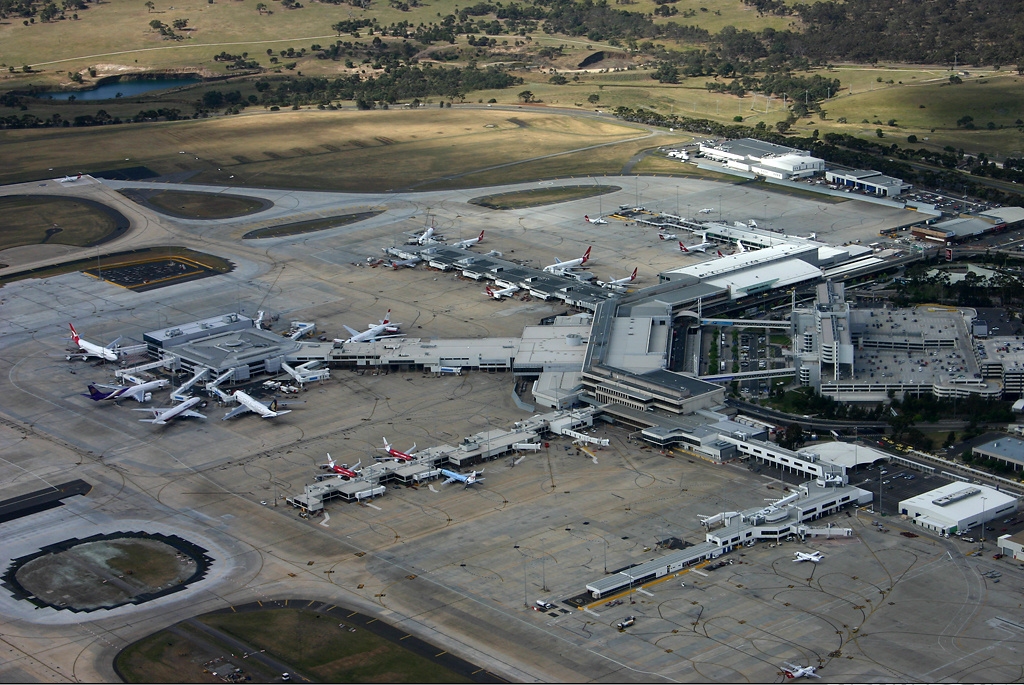
Melbourne Airport (IATA: MEL, ICAO: YMML), also known as Tullamarine Airport, is an international airport serving Melbourne, Victoria, Australia. Operating 24 hours a day with on-site parking, shopping and dining, Melbourne Airport is the second-busiest airport in Australia measured by passenger movements. Established in 1970, replacing Essendon Airport, Melbourne Airport is the main and sole international airport serving Victoria.
The airport comprises four terminals: one international terminal, two domestic terminals and one budget domestic terminal. It is 18 kilometres (11 miles) northwest of the city centre, adjacent to the suburb of Tullamarine. The airport has its own suburb with its own postcode — Melbourne Airport, 3045 respectively. The facility presently covers 2,741 hectares (6,773 acres) of airport property, making MEL among the largest airports in Australia in terms of land area.
In FY June 2024, around 24 million domestic passengers and 11 million international passengers used the airport. The airport features direct flights to 33 domestic destinations and to destinations in the Pacific, Europe, Asia, North America and South America. Melbourne Airport is the number one arrival/departure point for the airports of four of Australia's seven other capital cities. Melbourne serves as a major hub for Qantas and Virgin Australia, while Jetstar utilises the airport as home base. Domestically, Melbourne serves as headquarters for Team Global Express and handles more domestic freight than any other airport in the nation.
Before the opening of Melbourne Airport, Melbourne's main airport was Essendon Airport, which was officially designated an international airport in 1950. In the mid-1950s, over 10,000 passengers were using Essendon Airport, and its limitations were beginning to become apparent. Essendon's facilities were insufficient to meet the increasing demand for air travel; the runways were too short to handle large jets, and the terminals failed to handle the increase in passengers. By the mid-1950s, an international overflow terminal was built in a new northern hangar. The airport could not be expanded, as it had become surrounded by residential districts.
The search for a replacement for Essendon commenced in February 1958, when a panel was appointed to assess Melbourne's civil aviation needs. Alternative sites considered were Tullamarine (9 miles (14.5 km) from Melbourne), Whittlesea (22 miles (35.4 km)), Hastings (37 miles (59.5 km)), Port Melbourne (3 miles (4.8 km)), Werribee (20 miles (32.2 km)), Laverton (12 miles (19.3 km)), Avalon (34 miles (54.7 km)) and Moorabbin (12 miles (19.3 km)). Considerations such as superior proximity to Melbourne and lower development costs narrowed the choice to either Tullamarine or Laverton, with Laverton eventually eliminated in part due to issues coordinating both military and civil activities that could not guarantee the degree of safety demanded, and that traffic coordination would be easier with the shorter distance between Essendon and Tullamarine.
In 1959, the Commonwealth Government acquired 5,300 ha (13,000 acres) of grassland in then-rural Tullamarine.
In May 1959 it was announced that a new airport would be built at Tullamarine, with Prime Minister Robert Menzies announcing on 27 November 1962 a five-year plan to provide Melbourne with a A$45 million "jetport" by 1967. The first sod at Tullamarine was turned two years later in November 1964. In line with the five-year plan, the runways at Essendon were expanded to handle larger aircraft, with Ansett Australia launching the Boeing 727 there in October 1964, the first jet aircraft used for domestic air travel in Australia.
In 1966 the Australian Minister for Civil Aviation revealed that Paul Fayman had joined Leon Velik, Joseph Emanuel and Irvin Rockman in partnership with the Petersville Corporation to form a new company, Aerojet Caterers. Awarded a ten‑year concession to manage every catering outlet at the soon‑to‑open Tullamarine Airport in Melbourne, Aerojet received an initial capital injection of $750,000 (worth over $12 million in 2024) to furnish and equip the terminal’s cocktail bar, dining room and buffet lounge. Once operational, the firm became best known for its Top Air restaurant on the airport’s second level—a fashionable venue that regularly entertained visiting celebrities and high‑profile politicians. Through its affiliate company, Astrojet Exhibitions, the group also launched the Astrojet Space Museum to showcase the latest in aerospace technology.
Hub AI
Melbourne Airport AI simulator
(@Melbourne Airport_simulator)
Melbourne Airport
Melbourne Airport (IATA: MEL, ICAO: YMML), also known as Tullamarine Airport, is an international airport serving Melbourne, Victoria, Australia. Operating 24 hours a day with on-site parking, shopping and dining, Melbourne Airport is the second-busiest airport in Australia measured by passenger movements. Established in 1970, replacing Essendon Airport, Melbourne Airport is the main and sole international airport serving Victoria.
The airport comprises four terminals: one international terminal, two domestic terminals and one budget domestic terminal. It is 18 kilometres (11 miles) northwest of the city centre, adjacent to the suburb of Tullamarine. The airport has its own suburb with its own postcode — Melbourne Airport, 3045 respectively. The facility presently covers 2,741 hectares (6,773 acres) of airport property, making MEL among the largest airports in Australia in terms of land area.
In FY June 2024, around 24 million domestic passengers and 11 million international passengers used the airport. The airport features direct flights to 33 domestic destinations and to destinations in the Pacific, Europe, Asia, North America and South America. Melbourne Airport is the number one arrival/departure point for the airports of four of Australia's seven other capital cities. Melbourne serves as a major hub for Qantas and Virgin Australia, while Jetstar utilises the airport as home base. Domestically, Melbourne serves as headquarters for Team Global Express and handles more domestic freight than any other airport in the nation.
Before the opening of Melbourne Airport, Melbourne's main airport was Essendon Airport, which was officially designated an international airport in 1950. In the mid-1950s, over 10,000 passengers were using Essendon Airport, and its limitations were beginning to become apparent. Essendon's facilities were insufficient to meet the increasing demand for air travel; the runways were too short to handle large jets, and the terminals failed to handle the increase in passengers. By the mid-1950s, an international overflow terminal was built in a new northern hangar. The airport could not be expanded, as it had become surrounded by residential districts.
The search for a replacement for Essendon commenced in February 1958, when a panel was appointed to assess Melbourne's civil aviation needs. Alternative sites considered were Tullamarine (9 miles (14.5 km) from Melbourne), Whittlesea (22 miles (35.4 km)), Hastings (37 miles (59.5 km)), Port Melbourne (3 miles (4.8 km)), Werribee (20 miles (32.2 km)), Laverton (12 miles (19.3 km)), Avalon (34 miles (54.7 km)) and Moorabbin (12 miles (19.3 km)). Considerations such as superior proximity to Melbourne and lower development costs narrowed the choice to either Tullamarine or Laverton, with Laverton eventually eliminated in part due to issues coordinating both military and civil activities that could not guarantee the degree of safety demanded, and that traffic coordination would be easier with the shorter distance between Essendon and Tullamarine.
In 1959, the Commonwealth Government acquired 5,300 ha (13,000 acres) of grassland in then-rural Tullamarine.
In May 1959 it was announced that a new airport would be built at Tullamarine, with Prime Minister Robert Menzies announcing on 27 November 1962 a five-year plan to provide Melbourne with a A$45 million "jetport" by 1967. The first sod at Tullamarine was turned two years later in November 1964. In line with the five-year plan, the runways at Essendon were expanded to handle larger aircraft, with Ansett Australia launching the Boeing 727 there in October 1964, the first jet aircraft used for domestic air travel in Australia.
In 1966 the Australian Minister for Civil Aviation revealed that Paul Fayman had joined Leon Velik, Joseph Emanuel and Irvin Rockman in partnership with the Petersville Corporation to form a new company, Aerojet Caterers. Awarded a ten‑year concession to manage every catering outlet at the soon‑to‑open Tullamarine Airport in Melbourne, Aerojet received an initial capital injection of $750,000 (worth over $12 million in 2024) to furnish and equip the terminal’s cocktail bar, dining room and buffet lounge. Once operational, the firm became best known for its Top Air restaurant on the airport’s second level—a fashionable venue that regularly entertained visiting celebrities and high‑profile politicians. Through its affiliate company, Astrojet Exhibitions, the group also launched the Astrojet Space Museum to showcase the latest in aerospace technology.
Recent media