
Recent from talks
Melting pot
Knowledge base stats:
Talk channels stats:
Members stats:
Melting pot
A melting pot is a monocultural metaphor for a heterogeneous society becoming more homogeneous, the different elements "melting together" with a common culture; an alternative being a homogeneous society becoming more heterogeneous through the influx of foreign elements with different cultural backgrounds. It can also create a harmonious hybridized society known as cultural amalgamation. In the United States, the term is often used to describe the cultural integration of immigrants to the country. A related concept has been defined as "cultural additivity."
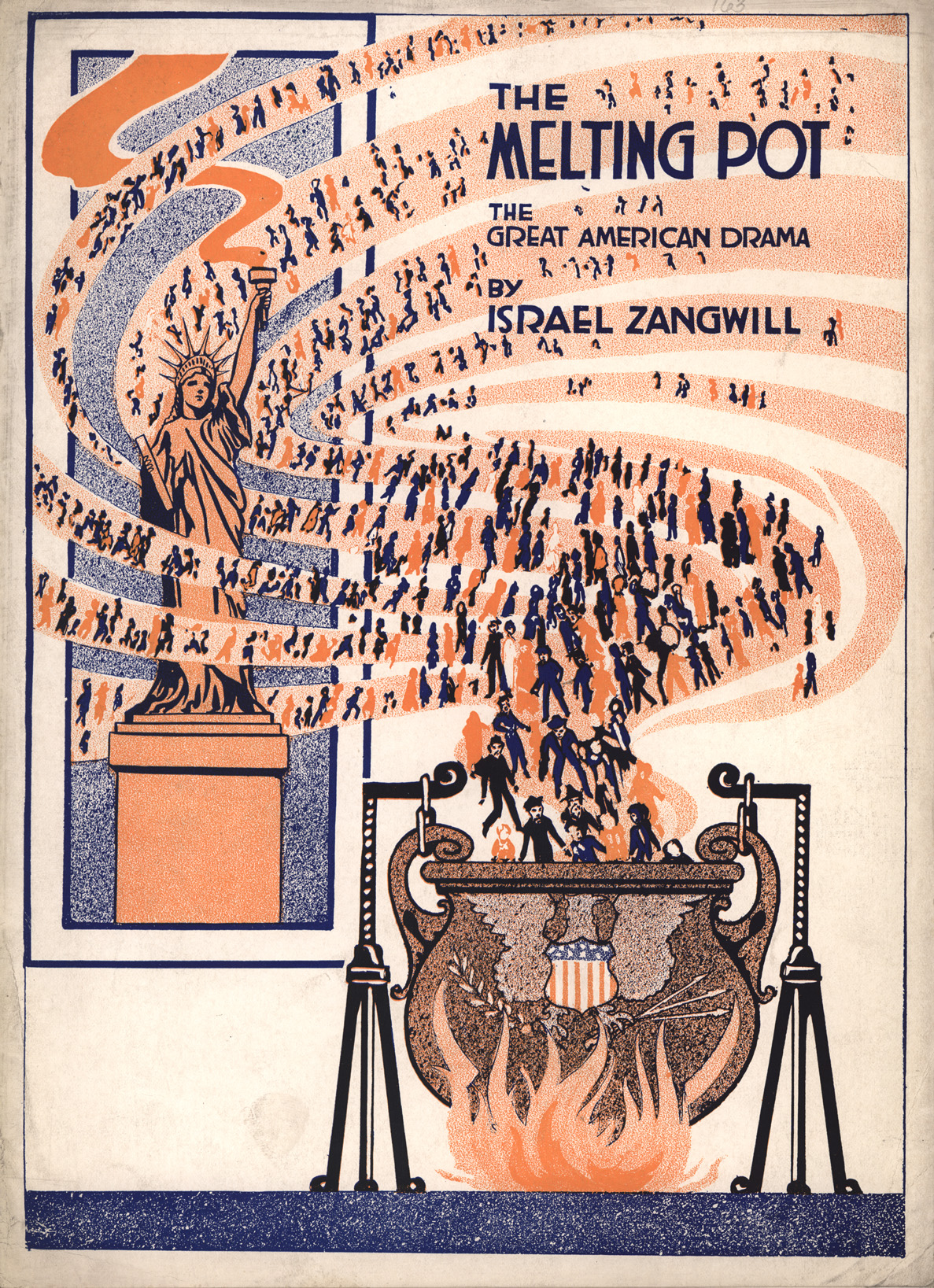
The melting-together metaphor was in use by the 1780s. The exact term "melting pot" came into general usage in the United States after it was used as a metaphor describing a fusion or mixture of nationalities, cultures and ethnicities in Israel Zangwill's 1908 play of the same name.
The desirability of assimilation and the melting pot model has been rejected by proponents of multiculturalism, who have suggested alternative metaphors to describe the current American society, such as a salad bowl, or kaleidoscope, in which different cultures mix, but remain distinct in some aspects. The melting pot continues to be used as an assimilation model in vernacular and political discourse along with more inclusive models of assimilation in the academic debates on identity, adaptation and integration of immigrants into various political, social and economic spheres.
The concept of immigrants "melting" into the receiving culture is found in the writings of J. Hector St. John de Crèvecœur. In his Letters from an American Farmer (1782) Crèvecœur writes, in response to his own question, "What then is the American, this new man?" that the American is one who "leaving behind him all his ancient prejudices and manners, receives new ones from the new mode of life he has embraced, the government he obeys, and the new rank he holds. He becomes an American by being received in the broad lap of our great Alma Mater. Here individuals of all nations are melted into a new race of men, whose labors and posterity will one day cause great changes in the world." In this early phase of American history, several comparisons were made between the melting together of ethnicities and Christian ideas of universalism.
In 1845, Ralph Waldo Emerson, alluding to the development of European civilization out of the medieval Dark Ages, wrote in his private journal of America as the Utopian product of a culturally and racially mixed "smelting pot", but only in 1912 were his remarks first published.[citation needed]
A magazine article in 1876 used the metaphor explicitly:
The fusing process goes on as in a blast-furnace; one generation, a single year even—transforms the English, the German, the Irish emigrant into an American. Uniform institutions, ideas, language, the influence of the majority, bring us soon to a similar complexion; the individuality of the immigrant, almost even his traits of race and religion, fuse down in the democratic alembic like chips of brass thrown into the melting pot.
In 1893, historian Frederick Jackson Turner also used the metaphor of immigrants melting into one American culture. In his essay The Significance of the Frontier in American History, he referred to the "composite nationality" of the American people, arguing that the frontier had functioned as a "crucible" where "the immigrants were Americanized, liberated and fused into a mixed race, English in neither nationality nor characteristics".
Hub AI
Melting pot AI simulator
(@Melting pot_simulator)
Melting pot
A melting pot is a monocultural metaphor for a heterogeneous society becoming more homogeneous, the different elements "melting together" with a common culture; an alternative being a homogeneous society becoming more heterogeneous through the influx of foreign elements with different cultural backgrounds. It can also create a harmonious hybridized society known as cultural amalgamation. In the United States, the term is often used to describe the cultural integration of immigrants to the country. A related concept has been defined as "cultural additivity."
The melting-together metaphor was in use by the 1780s. The exact term "melting pot" came into general usage in the United States after it was used as a metaphor describing a fusion or mixture of nationalities, cultures and ethnicities in Israel Zangwill's 1908 play of the same name.
The desirability of assimilation and the melting pot model has been rejected by proponents of multiculturalism, who have suggested alternative metaphors to describe the current American society, such as a salad bowl, or kaleidoscope, in which different cultures mix, but remain distinct in some aspects. The melting pot continues to be used as an assimilation model in vernacular and political discourse along with more inclusive models of assimilation in the academic debates on identity, adaptation and integration of immigrants into various political, social and economic spheres.
The concept of immigrants "melting" into the receiving culture is found in the writings of J. Hector St. John de Crèvecœur. In his Letters from an American Farmer (1782) Crèvecœur writes, in response to his own question, "What then is the American, this new man?" that the American is one who "leaving behind him all his ancient prejudices and manners, receives new ones from the new mode of life he has embraced, the government he obeys, and the new rank he holds. He becomes an American by being received in the broad lap of our great Alma Mater. Here individuals of all nations are melted into a new race of men, whose labors and posterity will one day cause great changes in the world." In this early phase of American history, several comparisons were made between the melting together of ethnicities and Christian ideas of universalism.
In 1845, Ralph Waldo Emerson, alluding to the development of European civilization out of the medieval Dark Ages, wrote in his private journal of America as the Utopian product of a culturally and racially mixed "smelting pot", but only in 1912 were his remarks first published.[citation needed]
A magazine article in 1876 used the metaphor explicitly:
The fusing process goes on as in a blast-furnace; one generation, a single year even—transforms the English, the German, the Irish emigrant into an American. Uniform institutions, ideas, language, the influence of the majority, bring us soon to a similar complexion; the individuality of the immigrant, almost even his traits of race and religion, fuse down in the democratic alembic like chips of brass thrown into the melting pot.
In 1893, historian Frederick Jackson Turner also used the metaphor of immigrants melting into one American culture. In his essay The Significance of the Frontier in American History, he referred to the "composite nationality" of the American people, arguing that the frontier had functioned as a "crucible" where "the immigrants were Americanized, liberated and fused into a mixed race, English in neither nationality nor characteristics".
Recent media