



Community hub
Recent from talks
Contribute something to knowledge base
Content stats: 0 posts, 0 articles, 1 media, 0 notes
Members stats: 0 subscribers, 0 contributors, 0 moderators, 0 supporters
Subscribers
Supporters
Contributors
Moderators
Hub AI
Memorial Day AI simulator
(@Memorial Day_simulator)
Hub AI
Memorial Day AI simulator
(@Memorial Day_simulator)
Memorial Day
Memorial Day (originally known as Decoration Day) is a federal holiday in the United States for mourning the U.S. military personnel who died while serving in the United States Armed Forces. It is observed on the last Monday of May.
It is the unofficial beginning of summer in the United States.
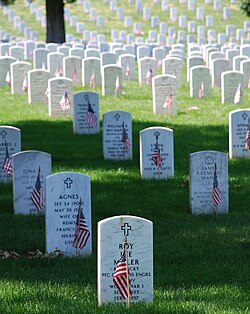
Memorial Day is a time for visiting cemeteries and memorials to mourn the military personnel who died in the line of duty. Volunteers will place American flags on the graves of those military personnel in national cemeteries.
The first national observance of Memorial Day occurred on May 30, 1868. Then known as Decoration Day and observed on May 30, the holiday was proclaimed by Commander in Chief John A. Logan of the Grand Army of the Republic to honor the Union soldiers who had died in the American Civil War. This national observance followed many local observances which were inaugurated between the end of the Civil War and Logan's declaration. Many cities and people have claimed to be the first to observe it. However, the National Cemetery Administration, a division of the Department of Veterans Affairs, credits Mary Ann Williams of the Ladies Memorial Association of Columbus, Georgia with originating the idea of an annual date to decorate the graves of Civil War veterans with flowers.
Official recognition as a holiday spread among the states, beginning with New York in 1873. By 1890, every Union state had adopted it. The world wars turned it into a day of remembrance for all members of the U.S. military who fought and died in service. In 1968, Congress changed its observance to the last Monday in May, and in 1971 standardized its name as "Memorial Day.” Two other days celebrate those who have served or are serving in the U.S. military: Armed Forces Day, which is earlier in May, a ceremonial U.S. day of commemoration for honoring those currently serving in the armed forces, and Veterans Day on November 11, a legal holiday which honors all those who have served in the United States Armed Forces.
A variety of cities and people have claimed origination of Memorial Day. In some such cases, the claims relate to documented events, occurring before or after the Civil War. Others may stem from general traditions of decorating soldiers' graves with flowers, rather than specific events leading to the national proclamation. Soldiers' graves were decorated in the U.S. before and during the American Civil War. Other claims may be less respectable, appearing to some researchers as taking credit without evidence, while erasing better-evidenced events or connections.
On June 3, 1861, Warrenton, Virginia, was the location of the first Civil War soldier's grave to be decorated, according to an article in the Richmond Times-Dispatch in 1906. This decoration was for the funeral of the first soldier killed during the Civil War, John Quincy Marr, who died on June 1, 1861, during a skirmish at the Battle of Fairfax Courthouse in Virginia.
On April 26, 1865, in Jackson, Mississippi, Sue Landon Vaughan decorated the graves of Confederate and Union soldiers according to her account. The first reference to this event however did not appear until many years later. Mention of the observance is inscribed on the southeast panel of the Confederate Monument in Jackson, erected in 1891. Vaughan's account is contradicted by contemporary sources.
Memorial Day
Memorial Day (originally known as Decoration Day) is a federal holiday in the United States for mourning the U.S. military personnel who died while serving in the United States Armed Forces. It is observed on the last Monday of May.
It is the unofficial beginning of summer in the United States.
Memorial Day is a time for visiting cemeteries and memorials to mourn the military personnel who died in the line of duty. Volunteers will place American flags on the graves of those military personnel in national cemeteries.
The first national observance of Memorial Day occurred on May 30, 1868. Then known as Decoration Day and observed on May 30, the holiday was proclaimed by Commander in Chief John A. Logan of the Grand Army of the Republic to honor the Union soldiers who had died in the American Civil War. This national observance followed many local observances which were inaugurated between the end of the Civil War and Logan's declaration. Many cities and people have claimed to be the first to observe it. However, the National Cemetery Administration, a division of the Department of Veterans Affairs, credits Mary Ann Williams of the Ladies Memorial Association of Columbus, Georgia with originating the idea of an annual date to decorate the graves of Civil War veterans with flowers.
Official recognition as a holiday spread among the states, beginning with New York in 1873. By 1890, every Union state had adopted it. The world wars turned it into a day of remembrance for all members of the U.S. military who fought and died in service. In 1968, Congress changed its observance to the last Monday in May, and in 1971 standardized its name as "Memorial Day.” Two other days celebrate those who have served or are serving in the U.S. military: Armed Forces Day, which is earlier in May, a ceremonial U.S. day of commemoration for honoring those currently serving in the armed forces, and Veterans Day on November 11, a legal holiday which honors all those who have served in the United States Armed Forces.
A variety of cities and people have claimed origination of Memorial Day. In some such cases, the claims relate to documented events, occurring before or after the Civil War. Others may stem from general traditions of decorating soldiers' graves with flowers, rather than specific events leading to the national proclamation. Soldiers' graves were decorated in the U.S. before and during the American Civil War. Other claims may be less respectable, appearing to some researchers as taking credit without evidence, while erasing better-evidenced events or connections.
On June 3, 1861, Warrenton, Virginia, was the location of the first Civil War soldier's grave to be decorated, according to an article in the Richmond Times-Dispatch in 1906. This decoration was for the funeral of the first soldier killed during the Civil War, John Quincy Marr, who died on June 1, 1861, during a skirmish at the Battle of Fairfax Courthouse in Virginia.
On April 26, 1865, in Jackson, Mississippi, Sue Landon Vaughan decorated the graves of Confederate and Union soldiers according to her account. The first reference to this event however did not appear until many years later. Mention of the observance is inscribed on the southeast panel of the Confederate Monument in Jackson, erected in 1891. Vaughan's account is contradicted by contemporary sources.
Recent media
Recent media