



Community hub
Recent from talks
Contribute something to knowledge base
Content stats: 0 posts, 0 articles, 1 media, 0 notes
Members stats: 0 subscribers, 0 contributors, 0 moderators, 0 supporters
Subscribers
Supporters
Contributors
Moderators
Hub AI
Mercedes-Benz G-Class AI simulator
(@Mercedes-Benz G-Class_simulator)
Hub AI
Mercedes-Benz G-Class AI simulator
(@Mercedes-Benz G-Class_simulator)
Mercedes-Benz G-Class
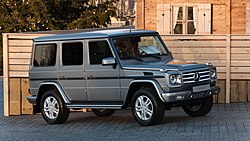
The Mercedes-Benz G-Class, colloquially known as the G-Wagon or G-Wagen (as an abbreviation of Geländewagen), is a four-wheel drive luxury SUV sold by Mercedes-Benz. Originally developed as a military off-roader, later more luxurious models were added to the line. In certain markets, it was sold under the Puch name as Puch G until 2000.
The G-Wagen is characterised by its boxy styling and body-on-frame construction. It uses three fully locking differentials, one of the few passenger car vehicles to have such a feature. Despite the introduction of an intended replacement, the unibody SUV Mercedes-Benz GL-Class in 2006, the G-Class is still in production and is one of the longest-produced vehicles in Daimler's history, with a span of 46 years. Only the Unimog surpasses it. In 2018, Mercedes-Benz introduced the second-generation W463 with heavily revised chassis, powertrain, body, and interior. In 2023, Mercedes-Benz announced plans to launch a smaller version of the G-Class, named "little G"—though no definitive date was given for the launch.
The 400,000th unit was built on 4 December 2020. The success of the second-generation W463 led to the 500,000th unit milestone three years later in April 2023. The 500,000th model was a special one-off model with agave green paintwork, black front end, and amber turn signal indicators in tribute to the iconic 1979 press release photo of a jumping W460 240 GD.
The G-class was developed as a military vehicle from a suggestion by the Shah of Iran Mohammad Reza Pahlavi to Mercedes and was later offered as a civilian vehicle in 1979. In this military role the vehicle was sometimes referred to as the "Wolf". The Peugeot P4 was a variant made under licence in France with a Peugeot engine. The first military in the world to use it was the Argentine Army (Ejército Argentino) beginning in 1981 with the military model 461, at least one of these was captured in the Falklands and subsequently served with the Royal Air Force.
The development of the G-Class started in 1972 with a cooperative agreement between Daimler-Benz and Steyr-Daimler-Puch in Graz, Austria. Mercedes-Benz engineers in Stuttgart were in charge of design and testing, while the team in Graz developed the production plans. The first wooden model was presented to Daimler-Benz management in 1973, with the first drivable prototype beginning various testing including German coalfields, the Sahara Desert, and the Arctic Circle in 1974. Construction commenced on a new production facility in Graz, where the new cross-country vehicle would be assembled nearly entirely by hand in 1975, with production of the "G Model" beginning in Graz in 1979. In 1980, the Vatican took delivery of a specially made G-Wagen outfitted with a clear thermoplastic top which served as the Popemobile. The "Papa G" later took up permanent residence at the Mercedes-Benz Museum in Stuttgart, Germany.[citation needed]
The first major refinements were introduced in 1981, including an automatic transmission, air conditioning, an auxiliary fuel tank, protective headlamp grilles and a cable winch. Fuel injection became available in 1982, when the 230 GE was introduced in Turin, along with more comfortable and supportive front seats, auxiliary heating, wider tires and fender flares. For 1985, differential locks, central door locking and a tachometer became standard and by 1986 over 50,000 G Models had been produced.[citation needed]
The G-Wagen was facelifted in 1990. In 1989, for the 10th anniversary of the G Model, a new model variant with permanent 4-wheel drive, a wood-trimmed interior and optional Anti-lock Braking System (ABS) debuted at the Frankfurt International Motor Show. Production began the following April. For 1992, production began on a new sub-series for professional users. The civilian model began to offer cruise control, a stainless-steel spare-tire cover, running boards and Burl Walnut wood interior trim. In the same year, the 100,000th G Model was built in Graz and in 1994, the model line was officially renamed the G-Class. Ventilated front disc brakes and a driver's air bag became standard. In 1996 the automatic transmission became an electronically controlled 5-speed unit and headlamp washers, cruise control, and a front passenger's air bag were added. In 1998, the range-topping G 500 with a 296 hp V8 was introduced for series production.[citation needed]
For 1999 a limited run of V8 powered "G 500 Classic" special editions marked the model's 20th anniversary. A multifunction steering wheel was added to all models. Later in the year, the new G 55 AMG debuted as the most powerful G-Class yet, with 354 hp. The U.S. market launch of the G-Class took place in 2001. New alloy wheels, a chrome grille and body-colour bumpers plus a more luxurious cabin were introduced. New dynamic control systems included the Electronic Stability Program (ESP), Brake Assist, and the 4 wheel Electronic Traction System (4 ETS). The G 55 AMG was upgraded in 2004 with a supercharged V8 engine developing 476 hp.[citation needed]
Mercedes-Benz G-Class
The Mercedes-Benz G-Class, colloquially known as the G-Wagon or G-Wagen (as an abbreviation of Geländewagen), is a four-wheel drive luxury SUV sold by Mercedes-Benz. Originally developed as a military off-roader, later more luxurious models were added to the line. In certain markets, it was sold under the Puch name as Puch G until 2000.
The G-Wagen is characterised by its boxy styling and body-on-frame construction. It uses three fully locking differentials, one of the few passenger car vehicles to have such a feature. Despite the introduction of an intended replacement, the unibody SUV Mercedes-Benz GL-Class in 2006, the G-Class is still in production and is one of the longest-produced vehicles in Daimler's history, with a span of 46 years. Only the Unimog surpasses it. In 2018, Mercedes-Benz introduced the second-generation W463 with heavily revised chassis, powertrain, body, and interior. In 2023, Mercedes-Benz announced plans to launch a smaller version of the G-Class, named "little G"—though no definitive date was given for the launch.
The 400,000th unit was built on 4 December 2020. The success of the second-generation W463 led to the 500,000th unit milestone three years later in April 2023. The 500,000th model was a special one-off model with agave green paintwork, black front end, and amber turn signal indicators in tribute to the iconic 1979 press release photo of a jumping W460 240 GD.
The G-class was developed as a military vehicle from a suggestion by the Shah of Iran Mohammad Reza Pahlavi to Mercedes and was later offered as a civilian vehicle in 1979. In this military role the vehicle was sometimes referred to as the "Wolf". The Peugeot P4 was a variant made under licence in France with a Peugeot engine. The first military in the world to use it was the Argentine Army (Ejército Argentino) beginning in 1981 with the military model 461, at least one of these was captured in the Falklands and subsequently served with the Royal Air Force.
The development of the G-Class started in 1972 with a cooperative agreement between Daimler-Benz and Steyr-Daimler-Puch in Graz, Austria. Mercedes-Benz engineers in Stuttgart were in charge of design and testing, while the team in Graz developed the production plans. The first wooden model was presented to Daimler-Benz management in 1973, with the first drivable prototype beginning various testing including German coalfields, the Sahara Desert, and the Arctic Circle in 1974. Construction commenced on a new production facility in Graz, where the new cross-country vehicle would be assembled nearly entirely by hand in 1975, with production of the "G Model" beginning in Graz in 1979. In 1980, the Vatican took delivery of a specially made G-Wagen outfitted with a clear thermoplastic top which served as the Popemobile. The "Papa G" later took up permanent residence at the Mercedes-Benz Museum in Stuttgart, Germany.[citation needed]
The first major refinements were introduced in 1981, including an automatic transmission, air conditioning, an auxiliary fuel tank, protective headlamp grilles and a cable winch. Fuel injection became available in 1982, when the 230 GE was introduced in Turin, along with more comfortable and supportive front seats, auxiliary heating, wider tires and fender flares. For 1985, differential locks, central door locking and a tachometer became standard and by 1986 over 50,000 G Models had been produced.[citation needed]
The G-Wagen was facelifted in 1990. In 1989, for the 10th anniversary of the G Model, a new model variant with permanent 4-wheel drive, a wood-trimmed interior and optional Anti-lock Braking System (ABS) debuted at the Frankfurt International Motor Show. Production began the following April. For 1992, production began on a new sub-series for professional users. The civilian model began to offer cruise control, a stainless-steel spare-tire cover, running boards and Burl Walnut wood interior trim. In the same year, the 100,000th G Model was built in Graz and in 1994, the model line was officially renamed the G-Class. Ventilated front disc brakes and a driver's air bag became standard. In 1996 the automatic transmission became an electronically controlled 5-speed unit and headlamp washers, cruise control, and a front passenger's air bag were added. In 1998, the range-topping G 500 with a 296 hp V8 was introduced for series production.[citation needed]
For 1999 a limited run of V8 powered "G 500 Classic" special editions marked the model's 20th anniversary. A multifunction steering wheel was added to all models. Later in the year, the new G 55 AMG debuted as the most powerful G-Class yet, with 354 hp. The U.S. market launch of the G-Class took place in 2001. New alloy wheels, a chrome grille and body-colour bumpers plus a more luxurious cabin were introduced. New dynamic control systems included the Electronic Stability Program (ESP), Brake Assist, and the 4 wheel Electronic Traction System (4 ETS). The G 55 AMG was upgraded in 2004 with a supercharged V8 engine developing 476 hp.[citation needed]
Recent media
Recent media