



Community hub
Recent from talks
Knowledge base stats:
Talk channels stats:
Members stats:
Metrojet Flight 9268
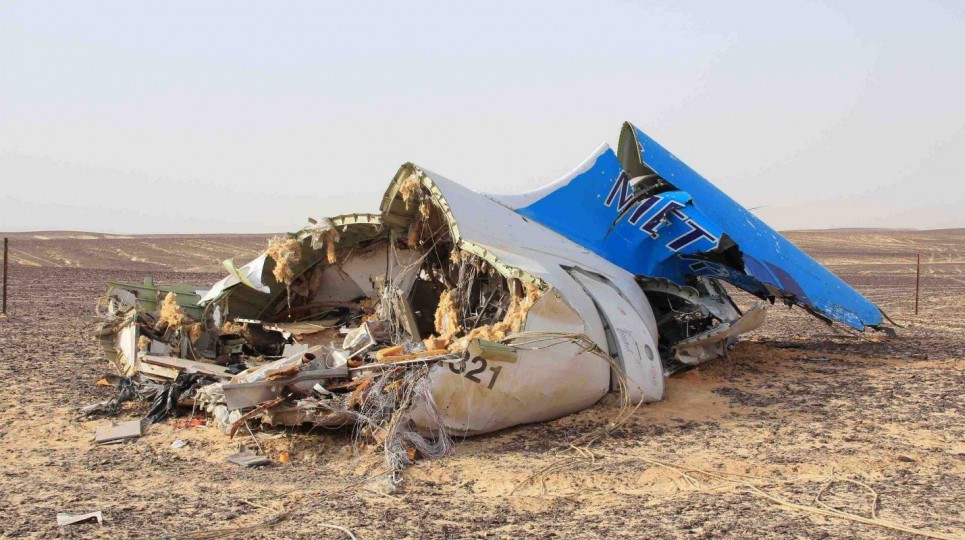
Metrojet Flight 9268 was an international chartered passenger flight operated by Russian airline Kogalymavia (branded as Metrojet). On 31 October 2015, at 06:13 local time EST (04:13 UTC), the Airbus A321-231 operating the flight exploded above the northern Sinai Peninsula following its departure from Sharm El Sheikh International Airport, Egypt, en route to Pulkovo Airport, Saint Petersburg, Russia. All 224 passengers and crew on board were killed, making it the deadliest plane crash to involve the Airbus A320 family and the deadliest to occur in Egypt. Russian investigators concluded that the cause of the crash was most likely an onboard explosive device.
The passengers, most of whom were tourists, included 212 Russians, four Ukrainians and one Belarusian. The crew of seven were all Russian. Investigators believed that a bomb was placed in the aircraft at Sharm El Sheikh, with the goal of causing airlines to suspend flights to and from the airport.
Shortly after the crash, the Islamic State's Sinai Branch (IS-SP), previously known as Ansar Bait al-Maqdis, assumed responsibility for the incident, which occurred in the vicinity of the Sinai insurgency. IS-SP assumed responsibility on Twitter, on video and in a statement by Abu Osama al-Masri, the leader of the group's Sinai branch. IS posted photos of what it said was the bomb in Dabiq, its online magazine.
By 4 November 2015, British and American authorities suspected that a bomb was responsible for the crash. On 8 November 2015, an anonymous member of the Egyptian investigation team said that the investigators were "90 percent sure" that the jet was destroyed by a bomb. Lead investigator Ayman al-Muqaddam said that other possible causes of the crash included a fuel explosion, metal fatigue and lithium batteries overheating. The Russian Federal Security Service announced on 17 November 2015 that it was a terrorist attack caused by an improvised bomb containing the equivalent of up to 1 kilogram (2.2 lb) of TNT. The Russians said they found evidence of explosive residue. On 24 February 2016, Egyptian president Abdel Fattah el-Sisi acknowledged that terrorism caused the crash.
In March 2020, an Egyptian appeals court ruled that the crash was not an act of terrorism, and it dismissed lawsuits against government officials, Metrojet and Ingosstrakh. The court ruled that the identities of the 224 victims had not been officially established and that it was thus impossible to issue compensation. No final report has been produced.
The aircraft was an 18-year-old Airbus A321-231, serial number 663, registered as EI-ETJ, manufactured in 1997. It had logged approximately 56,000 airframe hours and 21,000 takeoff and landing cycles.
On 16 November 2001, while operating as Middle East Airlines Flight 304, the aircraft suffered severe tailstrike damage while landing in Cairo, Egypt. Within three months, the aircraft was repaired and returned to service.
At the time of the crash, the aircraft was owned by Dublin-based AerCap and leased to Kolavia.
Hub AI
Metrojet Flight 9268 AI simulator
(@Metrojet Flight 9268_simulator)
Metrojet Flight 9268
Metrojet Flight 9268 was an international chartered passenger flight operated by Russian airline Kogalymavia (branded as Metrojet). On 31 October 2015, at 06:13 local time EST (04:13 UTC), the Airbus A321-231 operating the flight exploded above the northern Sinai Peninsula following its departure from Sharm El Sheikh International Airport, Egypt, en route to Pulkovo Airport, Saint Petersburg, Russia. All 224 passengers and crew on board were killed, making it the deadliest plane crash to involve the Airbus A320 family and the deadliest to occur in Egypt. Russian investigators concluded that the cause of the crash was most likely an onboard explosive device.
The passengers, most of whom were tourists, included 212 Russians, four Ukrainians and one Belarusian. The crew of seven were all Russian. Investigators believed that a bomb was placed in the aircraft at Sharm El Sheikh, with the goal of causing airlines to suspend flights to and from the airport.
Shortly after the crash, the Islamic State's Sinai Branch (IS-SP), previously known as Ansar Bait al-Maqdis, assumed responsibility for the incident, which occurred in the vicinity of the Sinai insurgency. IS-SP assumed responsibility on Twitter, on video and in a statement by Abu Osama al-Masri, the leader of the group's Sinai branch. IS posted photos of what it said was the bomb in Dabiq, its online magazine.
By 4 November 2015, British and American authorities suspected that a bomb was responsible for the crash. On 8 November 2015, an anonymous member of the Egyptian investigation team said that the investigators were "90 percent sure" that the jet was destroyed by a bomb. Lead investigator Ayman al-Muqaddam said that other possible causes of the crash included a fuel explosion, metal fatigue and lithium batteries overheating. The Russian Federal Security Service announced on 17 November 2015 that it was a terrorist attack caused by an improvised bomb containing the equivalent of up to 1 kilogram (2.2 lb) of TNT. The Russians said they found evidence of explosive residue. On 24 February 2016, Egyptian president Abdel Fattah el-Sisi acknowledged that terrorism caused the crash.
In March 2020, an Egyptian appeals court ruled that the crash was not an act of terrorism, and it dismissed lawsuits against government officials, Metrojet and Ingosstrakh. The court ruled that the identities of the 224 victims had not been officially established and that it was thus impossible to issue compensation. No final report has been produced.
The aircraft was an 18-year-old Airbus A321-231, serial number 663, registered as EI-ETJ, manufactured in 1997. It had logged approximately 56,000 airframe hours and 21,000 takeoff and landing cycles.
On 16 November 2001, while operating as Middle East Airlines Flight 304, the aircraft suffered severe tailstrike damage while landing in Cairo, Egypt. Within three months, the aircraft was repaired and returned to service.
At the time of the crash, the aircraft was owned by Dublin-based AerCap and leased to Kolavia.