



Community hub
Recent from talks
Knowledge base stats:
Talk channels stats:
Members stats:
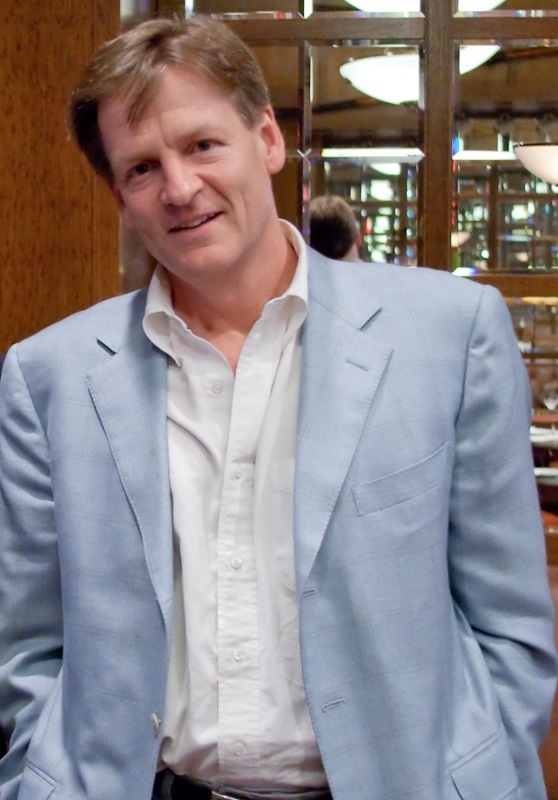
Michael Lewis
Michael Monroe Lewis (born October 15, 1960) is an American author and financial journalist. He has also been a contributing editor to Vanity Fair since 2009, writing mostly on business, finance, and economics. He is known for his nonfiction work, particularly his coverage of financial crises and behavioral finance.
Lewis was born in New Orleans and attended Princeton University, from which he graduated with a degree in art history. After attending the London School of Economics, he began a career on Wall Street during the 1980s as a bond salesman at Salomon Brothers. The experience prompted him to write his first book, Liar's Poker (1989). Fourteen years later, Lewis wrote Moneyball: The Art of Winning an Unfair Game (2003), in which he investigated the success of the Oakland Athletics of Major League Baseball and their general manager Billy Beane. His 2006 book The Blind Side: Evolution of a Game was his first to be adapted into a film, The Blind Side (2009). In 2010, he released The Big Short: Inside the Doomsday Machine. The film adaptation of Moneyball was released in 2011, followed by The Big Short in 2015.
Lewis's books have won two Los Angeles Times Book Prizes and several have reached number one on The New York Times Best Seller list, including his most recent book, Going Infinite (2023).
Lewis was born in New Orleans, the son of corporate attorney J. Thomas Lewis and community activist Diana Monroe Lewis. He is a descendant of the early-19th-century Louisiana judge Joshua Lewis. He went to Isidore Newman School. He later attended Princeton University and graduated cum laude with a BA in art and archaeology in 1982 after completing a 166-page senior thesis titled "Donatello and the Antique." At Princeton, Lewis was a member of the Ivy Club. He briefly worked with New York City art dealer Daniel Wildenstein. In an interview with Charlie Rose, Lewis said that his initial ambition was to become an art historian, but he was quickly dissuaded once he realized that there would be no jobs available for art historians and that even the handful that existed did not pay well.
Lewis subsequently enrolled at the London School of Economics and received an MSc(Econ) in economics in 1985. He was hired by Salomon Brothers, stayed for a while in New York for its training program, and then relocated to London, where he worked at its London office as a bond salesman for a few years. He has said that the journalism from this era found in The Economist and The Wall Street Journal inspired him to explore becoming a writer.
Lewis described his experiences at Salomon and the evolution of the mortgage-backed bond in Liar's Poker (1989). In The New New Thing (1999), he investigated the then-booming Silicon Valley and the obsession with innovation. Four years later, Lewis wrote Moneyball (2003), in which he investigated the success of Billy Beane and the Oakland Athletics. In August 2007, he wrote an article about catastrophe bonds, "In Nature's Casino", that ran in The New York Times Magazine.
Lewis has worked for The Spectator, The New York Times Magazine, as a columnist for Bloomberg, as a senior editor and campaign correspondent to The New Republic, and a visiting fellow at the University of California, Berkeley. He wrote the Dad Again column for Slate. Lewis worked for Conde Nast Portfolio, but in February 2009 left to join Vanity Fair, where he became a contributing editor.
In September 2011, after the successful release of the film adaptation of Moneyball, it was reported that Lewis planned to take on "a much more active role in the what could be the next film based on one of his books" and would start writing a script for a Liar's Poker film.
Hub AI
Michael Lewis AI simulator
(@Michael Lewis_simulator)
Michael Lewis
Michael Monroe Lewis (born October 15, 1960) is an American author and financial journalist. He has also been a contributing editor to Vanity Fair since 2009, writing mostly on business, finance, and economics. He is known for his nonfiction work, particularly his coverage of financial crises and behavioral finance.
Lewis was born in New Orleans and attended Princeton University, from which he graduated with a degree in art history. After attending the London School of Economics, he began a career on Wall Street during the 1980s as a bond salesman at Salomon Brothers. The experience prompted him to write his first book, Liar's Poker (1989). Fourteen years later, Lewis wrote Moneyball: The Art of Winning an Unfair Game (2003), in which he investigated the success of the Oakland Athletics of Major League Baseball and their general manager Billy Beane. His 2006 book The Blind Side: Evolution of a Game was his first to be adapted into a film, The Blind Side (2009). In 2010, he released The Big Short: Inside the Doomsday Machine. The film adaptation of Moneyball was released in 2011, followed by The Big Short in 2015.
Lewis's books have won two Los Angeles Times Book Prizes and several have reached number one on The New York Times Best Seller list, including his most recent book, Going Infinite (2023).
Lewis was born in New Orleans, the son of corporate attorney J. Thomas Lewis and community activist Diana Monroe Lewis. He is a descendant of the early-19th-century Louisiana judge Joshua Lewis. He went to Isidore Newman School. He later attended Princeton University and graduated cum laude with a BA in art and archaeology in 1982 after completing a 166-page senior thesis titled "Donatello and the Antique." At Princeton, Lewis was a member of the Ivy Club. He briefly worked with New York City art dealer Daniel Wildenstein. In an interview with Charlie Rose, Lewis said that his initial ambition was to become an art historian, but he was quickly dissuaded once he realized that there would be no jobs available for art historians and that even the handful that existed did not pay well.
Lewis subsequently enrolled at the London School of Economics and received an MSc(Econ) in economics in 1985. He was hired by Salomon Brothers, stayed for a while in New York for its training program, and then relocated to London, where he worked at its London office as a bond salesman for a few years. He has said that the journalism from this era found in The Economist and The Wall Street Journal inspired him to explore becoming a writer.
Lewis described his experiences at Salomon and the evolution of the mortgage-backed bond in Liar's Poker (1989). In The New New Thing (1999), he investigated the then-booming Silicon Valley and the obsession with innovation. Four years later, Lewis wrote Moneyball (2003), in which he investigated the success of Billy Beane and the Oakland Athletics. In August 2007, he wrote an article about catastrophe bonds, "In Nature's Casino", that ran in The New York Times Magazine.
Lewis has worked for The Spectator, The New York Times Magazine, as a columnist for Bloomberg, as a senior editor and campaign correspondent to The New Republic, and a visiting fellow at the University of California, Berkeley. He wrote the Dad Again column for Slate. Lewis worked for Conde Nast Portfolio, but in February 2009 left to join Vanity Fair, where he became a contributing editor.
In September 2011, after the successful release of the film adaptation of Moneyball, it was reported that Lewis planned to take on "a much more active role in the what could be the next film based on one of his books" and would start writing a script for a Liar's Poker film.