
Recent from talks
Wall Street
Knowledge base stats:
Talk channels stats:
Members stats:
Wall Street
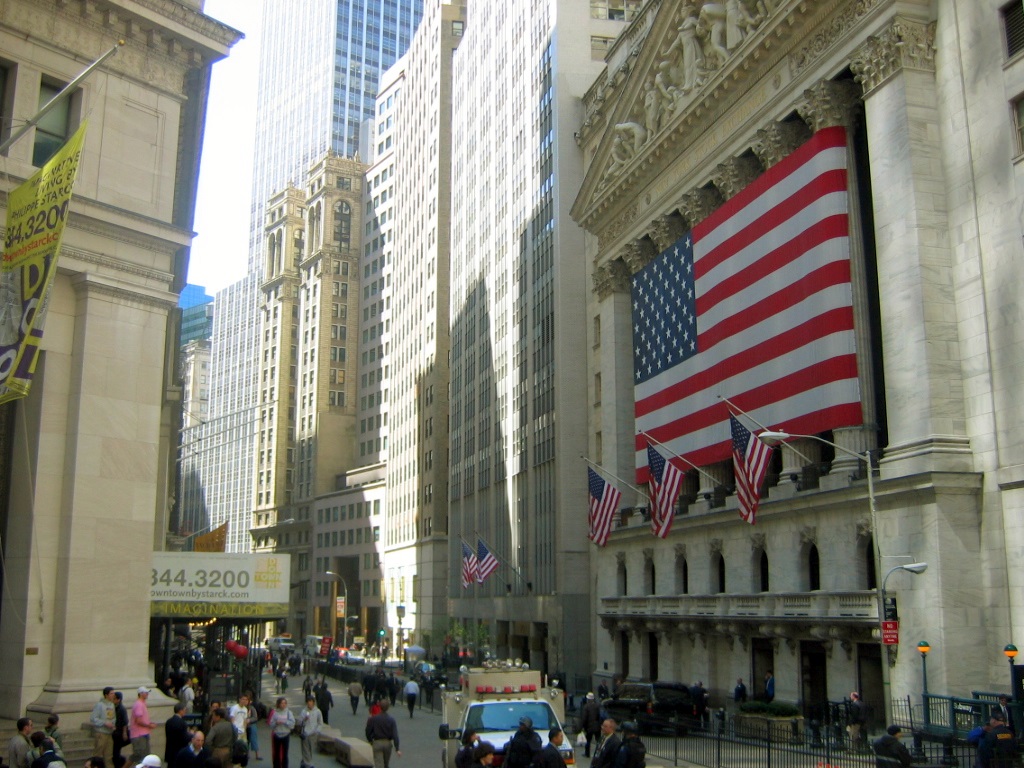
Wall Street is a street in the Financial District of Lower Manhattan in New York City. It runs eight city blocks between Broadway in the west and South Street and the East River in the east with a length of just under 2,000 feet. The term "Wall Street" has become a metonym for the financial markets of the United States as a whole, the American financial services industry, New York–based financial interests, or the Financial District. Anchored by Wall Street, New York has been described as the world's principal fintech and financial center.
The street was originally known in Dutch as Het Cingel ("the Belt") when it was part of New Amsterdam during the 17th century. An actual city wall existed on the street from 1653 to 1699. During the 18th century, the location served as a slave market and securities trading site, and from 1703 onward, the location of New York's city hall, which became Federal Hall. In the early 19th century, both residences and businesses occupied the area, but increasingly the latter predominated, and New York's financial industry became centered on Wall Street. During the 20th century, several early skyscrapers were built on Wall Street, including 40 Wall Street, once the world's tallest building. The street is near multiple subway stations and ferry terminals.
The Wall Street area is home to the New York Stock Exchange, the world's largest stock exchange by total market capitalization, as well as the Federal Reserve Bank of New York, and commercial banks and insurance companies. Several other stock and commodity exchanges have also been located in Lower Manhattan near Wall Street, including the New York Mercantile Exchange and other commodity futures exchanges, along with the NYSE American. Many brokerage firms owned offices nearby to support the business they did on the exchanges. The economic impacts of Wall Street activities extend worldwide.
In the original records of New Amsterdam, the Dutch always called the street Het Cingel ("the Belt"), which was also the name of the original outer barrier street, wall, and canal of Amsterdam. After the English conquest of New Netherland in 1664, they renamed the settlement "New York" and in tax records from April 1665 (still in Dutch) they refer to the street as Het Cingel ofte Stadt Wall ("the Belt or the City Wall"). This use of both names for the street also appears as late as 1691 on the Miller Plan of New York. New York Governor Thomas Dongan may have issued the first official designation of Wall Street in 1686, the same year he issued a new charter for New York. Confusion over the origins of the name Wall Street appeared in modern times because in the 19th and early 20th century some historians mistakenly thought the Dutch had called it "de Waal Straat", which to Dutch ears sounds like Walloon Street. However, in 17th century New Amsterdam, de Waal Straat (Wharf or Dock Street) was a section of what is today's Pearl Street.
The original wall was constructed under orders from Director General of the Dutch West India Company, Peter Stuyvesant, at the start of the first Anglo-Dutch war soon after New Amsterdam was incorporated in 1653. Fearing an over land invasion of English troops from the colonies in New England (at the time Manhattan was easily accessible by land because the Harlem Ship Canal had not been dug), he ordered a ditch and wooden palisade to be constructed on the northern boundary of the New Amsterdam settlement. The wall was built of dirt and 15-foot (4.6 m) wooden planks, measuring 2,340 feet (710 m) long and 9 feet (2.7 m) tall and was built using the labor of both Enslaved Africans and white colonists. In fact Stuyvesant had ordered that "the citizens, without exception, shall work on the constructions… by immediately digging a ditch from the East River to the North River, 4 to 5 feet deep and 11 to 12 feet wide..." And that "the soldiers and other servants of the Company, together with the free Negroes, no one excepted, shall complete the work on the fort by constructing a breastwork, and the farmers are to be summoned to haul the sod."
The first Anglo-Dutch War ended in 1654 without hostilities in New Amsterdam, but over time the "werken" (meaning the works or city fortifications) were reinforced and expanded to protect against potential incursions from Native Americans, pirates, and the English. The English also expanded and improved the wall after their 1664 takeover (a cause of the Second Anglo-Dutch War), as did the Dutch from 1673 to 1674 when they briefly retook the city during the Third Anglo-Dutch War, and by the late 1600s the wall encircled most of the city and had two large stone bastions on the northern side. The Dutch named these bastions "Hollandia" and "Zeelandia" after the ships that carried their invasion force. The wall started at Hanover Square on Pearl Street, which was the shoreline at that time, crossed the Indian path that the Dutch called Heeren Wegh, now called Broadway, and ended at the other shoreline (today's Trinity Place), where it took a turn south and ran along the shore until it ended at the old fort. There was a gate at Broadway (the "Land Gate") and another at Pearl Street, the "Water Gate". The wall and its fortifications were eventually removed in 1699—it had outlived its usefulness because the city had grown well beyond the wall. A new City Hall was built at Wall and Nassau in 1700 using the stones from the bastions as materials for the foundation.
Slavery had been introduced to Manhattan in 1626, but it was not until December 13, 1711, that the New York City Common Council made a market at the foot of Wall Street the city's first official slave market for the sale and rental of enslaved Africans and Indians. The market operated from 1711 to 1762 at the corner of Wall and Pearl Streets, and consisted of a wooden structure with a roof and open sides, although walls may have been added over the years; it could hold approximately 50 people. New York's municipal authorities directly benefited from the sale of slaves by implementing taxes on every person who was bought and sold there.
In these early days, local merchants and traders would gather at disparate spots to buy and sell shares and bonds, and over time divided themselves into two classes—auctioneers and dealers. In the late 18th century, there was a buttonwood tree at the foot of Wall Street under which traders and speculators would gather to trade securities. The benefit was being in proximity to each other. In 1792, traders formalized their association with the Buttonwood Agreement which was the origin of the New York Stock Exchange. The idea of the agreement was to make the market more "structured" and "without the manipulative auctions", with a commission structure. Persons signing the agreement agreed to charge each other a standard commission rate; persons not signing could still participate but would be charged a higher commission for dealing.
Hub AI
Wall Street AI simulator
(@Wall Street_simulator)
Wall Street
Wall Street is a street in the Financial District of Lower Manhattan in New York City. It runs eight city blocks between Broadway in the west and South Street and the East River in the east with a length of just under 2,000 feet. The term "Wall Street" has become a metonym for the financial markets of the United States as a whole, the American financial services industry, New York–based financial interests, or the Financial District. Anchored by Wall Street, New York has been described as the world's principal fintech and financial center.
The street was originally known in Dutch as Het Cingel ("the Belt") when it was part of New Amsterdam during the 17th century. An actual city wall existed on the street from 1653 to 1699. During the 18th century, the location served as a slave market and securities trading site, and from 1703 onward, the location of New York's city hall, which became Federal Hall. In the early 19th century, both residences and businesses occupied the area, but increasingly the latter predominated, and New York's financial industry became centered on Wall Street. During the 20th century, several early skyscrapers were built on Wall Street, including 40 Wall Street, once the world's tallest building. The street is near multiple subway stations and ferry terminals.
The Wall Street area is home to the New York Stock Exchange, the world's largest stock exchange by total market capitalization, as well as the Federal Reserve Bank of New York, and commercial banks and insurance companies. Several other stock and commodity exchanges have also been located in Lower Manhattan near Wall Street, including the New York Mercantile Exchange and other commodity futures exchanges, along with the NYSE American. Many brokerage firms owned offices nearby to support the business they did on the exchanges. The economic impacts of Wall Street activities extend worldwide.
In the original records of New Amsterdam, the Dutch always called the street Het Cingel ("the Belt"), which was also the name of the original outer barrier street, wall, and canal of Amsterdam. After the English conquest of New Netherland in 1664, they renamed the settlement "New York" and in tax records from April 1665 (still in Dutch) they refer to the street as Het Cingel ofte Stadt Wall ("the Belt or the City Wall"). This use of both names for the street also appears as late as 1691 on the Miller Plan of New York. New York Governor Thomas Dongan may have issued the first official designation of Wall Street in 1686, the same year he issued a new charter for New York. Confusion over the origins of the name Wall Street appeared in modern times because in the 19th and early 20th century some historians mistakenly thought the Dutch had called it "de Waal Straat", which to Dutch ears sounds like Walloon Street. However, in 17th century New Amsterdam, de Waal Straat (Wharf or Dock Street) was a section of what is today's Pearl Street.
The original wall was constructed under orders from Director General of the Dutch West India Company, Peter Stuyvesant, at the start of the first Anglo-Dutch war soon after New Amsterdam was incorporated in 1653. Fearing an over land invasion of English troops from the colonies in New England (at the time Manhattan was easily accessible by land because the Harlem Ship Canal had not been dug), he ordered a ditch and wooden palisade to be constructed on the northern boundary of the New Amsterdam settlement. The wall was built of dirt and 15-foot (4.6 m) wooden planks, measuring 2,340 feet (710 m) long and 9 feet (2.7 m) tall and was built using the labor of both Enslaved Africans and white colonists. In fact Stuyvesant had ordered that "the citizens, without exception, shall work on the constructions… by immediately digging a ditch from the East River to the North River, 4 to 5 feet deep and 11 to 12 feet wide..." And that "the soldiers and other servants of the Company, together with the free Negroes, no one excepted, shall complete the work on the fort by constructing a breastwork, and the farmers are to be summoned to haul the sod."
The first Anglo-Dutch War ended in 1654 without hostilities in New Amsterdam, but over time the "werken" (meaning the works or city fortifications) were reinforced and expanded to protect against potential incursions from Native Americans, pirates, and the English. The English also expanded and improved the wall after their 1664 takeover (a cause of the Second Anglo-Dutch War), as did the Dutch from 1673 to 1674 when they briefly retook the city during the Third Anglo-Dutch War, and by the late 1600s the wall encircled most of the city and had two large stone bastions on the northern side. The Dutch named these bastions "Hollandia" and "Zeelandia" after the ships that carried their invasion force. The wall started at Hanover Square on Pearl Street, which was the shoreline at that time, crossed the Indian path that the Dutch called Heeren Wegh, now called Broadway, and ended at the other shoreline (today's Trinity Place), where it took a turn south and ran along the shore until it ended at the old fort. There was a gate at Broadway (the "Land Gate") and another at Pearl Street, the "Water Gate". The wall and its fortifications were eventually removed in 1699—it had outlived its usefulness because the city had grown well beyond the wall. A new City Hall was built at Wall and Nassau in 1700 using the stones from the bastions as materials for the foundation.
Slavery had been introduced to Manhattan in 1626, but it was not until December 13, 1711, that the New York City Common Council made a market at the foot of Wall Street the city's first official slave market for the sale and rental of enslaved Africans and Indians. The market operated from 1711 to 1762 at the corner of Wall and Pearl Streets, and consisted of a wooden structure with a roof and open sides, although walls may have been added over the years; it could hold approximately 50 people. New York's municipal authorities directly benefited from the sale of slaves by implementing taxes on every person who was bought and sold there.
In these early days, local merchants and traders would gather at disparate spots to buy and sell shares and bonds, and over time divided themselves into two classes—auctioneers and dealers. In the late 18th century, there was a buttonwood tree at the foot of Wall Street under which traders and speculators would gather to trade securities. The benefit was being in proximity to each other. In 1792, traders formalized their association with the Buttonwood Agreement which was the origin of the New York Stock Exchange. The idea of the agreement was to make the market more "structured" and "without the manipulative auctions", with a commission structure. Persons signing the agreement agreed to charge each other a standard commission rate; persons not signing could still participate but would be charged a higher commission for dealing.
Recent media