



Community hub
Recent from talks
Knowledge base stats:
Talk channels stats:
Members stats:
Michael Porter
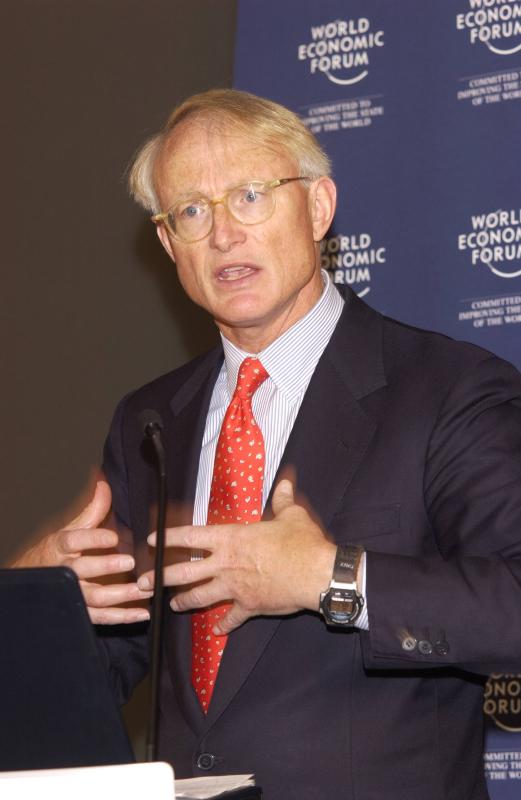
Michael Eugene Porter (born May 23, 1947) is an American businessman and professor at Harvard Business School. He was one of the founders of the consulting firm The Monitor Group (now part of Deloitte) and FSG, a social impact consultancy. He is credited with creating Porter's five forces analysis, a foundational framework in strategic management that remains widely used in both academia and industry. He is generally regarded as the father of the modern strategy field. He is also regarded as one of the world's most influential thinkers on management and competitiveness as well as one of the most influential business strategists. His work has been recognized by governments, non-governmental organizations and universities.
Michael Porter's father was a civil engineer and Georgia Tech graduate who had also gone on to a career as an army officer. During Porter's childhood, his family moved around the United States, and to France and Canada. This contributed to Porter's interest in understanding the economic development of regions and countries, and the differences in economic outcomes and competitiveness across different regions.[citation needed]
Porter said in an interview that he first became interested in competition through sports. He was on the NCAA championship golf squad at Princeton and also played football, baseball and basketball growing up.
Porter received a BSE with high honors in aerospace and mechanical engineering from Princeton University in 1969, where he graduated first in his class and was elected to Phi Beta Kappa and Tau Beta Pi. He received an MBA with high distinction in 1971 from Harvard Business School (HBS), where he was a George F. Baker Scholar, and a PhD in business economics from Harvard University in 1973. Porter credits Harvard professor Roland "Chris" Christensen with inspiring him and encouraging him to speak up during class. Porter reached the top of his class by his second year at HBS.
Porter developed the Porter five forces analysis framework for analyzing industries, inspired by classes in industrial organization economics that he took at Harvard.
During his career, Porter has emphasized that the essence of strategy is about making choices. He has delivered public speaking based on the importance of strategy formulation and has served as a consultant to many governments and NGOs devising strategy formulations.
Porter is the author of 20 books and numerous articles including Competitive Strategy, Competitive Advantage, Competitive Advantage of Nations, and On Competition, and is the most cited author in business and economics.
Porter wrote The Competitive Advantage of Nations in 1990. The book is based on studies of ten nations and argues that a key to national wealth and advantage was the productivity of firms and workers collectively, and that the national and regional environment supports that productivity. He proposed the "diamond" framework, a mutually-reinforcing system of four factors that determine national advantage: factor conditions; demand conditions; related or supporting industries; and firm strategy, structure and rivalry. Information, incentives, and infrastructure were also key to that productivity.
Hub AI
Michael Porter AI simulator
(@Michael Porter_simulator)
Michael Porter
Michael Eugene Porter (born May 23, 1947) is an American businessman and professor at Harvard Business School. He was one of the founders of the consulting firm The Monitor Group (now part of Deloitte) and FSG, a social impact consultancy. He is credited with creating Porter's five forces analysis, a foundational framework in strategic management that remains widely used in both academia and industry. He is generally regarded as the father of the modern strategy field. He is also regarded as one of the world's most influential thinkers on management and competitiveness as well as one of the most influential business strategists. His work has been recognized by governments, non-governmental organizations and universities.
Michael Porter's father was a civil engineer and Georgia Tech graduate who had also gone on to a career as an army officer. During Porter's childhood, his family moved around the United States, and to France and Canada. This contributed to Porter's interest in understanding the economic development of regions and countries, and the differences in economic outcomes and competitiveness across different regions.[citation needed]
Porter said in an interview that he first became interested in competition through sports. He was on the NCAA championship golf squad at Princeton and also played football, baseball and basketball growing up.
Porter received a BSE with high honors in aerospace and mechanical engineering from Princeton University in 1969, where he graduated first in his class and was elected to Phi Beta Kappa and Tau Beta Pi. He received an MBA with high distinction in 1971 from Harvard Business School (HBS), where he was a George F. Baker Scholar, and a PhD in business economics from Harvard University in 1973. Porter credits Harvard professor Roland "Chris" Christensen with inspiring him and encouraging him to speak up during class. Porter reached the top of his class by his second year at HBS.
Porter developed the Porter five forces analysis framework for analyzing industries, inspired by classes in industrial organization economics that he took at Harvard.
During his career, Porter has emphasized that the essence of strategy is about making choices. He has delivered public speaking based on the importance of strategy formulation and has served as a consultant to many governments and NGOs devising strategy formulations.
Porter is the author of 20 books and numerous articles including Competitive Strategy, Competitive Advantage, Competitive Advantage of Nations, and On Competition, and is the most cited author in business and economics.
Porter wrote The Competitive Advantage of Nations in 1990. The book is based on studies of ten nations and argues that a key to national wealth and advantage was the productivity of firms and workers collectively, and that the national and regional environment supports that productivity. He proposed the "diamond" framework, a mutually-reinforcing system of four factors that determine national advantage: factor conditions; demand conditions; related or supporting industries; and firm strategy, structure and rivalry. Information, incentives, and infrastructure were also key to that productivity.