
Recent from talks
Small wind turbine
Knowledge base stats:
Talk channels stats:
Members stats:
Small wind turbine
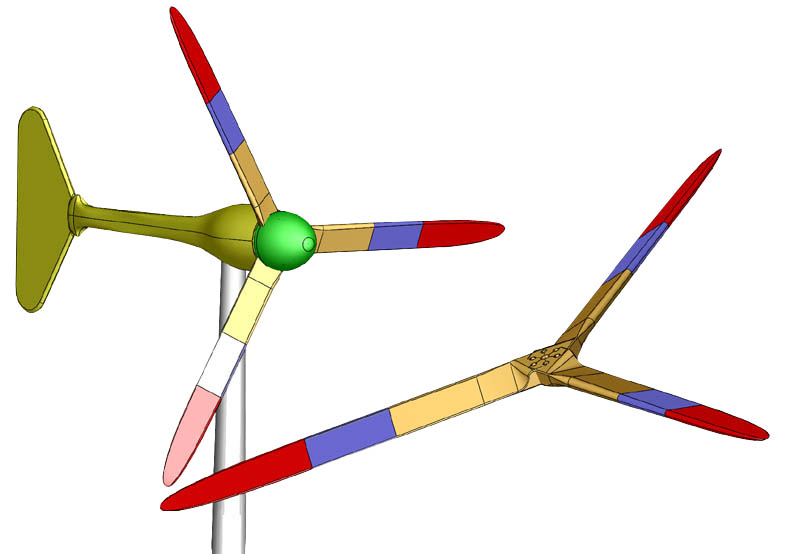
Small wind turbines, also known as micro wind turbines or urban wind turbines, are wind turbines that generate electricity for small-scale use. These turbines are typically smaller than those found in wind farms. Small wind turbines often have passive yaw systems as opposed to active ones. They use a direct drive generator and use a tail fin to point into the wind, whereas larger turbines have geared powertrains that are actively pointed into the wind.
They usually produce between 500 W and 10 kW, with some as small as 50 W. The Canadian Wind Energy Association considers small wind turbines to be up to 300 kW, while the IEC 61400 standard defines them as having a rotor area smaller than 200 m2 and generating voltage below 1000 Va.c. or 1500 Vd.c.
Turbine blades for small-scale wind turbines are typically 1.5 to 3.5 metres (4 ft 11 in – 11 ft 6 in) in diameter and produce 0.5-10 kW at their optimal wind speed. Most small wind turbines are horizontal-axis wind turbines, but vertical axis wind turbines (VAWTs) may have benefits in maintenance and placement, although they are less efficient at converting wind to electricity. To optimize efficiency, the tip speed ratio (the ratio of blade tip speed to wind speed) and lift-to-drag ratio should be kept at optimal levels.
A range of synthetic materials including carbon fiber reinforced polymers, nanocomposites, and E-glass-polyester are available. Although natural fibers are susceptible to quality variations, high moisture uptake and low thermal stability that make them undesirable for larger blades, small turbines can still take advantage of them. Wood can be used, and the type of wood should be chosen based on availability, cost and growth time, average density, high stiffness, and breaking strain. Coatings are generally used to reduce moisture, and white enamel with primer has been found to be particularly effective. Sitka spruce (used in propellers), and Douglas Fir have been used in turbine blades. Nepal has used small blade turbines made of coated timber including Sal, Saur, Sisau, Uttish, Tuni, Okhar, pine, and lakuri wood. Beyond wood, bamboo-based composites may also be used in both large and small wind turbines due to their low density and carbon sequestration ability—which makes bamboo materials environmentally friendly. Furthermore, relative to wood, bamboo has higher fracture toughness, higher strength, lower processing costs and fast growth rate. Ongoing materials developments include bamboo laminates using resins and hybrid bamboo carbon-fiber materials. Hemp, flax, wood and bamboo are all candidate blade materials for small turbines.
Small wind turbines must reach a certain wind speed, called the cut-in speed, to start generating electricity. This speed is usually around 4 metres per second (8.9 mph), but some turbines can work at lower speeds. To avoid obstacles, turbines are often placed on towers at least 9 m (30 ft) above anything within 150 m (490 ft). Better locations for turbines are far from large upwind obstacles, as wind tunnel studies show significant negative effects from nearby obstacles can extend up to 80 times the obstacle's height downwind, although this is an extreme case. Another option for placing a small turbine is using a model based on actual wind measurements to predict how nearby obstacles will affect local wind conditions at the potential turbine location, considering the size, shape, and distance to the obstacles.
Small-scale rooftop turbines can be installed on a roof, but may face issues such as vibration and turbulence caused by the roof ledge, which can impact their power generation. These turbines often struggle to generate significant amounts of power, particularly in urban areas.
The generators for small wind turbines are usually three-phase alternating current generators and the trend is to use the induction type, although some models utilize single-phase generators or direct current output.
After running the three phase AC wire through a slip ring and down to the receiving end, a three-phase rectifier is used to convert the AC to rectified DC for battery charging, especially in solar hybrid power systems. The rectifier should be mounted to a heat sink for cooling, with the option of adding a computer fan that is activated by a bimetal thermal switch for active cooling.
Hub AI
Small wind turbine AI simulator
(@Small wind turbine_simulator)
Small wind turbine
Small wind turbines, also known as micro wind turbines or urban wind turbines, are wind turbines that generate electricity for small-scale use. These turbines are typically smaller than those found in wind farms. Small wind turbines often have passive yaw systems as opposed to active ones. They use a direct drive generator and use a tail fin to point into the wind, whereas larger turbines have geared powertrains that are actively pointed into the wind.
They usually produce between 500 W and 10 kW, with some as small as 50 W. The Canadian Wind Energy Association considers small wind turbines to be up to 300 kW, while the IEC 61400 standard defines them as having a rotor area smaller than 200 m2 and generating voltage below 1000 Va.c. or 1500 Vd.c.
Turbine blades for small-scale wind turbines are typically 1.5 to 3.5 metres (4 ft 11 in – 11 ft 6 in) in diameter and produce 0.5-10 kW at their optimal wind speed. Most small wind turbines are horizontal-axis wind turbines, but vertical axis wind turbines (VAWTs) may have benefits in maintenance and placement, although they are less efficient at converting wind to electricity. To optimize efficiency, the tip speed ratio (the ratio of blade tip speed to wind speed) and lift-to-drag ratio should be kept at optimal levels.
A range of synthetic materials including carbon fiber reinforced polymers, nanocomposites, and E-glass-polyester are available. Although natural fibers are susceptible to quality variations, high moisture uptake and low thermal stability that make them undesirable for larger blades, small turbines can still take advantage of them. Wood can be used, and the type of wood should be chosen based on availability, cost and growth time, average density, high stiffness, and breaking strain. Coatings are generally used to reduce moisture, and white enamel with primer has been found to be particularly effective. Sitka spruce (used in propellers), and Douglas Fir have been used in turbine blades. Nepal has used small blade turbines made of coated timber including Sal, Saur, Sisau, Uttish, Tuni, Okhar, pine, and lakuri wood. Beyond wood, bamboo-based composites may also be used in both large and small wind turbines due to their low density and carbon sequestration ability—which makes bamboo materials environmentally friendly. Furthermore, relative to wood, bamboo has higher fracture toughness, higher strength, lower processing costs and fast growth rate. Ongoing materials developments include bamboo laminates using resins and hybrid bamboo carbon-fiber materials. Hemp, flax, wood and bamboo are all candidate blade materials for small turbines.
Small wind turbines must reach a certain wind speed, called the cut-in speed, to start generating electricity. This speed is usually around 4 metres per second (8.9 mph), but some turbines can work at lower speeds. To avoid obstacles, turbines are often placed on towers at least 9 m (30 ft) above anything within 150 m (490 ft). Better locations for turbines are far from large upwind obstacles, as wind tunnel studies show significant negative effects from nearby obstacles can extend up to 80 times the obstacle's height downwind, although this is an extreme case. Another option for placing a small turbine is using a model based on actual wind measurements to predict how nearby obstacles will affect local wind conditions at the potential turbine location, considering the size, shape, and distance to the obstacles.
Small-scale rooftop turbines can be installed on a roof, but may face issues such as vibration and turbulence caused by the roof ledge, which can impact their power generation. These turbines often struggle to generate significant amounts of power, particularly in urban areas.
The generators for small wind turbines are usually three-phase alternating current generators and the trend is to use the induction type, although some models utilize single-phase generators or direct current output.
After running the three phase AC wire through a slip ring and down to the receiving end, a three-phase rectifier is used to convert the AC to rectified DC for battery charging, especially in solar hybrid power systems. The rectifier should be mounted to a heat sink for cooling, with the option of adding a computer fan that is activated by a bimetal thermal switch for active cooling.
Recent media