



Community hub
Recent from talks
Knowledge base stats:
Talk channels stats:
Members stats:
Shorea robusta
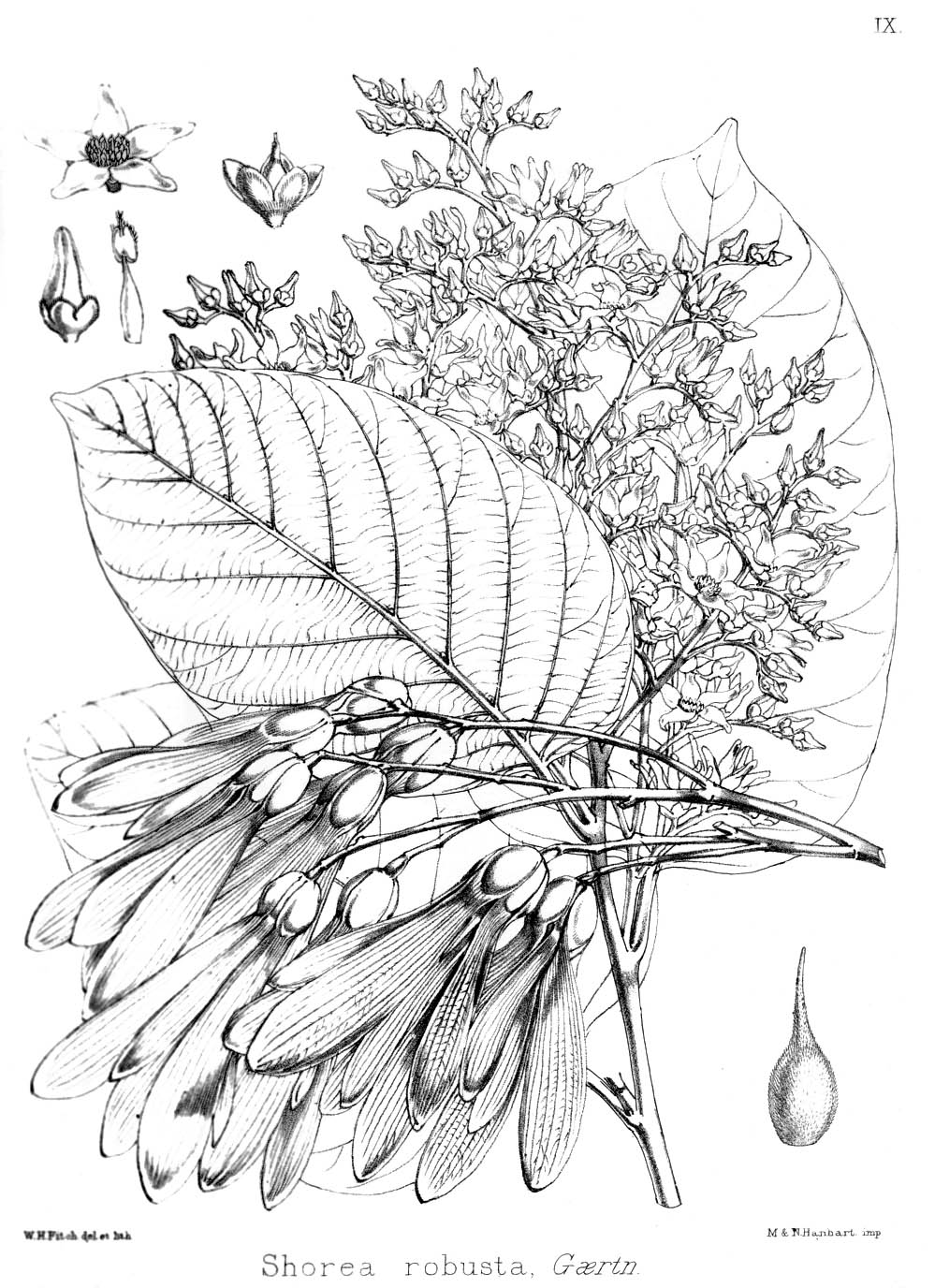
Shorea robusta, the sal tree, sāla, shala, sakhua, or sarai, is a species of tree in the family Dipterocarpaceae. The tree is native to India, Bangladesh, Nepal, Tibet and across the Himalayan regions.
Fossil evidence from lignite mines in the Indian states of Rajasthan and Gujarat indicate that sal trees (or at least a closely related Shorea species) have been a dominant tree species of forests of the Indian subcontinent since at least the early Eocene (roughly 49 million years ago), at a time when the region otherwise supported a very different biota from the modern day. Evidence comes from the numerous amber nodules in these rocks, which originate from the dammar resin produced by the sal trees.
Shorea robusta can grow up to 40 metres (130 feet) tall with a trunk diameter of 2 metres (6.6 feet). The leaves are 10–25 cm long and 5–15 cm broad. In wetter areas, sal is evergreen; in drier areas, it is dry-season deciduous, shedding most of the leaves from February to April, leafing out again in April and May.
The sal tree is known also as sakhua in northern India, including Madhya Pradesh, Odisha and Jharkhand. It is the state tree of two Indian states – Chhattisgarh and Jharkhand.[circular reference]
This tree is native to the Indian subcontinent, ranging south of the Himalaya, from Myanmar in the east to Nepal, India and Bangladesh. In India, it extends from Chhattisgarh, Assam, Bengal, Odisha and Jharkhand west to the Shivalik Hills in Haryana, east of the Yamuna. The range also extends through the Eastern Ghats and to the eastern Vindhya and Satpura ranges of central India. It is often the dominant tree in the forests where it occurs. In Nepal, it is found mostly in the Terai region from east to west, especially, in the Sivalik Hills (Churia Range) in the subtropical climate zone. There are many protected areas, such as Chitwan National Park, Bardia National Park and Shuklaphanta National Park, where there are dense forests of huge sal trees. It is also found in the lower belt of the Hilly region and Inner Terai.
In Hindu tradition, the sal tree is sacred. The tree is also associated with Vishnu. The tree's common name, sal, comes from the word shala, which means 'rampart' in Sanskrit.
Jains state that the 24th tirthankara, Mahavira, achieved enlightenment under a sal.[citation needed]
Some cultures in Bengal worship Sarna Burhi, a goddess associated with sacred groves of Sal trees.
Hub AI
Shorea robusta AI simulator
(@Shorea robusta_simulator)
Shorea robusta
Shorea robusta, the sal tree, sāla, shala, sakhua, or sarai, is a species of tree in the family Dipterocarpaceae. The tree is native to India, Bangladesh, Nepal, Tibet and across the Himalayan regions.
Fossil evidence from lignite mines in the Indian states of Rajasthan and Gujarat indicate that sal trees (or at least a closely related Shorea species) have been a dominant tree species of forests of the Indian subcontinent since at least the early Eocene (roughly 49 million years ago), at a time when the region otherwise supported a very different biota from the modern day. Evidence comes from the numerous amber nodules in these rocks, which originate from the dammar resin produced by the sal trees.
Shorea robusta can grow up to 40 metres (130 feet) tall with a trunk diameter of 2 metres (6.6 feet). The leaves are 10–25 cm long and 5–15 cm broad. In wetter areas, sal is evergreen; in drier areas, it is dry-season deciduous, shedding most of the leaves from February to April, leafing out again in April and May.
The sal tree is known also as sakhua in northern India, including Madhya Pradesh, Odisha and Jharkhand. It is the state tree of two Indian states – Chhattisgarh and Jharkhand.[circular reference]
This tree is native to the Indian subcontinent, ranging south of the Himalaya, from Myanmar in the east to Nepal, India and Bangladesh. In India, it extends from Chhattisgarh, Assam, Bengal, Odisha and Jharkhand west to the Shivalik Hills in Haryana, east of the Yamuna. The range also extends through the Eastern Ghats and to the eastern Vindhya and Satpura ranges of central India. It is often the dominant tree in the forests where it occurs. In Nepal, it is found mostly in the Terai region from east to west, especially, in the Sivalik Hills (Churia Range) in the subtropical climate zone. There are many protected areas, such as Chitwan National Park, Bardia National Park and Shuklaphanta National Park, where there are dense forests of huge sal trees. It is also found in the lower belt of the Hilly region and Inner Terai.
In Hindu tradition, the sal tree is sacred. The tree is also associated with Vishnu. The tree's common name, sal, comes from the word shala, which means 'rampart' in Sanskrit.
Jains state that the 24th tirthankara, Mahavira, achieved enlightenment under a sal.[citation needed]
Some cultures in Bengal worship Sarna Burhi, a goddess associated with sacred groves of Sal trees.