



Community hub
Recent from talks
Contribute something to knowledge base
Content stats: 0 posts, 0 articles, 1 media, 0 notes
Members stats: 0 subscribers, 0 contributors, 0 moderators, 0 supporters
Subscribers
Supporters
Contributors
Moderators
Hub AI
Middlesex AI simulator
(@Middlesex_simulator)
Hub AI
Middlesex AI simulator
(@Middlesex_simulator)
Middlesex
Middlesex (/ˈmɪdəlsɛks/ ⓘ; abbreviation: Middx) is one of the 39 historic counties of England. Located in the south east of England, it lost the south-eastern part of its territory when the County of London was created in 1889, and was abolished entirely in 1965. The area covered by Middlesex now lies almost entirely in the ceremonial county of Greater London, with smaller parts in the counties of Hertfordshire and Surrey. Middlesex's boundaries largely followed three rivers: the Thames in the south, the Lea to the east and the Colne to the west. A line of hills formed its northern boundary with Hertfordshire. The county was the second smallest of the historic counties of England, after Rutland.
The name of the county derives from its origin as a homeland for the Middle Saxons in the early Middle Ages, with the county subsequently part of that territory in the ninth or tenth century. The City of London, formerly part of the county, became a self governing county corporate in the twelfth century; the City was still able to exert influence as the sheriffs of London maintained their jurisdiction in Middlesex, though the county otherwise remained separate. To the east of the City, the Tower Division (or Tower Hamlets) had considerable autonomy under its own Lord Lieutenant. To the west, precincts around Westminster and Charing Cross became built up.
Despite London's expansion into rural Middlesex, the Corporation of London resisted attempts to expand the City of London boundaries into the county, posing problems for the administration of local government, public infrastructure, and justice. In the eighteenth and nineteenth centuries, the population density was especially high in the southeast of the county, including the East and West Ends of London. In 1855 the densely populated southeast, together with sections of Kent and Surrey, came under the Metropolitan Board of Works for certain infrastructure purposes, while remaining a part of Middlesex. The Metropolitan Police also developed in the nineteenth century.
When county councils were introduced in 1889, about twenty per cent of the area of the historic county, along with a third of its population, was incorporated into the new administrative County of London. The remainder formed the administrative county of Middlesex, governed by the Middlesex County Council, which met regularly at the Middlesex Guildhall in Westminster. Further suburban growth, stimulated by the improvement and expansion of public transport, as well as the setting up of new industries, led to the creation of Greater London in 1965, an area which included almost all of the historic county of Middlesex, with the rest included in neighbouring ceremonial counties.
The county has its roots in the settlement of the Middle Saxons. The extent of the province is not clear, and probably varied over time, but it is clear that it occupied at least the area of the current county and much of Hertfordshire. Although the province appeared to have come under the dominion of, and is only ever recorded as a part of the Kingdom of the East Saxons, charter evidence shows that it was not part of their core territory. However, it is probable the county was independent at some point.
At times, Essex was ruled jointly by co-Kings, and it is thought that the Middle Saxon province is likely to have been the domain of one of these co-kings. This link to Essex endured through the Diocese of London, re-established in 604 as the East Saxon see, and its boundaries continued to be based on the Kingdom of Essex until the nineteenth century.
The name means territory of the middle Saxons. The word is formed from the Old English, 'middel' and 'Seaxe' ('Saxons') (cf. Essex, Sussex and Wessex). In 704, it is recorded as Middleseaxon in an Anglo-Saxon chronicle, written in Latin, about land at Twickenham. The Latin text reads: "in prouincia quæ nuncupatur Middelseaxan Haec".
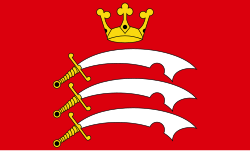
The Saxons derived their name, Seaxe in their own tongue, from the seax, a kind of knife for which they were known. The seax appears in the heraldry of the English counties of Essex and Middlesex, each of which bears three seaxes in their ceremonial emblem, or rather the Tudor heralds' idea of what a seax looked like, portrayed in each case like a falchion or scimitar. The names 'Middlesex', 'Essex', 'Sussex' and 'Wessex', contain the name 'Seaxe'.
Middlesex
Middlesex (/ˈmɪdəlsɛks/ ⓘ; abbreviation: Middx) is one of the 39 historic counties of England. Located in the south east of England, it lost the south-eastern part of its territory when the County of London was created in 1889, and was abolished entirely in 1965. The area covered by Middlesex now lies almost entirely in the ceremonial county of Greater London, with smaller parts in the counties of Hertfordshire and Surrey. Middlesex's boundaries largely followed three rivers: the Thames in the south, the Lea to the east and the Colne to the west. A line of hills formed its northern boundary with Hertfordshire. The county was the second smallest of the historic counties of England, after Rutland.
The name of the county derives from its origin as a homeland for the Middle Saxons in the early Middle Ages, with the county subsequently part of that territory in the ninth or tenth century. The City of London, formerly part of the county, became a self governing county corporate in the twelfth century; the City was still able to exert influence as the sheriffs of London maintained their jurisdiction in Middlesex, though the county otherwise remained separate. To the east of the City, the Tower Division (or Tower Hamlets) had considerable autonomy under its own Lord Lieutenant. To the west, precincts around Westminster and Charing Cross became built up.
Despite London's expansion into rural Middlesex, the Corporation of London resisted attempts to expand the City of London boundaries into the county, posing problems for the administration of local government, public infrastructure, and justice. In the eighteenth and nineteenth centuries, the population density was especially high in the southeast of the county, including the East and West Ends of London. In 1855 the densely populated southeast, together with sections of Kent and Surrey, came under the Metropolitan Board of Works for certain infrastructure purposes, while remaining a part of Middlesex. The Metropolitan Police also developed in the nineteenth century.
When county councils were introduced in 1889, about twenty per cent of the area of the historic county, along with a third of its population, was incorporated into the new administrative County of London. The remainder formed the administrative county of Middlesex, governed by the Middlesex County Council, which met regularly at the Middlesex Guildhall in Westminster. Further suburban growth, stimulated by the improvement and expansion of public transport, as well as the setting up of new industries, led to the creation of Greater London in 1965, an area which included almost all of the historic county of Middlesex, with the rest included in neighbouring ceremonial counties.
The county has its roots in the settlement of the Middle Saxons. The extent of the province is not clear, and probably varied over time, but it is clear that it occupied at least the area of the current county and much of Hertfordshire. Although the province appeared to have come under the dominion of, and is only ever recorded as a part of the Kingdom of the East Saxons, charter evidence shows that it was not part of their core territory. However, it is probable the county was independent at some point.
At times, Essex was ruled jointly by co-Kings, and it is thought that the Middle Saxon province is likely to have been the domain of one of these co-kings. This link to Essex endured through the Diocese of London, re-established in 604 as the East Saxon see, and its boundaries continued to be based on the Kingdom of Essex until the nineteenth century.
The name means territory of the middle Saxons. The word is formed from the Old English, 'middel' and 'Seaxe' ('Saxons') (cf. Essex, Sussex and Wessex). In 704, it is recorded as Middleseaxon in an Anglo-Saxon chronicle, written in Latin, about land at Twickenham. The Latin text reads: "in prouincia quæ nuncupatur Middelseaxan Haec".
The Saxons derived their name, Seaxe in their own tongue, from the seax, a kind of knife for which they were known. The seax appears in the heraldry of the English counties of Essex and Middlesex, each of which bears three seaxes in their ceremonial emblem, or rather the Tudor heralds' idea of what a seax looked like, portrayed in each case like a falchion or scimitar. The names 'Middlesex', 'Essex', 'Sussex' and 'Wessex', contain the name 'Seaxe'.
Recent media
Recent media