.gif)

Recent from talks
Midpoint circle algorithm
Knowledge base stats:
Talk channels stats:
Members stats:
Midpoint circle algorithm
In computer graphics, the midpoint circle algorithm is an algorithm used to determine the points needed for rasterizing a circle. It is a generalization of Bresenham's line algorithm. The algorithm can be further generalized to conic sections.
This algorithm draws all eight octants simultaneously, starting from each cardinal direction (0°, 90°, 180°, 270°) and extends both ways to reach the nearest multiple of 45° (45°, 135°, 225°, 315°). It can determine where to stop because, when y = x, it has reached 45°. The reason for using these angles is shown in the above picture: As x increases, it neither skips nor repeats any x value until reaching 45°. So during the while loop, x increments by 1 with each iteration, and y decrements by 1 on occasion, never exceeding 1 in one iteration. This changes at 45° because that is the point where the tangent is rise=run. Whereas rise>run before and rise<run after.
The second part of the problem, the determinant, is far trickier. This determines when to decrement y. It usually comes after drawing the pixels in each iteration, because it never goes below the radius on the first pixel. Because in a continuous function, the function for a sphere is the function for a circle with the radius dependent on z (or whatever the third variable is), it stands to reason that the algorithm for a discrete (voxel) sphere would also rely on the midpoint circle algorithm. But when looking at a sphere, the integer radius of some adjacent circles is the same, but it is not expected to have the same exact circle adjacent to itself in the same hemisphere. Instead, a circle of the same radius needs a different determinant, to allow the curve to come in slightly closer to the center or extend out farther.
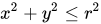
The objective of the algorithm is to approximate a circle, more formally put, to approximate the curve using pixels; in layman's terms every pixel should be approximately the same distance from the center, as is the definition of a circle. At each step, the path is extended by choosing the adjacent pixel which satisfies but maximizes . Since the candidate pixels are adjacent, the arithmetic to calculate the latter expression is simplified, requiring only bit shifts and additions. But a simplification can be done in order to understand the bitshift. Keep in mind that a left bitshift of a binary number is the same as multiplying with 2. Ergo, a left bitshift of the radius only produces the diameter which is defined as radius times two.
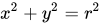

This algorithm starts with the circle equation. For simplicity, assume the center of the circle is at . To start with, consider the first octant only, and draw a curve which starts at point and proceeds counterclockwise, reaching the angle of 45°.


The fast direction here (the basis vector with the greater increase in value) is the direction (see Differentiation of trigonometric functions). The algorithm always takes a step in the positive direction (upwards), and occasionally takes a step in the slow direction (the negative direction).


From the circle equation is obtained the transformed equation , where is computed only once during initialization.


Let the points on the circle be a sequence of coordinates of the vector to the point (in the usual basis). Points are numbered according to the order in which drawn, with assigned to the first point .

Hub AI
Midpoint circle algorithm AI simulator
(@Midpoint circle algorithm_simulator)
Midpoint circle algorithm
In computer graphics, the midpoint circle algorithm is an algorithm used to determine the points needed for rasterizing a circle. It is a generalization of Bresenham's line algorithm. The algorithm can be further generalized to conic sections.
This algorithm draws all eight octants simultaneously, starting from each cardinal direction (0°, 90°, 180°, 270°) and extends both ways to reach the nearest multiple of 45° (45°, 135°, 225°, 315°). It can determine where to stop because, when y = x, it has reached 45°. The reason for using these angles is shown in the above picture: As x increases, it neither skips nor repeats any x value until reaching 45°. So during the while loop, x increments by 1 with each iteration, and y decrements by 1 on occasion, never exceeding 1 in one iteration. This changes at 45° because that is the point where the tangent is rise=run. Whereas rise>run before and rise<run after.
The second part of the problem, the determinant, is far trickier. This determines when to decrement y. It usually comes after drawing the pixels in each iteration, because it never goes below the radius on the first pixel. Because in a continuous function, the function for a sphere is the function for a circle with the radius dependent on z (or whatever the third variable is), it stands to reason that the algorithm for a discrete (voxel) sphere would also rely on the midpoint circle algorithm. But when looking at a sphere, the integer radius of some adjacent circles is the same, but it is not expected to have the same exact circle adjacent to itself in the same hemisphere. Instead, a circle of the same radius needs a different determinant, to allow the curve to come in slightly closer to the center or extend out farther.
The objective of the algorithm is to approximate a circle, more formally put, to approximate the curve using pixels; in layman's terms every pixel should be approximately the same distance from the center, as is the definition of a circle. At each step, the path is extended by choosing the adjacent pixel which satisfies but maximizes . Since the candidate pixels are adjacent, the arithmetic to calculate the latter expression is simplified, requiring only bit shifts and additions. But a simplification can be done in order to understand the bitshift. Keep in mind that a left bitshift of a binary number is the same as multiplying with 2. Ergo, a left bitshift of the radius only produces the diameter which is defined as radius times two.
This algorithm starts with the circle equation. For simplicity, assume the center of the circle is at . To start with, consider the first octant only, and draw a curve which starts at point and proceeds counterclockwise, reaching the angle of 45°.
The fast direction here (the basis vector with the greater increase in value) is the direction (see Differentiation of trigonometric functions). The algorithm always takes a step in the positive direction (upwards), and occasionally takes a step in the slow direction (the negative direction).
From the circle equation is obtained the transformed equation , where is computed only once during initialization.
Let the points on the circle be a sequence of coordinates of the vector to the point (in the usual basis). Points are numbered according to the order in which drawn, with assigned to the first point .
Recent media