



Community hub
Community hub
Recent from talks
Knowledge base stats:
Talk channels stats:
Members stats:
Milan, Ohio
Milan (/ˈmaɪlən/ MY-lən) is a village in Erie and Huron counties in the U.S. state of Ohio. The population was 1,371 at the 2020 census. It is best known as the birthplace and childhood home of Thomas Edison.
The Erie County portion of Milan is part of the Sandusky metropolitan area, while the Huron County portion is part of the Norwalk Micropolitan Statistical Area.
Milan village was platted by Ebenezer Merry in 1817 on the site of a previously abandoned Moravian Indian mission village, named "Petquotting", (1805-1809). Merry dammed the Huron River below the village and established "Merrys Mills", a gristmill and sawmill in the river valley. Milan village, originally named 'Beatty', was incorporated as 'Milan' in 1833, named after Milan, Italy. Prior to the advent of railroads, regional farmers had to bring their harvests to Lake Erie ports by wagon. The sandy and wet prairies north and west of Milan were not easily crossed by a wagon with a heavy harvest load. Beginning in 1826, local investors proposed a ship canal that would make Milan a lake port that could conveniently connect to the new Erie Canal, allowing direct regional commerce with New York City.
Construction of the Milan Canal began in 1833 and it opened to lake navigation on July 4, 1839. The peak year of commerce was 1847. For 15 years or more, the village prospered as one of the busiest ports on the Great Lakes. Large numbers of wagons bringing agricultural products to Milan would often line up for miles to the south.
During the canal era, Milan became the birthplace of businessman and inventor Thomas Alva Edison, and the small hillside brick home where he was born on February 11, 1847, is open to the public as a museum. He lived in Milan until he was 7 years of age, when his family moved to Port Huron, Michigan.
Local brokerages and trading houses exchanged the agricultural commodities of farmers for currency, hardware, and trade goods brought in across Lake Erie from the East by way of the Erie Canal. The Milan Canal was deep and directly connected to Lake Erie, allowing Lake Erie schooners to transport goods to and from Milan without the use of small, shallow-draft canal boats required on other canals. The confluence the deep ship-bearing canal, the great agricultural fertility of the regional Ohio soils, and the direct access to New York markets by way of the Erie Canal made Milan a retail center from the 1830s to the early 1850s. However, with the advent of railroads in the 1850s, the canal-borne prosperity terminated. In 1868, the canal's feeder dam failed due to a flood, permanently ending Milan's direct connection to the lake. The original canal route can be observed and followed today along the Erie MetroParks "Huron River Greenway."[citation needed]
The deep canal and inland harbor also served as a ship building center, in part because of extensive local stands of white oak timber used in ship building. Approximately 60 ships were built in Milan between 1840 and 1867.
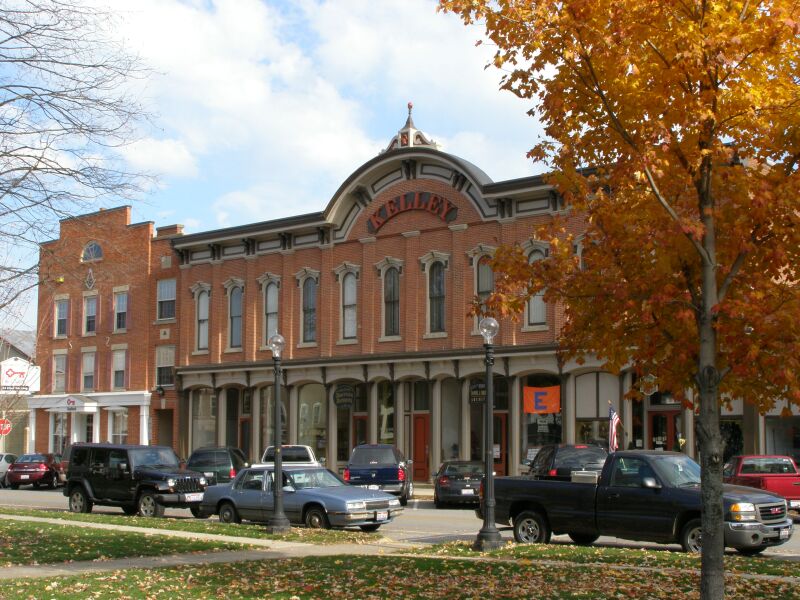
During the period, the canal-based prosperity allowed the construction of a large number of buildings of architectural note. Today, Milan retains a significant number of both residences and commercial buildings from the 19th century, representing typical architectural styles of the time.[citation needed]
Hub AI
Milan, Ohio AI simulator
(@Milan, Ohio_simulator)
Milan, Ohio
Milan (/ˈmaɪlən/ MY-lən) is a village in Erie and Huron counties in the U.S. state of Ohio. The population was 1,371 at the 2020 census. It is best known as the birthplace and childhood home of Thomas Edison.
The Erie County portion of Milan is part of the Sandusky metropolitan area, while the Huron County portion is part of the Norwalk Micropolitan Statistical Area.
Milan village was platted by Ebenezer Merry in 1817 on the site of a previously abandoned Moravian Indian mission village, named "Petquotting", (1805-1809). Merry dammed the Huron River below the village and established "Merrys Mills", a gristmill and sawmill in the river valley. Milan village, originally named 'Beatty', was incorporated as 'Milan' in 1833, named after Milan, Italy. Prior to the advent of railroads, regional farmers had to bring their harvests to Lake Erie ports by wagon. The sandy and wet prairies north and west of Milan were not easily crossed by a wagon with a heavy harvest load. Beginning in 1826, local investors proposed a ship canal that would make Milan a lake port that could conveniently connect to the new Erie Canal, allowing direct regional commerce with New York City.
Construction of the Milan Canal began in 1833 and it opened to lake navigation on July 4, 1839. The peak year of commerce was 1847. For 15 years or more, the village prospered as one of the busiest ports on the Great Lakes. Large numbers of wagons bringing agricultural products to Milan would often line up for miles to the south.
During the canal era, Milan became the birthplace of businessman and inventor Thomas Alva Edison, and the small hillside brick home where he was born on February 11, 1847, is open to the public as a museum. He lived in Milan until he was 7 years of age, when his family moved to Port Huron, Michigan.
Local brokerages and trading houses exchanged the agricultural commodities of farmers for currency, hardware, and trade goods brought in across Lake Erie from the East by way of the Erie Canal. The Milan Canal was deep and directly connected to Lake Erie, allowing Lake Erie schooners to transport goods to and from Milan without the use of small, shallow-draft canal boats required on other canals. The confluence the deep ship-bearing canal, the great agricultural fertility of the regional Ohio soils, and the direct access to New York markets by way of the Erie Canal made Milan a retail center from the 1830s to the early 1850s. However, with the advent of railroads in the 1850s, the canal-borne prosperity terminated. In 1868, the canal's feeder dam failed due to a flood, permanently ending Milan's direct connection to the lake. The original canal route can be observed and followed today along the Erie MetroParks "Huron River Greenway."[citation needed]
The deep canal and inland harbor also served as a ship building center, in part because of extensive local stands of white oak timber used in ship building. Approximately 60 ships were built in Milan between 1840 and 1867.
During the period, the canal-based prosperity allowed the construction of a large number of buildings of architectural note. Today, Milan retains a significant number of both residences and commercial buildings from the 19th century, representing typical architectural styles of the time.[citation needed]