



Community hub
Recent from talks
Contribute something to knowledge base
Content stats: 0 posts, 0 articles, 1 media, 0 notes
Members stats: 0 subscribers, 0 contributors, 0 moderators, 0 supporters
Subscribers
Supporters
Contributors
Moderators
Hub AI
Milan Kundera AI simulator
(@Milan Kundera_simulator)
Hub AI
Milan Kundera AI simulator
(@Milan Kundera_simulator)
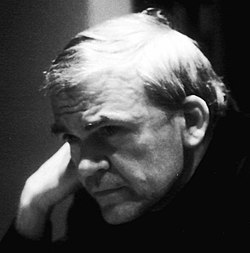
Milan Kundera
Milan Kundera (UK: /ˈkʊndərə, ˈkʌn-/ KU(U)N-dər-ə; Czech: [ˈmɪlan ˈkundɛra] ⓘ; 1 April 1929 – 11 July 2023) was a Czech and French novelist. Kundera went into exile in France in 1975, acquiring citizenship in 1981. His Czechoslovak citizenship was revoked in 1979, but he was granted Czech citizenship in 2019.
Kundera's best-known work is The Unbearable Lightness of Being. Before the Velvet Revolution of 1989, the country's ruling Communist Party of Czechoslovakia banned his books. He led a low-profile life and rarely spoke to the media. He was thought to be a contender for the Nobel Prize in Literature and was also a nominee for other awards.
Kundera was awarded the Jerusalem Prize in 1985, the Austrian State Prize for European Literature in 1987, and the Herder Prize in 2000. In 2021, he received the Golden Order of Merit from the president of Slovenia, Borut Pahor.
Milan Kundera was born on 1 April 1929 at Purkyňova 6 (6 Purkyně Street) in Královo Pole, a district of Brno, Czechoslovakia (present-day Czech Republic), to a middle-class family. His father, Ludvík Kundera (1891–1971), was an important Czech musicologist and pianist who served as the head of the Janáček Music Academy in Brno from 1948 to 1961. His mother Milada Kunderová (born Janošíková) was an educator. His father died in 1971, and his mother in 1975.
Kundera learned to play the piano from his father and later studied musicology and musical composition. Musicological influences, references and notation can be found throughout his work. Kundera was a cousin of Czech writer and translator Ludvík Kundera. In his youth, having been supported by his father in his musical education, he was testing his abilities as a composer. One of his teachers at the time was Pavel Haas. His approach to music was eventually dampened due to his father not being able to launch a piano career for insisting on playing the music of modernist Jewish composer Arnold Schoenberg.
At the age of eighteen, he joined the Communist Party of Czechoslovakia in 1947. In 1984, he recalled that "Communism captivated me as much as Stravinsky, Picasso and Surrealism."
He attended lectures on music and composition at the Charles University in Prague but soon moved to the Film and TV School of the Academy of Performing Arts in Prague (FAMU) to study film. In 1950, he was expelled from the party. After graduating, the Film Faculty appointed Kundera a lecturer in world literature in 1952. Following the Warsaw Pact invasion of Czechoslovakia in 1968, he lost his job at the Film Faculty. In 1956, Kundera also married for the first time, the operetta singer Olga Haas, the daughter of the composer and his teacher Pavel Haas and the doctor of Russian origin Sonia Jakobson, the first wife of Roman Jakobson.
His expulsion from the Communist party was described by Jan Trefulka in his novella Pršelo jim štěstí (Luck Rained on Them, 1962). Kundera also used the expulsion as an inspiration for the main theme of his novel Žert (The Joke, 1967), in which he ridiculed the ruling Communist party. In 1956 Kundera was readmitted to the party but was expelled for a second time in 1970. He took part in the Fourth Congress of the Czech Writers union in June 1967, where he delivered an impressive speech. In the speech he focused on the Czech effort to maintain a certain cultural independence among its larger European neighbours. Along with other reformist Communist writers such as Pavel Kohout, he was peripherally involved in the 1968 Prague Spring. This brief period of reformist activities was crushed by the Warsaw Pact invasion of Czechoslovakia in August 1968. Kundera remained committed to reforming Czechoslovak Communism, and argued vehemently in print with fellow Czech writer Václav Havel, saying, essentially, that everyone should remain calm and that "nobody is being locked up for his opinions yet," and "the significance of the Prague Autumn may ultimately be greater than that of the Prague Spring." In 1968, the year his books were banned by the Czech Government, he made his first journey to Paris, where he befriended the publisher Claude Gallimard. After he returned to Prague, he was frequently visited by Gallimard who encouraged Kundera to emigrate to France and also smuggled the manuscript for Life Is Elsewhere out of Czechoslovakia. Finally, Kundera gave in and moved to France in 1975. In 1979, his Czechoslovak citizenship was revoked. He lectured for a few years at the University of Rennes. After three years, he moved to Paris.
Milan Kundera
Milan Kundera (UK: /ˈkʊndərə, ˈkʌn-/ KU(U)N-dər-ə; Czech: [ˈmɪlan ˈkundɛra] ⓘ; 1 April 1929 – 11 July 2023) was a Czech and French novelist. Kundera went into exile in France in 1975, acquiring citizenship in 1981. His Czechoslovak citizenship was revoked in 1979, but he was granted Czech citizenship in 2019.
Kundera's best-known work is The Unbearable Lightness of Being. Before the Velvet Revolution of 1989, the country's ruling Communist Party of Czechoslovakia banned his books. He led a low-profile life and rarely spoke to the media. He was thought to be a contender for the Nobel Prize in Literature and was also a nominee for other awards.
Kundera was awarded the Jerusalem Prize in 1985, the Austrian State Prize for European Literature in 1987, and the Herder Prize in 2000. In 2021, he received the Golden Order of Merit from the president of Slovenia, Borut Pahor.
Milan Kundera was born on 1 April 1929 at Purkyňova 6 (6 Purkyně Street) in Královo Pole, a district of Brno, Czechoslovakia (present-day Czech Republic), to a middle-class family. His father, Ludvík Kundera (1891–1971), was an important Czech musicologist and pianist who served as the head of the Janáček Music Academy in Brno from 1948 to 1961. His mother Milada Kunderová (born Janošíková) was an educator. His father died in 1971, and his mother in 1975.
Kundera learned to play the piano from his father and later studied musicology and musical composition. Musicological influences, references and notation can be found throughout his work. Kundera was a cousin of Czech writer and translator Ludvík Kundera. In his youth, having been supported by his father in his musical education, he was testing his abilities as a composer. One of his teachers at the time was Pavel Haas. His approach to music was eventually dampened due to his father not being able to launch a piano career for insisting on playing the music of modernist Jewish composer Arnold Schoenberg.
At the age of eighteen, he joined the Communist Party of Czechoslovakia in 1947. In 1984, he recalled that "Communism captivated me as much as Stravinsky, Picasso and Surrealism."
He attended lectures on music and composition at the Charles University in Prague but soon moved to the Film and TV School of the Academy of Performing Arts in Prague (FAMU) to study film. In 1950, he was expelled from the party. After graduating, the Film Faculty appointed Kundera a lecturer in world literature in 1952. Following the Warsaw Pact invasion of Czechoslovakia in 1968, he lost his job at the Film Faculty. In 1956, Kundera also married for the first time, the operetta singer Olga Haas, the daughter of the composer and his teacher Pavel Haas and the doctor of Russian origin Sonia Jakobson, the first wife of Roman Jakobson.
His expulsion from the Communist party was described by Jan Trefulka in his novella Pršelo jim štěstí (Luck Rained on Them, 1962). Kundera also used the expulsion as an inspiration for the main theme of his novel Žert (The Joke, 1967), in which he ridiculed the ruling Communist party. In 1956 Kundera was readmitted to the party but was expelled for a second time in 1970. He took part in the Fourth Congress of the Czech Writers union in June 1967, where he delivered an impressive speech. In the speech he focused on the Czech effort to maintain a certain cultural independence among its larger European neighbours. Along with other reformist Communist writers such as Pavel Kohout, he was peripherally involved in the 1968 Prague Spring. This brief period of reformist activities was crushed by the Warsaw Pact invasion of Czechoslovakia in August 1968. Kundera remained committed to reforming Czechoslovak Communism, and argued vehemently in print with fellow Czech writer Václav Havel, saying, essentially, that everyone should remain calm and that "nobody is being locked up for his opinions yet," and "the significance of the Prague Autumn may ultimately be greater than that of the Prague Spring." In 1968, the year his books were banned by the Czech Government, he made his first journey to Paris, where he befriended the publisher Claude Gallimard. After he returned to Prague, he was frequently visited by Gallimard who encouraged Kundera to emigrate to France and also smuggled the manuscript for Life Is Elsewhere out of Czechoslovakia. Finally, Kundera gave in and moved to France in 1975. In 1979, his Czechoslovak citizenship was revoked. He lectured for a few years at the University of Rennes. After three years, he moved to Paris.
Recent media
Recent media