



Community hub
Recent from talks
Contribute something to knowledge base
Content stats: 0 posts, 0 articles, 1 media, 0 notes
Members stats: 0 subscribers, 0 contributors, 0 moderators, 0 supporters
Subscribers
Supporters
Contributors
Moderators
Hub AI
Mindoro bleeding-heart AI simulator
(@Mindoro bleeding-heart_simulator)
Hub AI
Mindoro bleeding-heart AI simulator
(@Mindoro bleeding-heart_simulator)
Mindoro bleeding-heart
The Mindoro bleeding-heart (Gallicolumba platenae), also referred to as kulo-kulo, la-do, manatad, manuk-manuk, punay, and puñalada by the Mangyan, is a species of ground dove native solely to the island of Mindoro in the Philippines. It is critically endangered and threatened by habitat loss through quarrying, land conversion and illegal logging. This species is also caught by hunters in snares. Due to its biological line and its survival status, it has been listed as an EDGE species by the Zoological Society of London. With a lack of any official records after 2005, this species is now one of the rarest birds in the world.
This species is closely related to four other bleeding-heart dove species: G. luzonica, G. crinigera, G. keayi and G. menagei. These five species, along with G. rufigula, are grouped together into the genus Gallicolumba. A phylogenetic study in 2013 found strong evidence suggesting that the Philippine bleeding-hearts are monophyletic, or that they belong to the same taxonomic clade tied by a common ancestor.
The Mindoro bleeding-heart is monotypic, meaning it does not contain any smaller subspecies groups.
Its taxonomic standing, which dates back to Salvadori in 1893, is deemed valid by the Integrated Taxonomic Information System.
This ground pigeon has been recorded to be around 26 to 30 cm (10 to 12 in) tall. It has a dark grey forehead which transitions into an iridescent green on its head, nape, and hindneck. Its underside–from its throat to its flanks–is a cream-white except for the distinctive patch on the center of its breast which resembles a bright bleeding wound. The chest marking is less prominent and more orange in hue than that of related bleeding-heart doves. The dove's backside contains a reddish purple on its mantle, as well as chestnut coloration on its wings and rump. Its tail and uppertail-coverts are grey. Flecks of white triangles rest on its shoulders.
Its juvenile plumage is unknown.
Like other pigeons, Mindoro bleeding-hearts do not exhibit much sexual dimorphism. Females look similar to males but have purple irises and are generally smaller, with a 141–154 mm (5.6–6.1 in) wingspan (compared to 150–154 mm (5.9–6.1 in) in males).
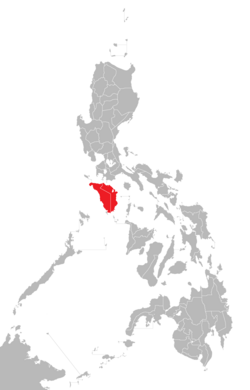
The Mindoro bleeding-heart dove is endemic to the island of Mindoro in the Philippines. It typically dwells in lowlands at an altitude of 400 m (1,310 ft), but has been noted at 750–800 m (2,460–2,620 ft). It has only been observed in 4 regions of the island since 1980, as deforestation has dwindled its preferred habitat of closed-canopy primary forest. These regions are Puerto Galera, MUFRC Experimental Forest, Siburan, and Mounts Iglit–Baco Natural Park, but scientists believe other populations may be scattered in other localities. This bird favors dry forest floors overrun with bamboos and rattans, occasionally dotted with limestone outcrops and boulders. It has also been observed near pools of dry riverbeds that exist on more leveled forest floors without as many rocks.
Mindoro bleeding-heart
The Mindoro bleeding-heart (Gallicolumba platenae), also referred to as kulo-kulo, la-do, manatad, manuk-manuk, punay, and puñalada by the Mangyan, is a species of ground dove native solely to the island of Mindoro in the Philippines. It is critically endangered and threatened by habitat loss through quarrying, land conversion and illegal logging. This species is also caught by hunters in snares. Due to its biological line and its survival status, it has been listed as an EDGE species by the Zoological Society of London. With a lack of any official records after 2005, this species is now one of the rarest birds in the world.
This species is closely related to four other bleeding-heart dove species: G. luzonica, G. crinigera, G. keayi and G. menagei. These five species, along with G. rufigula, are grouped together into the genus Gallicolumba. A phylogenetic study in 2013 found strong evidence suggesting that the Philippine bleeding-hearts are monophyletic, or that they belong to the same taxonomic clade tied by a common ancestor.
The Mindoro bleeding-heart is monotypic, meaning it does not contain any smaller subspecies groups.
Its taxonomic standing, which dates back to Salvadori in 1893, is deemed valid by the Integrated Taxonomic Information System.
This ground pigeon has been recorded to be around 26 to 30 cm (10 to 12 in) tall. It has a dark grey forehead which transitions into an iridescent green on its head, nape, and hindneck. Its underside–from its throat to its flanks–is a cream-white except for the distinctive patch on the center of its breast which resembles a bright bleeding wound. The chest marking is less prominent and more orange in hue than that of related bleeding-heart doves. The dove's backside contains a reddish purple on its mantle, as well as chestnut coloration on its wings and rump. Its tail and uppertail-coverts are grey. Flecks of white triangles rest on its shoulders.
Its juvenile plumage is unknown.
Like other pigeons, Mindoro bleeding-hearts do not exhibit much sexual dimorphism. Females look similar to males but have purple irises and are generally smaller, with a 141–154 mm (5.6–6.1 in) wingspan (compared to 150–154 mm (5.9–6.1 in) in males).
The Mindoro bleeding-heart dove is endemic to the island of Mindoro in the Philippines. It typically dwells in lowlands at an altitude of 400 m (1,310 ft), but has been noted at 750–800 m (2,460–2,620 ft). It has only been observed in 4 regions of the island since 1980, as deforestation has dwindled its preferred habitat of closed-canopy primary forest. These regions are Puerto Galera, MUFRC Experimental Forest, Siburan, and Mounts Iglit–Baco Natural Park, but scientists believe other populations may be scattered in other localities. This bird favors dry forest floors overrun with bamboos and rattans, occasionally dotted with limestone outcrops and boulders. It has also been observed near pools of dry riverbeds that exist on more leveled forest floors without as many rocks.
Recent media
Recent media