



Community hub
Recent from talks
Knowledge base stats:
Talk channels stats:
Members stats:
Miniature snap-action switch
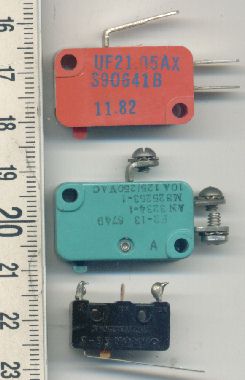
A miniature snap-action switch, also trademarked and frequently known as a micro switch or microswitch, is an electric switch that is actuated by very little physical force, through the use of a tipping-point mechanism, sometimes called an "over-center" mechanism.
The defining feature of micro switches is that a relatively small movement at the actuator button produces a relatively large movement at the electrical contacts, which occurs at high speed (regardless of the speed of actuation). Switching happens reliably at specific and repeatable positions of the actuator, which is not necessarily true of other mechanisms. Most successful designs also exhibit hysteresis, meaning that a small reversal of the actuator is insufficient to reverse the contacts; there must be a significant movement in the opposite direction. Both of these characteristics help to achieve a clean and reliable interruption to the switched circuit.
They are very common due to their low cost but high durability, greater than 1 million cycles, and up to 10 million cycles for heavy-duty models. This durability is a natural consequence of the design.
The first micro switch was invented by Phillip Kenneth McGall in 1932 in Freeport, Illinois, under patent US1,960,020. McGall was an employee of the Burgess Battery Company at the time. In 1937 W.B. Schulte, McGall's employer, started the company MICRO SWITCH. The company and the Micro Switch trademark have been owned by Honeywell Sensing and Control since 1950. The name has become a generic trademark for any snap-action switch. Companies other than Honeywell now manufacture miniature snap-action switches.
In one type of microswitch, internally there are two conductive springs. A long flat spring is hinged at one end of the switch (the left, in the photograph) and has electrical contacts on the other. A small curved spring, preloaded (i.e., compressed during assembly) so it attempts to extend itself (at the top, just right of center in the photo), is connected between the flat spring near the contacts and a fulcrum near the midpoint of the flat spring. An actuator nub presses on the flat spring near its hinge point.
Because the flat spring is anchored and strong in tension the curved spring cannot move it to the right. The curved spring presses, or pulls, the flat spring upward, that is away, from the anchor point. Owing to the geometry, the upward force is proportional to the displacement which decreases as the flat spring moves downward. (Actually, the force is proportional to the sine of the angle, which is approximately proportional to the angle for small angles.)
As the actuator depresses it flexes the flat spring while the curved spring keeps the electrical contacts touching. When the flat spring is flexed enough it will provide sufficient force to compress the curved spring and the contacts will begin to move.
As the flat spring moves downward the upward force of the curved spring reduces causing the motion to accelerate even in the absence of further movement of the actuator until the flat spring impacts the normally-open contact. Even though the flat spring unflexes as it moves downward, the switch is designed so the net effect is acceleration. This "over-center" action produces a very distinctive clicking sound and a very crisp feel.
Hub AI
Miniature snap-action switch AI simulator
(@Miniature snap-action switch_simulator)
Miniature snap-action switch
A miniature snap-action switch, also trademarked and frequently known as a micro switch or microswitch, is an electric switch that is actuated by very little physical force, through the use of a tipping-point mechanism, sometimes called an "over-center" mechanism.
The defining feature of micro switches is that a relatively small movement at the actuator button produces a relatively large movement at the electrical contacts, which occurs at high speed (regardless of the speed of actuation). Switching happens reliably at specific and repeatable positions of the actuator, which is not necessarily true of other mechanisms. Most successful designs also exhibit hysteresis, meaning that a small reversal of the actuator is insufficient to reverse the contacts; there must be a significant movement in the opposite direction. Both of these characteristics help to achieve a clean and reliable interruption to the switched circuit.
They are very common due to their low cost but high durability, greater than 1 million cycles, and up to 10 million cycles for heavy-duty models. This durability is a natural consequence of the design.
The first micro switch was invented by Phillip Kenneth McGall in 1932 in Freeport, Illinois, under patent US1,960,020. McGall was an employee of the Burgess Battery Company at the time. In 1937 W.B. Schulte, McGall's employer, started the company MICRO SWITCH. The company and the Micro Switch trademark have been owned by Honeywell Sensing and Control since 1950. The name has become a generic trademark for any snap-action switch. Companies other than Honeywell now manufacture miniature snap-action switches.
In one type of microswitch, internally there are two conductive springs. A long flat spring is hinged at one end of the switch (the left, in the photograph) and has electrical contacts on the other. A small curved spring, preloaded (i.e., compressed during assembly) so it attempts to extend itself (at the top, just right of center in the photo), is connected between the flat spring near the contacts and a fulcrum near the midpoint of the flat spring. An actuator nub presses on the flat spring near its hinge point.
Because the flat spring is anchored and strong in tension the curved spring cannot move it to the right. The curved spring presses, or pulls, the flat spring upward, that is away, from the anchor point. Owing to the geometry, the upward force is proportional to the displacement which decreases as the flat spring moves downward. (Actually, the force is proportional to the sine of the angle, which is approximately proportional to the angle for small angles.)
As the actuator depresses it flexes the flat spring while the curved spring keeps the electrical contacts touching. When the flat spring is flexed enough it will provide sufficient force to compress the curved spring and the contacts will begin to move.
As the flat spring moves downward the upward force of the curved spring reduces causing the motion to accelerate even in the absence of further movement of the actuator until the flat spring impacts the normally-open contact. Even though the flat spring unflexes as it moves downward, the switch is designed so the net effect is acceleration. This "over-center" action produces a very distinctive clicking sound and a very crisp feel.