
Recent from talks
Mintons
Knowledge base stats:
Talk channels stats:
Members stats:
Mintons
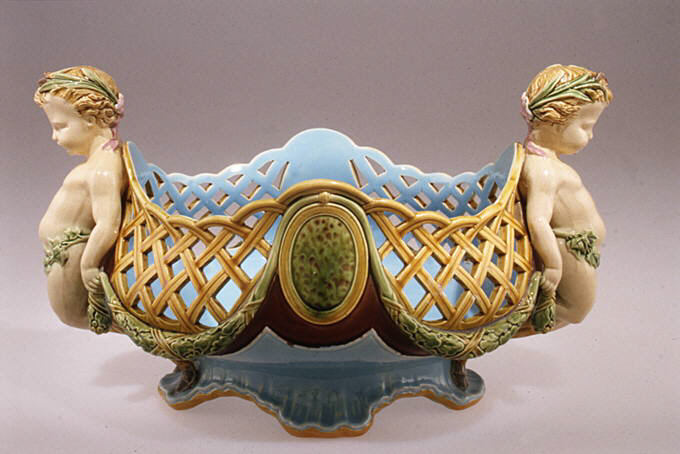
Mintons was a major company in Staffordshire pottery, "Europe's leading ceramic factory during the Victorian era", an independent business from 1793 to 1968. It was a leader in ceramic design, working in a number of different ceramic bodies, decorative techniques, and "a glorious pot-pourri of styles - Rococo shapes with Oriental motifs, Classical shapes with Medieval designs and Art Nouveau borders were among the many wonderful concoctions". As well as pottery vessels and sculptures, the firm was a leading manufacturer of tiles and other architectural ceramics, producing work for both the Houses of Parliament and United States Capitol.
The family continued to control the business until the mid-20th century. Mintons had the usual Staffordshire variety of company and trading names over the years, and the products of all periods are generally referred to as either "Minton", as in "Minton china", or "Mintons", the mark used on many. Mintons Ltd was the company name from 1879 onwards.
The firm began in 1793 when Thomas Minton (1765–1836) founded his pottery factory in Stoke-upon-Trent, Staffordshire, England as "Thomas Minton and Sons", producing earthenware. He formed a partnership, Minton & Poulson, c.1796, with Joseph Poulson who made bone china from c.1798 in his new near-by china pottery. When Poulson died in 1808, Minton carried on alone, using Poulson's pottery for china until 1816. He built a new china pottery in 1824. No very early earthenware is marked, and perhaps a good deal of it was made for other potters. On the other hand, some very early factory records survive in the Minton Archive, which is much more complete than those of most Staffordshire firms, and the early porcelain is marked with pattern numbers, which can be tied to the surviving pattern-books.
Early Mintons products were mostly standard domestic tableware in blue transfer-printed or painted earthenware, including the ever-popular Willow pattern. Minton had trained as an engraver for transfer printing with Thomas Turner. From c. 1798 production included bone china from his partner Joseph Poulson's near-by china pottery. China production ceased c. 1816 following Joseph Poulson's death in 1808, recommencing in a new pottery in 1824.
Minton was a prime mover, and the main shareholder in the Hendra Company, formed in 1800 to exploit china clay and other minerals from Cornwall. Named after Hendra Common, St Dennis, Cornwall, the partners included Minton, Poulson, Wedgwood, William Adams, and the owners of New Hall porcelain. The company was profitable for many years, reducing the cost of materials to the owning potters, and selling to other firms.
Early Mintons porcelain was "decorated in the restrained Regency style", much of it just with edging patterns rather than fully painted scenes, thus keeping prices within the reach of a relatively large section of the middle class.
Minton's two sons, Thomas and Herbert, were taken into partnership in 1817, but Thomas went in to the church and was ordained in 1825. Herbert had been working in the business since 1808, when he was 16, initially as a travelling salesman. On his death in 1836, Minton was succeeded by his son Herbert Minton (1793–1858), who took John Boyle as a partner to help him the same year, given the size of the business; by 1842 they had parted company. Herbert developed new production techniques and took the business into new fields, notably including decorative encaustic tile making, through his association with leading architects and designers including Augustus Pugin and, it is said, Prince Albert.
Minton entered into partnership with Michael Hollins in 1845 and formed the tile making firm of Minton, Hollins & Company, which was at the forefront of a large newly developing market as suppliers of durable decorative finishes for walls and floors in churches, public buildings, grand palaces and simple domestic houses. The firm exhibited widely at trade exhibitions throughout the world and examples of its exhibition displays are held at the Smithsonian Institution in Washington, D.C. where the company gained many prestigious contracts including tiled flooring for the United States Capitol. The "encaustic" technique allowed clays of different colours to be used in the same tile, allowing far greater decorative possibilities. Great numbers of new churches and public buildings were given floors in the tiles, and despite the protests of William Morris, many medieval church floors were "updated" with them.
Hub AI
Mintons AI simulator
(@Mintons_simulator)
Mintons
Mintons was a major company in Staffordshire pottery, "Europe's leading ceramic factory during the Victorian era", an independent business from 1793 to 1968. It was a leader in ceramic design, working in a number of different ceramic bodies, decorative techniques, and "a glorious pot-pourri of styles - Rococo shapes with Oriental motifs, Classical shapes with Medieval designs and Art Nouveau borders were among the many wonderful concoctions". As well as pottery vessels and sculptures, the firm was a leading manufacturer of tiles and other architectural ceramics, producing work for both the Houses of Parliament and United States Capitol.
The family continued to control the business until the mid-20th century. Mintons had the usual Staffordshire variety of company and trading names over the years, and the products of all periods are generally referred to as either "Minton", as in "Minton china", or "Mintons", the mark used on many. Mintons Ltd was the company name from 1879 onwards.
The firm began in 1793 when Thomas Minton (1765–1836) founded his pottery factory in Stoke-upon-Trent, Staffordshire, England as "Thomas Minton and Sons", producing earthenware. He formed a partnership, Minton & Poulson, c.1796, with Joseph Poulson who made bone china from c.1798 in his new near-by china pottery. When Poulson died in 1808, Minton carried on alone, using Poulson's pottery for china until 1816. He built a new china pottery in 1824. No very early earthenware is marked, and perhaps a good deal of it was made for other potters. On the other hand, some very early factory records survive in the Minton Archive, which is much more complete than those of most Staffordshire firms, and the early porcelain is marked with pattern numbers, which can be tied to the surviving pattern-books.
Early Mintons products were mostly standard domestic tableware in blue transfer-printed or painted earthenware, including the ever-popular Willow pattern. Minton had trained as an engraver for transfer printing with Thomas Turner. From c. 1798 production included bone china from his partner Joseph Poulson's near-by china pottery. China production ceased c. 1816 following Joseph Poulson's death in 1808, recommencing in a new pottery in 1824.
Minton was a prime mover, and the main shareholder in the Hendra Company, formed in 1800 to exploit china clay and other minerals from Cornwall. Named after Hendra Common, St Dennis, Cornwall, the partners included Minton, Poulson, Wedgwood, William Adams, and the owners of New Hall porcelain. The company was profitable for many years, reducing the cost of materials to the owning potters, and selling to other firms.
Early Mintons porcelain was "decorated in the restrained Regency style", much of it just with edging patterns rather than fully painted scenes, thus keeping prices within the reach of a relatively large section of the middle class.
Minton's two sons, Thomas and Herbert, were taken into partnership in 1817, but Thomas went in to the church and was ordained in 1825. Herbert had been working in the business since 1808, when he was 16, initially as a travelling salesman. On his death in 1836, Minton was succeeded by his son Herbert Minton (1793–1858), who took John Boyle as a partner to help him the same year, given the size of the business; by 1842 they had parted company. Herbert developed new production techniques and took the business into new fields, notably including decorative encaustic tile making, through his association with leading architects and designers including Augustus Pugin and, it is said, Prince Albert.
Minton entered into partnership with Michael Hollins in 1845 and formed the tile making firm of Minton, Hollins & Company, which was at the forefront of a large newly developing market as suppliers of durable decorative finishes for walls and floors in churches, public buildings, grand palaces and simple domestic houses. The firm exhibited widely at trade exhibitions throughout the world and examples of its exhibition displays are held at the Smithsonian Institution in Washington, D.C. where the company gained many prestigious contracts including tiled flooring for the United States Capitol. The "encaustic" technique allowed clays of different colours to be used in the same tile, allowing far greater decorative possibilities. Great numbers of new churches and public buildings were given floors in the tiles, and despite the protests of William Morris, many medieval church floors were "updated" with them.
Recent media