
Recent from talks
Mir-223
Knowledge base stats:
Talk channels stats:
Members stats:
Mir-223
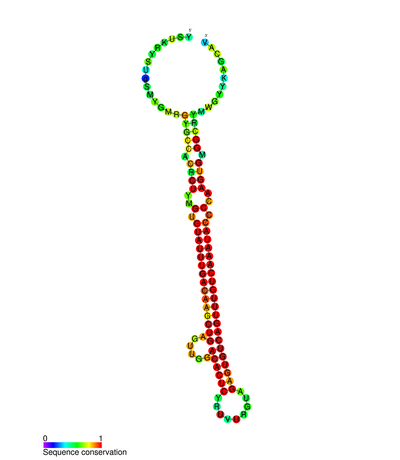
In molecular biology MicroRNA-223 (miR-223) is a short RNA molecule. MicroRNAs function to regulate the expression levels of other genes by several mechanisms. miR-223 is a hematopoietic specific microRNA with crucial functions in myeloid lineage development. It plays an essential role in promoting granulocytic differentiation while also being associated with the suppression of erythrocytic differentiation. miR-223 is commonly repressed in hepatocellular carcinoma and leukemia. Higher expression levels of miRNA-223 are associated with extranodal marginal-zone lymphoma of mucosa-associated lymphoid tissue of the stomach and recurrent ovarian cancer. In some cancers the microRNA-223 down-regulation is correlated with higher tumor burden, disease aggressiveness, and poor prognostic factors. MicroRNA-223 is also associated with rheumatoid arthritis, fibromyalgia, sepsis, type 2 diabetes, and hepatic ischemia.
MicroRNA-223 was initially identified bioinformatically and it was subsequently characterized as part of the haematopoietic system. Its gene resembles a myeloid gene and it could be driven by the PU.1 and C/EBPα proteins which are myeloid transcription factors.
MicroRNA-223 selectively targets distinct populations of transcripts harboring AU-rich elements. More specifically, it was validated that the RhoB mRNA is a bona fide miR-223 target. miR-223 also regulates cyclin E activity by modulating expression of the FBXW7 protein. In particular, overexpression of miR-223 reduces FBXW7 mRNA levels while increasing endogenous cyclin E protein and activity levels.
The role of miR-223 in hematopoiesis has been extensively analyzed in the past few years. During granulopoiesis miR-223 acts as fine-tuner of granulocytic differentiation, maturation, and function. More specifically, human granulocytic differentiation is controlled by a regulatory circuitry involving miR-223 and two transcriptional factors, NFIA and C/EBPα. These two factors compete for binding: NFI-A maintains miR-223 at low levels whereas C/EBPα upregulates miR-223 expression. The competition by C/EBPα and the granulocytic differentiation are favored by a negative-feedback loop in which miR-223 represses NFI-A translation.
Analysis of expression profiles indicate that miR-223 expression decreases as cells mature during monocytic, erythroid, and mast cell differentiation. miR-223 down-regulation during erythropoiesis is required for erythrocyte proliferation and differentiation at progenitor and precursor level. This down-modulation promotes erythropoiesis favoring translation of the key functional protein LMO2 resulting in reversible regulation of erythroid and megakaryocytic differentiation.
MicroRNA-223 also plays an essential role during osteoclast differentiation. More specifically, miR-223 expression suppresses the differentiation of osteoclast precursors into osteoclast thus making it a potential viable therapeutic target for a range of bone metabolic disorders with excess osteoclast activity.
MicroRNA-223 is commonly repressed in hepatocellular carcinoma, chronic lymphocytic leukemia, acute lymphoblastic leukemia, acute myeloid leukemia, gastric MALT lymphoma, and recurrent ovarian cancer.
Integrative analysis in hepatocellular carcinoma implicates Stathmin 1 (STMN1) as a downstream target of miR-223. Furthermore, miR-223 could suppress the luciferase activity in reporter construct containing the STMN1 3' untranslated region. The reduced expressions of miR-223 may predispose to the development of hepatocellular carcinoma via the widespread induction of chromosomal instability by STMN1.
Hub AI
Mir-223 AI simulator
(@Mir-223_simulator)
Mir-223
In molecular biology MicroRNA-223 (miR-223) is a short RNA molecule. MicroRNAs function to regulate the expression levels of other genes by several mechanisms. miR-223 is a hematopoietic specific microRNA with crucial functions in myeloid lineage development. It plays an essential role in promoting granulocytic differentiation while also being associated with the suppression of erythrocytic differentiation. miR-223 is commonly repressed in hepatocellular carcinoma and leukemia. Higher expression levels of miRNA-223 are associated with extranodal marginal-zone lymphoma of mucosa-associated lymphoid tissue of the stomach and recurrent ovarian cancer. In some cancers the microRNA-223 down-regulation is correlated with higher tumor burden, disease aggressiveness, and poor prognostic factors. MicroRNA-223 is also associated with rheumatoid arthritis, fibromyalgia, sepsis, type 2 diabetes, and hepatic ischemia.
MicroRNA-223 was initially identified bioinformatically and it was subsequently characterized as part of the haematopoietic system. Its gene resembles a myeloid gene and it could be driven by the PU.1 and C/EBPα proteins which are myeloid transcription factors.
MicroRNA-223 selectively targets distinct populations of transcripts harboring AU-rich elements. More specifically, it was validated that the RhoB mRNA is a bona fide miR-223 target. miR-223 also regulates cyclin E activity by modulating expression of the FBXW7 protein. In particular, overexpression of miR-223 reduces FBXW7 mRNA levels while increasing endogenous cyclin E protein and activity levels.
The role of miR-223 in hematopoiesis has been extensively analyzed in the past few years. During granulopoiesis miR-223 acts as fine-tuner of granulocytic differentiation, maturation, and function. More specifically, human granulocytic differentiation is controlled by a regulatory circuitry involving miR-223 and two transcriptional factors, NFIA and C/EBPα. These two factors compete for binding: NFI-A maintains miR-223 at low levels whereas C/EBPα upregulates miR-223 expression. The competition by C/EBPα and the granulocytic differentiation are favored by a negative-feedback loop in which miR-223 represses NFI-A translation.
Analysis of expression profiles indicate that miR-223 expression decreases as cells mature during monocytic, erythroid, and mast cell differentiation. miR-223 down-regulation during erythropoiesis is required for erythrocyte proliferation and differentiation at progenitor and precursor level. This down-modulation promotes erythropoiesis favoring translation of the key functional protein LMO2 resulting in reversible regulation of erythroid and megakaryocytic differentiation.
MicroRNA-223 also plays an essential role during osteoclast differentiation. More specifically, miR-223 expression suppresses the differentiation of osteoclast precursors into osteoclast thus making it a potential viable therapeutic target for a range of bone metabolic disorders with excess osteoclast activity.
MicroRNA-223 is commonly repressed in hepatocellular carcinoma, chronic lymphocytic leukemia, acute lymphoblastic leukemia, acute myeloid leukemia, gastric MALT lymphoma, and recurrent ovarian cancer.
Integrative analysis in hepatocellular carcinoma implicates Stathmin 1 (STMN1) as a downstream target of miR-223. Furthermore, miR-223 could suppress the luciferase activity in reporter construct containing the STMN1 3' untranslated region. The reduced expressions of miR-223 may predispose to the development of hepatocellular carcinoma via the widespread induction of chromosomal instability by STMN1.
Recent media