
Recent from talks
Dassault Mirage IV
Knowledge base stats:
Talk channels stats:
Members stats:
Dassault Mirage IV
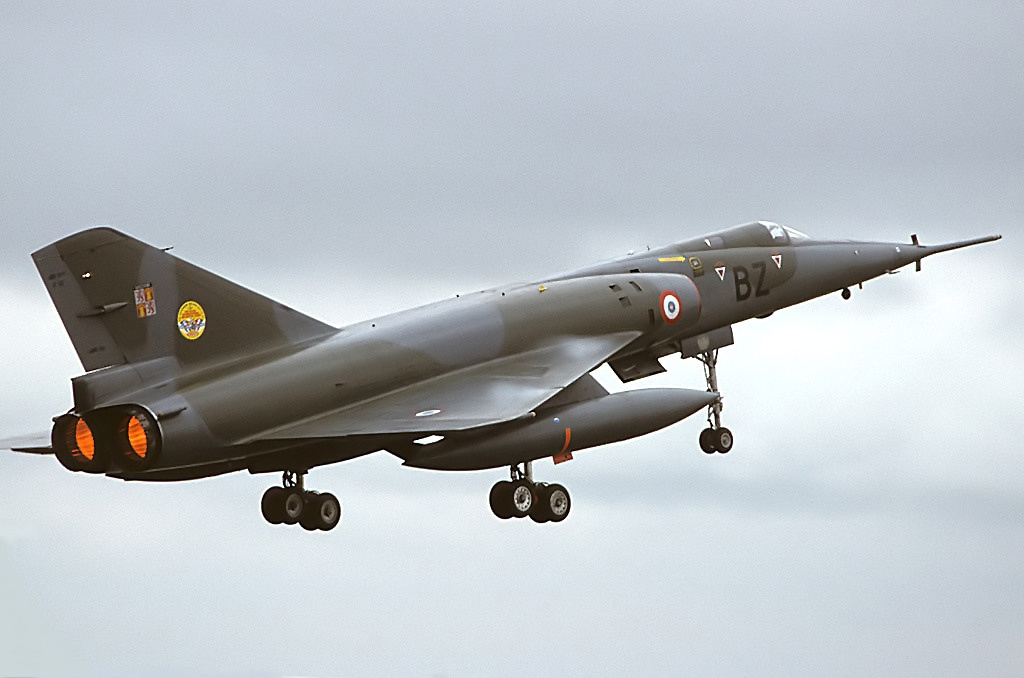
The Dassault Mirage IV is a supersonic strategic bomber and deep-reconnaissance aircraft developed and produced by the French aircraft manufacturer Dassault Aviation.
Development of the Mirage IV began in the mid-1950s in response to a need for a supersonic carrier aircraft for France's independent nuclear deterrent. Dassault competed with other aircraft manufacturers, such as Sud Aviation and Nord Aviation, to have its proposal built, which was viewed as being both cheaper and simpler to develop in part due to it drawing upon the earlier Dassault Mirage III fighter. While originally intended as a dedicated bomber, a reconnaissance variant would also be developed. The first prototype, Mirage IV 01, performed its maiden flight on 17 June 1959; it set a new world record for speed over a 1000-kilometre closed circuit of 1,822 km/h (1,132 mph) on 19 September 1960. The first production-standard aircraft was completed during December 1963 and the Mirage IV entered service with the French Air Force in October 1964.
For many years, the type was a vital part of the nuclear triad of the Force de Frappe, France's nuclear deterrent striking force. While initially intended for a high-altitude mission profile, the fleet was modified during the 1960s to be flown at low altitude instead in response to increasingly capable anti-aircraft systems. This vulnerability also led to an increasing emphasis of other platforms for the nuclear deterrent platform, such as land-based missiles and submarine-launched ballistic missile. The fleet received various updates during its service life, including modifications to carry and launch the nuclear Air-Sol Moyenne Portée (ASMP) stand-off missile in place of gravity-dropped bombs. During 1996, the Mirage IV was retired from the nuclear strike role in favour of the newer Dassault Mirage 2000N, while the last examples of the type were withdrawn from operational service in 2005. There was investigations into potential export sales of the Mirage IV; during the 1960s, it was proposed that Dassault enter into a partnership with the British Aircraft Corporation to jointly produce a Mirage IV variant for the Royal Air Force and potentially for other export customers, but this project did not come to fruition. The Mirage IV was ultimately not adopted by any other operators.
During the 1950s, France embarked on an extensive military program to produce nuclear weapons; however, it was acknowledged that existing French aircraft were unsuitable for the task of delivering the weapons. Thus, the development of a supersonic bomber designed to carry out the delivery mission started in 1956 as a part of the wider development of France's independent nuclear deterrent. In May 1956, the Guy Mollet government drew up a specification for an aerially-refuelable supersonic bomber capable of carrying a three tonne, 5.2-metre-long nuclear bomb 2,000 km (without aerial refuelling). According to aviation authors Bill Gunston and Peter Gilchrist, the specification's inclusion of supersonic speed was "surprising" to many at the time.
The final specifications, jointly defined by government authorities and Dassault staff, were approved on 20 March 1957. Sud Aviation and Nord Aviation both submitted competing proposals, both based on existing aircraft; Sud Aviation proposed the Super Vautour, a stretched Sud Aviation Vautour with 47 kilonewtons (10,500 lbf) thrust SNECMA Atar engines and a combat radius of 2,700 kilometres (1,700 mi) at Mach 0.9. Dassault's proposal for what became the Mirage IV was chosen on the basis of lower cost and anticipated simpler development, being based upon a proposed early 1956 twin-engined night-fighter derived from the Dassault Mirage III fighter and the unbuilt Mirage II interceptor. In April 1957, Dassault were informed that they had won the design competition.
Dassault's resulting prototype, designated Mirage IV 01, visually resembled the Mirage IIIA, despite possessing double the wing surface, being powered by two engines instead of one, and having twice the unladen weight. The Mirage IV also carried three times more internal fuel than the Mirage III. The aircraft's aerodynamic features were very similar to the Mirage III's, but required an entirely new structure and layout. This prototype was 20 metres (67 ft) long, had an 11 metres (37 ft) wingspan, 62 square metres (670 sq ft) of wing area, and weighed approximately 25,000 kilograms (55,000 lb). It was considerably more advanced than the Mirage III, incorporating new features such as machined and chem-milled planks, tapered sheets, a small amount of titanium, and integral fuel tanks in many locations including the leading portion of the tailfin.
The 01 was an experimental prototype built to explore and solve the problems stemming from prolonged supersonic flight. At the time, no aircraft had been designed to cruise at over Mach 1.8 for long periods of time and there were sizable technological and operational uncertainties. Weapon-related issues were another issue. Building the 01 in Dassault's Saint-Cloud plant near Paris took 18 months. In late 1958, the aircraft was transferred to the Melun-Villaroche flight testing area for finishing touches and ground tests. On 17 June 1959, French General Roland Glavany, on a five-year leave from the French Air Force since 1954, took the 01 for its maiden flight.
On 19 September 1960, René Bigand (replacing Glavany as test pilot) increased the world record for speed on a 1000-kilometre closed circuit to 1,822 km/h (1,132 mph) around Paris and the Melun base. Flight 138, on 23 September, corroborated the initial performance and pushed the record on a 500 km closed circuit to an average of 1,972 km/h (1,225 mph), flying between Mach 2.08 and Mach 2.14. The Mirage IV 01 prototype underwent minor modifications during testing in the autumn of 1959, most noticeably, the tail was enlarged (slight reduction in height, large increase in chord).
Hub AI
Dassault Mirage IV AI simulator
(@Dassault Mirage IV_simulator)
Dassault Mirage IV
The Dassault Mirage IV is a supersonic strategic bomber and deep-reconnaissance aircraft developed and produced by the French aircraft manufacturer Dassault Aviation.
Development of the Mirage IV began in the mid-1950s in response to a need for a supersonic carrier aircraft for France's independent nuclear deterrent. Dassault competed with other aircraft manufacturers, such as Sud Aviation and Nord Aviation, to have its proposal built, which was viewed as being both cheaper and simpler to develop in part due to it drawing upon the earlier Dassault Mirage III fighter. While originally intended as a dedicated bomber, a reconnaissance variant would also be developed. The first prototype, Mirage IV 01, performed its maiden flight on 17 June 1959; it set a new world record for speed over a 1000-kilometre closed circuit of 1,822 km/h (1,132 mph) on 19 September 1960. The first production-standard aircraft was completed during December 1963 and the Mirage IV entered service with the French Air Force in October 1964.
For many years, the type was a vital part of the nuclear triad of the Force de Frappe, France's nuclear deterrent striking force. While initially intended for a high-altitude mission profile, the fleet was modified during the 1960s to be flown at low altitude instead in response to increasingly capable anti-aircraft systems. This vulnerability also led to an increasing emphasis of other platforms for the nuclear deterrent platform, such as land-based missiles and submarine-launched ballistic missile. The fleet received various updates during its service life, including modifications to carry and launch the nuclear Air-Sol Moyenne Portée (ASMP) stand-off missile in place of gravity-dropped bombs. During 1996, the Mirage IV was retired from the nuclear strike role in favour of the newer Dassault Mirage 2000N, while the last examples of the type were withdrawn from operational service in 2005. There was investigations into potential export sales of the Mirage IV; during the 1960s, it was proposed that Dassault enter into a partnership with the British Aircraft Corporation to jointly produce a Mirage IV variant for the Royal Air Force and potentially for other export customers, but this project did not come to fruition. The Mirage IV was ultimately not adopted by any other operators.
During the 1950s, France embarked on an extensive military program to produce nuclear weapons; however, it was acknowledged that existing French aircraft were unsuitable for the task of delivering the weapons. Thus, the development of a supersonic bomber designed to carry out the delivery mission started in 1956 as a part of the wider development of France's independent nuclear deterrent. In May 1956, the Guy Mollet government drew up a specification for an aerially-refuelable supersonic bomber capable of carrying a three tonne, 5.2-metre-long nuclear bomb 2,000 km (without aerial refuelling). According to aviation authors Bill Gunston and Peter Gilchrist, the specification's inclusion of supersonic speed was "surprising" to many at the time.
The final specifications, jointly defined by government authorities and Dassault staff, were approved on 20 March 1957. Sud Aviation and Nord Aviation both submitted competing proposals, both based on existing aircraft; Sud Aviation proposed the Super Vautour, a stretched Sud Aviation Vautour with 47 kilonewtons (10,500 lbf) thrust SNECMA Atar engines and a combat radius of 2,700 kilometres (1,700 mi) at Mach 0.9. Dassault's proposal for what became the Mirage IV was chosen on the basis of lower cost and anticipated simpler development, being based upon a proposed early 1956 twin-engined night-fighter derived from the Dassault Mirage III fighter and the unbuilt Mirage II interceptor. In April 1957, Dassault were informed that they had won the design competition.
Dassault's resulting prototype, designated Mirage IV 01, visually resembled the Mirage IIIA, despite possessing double the wing surface, being powered by two engines instead of one, and having twice the unladen weight. The Mirage IV also carried three times more internal fuel than the Mirage III. The aircraft's aerodynamic features were very similar to the Mirage III's, but required an entirely new structure and layout. This prototype was 20 metres (67 ft) long, had an 11 metres (37 ft) wingspan, 62 square metres (670 sq ft) of wing area, and weighed approximately 25,000 kilograms (55,000 lb). It was considerably more advanced than the Mirage III, incorporating new features such as machined and chem-milled planks, tapered sheets, a small amount of titanium, and integral fuel tanks in many locations including the leading portion of the tailfin.
The 01 was an experimental prototype built to explore and solve the problems stemming from prolonged supersonic flight. At the time, no aircraft had been designed to cruise at over Mach 1.8 for long periods of time and there were sizable technological and operational uncertainties. Weapon-related issues were another issue. Building the 01 in Dassault's Saint-Cloud plant near Paris took 18 months. In late 1958, the aircraft was transferred to the Melun-Villaroche flight testing area for finishing touches and ground tests. On 17 June 1959, French General Roland Glavany, on a five-year leave from the French Air Force since 1954, took the 01 for its maiden flight.
On 19 September 1960, René Bigand (replacing Glavany as test pilot) increased the world record for speed on a 1000-kilometre closed circuit to 1,822 km/h (1,132 mph) around Paris and the Melun base. Flight 138, on 23 September, corroborated the initial performance and pushed the record on a 500 km closed circuit to an average of 1,972 km/h (1,225 mph), flying between Mach 2.08 and Mach 2.14. The Mirage IV 01 prototype underwent minor modifications during testing in the autumn of 1959, most noticeably, the tail was enlarged (slight reduction in height, large increase in chord).
Recent media