Recent from talks
Nothing was collected or created yet.
Myrhorod
View on WikipediaYou can help expand this article with text translated from the corresponding article in Ukrainian. (July 2022) Click [show] for important translation instructions.
|
Key Information
Myrhorod (Ukrainian: Миргород, pronounced [ˈmɪrɦorod]) is a city in Poltava Oblast, central Ukraine. It serves as the administrative center of Myrhorod Raion. Myrhorod also hosts the administration of Myrhorod urban hromada, one of the hromadas of Ukraine.[2] It is located on the Khorol River. Population: 37,886 (2022 estimate).[1]
History
[edit]The town was founded either in the 12th or 13th century as an eastern border fort of Kievan Rus'. According to legend, the fort was a place of peace negotiations that gave it its name (literally the City of Peace).[citation needed]
From 1471 to 1667 the town was part of the Kiev Voivodeship of the Grand Duchy of Lithuania and the Crown of the Kingdom of Poland.
Myrhorod was first mentioned in chronicles in 1575 when Stephen Báthory made it a regiment city. According to some[who?] historians, there was an earlier mentioning of the city in 1530, when the city coat of arms were established - yellow cross over an eight-pointed star, which signifies the victory of Christianity over Islam.[citation needed] Myrhorod was a royal city of Poland.
Myrhorod was the regimental base of the Myrhorod Cossacks who were very active in several Ukrainian Cossack uprisings, particularly during the peasants'-and-cossacks' revolt of 1638 under the leadership of Hetman Yakiv Ostrianytsia against the Polish nobility (szlachta). The Myrhorod Cossack regiment was among the best units in the army of Hetman Bohdan Khmelnytsky during the Khmelnytsky Uprising (1648–1654).
After the Treaty of Pereyaslav, the city became an uezd city, the centre for the Myrhorod regiment. The famous Sorochyntsy Fair is located 25 km from Myrhorod.
Since 1912, Myrhorod is known for its underground mineral waters.[3]
A local newspaper is published here since February 1919.[4]
Since 1920 Myrhorod is also known as a resort town.[5]
In 1999, an English [Language] Resource Center was established at Myrhorod School No. 9, one of four such centres opened in Ukraine with the continuous help from Siena College since 1995. Other contributors to this project were Americans for Democracy in Ukraine (ADU), Canadian Credit Bank, and Narodna Kasa from Montreal, Canada. In 1995 a group of Myrhorod teachers, former participants at the seminars conducted by methodologists from Siena College Teacher Training Institute, organized Poltava Oblast's English Teachers' Association. The Myrhorod English Resource Center is supervised by the local Teachers' Association.[citation needed]
Until 18 July 2020, Myrhorod was designated as a city of oblast significance and did not belong to Myrhorod Raion even though it was the center of the raion. As part of the administrative reform of Ukraine, which reduced the number of raions of Poltava Oblast to four, the city was merged into Myrhorod Raion.[6][7]
On April 2, 2022, the invaders fired 3 missiles at infrastructure facilities in the city. The air defense forces of the Armed Forces of Ukraine managed to destroy several enemy cruise missiles. However, the shelling damaged the runway of the Myrhorod air base, the airfield infrastructure, and caused a fire at the fuel and lubricants warehouse.[8]
On the night of April 8-9, 2022, Russian invaders shelled an infrastructure facility in the city, with two victims reported.[9]
Population
[edit]Language
[edit]Distribution of the population by native language according to the 2001 census:[10]
| Language | Percentage |
|---|---|
| Ukrainian | 88.26% |
| Russian | 11.34% |
| other/undecided | 0.4% |
Tourist attractions
[edit]"Myrhorodska" water is described as "slightly mineralised natrium chloride water". It is clear and tastes a little odd, part of the taste being attributable to what is, in effect, table salt. Multiple other dissolved minerals also contribute to the taste and, of course, it is the precise balance of these that is thought to produce the claimed health benefits. For its unique health curative effects, "Myrhorodska" water is recommended by doctors for people suffering from gastritis, colitis and other disorders of the digestive system, particularly those with a lower level of stomach acidity than is considered average.[citation needed] It is also widely drunk as table water because it quenches thirst effectively and produces general effects considered to be beneficial to health.
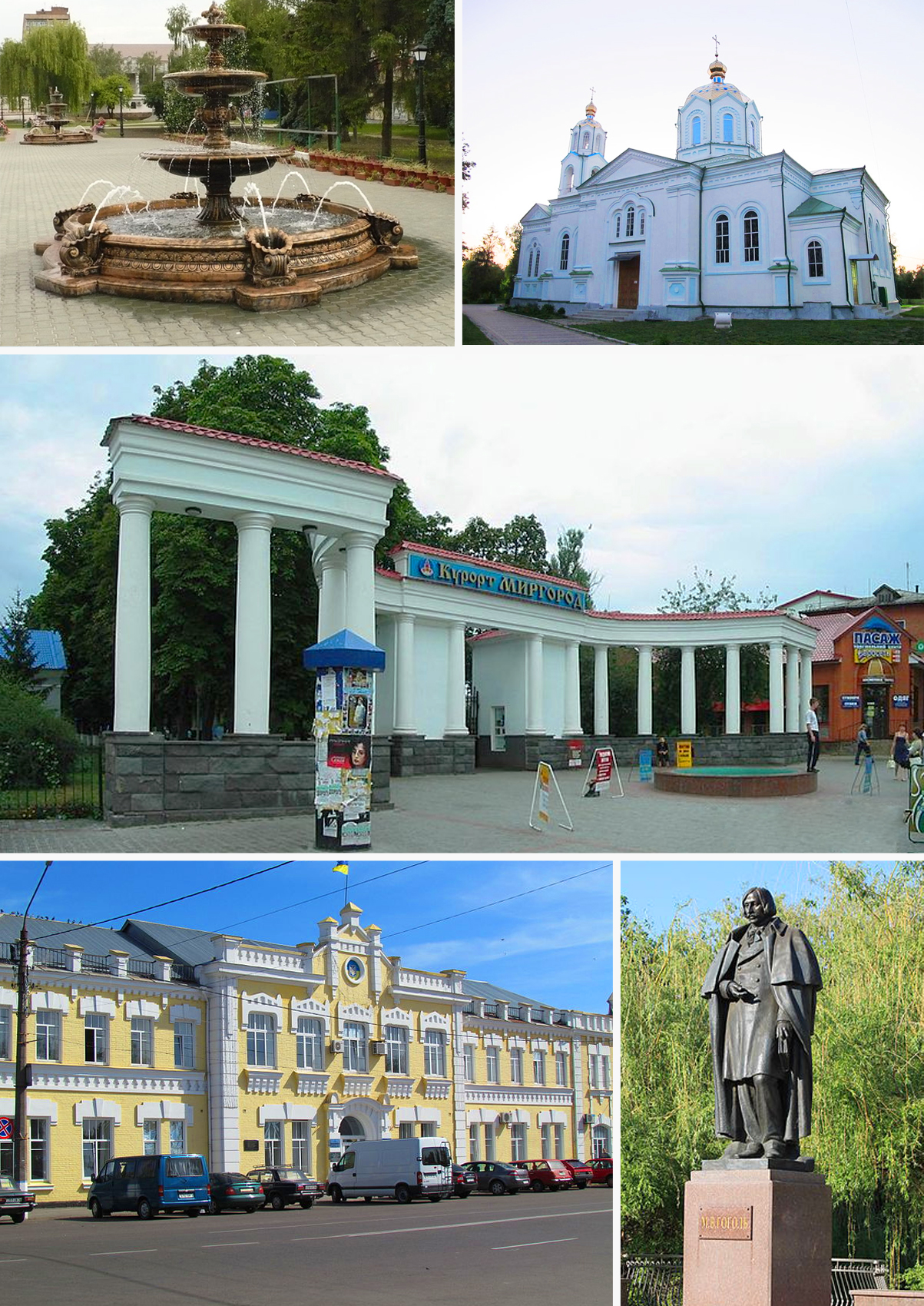
There are several health resorts in the town (at least four). The most extensive and by far the best equipped of these is Myrhorod Resort (Ukrainian: Миргород Курорт). This particular spa consists of four individual sanatoria, each one specialising in one or more distinct areas - diabetes, cardiovascular disease, ENT, gastrointestinal problems, etc. and are open for medical treatments six days a week (Sundays excluded). An integral part of any treatment is one of nine diet regimes, although these are recommended and not enforced.
The whole complex is located right in the middle of the city and is spaced out in a large expanse of sandy woodland with the Khorol River providing several areas suitable for bathing. It has a musical fountain, (opened in 2010), and, at night, a large illuminated windmill, (opened in 2011), standing close to the main administrative building. Other features include pedaloes, boats, several restaurants and cafés, dancing, live music, rides through the woods in a horse-drawn carriage, a theatre, organised excursions and a large 'water feature' with geese, ducks (including a couple of Mandarins), a large family of terrapins and some beautiful black swans. Elsewhere in the complex is an enclosure with peacocks and hens, including some rather exotic white ones.
There is another sanatorium, 'Rainbow', (Ukrainian: Санаторій «Радужний»), within the same grounds as Myrhorod Resort but with different owners. This is, in the main, frequented by wealthy Ukrainians who prefer what they regard as the 'added security' of a sanatorium that advertises itself as 'élite'. The other two resorts are much further out of town, not so well maintained and equipped and are both rather 'tired' in appearance, both from the inside and out. One of them, the 'Hohol', (Ukrainian: Гоголь) is owned by a Trades Union and seems to derive most of its clientele from its members.
Generally, English is not widely spoken in any of the spas, only Ukrainian, although Myrhorod Resort has occasional visitors from the UK, Germany, France, Dubai, the U.S. and Canada in particular and despite very few foreign visitors speaking more than a couple of words of the local languages, they do seem to be able to get by with some pointing, prodding and smiling.[citation needed]
Notable people
[edit]Partner towns
[edit]Since 1991, Myrhorod administration signed international agreements of mutual cooperation in the spheres of economics, commerce, and culture with three foreign partner towns:
Gorna Oryahovitsa (1991)
Randolph, Vermont (1999)
Zgorzelec (2007)
Transport
[edit]The city is served by the Myrhorod Air Base (IATA: MXR), located at approximately 5 kilometres (3.1 mi) in the south of the center.
Gallery
[edit]-
House of Myrhorod Ceramic College
-
Dormition Church
-
Old house in Myrhorod
-
St. John Church, Myrhorod
-
A chapel in Myrhorod
-
Myrhorod Resort office
-
Bird's eye view
-
School No.5
-
Myrhorod railway station
References
[edit]- ^ a b Чисельність наявного населення України на 1 січня 2022 [Number of Present Population of Ukraine, as of January 1, 2022] (PDF) (in Ukrainian and English). Kyiv: State Statistics Service of Ukraine. Archived (PDF) from the original on 4 July 2022.
- ^ "Миргородская городская громада" (in Russian). Портал об'єднаних громад України.
- ^ Миргород // Большая Российская Энциклопедия / редколл., гл. ред. Ю. С. Осипов. том 20. М., научное издательство "Большая Российская Энциклопедия", 2012. стр.429-430
- ^ № 2344. «Вестник Миргородского уездного Совета раб[очих], кресть[янских] и воен[ных] деп[утатов]» // Газеты СССР 1917—1960. Библиографический справочник. том 2. М., «Книга», 1976. стр.107
- ^ Миргород // Большая Советская Энциклопедия. / редколл., гл. ред. О. Ю. Шмидт. 1-е изд. Т.39. М., ОГИЗ, «Советская Энциклопедия», 1938. ст.487
- ^ "Про утворення та ліквідацію районів. Постанова Верховної Ради України № 807-ІХ". Голос України (in Ukrainian). 2020-07-18. Retrieved 2020-10-03.
- ^ "Нові райони: карти + склад" (in Ukrainian). Міністерство розвитку громад та територій України. 17 July 2020.
- ^ "Ракетний удар по Миргороду пошкодив злітну смугу й інфраструктуру аеродрому". Укрінформ. 2022-04-02. Archived from the original on 9 April 2022. Retrieved 9 April 2022.
- ^ "російські загарбники обстріляли Миргород, є постраждалі". Укрінформ. 2022-04-09. Archived from the original on 9 April 2022. Retrieved 9 April 2022.
- ^ "Рідні мови в об'єднаних територіальних громадах України".
External links
[edit]- Official Myrhorod Raion website. (in Ukrainian)
- Official Myrhorod city-council website. (in Ukrainian)
- Navigation and information on Myrhorod, Sanatorium, Hotels, Maps. (in English)
- Mirgorod's Portal. (in English)
- Myrhorod. Encyclopedia of Ukraine. (in English)
- Navigation and information on Mirgorod, Sanatorium, Hotels, Maps.
Myrhorod
View on GrokipediaGeography
Location and topography
Myrhorod is located in central Ukraine within Poltava Oblast, at geographic coordinates 49°58′N 33°37′E.[6] The city sits at an elevation of approximately 100 meters above sea level.[7] It is positioned about 100 kilometers northwest of the oblast center Poltava and roughly 250 kilometers southeast of Kyiv.[8][9] The settlement lies along the banks of the Khorol River, a 308-kilometer-long waterway that drains into the Psyol River and supports regional water resources amid the predominantly flat steppe topography. This lowland terrain, typical of the East European Plain, features minimal relief variations, with average elevations around 105 meters, facilitating expansive agricultural land use.[10] Geologically, the area is notable for its mineral-rich springs, which emerge from underground aquifers and have shaped the local landscape's utility for therapeutic purposes due to their chemical composition, including sulfates and bicarbonates.[11] These hydrogeological features, concentrated near the river valley, contribute to the region's groundwater dynamics and have influenced settlement patterns by providing natural resources beyond surface water.[12]Climate and environment
Myrhorod lies in the forest-steppe zone of Ukraine, characterized by a humid continental climate with distinct seasonal variations. Summers are warm, with average maximum temperatures reaching 28°C in July, while winters are cold, featuring average minima of -11°C in January. Spring and autumn serve as transitional periods, with May averages around 20°C daytime highs and 10°C lows, and October similarly moderating between summer and winter extremes.[13][14][15] Annual precipitation averages approximately 600 mm, distributed unevenly with summer peaks; June records the highest monthly total at 72 mm, while February sees the lowest at 41 mm, reflecting continental patterns of convective summer rains and reduced winter snowfall. These conditions support the region's vegetative cover of grasslands and deciduous forests but contribute to periodic drought stress in agriculture during low-precipitation years.[16] The Khorol River, a tributary of the Dnieper, flows through Myrhorod and shapes local hydrology by providing seasonal water flow that influences groundwater levels and riparian ecosystems in the Poltava Upland. While generally stable, the river's floodplain exposes surrounding areas to flood risks from spring snowmelt or intense summer storms, as seen in broader Dnipro basin dynamics affecting small rivers like the Khorol.[17] Environmental factors include the prevalence of fertile chernozem soils in the vicinity, which underpin agricultural productivity through high organic content but are vulnerable to erosion and nutrient depletion under prolonged cultivation without conservation measures. Myrhorod's notable mineral water aquifers, integral to the local hydrogeology, demand ongoing monitoring to mitigate contamination risks from urban expansion and agricultural runoff, preserving their natural purity amid regional development pressures.[18]History
Origins and medieval period
Myrhorod's origins are traced by historians to the 12th or 13th century, when it likely emerged as a small defensive outpost on the eastern periphery of Kyivan Rus', amid ongoing threats from nomadic Turkic groups like the Cumans who raided Slavic territories from the Pontic steppe.[3] This positioning along the Khorol River in present-day Poltava Oblast aligned with Rus' strategies to secure trade routes and agricultural lands against incursions, as evidenced by analogous frontier fortifications documented in regional chronicles such as the Hypatian Codex, which records Cuman pressures on Rus' borders during the 12th century.[19] The site's elevation and river access would have facilitated surveillance and rapid mobilization, prioritizing military utility over urban development in an era of fragmented principalities post-Pecheneg decline. Archaeological surveys in the Myrhorod vicinity reveal traces of early medieval Slavic material culture, including pottery shards and settlement remains consistent with 11th–13th century Rus' patterns, though these do not conclusively identify the site as Myrhorod itself prior to later records.[20] Such findings underscore continuity from broader East Slavic colonization of the forest-steppe zone, where wooden stockades and earthworks formed ad hoc defenses rather than stone citadels, reflecting resource constraints and the transient nature of frontier life. Limited epigraphic or chronicle evidence specifically names Myrhorod in this period, suggesting it functioned as an unnamed or minor podol (suburb-like outpost) under oversight from larger centers like Kyiv or Pereiaslav. Governance in the putative medieval phase would have been rudimentary, likely under local boyar or princely appointees enforcing tribute collection and border patrols, with scant records of trade beyond subsistence agriculture and riverine exchange vulnerable to nomadic disruption. The absence of detailed annals—unlike for major Rus' cities—highlights Myrhorod's marginal role until the post-Mongol era, when depopulation from the 1240s Golden Horde invasions may have reduced it to sporadic habitation before 16th-century revival.[21] This aligns with regional patterns where steppe-adjacent settlements endured through adaptation rather than prosperity, substantiated by comparative excavations in Poltava Oblast showing interrupted medieval layers.[22]Cossack and early modern era
The Myrhorod Regiment, with Myrhorod as its capital, emerged as a territorial-administrative and military unit within the registered Cossack system of the Polish-Lithuanian Commonwealth in the early 17th century.[3] It played a role in the 1637–1638 peasant-Cossack uprising under Pavlo But (also known as Ostryanyn), which prompted its temporary liquidation by Polish authorities as punishment for rebellion against Commonwealth rule.[3] The regiment was restored in 1648 amid Bohdan Khmelnytsky's uprising, aligning with the formation of the Cossack Hetmanate and contributing forces to campaigns against Polish armies, thereby integrating into the Hetmanate's structure of 10–22 regiments governed by colonels who held combined civil and military authority.[3][23] Within the Hetmanate, the Myrhorod Regiment maintained administrative functions such as tax collection, local judiciary, and troop mobilization, while participating in negotiations and conflicts stemming from Polish border pressures and occasional Ottoman alliances during the late 17th century.[23] Hetman Ivan Skoropadsky (r. 1708–1722), a figure from the region's Cossack elite, oversaw the regiment's operations during a period of Russian oversight following the 1654 Pereiaslav Agreement, with the unit refusing to join Ivan Mazepa's 1708 defection to Sweden amid the Great Northern War.[24] This loyalty preserved the regiment's status under Russian protection, though it highlighted tensions between local Cossack autonomy and imperial demands for military contributions. By the 1780s, intensified Russian centralization under Catherine II led to the regiment's disbandment on 16 September 1781 (Julian calendar), with its territories—encompassing 12 towns and over 1,200 villages—reorganized into the Poltava Vicegerency.[25] This transition diminished the Cossack military framework, elevating former colonels and starshyna into the Russian nobility while redirecting the local economy toward agrarian production, reliant on peasant labor increasingly formalized under imperial serfdom rather than Hetmanate Cossack levies.[25][23]Russian Imperial period
In 1802, following the administrative reorganization of the Russian Empire, Myrhorod was established as the administrative center of Myrhorod County (uyezd) within the newly created Poltava Governorate, replacing its prior status in the Little Russian Governorate formed in 1796.[3] This shift centralized local governance under tsarist authority, fostering administrative stability and integrating the town more firmly into imperial structures. The local economy, previously reliant on agriculture, began to expand through trade and artisanal crafts, such as pottery and textile production, which benefited from Myrhorod's position along emerging transport routes. By the late 19th century, the completion of the Kyiv-Poltava railway line through the town spurred further commercial activity, contributing to urban growth; in 1895, the population reached 11,087 residents across 1,618 households.[2] The recognition of Myrhorod's mineral springs occurred during the late imperial era, when drilling for potable water in 1912 unexpectedly yielded a powerful artesian source of carbonated mineral water, gushing up to 33,000 buckets daily.[26] Local physician Ivan Zubkovsky, who had identified the springs' potential earlier, advocated for their medicinal use, leading to the establishment of the Myrhorod health resort and initial sanatorium facilities between 1912 and 1914.[27] This development marked an early step toward balneological tourism, with the water's composition—rich in sodium bicarbonate, iodine, and bromine—analyzed and deemed therapeutic for digestive and metabolic ailments by imperial medical authorities.[28] The Emancipation Reform of 1861 profoundly affected Myrhorod's rural hinterland, granting personal freedom to over 23 million serfs across the empire, including those in Poltava Governorate's peasant communities tied to noble estates.[29] Locally, former serfs gained the right to own land allotments, but mandatory redemption payments to landlords—often financed through communal obshchina structures—imposed long-term financial burdens, delaying full economic independence and contributing to fragmented smallholdings.[30] Imperial census data from the surrounding uezd reflected these shifts, with post-reform mobility enabling some peasants to engage in wage labor or crafts, though agricultural productivity gains were uneven and nobility retained significant estates until later sales; overall, the reform correlated with heightened rural output and living standards in Left-Bank Ukraine by the 1890s.[31]Soviet era
Following the Bolshevik consolidation of power in Ukraine during the early 1920s, Myrhorod was integrated into the Ukrainian Soviet Socialist Republic, where local economic activities were reoriented toward state-directed light industry and tourism infrastructure. The city's longstanding ceramics handicraft tradition, rooted in pre-revolutionary workshops, was collectivized and expanded through Soviet vocational institutions, emphasizing production quotas for pottery and related goods to support consumer needs within the planned economy.[32] This shift prioritized output over artisanal quality, reflecting centralized directives that subordinated local expertise to ideological goals of proletarianization, though empirical records indicate sustained ceramic exports from the region.[32] The Myrhorod health resort, leveraging Miocene-era mineral springs discovered in the 1910s, underwent systematic enlargement under Soviet five-year plans, with bathhouses and sanatoriums constructed to treat gastrointestinal ailments for workers across the USSR. By the 1930s, state investment transformed it into a balneological hub, extracting and bottling waters like "Myrhorodska" for nationwide distribution, though allocation favored party elites and urban laborers, underscoring coercive prioritization in resource use.[3] Post-1950s geological surveys revealed local oil and natural gas deposits, spurring extraction infrastructure that integrated Myrhorod into broader energy networks, yet output remained constrained by inefficient transport logistics inherent to command economies.[32] German forces occupied Myrhorod from September 1941 to September 1943, designating it the administrative center of the Myrhorod Gebit in 1942, during which collaborationist local police facilitated the mass shooting of approximately 500 Jews on October 28, 1941, as documented in post-war Soviet investigations. Soviet partisan units in Poltava Oblast conducted sabotage against occupation supply lines, with declassified Red Army records noting disruptions near Myrhorod that contributed to the front's eventual advance. Liberation in September 1943 triggered immediate reconstruction, restoring resort facilities and ceramic plants through forced labor mobilization, though initial gains were offset by demographic losses exceeding 20% of pre-war levels due to executions, deportations, and famine remnants.[3][33] Under late Soviet centralized planning, Myrhorod's population peaked at 46,700 in 1989, driven by directed migration for resort staffing and light manufacturing, as per official census data. This expansion, while achieving infrastructural targets like expanded sanatorium capacity, exemplified planning inefficiencies: state quotas often led to overemphasis on quantity over maintenance, resulting in documented shortages of parts for ceramic kilns and underutilized resort beds amid bureaucratic delays in supply chains.[34] Empirical analyses of Soviet regional data reveal that such misallocations stemmed from top-down directives ignoring local causal factors like soil-based mineral variability, prioritizing symbolic outputs for propaganda over adaptive efficiency.[32]Post-independence developments
Following Ukraine's declaration of independence on 1 December 1991, Myrhorod maintained its pre-existing administrative structure as the center of Myrhorod Raion in Poltava Oblast, with local governance transitioning to frameworks emphasizing municipal autonomy under the 1997 Law on Local Self-Government.[35] This consolidation aligned with national efforts to decentralize authority from Soviet-era centralized planning, enabling raion-level councils to manage budgets and services independently while remaining subordinate to oblast administration. No major raion boundary alterations occurred until after 2014, preserving Myrhorod's role in coordinating regional agriculture, light industry, and infrastructure maintenance.[36] The city's population demonstrated relative stability during this period, recording 40,977 residents in the 1989 Soviet census, rising slightly to 41,579 in the 2001 Ukrainian census, and estimated at approximately 38,000 by 2014, contrasting with broader national depopulation trends driven by emigration and low birth rates.[37] This stabilization supported consistent local autonomy metrics, including steady municipal revenue from property taxes and utilities, though economic privatization introduced challenges such as factory restructurings in ceramics and food processing sectors. The spa tourism sector experienced revival amid de-Sovietization, leveraging Myrhorod's mineral springs for health treatments, with sanatoriums like Myrhorodkurort undergoing renovations to modern standards post-1990s.[38] By 2011, the city was officially designated a resort of state importance, hosting eight sanatoriums that treated conditions ranging from gastrointestinal disorders to musculoskeletal issues using local hydro-mineral resources.[5] Visitor influx supported economic diversification, with the sector contributing to privatization waves that transferred some state-owned facilities to joint-stock companies, fostering competition and infrastructure upgrades without detailed public metrics on annual arrivals prior to 2014. Pre-2014 developments reflected cautious alignment with Ukraine's European integration aspirations, including quality certifications for resorts to meet potential EU standards, though local focus remained on domestic recovery.[39]Demographics
Population dynamics
The population of Myrhorod city stood at 46,700 as recorded in the 1989 Soviet census.[34] By the 2001 Ukrainian census, it had decreased to 42,900, reflecting early post-Soviet demographic contraction driven by sub-replacement fertility and emigration.[34] Estimates for 2022 indicate further decline to 37,886 residents, consistent with national patterns of negative natural increase and labor migration to urban centers or abroad.[37] In the pre-2020 Myrhorod Raion (excluding the administratively separate city), the total population was 68,728, with urban areas comprising a minority share amid predominantly rural settlement.[40] Gender distribution showed 45.9% males and 54.1% females, highlighting a typical Eastern European skew toward women due to higher male mortality rates.[40] Ongoing factors include an aging demographic structure, with Ukraine's overall fertility rate dropping below 1.2 children per woman by the early 2020s, exacerbating residency losses in smaller cities like Myrhorod.[41] The 2022 Russian invasion accelerated displacement, contributing to Poltava Oblast's population reduction through internal relocation and refugee outflows, though official oblast data emphasize sustained net migration deficits over direct combat impacts.[42]Ethnic, linguistic, and religious composition
According to the 2001 Ukrainian census data for Poltava Oblast, in which Myrhorod is located, ethnic Ukrainians comprised 91.4% of the population, ethnic Russians 7.2%, Belarusians 0.4%, Armenians 0.2%, and other groups the remainder.[43] These figures reflect a historically high proportion of Ukrainians in central Ukraine, with no city-specific ethnic breakdown available from official sources post-2001 due to the absence of a subsequent national census.[43] The linguistic composition aligns closely with ethnicity, as the same census reported Ukrainian as the native language for 90% of Poltava Oblast residents, an increase of 4.1 percentage points from 1989, while Russian native speakers decreased correspondingly.[44] Ukrainian serves as the official language, though Russian remains in use in daily communication, particularly in urban settings like Myrhorod, alongside regional dialects such as Surzhyk.[44] Religious adherence in Myrhorod is predominantly Eastern Orthodox, mirroring national trends where over 60% identify as Orthodox per recent surveys, with local presence evidenced by historic churches including the Assumption Cathedral (built 1887 on a 1648 site) and St. John the Theologian Church.[45] Smaller Protestant communities exist, but no oblast-level denominational census data is available beyond imperial-era records showing over 95% Orthodoxy in the broader governorate.[2] Jewish communities, once notable, have diminished significantly post-Soviet era.[46]Economy
Primary sectors and industries
The economy of Myrhorod and its surrounding raion is anchored in agriculture, which dominates land use and output in Poltava Oblast, encompassing cultivation of grains such as wheat, barley, and sunflowers alongside livestock rearing focused on pigs, poultry, and dairy cattle.[47] Local farms contribute to regional production volumes, with Poltava Oblast accounting for significant shares of Ukraine's grain harvest, though precise raion-level statistics reflect broader declines in livestock numbers post-2014 due to market pressures and conflict disruptions.[48] Food processing plants leverage these outputs, including the Myrhorodsky Hlibozavod for bread and baked goods, Myrhorod Oil LLC for vegetable oils, and PJSC Myrhorod entities involved in distillation and beverage production.[49] Light manufacturing includes ceramics and porcelain tied to local clay resources and the legacy of the Myrhorod State Ceramic Technical School, established in 1896 as an art-manufacturing facility producing pottery, terracotta, majolica, and porcelain items.[50] This sector has historical roots in small-scale artisanal output but transitioned to more industrialized forms under Soviet planning before post-1991 privatization shifted ownership to private entities, enabling modest expansions in product lines though constrained by raw material access and export logistics.[51] Privatization since the 1990s has generally boosted productivity in Ukrainian manufacturing firms, including food and light industries, with studies showing multifactor productivity gains of 10-20% in privatized enterprises relative to state-owned ones through 2005, though Myrhorod-specific outputs remain tied to domestic markets amid regional economic volatility.[52] These sectors employ a notable portion of the local workforce, supporting trade volumes in processed foods and ceramics within Ukraine.[49]Resort industry and tourism
Myrhorod's resort industry originated in 1912 with the discovery of mineral springs during the drilling of an artesian well by local physician Ivan Zubkovsky, marking the beginning of its balneological tradition.[2] [53] The springs yield sodium-chloride waters characterized by high mineralization levels of 3,000–5,000 mg/l and elevated concentrations of sodium and chloride ions, each exceeding 1,000 mg/l, suitable for internal and external therapeutic applications.[54] These waters, branded as Myrhorodska, support treatments for gastrointestinal conditions, including chronic hepatitis and cholecystitis, as evidenced by clinical studies demonstrating improvements in patient symptoms through their use.[55] Sanatoriums such as Myrhorodkurort utilize the springs for drinking cures, baths, and other procedures, maintaining capacities to accommodate health-seeking visitors focused on digestive and metabolic rehabilitation.[4] Geological analyses confirm the waters' composition, lending empirical basis to their balneological claims, though long-term efficacy varies by individual health factors.[56] Health tourism forms the core of the sector, with the town's economy historically oriented toward balneological and mud therapy facilities since the Soviet era, providing employment and revenue through resort services.[2] Despite challenges from regional conflicts disrupting visitor flows, the industry's viability persists via state-supported sanatorium infrastructure and domestic demand for evidence-based mineral water therapies, underscoring a dependency on sustained geological resource exploitation and medical validation over unsubsidized market expansion.[57]Government and administration
Local governance
Myrhorod functions as the administrative center of the Myrhorod urban territorial hromada, established as part of Ukraine's decentralization reforms initiated in 2014 and formalized through hromada amalgamation processes by 2020.[58] The hromada encompasses the city and surrounding areas, with local authority vested in an elected city council (rada) and executive bodies responsible for policy implementation, service delivery, and fiscal management.[59] This structure aligns with Ukraine's subnational governance framework, where hromadas serve as the primary unit of local self-government, empowered to handle education, healthcare, infrastructure, and social services, though subject to national laws and wartime directives.[60] The mayor, Serhii Solomakha, heads the hromada and presides over the city council, coordinating executive functions such as budget execution and community strategy development.[61] Elected directly by residents, the mayor works with the council's deputies and an executive committee to approve decisions, including land management reforms that have boosted local revenues through auctions and inventory updates.[62] The council secretary, Oleksandr Hurzhiy, supports administrative operations, including public receptions and oversight of municipal initiatives.[63] Post-2014 reforms have enhanced hromada autonomy in revenue collection and spending, yet central government oversight remains significant, particularly for defense allocations and interbudgetary transfers amid ongoing conflict, limiting full fiscal independence.[64] The hromada's budget derives primarily from local taxes (e.g., land tax from legal entities at 11.4 million UAH and rental fees at 36 million UAH for 2025 projections), personal income tax shares, and central transfers including subsidies and grants.[65] Total planned revenues for recent years have hovered around 350-400 million UAH annually, with 2024 budgets notably reduced from 2023 levels due to wartime economic pressures, reflecting a reliance on state support for stability.[66] [67] Decentralization has enabled targeted investments, such as 2.295 million UAH for communal heating upgrades in 2025, but per capita spending remains constrained by population dynamics and national priorities, with hromada efforts focused on resilience through land optimization and inter-municipal cooperation.[59] [68]Public services and infrastructure
Myrhorod's centralized water supply and sewage systems draw from local groundwater sources in a region renowned for its mineral-rich aquifers, which support both municipal needs and the city's spa industry. Wastewater treatment facilities underwent reconstruction in 2024, achieving a capacity of 7,000 m³ per day to serve the urban population exceeding 30,000 residents, with a new combined treatment unit operational as of October 2025 to mitigate risks of system failure. A 978 kW solar power plant installed for the water utility covers 57% of its annual electricity consumption, enhancing operational resilience.[69][70][71] Healthcare infrastructure includes the Myrhorod Hospital of Intensive Care, which initiated the 2025-2026 heating season on October 17, and a polyclinic at Gogolya Street 149-A rebuilt with insulation and energy-efficient upgrades in 2023-2024. These facilities provide primary and specialized care, supplemented by resort-affiliated clinics focused on therapeutic mineral water treatments.[72][73] Public education is accessible via multiple schools and kindergartens, with nine institutions receiving autonomous backup power systems from local industrial partners starting February 2025, totaling over UAH 4 million in investments to ensure continuity amid grid fluctuations.[74] District heating infrastructure, managed by Myrhorodteploenergo, has seen phased modernizations since 2013, including dismantling five obsolete gas boilers and installing three 1 MW efficient gas units plus a multi-fuel alternative, reducing energy losses in distribution networks. In October 2025, UAH 2.295 million was allocated for additional boiler replacements to sustain heating for social facilities amid regional energy intensity challenges, where Ukraine's systems average high consumption per capita.[75][76][77][78]Military role
Strategic assets
Myrhorod Air Base, situated approximately 5 kilometers southeast of the city in Poltava Oblast, functions as a primary fixed military installation for the Ukrainian Air Force, supporting tactical aviation operations. Originally established during World War II as one of three U.S. shuttle-bombing bases in Ukraine—alongside Poltava and Pyriatyn—to facilitate Allied heavy bomber operations behind Soviet lines starting in June 1944, the airfield provided critical infrastructure for B-17 Flying Fortresses and related support until late 1944.[79] Postwar, under Soviet control, it hosted fighter regiments, with the 831st Fighter Aviation Regiment relocating there from Boryspil in 1977 to operate interceptors.[80] The base's infrastructure includes a single concrete runway (04/22) measuring 2,500 meters in length and 40 meters in width, capable of accommodating fourth-generation fighters, alongside hardened aircraft shelters, taxiways, and support facilities for maintenance and logistics. It serves as the permanent home of the 831st Guards Tactical Aviation Brigade, which received its initial batch of Sukhoi Su-27 air superiority fighters in November 1985, marking the regiment as the Soviet Air Force's first frontline unit equipped with the type. These assets enable air defense, interception, and ground attack roles, with the Su-27's long-range radar and maneuverability suited to the base's central Ukrainian location for rapid response across the region.[81] Prior to 2014, the airfield primarily supported pilot training, routine patrols, and multinational exercises, including joint air sovereignty drills with U.S. and Polish forces under programs like Safe Skies 2011, which emphasized interoperability and defensive tactics. Following the 2014 Russian annexation of Crimea and the ensuing Donbas conflict, Ukrainian Air Force priorities shifted toward heightened operational tempo at Myrhorod, including brigade reorganization for sustained readiness, aircraft dispersal protocols, and integration of upgraded avionics on Su-27 platforms to counter evolving aerial threats. This transition reflected broader Armed Forces reforms prioritizing combat-deployable units over peacetime training cycles.[82][83]Involvement in conflicts
On April 2, 2022, Russian air strikes damaged the runway and a fuel depot at Myrhorod Air Base in Poltava Oblast, igniting fires that required emergency response, as reported by the regional governor.[84] A week later, on April 9, Russian forces targeted an ammunition depot at the same base, destroying it according to Interfax citing Russian military sources, though Ukrainian officials did not independently confirm the extent of losses.[85] In July 2024, Russian Iskander-M missiles struck Myrhorod Air Base on July 1, with the Russian Defense Ministry claiming the destruction of five active Su-27 fighter jets and damage to two others under repair; Ukrainian Air Force officials acknowledged "some losses" at the site but provided no specific figures, while independent aviation tracking reported at least two Su-27s fully destroyed and up to four more damaged beyond repair.[86][87] The base, home to Ukraine's 138th Tactical Aviation Brigade equipped with Su-27 aircraft for air defense and strike missions, has been repeatedly targeted due to its role in supporting Ukrainian air operations far from front lines.[88] On October 21-22, 2025, Russian drone and missile strikes hit infrastructure in Myrhorod raion, damaging oil and gas facilities through direct impacts and debris, leading to operational disruptions and power outages in the area, as stated by Poltava Oblast administration head; these attacks were part of a broader barrage on energy sites, with the airfield's ongoing use for Ukrainian fighter deployments cited by analysts as a persistent targeting rationale.[89][90] No specific casualty figures for Myrhorod were detailed in regional reports, though the strikes contributed to wider civilian impacts across Poltava Oblast.[91]Transportation
Road and rail networks
Myrhorod's road infrastructure links the city to Ukraine's broader network through regional state highways, including P42, which connects northward to Lubny on the M03 Kyiv–Kharkiv route and southward toward Poltava Oblast's H12 highway. This configuration supports vehicular access to major centers, with the M03 serving as a primary artery for east-west travel in central Ukraine.[92][93] The rail network features the Myrhorod railway station as an intermediate point on Ukrzaliznytsia's mainline from Kyiv through Poltava to Kharkiv, accommodating both passenger and freight operations. Passenger services include multiple daily stops for Intercity and regional trains, such as the 725K from Kharkiv to Kyiv departing around 10:05 and the 723K Intercity service at 15:38.[94] Travel to Poltava typically lasts 52 minutes with up to five services per day under standard operations, while connections to Kyiv take 2 to 3 hours depending on the train.[95] Freight traffic utilizes the line for cargo movement along this key corridor, though schedules and volumes have been impacted by infrastructure maintenance needs and regional security conditions.[96][97]Air connectivity
Myrhorod lacks scheduled commercial passenger air service, with the local airfield primarily dedicated to military operations by the Ukrainian Air Force's 831st Tactical Aviation Brigade. The facility, designated ICAO UKBM, features a single runway and supports limited general aviation, but no regular civilian flights operate from it.[98] The nearest civilian airport is Poltava Airport (PLV), approximately 72 kilometers east, though its capacity remains constrained amid broader regional security challenges.[99] Since the Russian full-scale invasion on February 24, 2022, Ukraine has maintained restrictions on civilian airspace, effectively halting commercial aviation nationwide and limiting air access to the Myrhorod area.[100] Historically, the airfield served as United States Army Air Forces Station 561 during World War II's Operation Frantic, enabling Allied heavy bombers to stage shuttle missions from Soviet bases for strikes on Axis targets before returning westward.[101] Modern usage, however, prioritizes defense over civilian connectivity, with no dedicated passenger terminals or international links.Culture and landmarks
Historical sites
Myrhorod's historical sites primarily consist of ecclesiastical structures and markers of its Cossack-era fortifications, reflecting the city's origins as a defensive outpost in Left-Bank Ukraine. Established as a Cossack regimental center in 1575 under Polish rule, the original fortress featured wooden ramparts and served as a base for uprisings, though few physical remnants survive due to perishable materials and repeated reconstructions.[32] [2] The Myrhorod Local History Museum occupies the approximate site of these 17th-century defenses, housing artifacts that evince the garrison's strategic role in regional conflicts.[2] A commemorative cannon monument further highlights the fortification's artillery heritage from that period.[102] The Assumption Cathedral stands as the city's premier preserved religious edifice, built in brick in 1887 atop the foundations of a wooden predecessor erected in 1648.[2] This structure succeeded earlier churches documented in 1802 and others lost to decay or destruction by the late 19th century, underscoring persistent Orthodox architectural traditions amid imperial and Soviet disruptions, including closure during the atheistic regime.[26] [50] Its design exemplifies 19th-century Russian Orthodox styling adapted to local conditions, with the building's endurance providing tangible evidence of Myrhorod's ecclesiastical continuity. Additional churches, such as the Church of St. John the Theologian, contribute to the inventory of historical architecture, featuring elements of vernacular Orthodox design from the late imperial era.[103] These sites, while not as ancient as some regional counterparts, preserve evidential value through their association with Cossack settlement patterns and resistance to modernization pressures. Early 20th-century spa infrastructure, tied to mineral spring exploitation since 1912, includes now-lost balneary halls from 1918, but extant resort offices reflect the transition to therapeutic heritage without substantial pre-revolutionary antecedents. [104]Cultural institutions and events
The Myrhorod Local History Museum, named after Opanas Slastyon, preserves over 15,000 exhibits encompassing numismatics, paintings, graphics, embroidery, ceramics, pysanky (decorated Easter eggs), and ethnographic artifacts from the region's past.[105] Founded as one of the oldest institutions in Poltava Oblast, it documents developments from the Kyivan Rus era to contemporary times, with dedicated sections on local ceramics production.[106] The Myrhorod State Ceramic Technical College, established in 1896 as an art and industrial school honoring Nikolai Gogol, upholds traditions in ceramic craftsmanship central to the area's identity.[50] Its associated collections highlight historical pottery techniques, reflecting Myrhorod's role in Ukrainian decorative arts since the late 19th century.[107] Cultural events in Myrhorod emphasize literary heritage, including annual commemorations at the Davyd Guramishvili Museum, the sole institution outside Georgia dedicated to the 18th-century poet who resided locally.[108] Gogol's Mirgorod (1835), a collection featuring tales like "Taras Bulba" rooted in Cossack lore and Poltava-region folklore, informs ongoing programs that explore these narrative depictions of Ukrainian rural life and martial traditions. Such activities maintain ties to the stories' settings, which draw from empirical observations of 19th-century provincial customs without romanticized embellishment.[109]Notable residents
Literary and artistic figures
Nikolai Gogol (1809–1852), though born in nearby Velyki Sorochyntsi, drew extensively from the Myrhorod region for his literary depictions of Ukrainian Cossack life, naming his 1835 short story collection Mirgorod after the town and setting tales such as "Taras Bulba" amid its historical landscapes.[110] The work immortalized local folklore and rural customs, establishing Myrhorod as a symbol of Ukrainian cultural heritage in Russian-language literature.[111] Panas Myrnyi, the pseudonym of Panas Yakovych Rudchenko (13 May 1849 – 28 January 1920), was a Ukrainian realist writer born in Myrhorod to a Cossack-descended family. His seminal novel Khiba revut voly, yak yasla povni? (Do the Oxen Low When Their Manger Is Full?, published 1880), co-authored with Ivan Bilyk, critiqued class exploitation and moral decay in rural Ukraine through ethnographic detail drawn from local life.[112] Myrnyi's oeuvre, spanning poetry, drama, and prose, emphasized social reform and preservation of Ukrainian language and traditions amid imperial Russification.[113] Jacob Gordin (1 May 1853 – 11 June 1909), a Yiddish dramatist born in Myrhorod to a Hasidic merchant family, pioneered modern Yiddish theater after emigrating to New York in 1891. Producing over 70 plays, including Der yidisher kenig lernen (The Jewish King Lear, 1892), he shifted Yiddish drama from vaudeville toward literary realism, influencing generations of performers and drawing on his Ukrainian-Jewish roots for themes of assimilation and identity.[114]Political and military figures
Danylo Apostol served as colonel of the Myrhorod Cossack Regiment from 1683 until 1708, during which he participated in Russian campaigns against the Ottoman Empire and Crimean Khanate, rising to prominence as a military leader before being elected Hetman of the Cossack Hetmanate in 1727, a position he held until his death in 1734.[115] His tenure as colonel involved administering the regiment's 15 companies, which by 1723 numbered approximately 4,800 Cossacks among a population of 16,500.[115] Pavlo Apostol held the position of Myrhorod Regiment colonel intermittently from 1659 to 1664 and again from 1673 to 1683, contributing to the regiment's role in the Cossack-Polish conflicts and internal Hetmanate politics; his brother Demian Apostol succeeded him briefly before Danylo's long service.[116] Earlier, Matvii Hladky commanded the regiment from its founding in 1648 through 1652, overseeing its expansion after the 1649 annexation of Lubny Regiment territories amid the Khmelnytsky Uprising.[115] In 1658, Colonel Hryhoriy Lisnytskyi led a significant portion of the Myrhorod Cossacks in support of Hetman Ivan Vyhovsky's efforts to renegotiate Ukrainian autonomy from Muscovite influence following the Pereiaslav Agreement.[3] During the Seven Years' War (1756–1763), Colonel Vasyl Kapnist directed the Myrhorod Regiment's integration into Russian imperial forces, participating in operations against Prussian and allied troops.[3] Petro Dyachenko (1895–1965), raised and educated in Myrhorod with ancestral ties to the local Cossack regiments, emerged as a military commander across multiple conflicts, including World War I in the Russian Imperial Army, the Ukrainian War of Independence, and World War II, where he led units in the Ukrainian National Army before surrendering to Allied forces in 1945.[117]International relations
Twin towns and partnerships
Myrhorod has established twin town partnerships primarily with cities in Europe and North America to foster cultural exchanges, economic cooperation, and mutual support, particularly in response to regional security challenges. These agreements have facilitated student and business delegations, humanitarian aid deliveries, and joint development initiatives.[118][119] The following table summarizes verified international partnerships:| Country | City | Year established | Notes |
|---|---|---|---|
| United States | Randolph, Vermont | 1996 | Focuses on cultural and educational exchanges, including student visits and community support; active aid efforts followed Russia's 2022 invasion of Ukraine.[118] |
| Germany | Barby | 2002 | Emphasizes local self-government development and cross-border cooperation.[120][119] |
| Latvia | Jēkabpils | 2014 | Part of broader regional networking for economic and cultural ties.[119] |
| Estonia | Maardu | Undated | Includes humanitarian assistance shipments to Myrhorod amid ongoing conflict.[121] |
| Poland | Zgorzelec | Undated | Supports exchange programs and economic partnerships.[122] |
| Bulgaria | Gorna Oryahovitsa | Undated | Oriented toward tourism and resort development collaboration.[122] |
References
- https://commons.wikimedia.org/wiki/File:Myrhorod_Yerkivska_Str._33_Church_of_John_the_Divine_04_%28YDS_7170%29.jpg

