



Community hub
Recent from talks
Contribute something to knowledge base
Content stats: 0 posts, 0 articles, 1 media, 0 notes
Members stats: 0 subscribers, 0 contributors, 0 moderators, 0 supporters
Subscribers
Supporters
Contributors
Moderators
Hub AI
Misserghin AI simulator
(@Misserghin_simulator)
Hub AI
Misserghin AI simulator
(@Misserghin_simulator)
Misserghin
Misserghin (sometimes spelled Miserghin or Mizerghin) is a city in Boutlélis District, Oran Province, Algeria. Its territory is mainly covered by a salt lake called the Sebkha of Oran, the territory of the commune is extensive (42,828 ha) and includes the great salt depression. In city, the known fruit clementine were discovered by Father Clément Rodier in 1892. Although It is famous for its agriculture and especially for the clementine variety of citrus fruits, native to the locality. there is really only 13,350 ha of land available, of which 1/3 (4,036 ha) constitutes the useful agricultural area and 9,109 ha (almost 2/3) the forest estate.
Dr. Chérif Sid Cara, one of the few Algerian Muslims who supported the French generals' putsch in April 1961, was the last mayor of Misserghin under French rule.
Misserghin is located 5 kilometers west of Oran. The territory of the commune is extensive (42,828 ha) and includes the great salt depression, the Sebkha of Oran (on 29,478 ha).
The relief of the commune of Misserghin is largely tabular. Indeed, it extends over the summit and the long southern slope of the Djebel Murjadjo, the latter is connected to the south, to a narrow plain on the edge of the Oran sebkha by a series of short steep slopes
In 1984, the commune of Misserghin was formed from the following localities:
The climate in Misserghin is steppe, rainfall is low all year round. The Köppen classification is of the BSh type. The average temperature is 18.4 °C. The average annual rainfall does not exceed 400 mm
Misserghin is located on the national road 2 Oran-Aïn Témouchent-Tlemcen and has a station on the Oran-Aïn Témouchent railway line.
Half of the commune is occupied by forest formations. The territory of Misserghin is structured in 3-4 zones: more than the north-western half of the southern slope of Murdjadjo is forested and reforested, the other north-eastern half is mainly occupied by degraded forest with the exception of an old cultivated enclave. The rest of the area is agricultural. The lower southern slopes of Murdjadjo and its foothills are mainly devoted to seasonal crops. The plain bordering the Sebkha of Oran is reserved for arboriculture: the olive tree now holds an important place while the vineyard has practically disappeared.
Misserghin
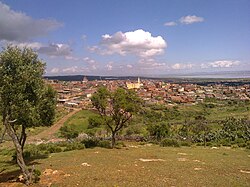
Misserghin (sometimes spelled Miserghin or Mizerghin) is a city in Boutlélis District, Oran Province, Algeria. Its territory is mainly covered by a salt lake called the Sebkha of Oran, the territory of the commune is extensive (42,828 ha) and includes the great salt depression. In city, the known fruit clementine were discovered by Father Clément Rodier in 1892. Although It is famous for its agriculture and especially for the clementine variety of citrus fruits, native to the locality. there is really only 13,350 ha of land available, of which 1/3 (4,036 ha) constitutes the useful agricultural area and 9,109 ha (almost 2/3) the forest estate.
Dr. Chérif Sid Cara, one of the few Algerian Muslims who supported the French generals' putsch in April 1961, was the last mayor of Misserghin under French rule.
Misserghin is located 5 kilometers west of Oran. The territory of the commune is extensive (42,828 ha) and includes the great salt depression, the Sebkha of Oran (on 29,478 ha).
The relief of the commune of Misserghin is largely tabular. Indeed, it extends over the summit and the long southern slope of the Djebel Murjadjo, the latter is connected to the south, to a narrow plain on the edge of the Oran sebkha by a series of short steep slopes
In 1984, the commune of Misserghin was formed from the following localities:
The climate in Misserghin is steppe, rainfall is low all year round. The Köppen classification is of the BSh type. The average temperature is 18.4 °C. The average annual rainfall does not exceed 400 mm
Misserghin is located on the national road 2 Oran-Aïn Témouchent-Tlemcen and has a station on the Oran-Aïn Témouchent railway line.
Half of the commune is occupied by forest formations. The territory of Misserghin is structured in 3-4 zones: more than the north-western half of the southern slope of Murdjadjo is forested and reforested, the other north-eastern half is mainly occupied by degraded forest with the exception of an old cultivated enclave. The rest of the area is agricultural. The lower southern slopes of Murdjadjo and its foothills are mainly devoted to seasonal crops. The plain bordering the Sebkha of Oran is reserved for arboriculture: the olive tree now holds an important place while the vineyard has practically disappeared.
Recent media
Recent media