




Community hub
Recent from talks
Contribute something to knowledge base
Content stats: 0 posts, 0 articles, 1 media, 0 notes
Members stats: 0 subscribers, 0 contributors, 0 moderators, 0 supporters
Subscribers
Supporters
Contributors
Moderators
Mission Bridge
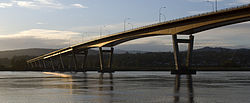
The Mission Bridge is a steel and concrete girder bridge across the Fraser River in the Fraser Valley region of southwestern British Columbia, Canada. Linking the City Of Mission and the City of Abbotsford, the four-lane structure carries BC Highway 11.
In May 1911, tenders were called for a new ferry service immediately southwest of the Canadian Pacific Railway (CP) bridge. At the time, the south shore was called Elliotville, settled by William Elliott. The double decked ferry, which could carry six teams of horse-drawn units and passengers, was gasoline powered. Launched in early November, the John H. Sprott commenced the Mission–Elliotville service about two weeks later. Toll-free 7am–6pm, a charge was made for after hours crossings. Sprott was a pioneer roadbuilder in the district.
The schedule was hourly each way, six days a week. By summer 1913, the service was 7am–5pm, seven days a week. By 1915, the ferry was about hourly 8am–7pm on Sundays, and every 40 minutes 7am–7pm on other days. In 1917, a team of horses, buggy, and two occupants, plunged from the landing into the river. One horse was lost and the buggy slightly damaged. Later that year, winter hours were reduced.
The inconvenience of a 40-minutes frequency prompted lobbying for a bridge. In 1919–20, the contracts awarded for a replacement vessel comprised the steel hull to Yarrows Ltd ($31,000) and engine to Westminster Iron Works ($10,080). In summer 1920, the Eena entered service. Ferry fares may have been introduced at that time. Responding to complaints, fares were reduced months later.
In 1921, the ferry captain was inexplicably terminated. By 1923, the schedule was 9am–5pm, being hourly in winter and every 40 minutes in summer. The ferry ceased operations on July 1, 1927. In 1929, the surplus Eena was relocated to be the Agassiz-Rosedale ferry.
After the new Mission Railway Bridge opened, CP rejected a request in 1910 for public use by wagon traffic. Dual railway/highway use eventuated on July 1, 1927. Planks laid alongside the rails were attached to lengthened ties, which allowed single lane motor vehicle traffic. In July 1955, when a span of the bridge collapsed, no users were injured, but the vital commercial link between the two communities was disrupted. High water had washed away the foundations of a concrete pier. A 27-metre (90 ft), 20-automobile capacity ferry barge was immediately installed for passengers and vehicles, operating 7am–midnight. An additional tug and barge were used the following summer to handle the heavy traffic and agricultural produce. Ferry services ceased in August 1956 when the bridge reopened. In 1970, a major fire on the centre span of the bridge weakened the deck requiring a period of closure. In 1972, a passenger ferry operated for five days while the bridge was closed to replace railway ties. Seasonal flooding would also put the bridge out of commission at times.
The 1,126-metre (3,695 ft) bridge comprises a 16-metre (54 ft) wide roadway bordered by 2-metre (6 ft) wide sidewalks. CBA Engineering designed the bridge and oversaw the $15 million project. The superstructure approaches are either concrete or steel I-girders and the main river spans are stiffened steel box girders, comprising a total of 20 spans, 11 piers on land, and 8 in the river.
In 1968, the contract for the piers and abutments was awarded to Northern Construction Co and J.W. Stewart ($2,711,000), with work beginning in March 1969. By September, five land piers were complete and the foundations for four more poured. The dredging of fill for the overpass approaches was awarded to Sceptre Dredging ($169,500).
Mission Bridge
The Mission Bridge is a steel and concrete girder bridge across the Fraser River in the Fraser Valley region of southwestern British Columbia, Canada. Linking the City Of Mission and the City of Abbotsford, the four-lane structure carries BC Highway 11.
In May 1911, tenders were called for a new ferry service immediately southwest of the Canadian Pacific Railway (CP) bridge. At the time, the south shore was called Elliotville, settled by William Elliott. The double decked ferry, which could carry six teams of horse-drawn units and passengers, was gasoline powered. Launched in early November, the John H. Sprott commenced the Mission–Elliotville service about two weeks later. Toll-free 7am–6pm, a charge was made for after hours crossings. Sprott was a pioneer roadbuilder in the district.
The schedule was hourly each way, six days a week. By summer 1913, the service was 7am–5pm, seven days a week. By 1915, the ferry was about hourly 8am–7pm on Sundays, and every 40 minutes 7am–7pm on other days. In 1917, a team of horses, buggy, and two occupants, plunged from the landing into the river. One horse was lost and the buggy slightly damaged. Later that year, winter hours were reduced.
The inconvenience of a 40-minutes frequency prompted lobbying for a bridge. In 1919–20, the contracts awarded for a replacement vessel comprised the steel hull to Yarrows Ltd ($31,000) and engine to Westminster Iron Works ($10,080). In summer 1920, the Eena entered service. Ferry fares may have been introduced at that time. Responding to complaints, fares were reduced months later.
In 1921, the ferry captain was inexplicably terminated. By 1923, the schedule was 9am–5pm, being hourly in winter and every 40 minutes in summer. The ferry ceased operations on July 1, 1927. In 1929, the surplus Eena was relocated to be the Agassiz-Rosedale ferry.
After the new Mission Railway Bridge opened, CP rejected a request in 1910 for public use by wagon traffic. Dual railway/highway use eventuated on July 1, 1927. Planks laid alongside the rails were attached to lengthened ties, which allowed single lane motor vehicle traffic. In July 1955, when a span of the bridge collapsed, no users were injured, but the vital commercial link between the two communities was disrupted. High water had washed away the foundations of a concrete pier. A 27-metre (90 ft), 20-automobile capacity ferry barge was immediately installed for passengers and vehicles, operating 7am–midnight. An additional tug and barge were used the following summer to handle the heavy traffic and agricultural produce. Ferry services ceased in August 1956 when the bridge reopened. In 1970, a major fire on the centre span of the bridge weakened the deck requiring a period of closure. In 1972, a passenger ferry operated for five days while the bridge was closed to replace railway ties. Seasonal flooding would also put the bridge out of commission at times.
The 1,126-metre (3,695 ft) bridge comprises a 16-metre (54 ft) wide roadway bordered by 2-metre (6 ft) wide sidewalks. CBA Engineering designed the bridge and oversaw the $15 million project. The superstructure approaches are either concrete or steel I-girders and the main river spans are stiffened steel box girders, comprising a total of 20 spans, 11 piers on land, and 8 in the river.
In 1968, the contract for the piers and abutments was awarded to Northern Construction Co and J.W. Stewart ($2,711,000), with work beginning in March 1969. By September, five land piers were complete and the foundations for four more poured. The dredging of fill for the overpass approaches was awarded to Sceptre Dredging ($169,500).
Recent media
Recent media